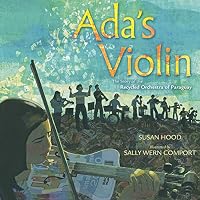
Ada's Violin: The Story of the Recycled Orchestra of Paraguay
by Susan Hood
On This Page
Description
A town built on a landfill. A community in need of hope. A girl with a dream. A man with a vision. An ingenious idea.Tags
Recommendations




Member Reviews
Author Susan Hood and illustrator Sally Wern Comport join forces in this immensely moving look at Paraguay's 'Recycled Orchestra,' a symphony made up of children from one of South America's poorest slums, playing instruments created from trash items taken from the dump around which their village was built. The story focuses on Ada Ríos, a young girl in Cateura, a village of gancheros (recyclers) that sprung up beside the main trash dump for Paraguay's capital city of Asunción. Part of a music-loving family, Ada had little chance to pursue this subject until engineer and amateur musician Favio Chávez came to town, offering free lessons to the children there. When there weren't enough instruments to go around, Chávez and the children show more had to get creative, making their own homemade instruments from what they could find. Learning to play together, the orchestra improved, eventually giving their first concert. Ada herself was made first violin, and the group became better and better known, garnering invitations to play, not just in other cities, but in other countries as well...
Although I have been aware of Ada's Violin: The Story of the Recycled Orchestra of Paraguay since its publication back in 2016, and although I am interested in the subject, I never seem to have gotten around to it until now. I'm glad I finally did, as I found it to be an immensely moving and inspirational book, pairing a story that had me tearing up on more than one occasion with gorgeous mixed media artwork that had me poring over the pages. The style of artwork created by Sally Wern Comport here - she used collage, acrylic glazes and paints, drawing and digital media - is well-suited to the story, as it incorporates various recycled objects (like bits of paper) into the visuals. So too did Ada and her friends incorporate found objects into their instruments, creating music and art from something that others found useless. The story highlights the resilience of the human spirit and the creativity of the human mind, as people with almost nothing find a way to make the world around them more beautiful. I was pleased to learn, in the extensive afterword, that the orchestra has raised money to improve the lives of the people of Cateura. As someone who is a fan of the rock band Metallica, I was also pleased to discover that the orchestra performed with them, in a massive concert in Colombia. Kudos to Metallica for having them as an opening act - I will definitely be seeking out the video of that performance, as well as the 60 Minutes special devoted to the orchestra. Highly recommended to picture-book readers looking for stories about poverty, creativity, recycling and making music. show less
Although I have been aware of Ada's Violin: The Story of the Recycled Orchestra of Paraguay since its publication back in 2016, and although I am interested in the subject, I never seem to have gotten around to it until now. I'm glad I finally did, as I found it to be an immensely moving and inspirational book, pairing a story that had me tearing up on more than one occasion with gorgeous mixed media artwork that had me poring over the pages. The style of artwork created by Sally Wern Comport here - she used collage, acrylic glazes and paints, drawing and digital media - is well-suited to the story, as it incorporates various recycled objects (like bits of paper) into the visuals. So too did Ada and her friends incorporate found objects into their instruments, creating music and art from something that others found useless. The story highlights the resilience of the human spirit and the creativity of the human mind, as people with almost nothing find a way to make the world around them more beautiful. I was pleased to learn, in the extensive afterword, that the orchestra has raised money to improve the lives of the people of Cateura. As someone who is a fan of the rock band Metallica, I was also pleased to discover that the orchestra performed with them, in a massive concert in Colombia. Kudos to Metallica for having them as an opening act - I will definitely be seeking out the video of that performance, as well as the 60 Minutes special devoted to the orchestra. Highly recommended to picture-book readers looking for stories about poverty, creativity, recycling and making music. show less
Hood presents the story of a Paraguayan youth orchestra whose instruments are fashioned from garbage collected in the local landfill.
Cateura is, literally, “a town made of trash.” The dump for the capital city of Asunción, Cateura receives 1,500 tons of trash daily, and 2,500 families subsist there, with generations of gancheros scouring for recyclable materials like cardboard and plastic. Favio Chávez, an environmental engineer assigned to Cateura to teach the recyclers safety methods, began offering music lessons to children, to help keep them safe. He enlisted a carpenter’s expertise in creating instruments from salvaged materials. “They transformed oil drums into cellos, water pipes into flutes, and packing crates into show more guitars!” Hood’s narrative focuses on talented Ada Ríos, whose years of dedicated practice on a metal-and-wood violin parallel the orchestra’s ascendant fame in Paraguay and internationally. “Ada and her friends flew on their first airplane, stayed in their first hotel…and saw sights they never imagined.” Comport’s complex, digitally enhanced collages combine acrylics, drawing, and layered typographic elements, conveying both the oppressive omnipresence of garbage and the functional beauty of the handcrafted instruments. For a spread celebrating the music’s transforming effects, Comport renders musicians and gancheros in silhouette against the landfill, bathed in sunset pinks and golds.
Pair with the suggested video links to experience the music of a remarkable, resilient cultural community. (author’s note, websites, videos, quotation sources, photographs) (Informational picture book. 4-8)
-Kirkus Review show less
Cateura is, literally, “a town made of trash.” The dump for the capital city of Asunción, Cateura receives 1,500 tons of trash daily, and 2,500 families subsist there, with generations of gancheros scouring for recyclable materials like cardboard and plastic. Favio Chávez, an environmental engineer assigned to Cateura to teach the recyclers safety methods, began offering music lessons to children, to help keep them safe. He enlisted a carpenter’s expertise in creating instruments from salvaged materials. “They transformed oil drums into cellos, water pipes into flutes, and packing crates into show more guitars!” Hood’s narrative focuses on talented Ada Ríos, whose years of dedicated practice on a metal-and-wood violin parallel the orchestra’s ascendant fame in Paraguay and internationally. “Ada and her friends flew on their first airplane, stayed in their first hotel…and saw sights they never imagined.” Comport’s complex, digitally enhanced collages combine acrylics, drawing, and layered typographic elements, conveying both the oppressive omnipresence of garbage and the functional beauty of the handcrafted instruments. For a spread celebrating the music’s transforming effects, Comport renders musicians and gancheros in silhouette against the landfill, bathed in sunset pinks and golds.
Pair with the suggested video links to experience the music of a remarkable, resilient cultural community. (author’s note, websites, videos, quotation sources, photographs) (Informational picture book. 4-8)
-Kirkus Review show less
Some books defy description that will do them justice, and this inspiring story of the triumph of the human spirit is one of them. It deserves a place in every library. Ada Rios grew up in abject poverty in a town where 1500 tons of trash were dumped every day and where recyclers scrounged anything salvageable. When Ada was 11, her grandmother saw a sign for music lessons and signed the children up. Without enough instruments, children couldn’t practice at home, so the teacher, Favio Chavez, began with the help of recyclers, making instruments from trash: “They transformed oil drums into cellos, water pipes into flutes, and packing crates into guitars!” Ada chose a violin. Without a classroom, Senor Chavez gave three-hour lessons show more outside, and they braved blistering heat and dodged downpours. Only the determined kept with it, as learning an instrument is hard, but their work paid off. Their orchestra performed first in their village of Cateura and then in other cities and countries. “The world dazzled them… just as they dazzled the world.” Embracing the notion of recycling in mixed media illustrations, which also dazzle, Sally Comport creates light-filled images that soar with a musicality all their own. An author’s note and more information provide websites with must-watch videos to see and hear these amazing musicians. show less
Thanks to GR friend Crystal for letting me know about this book. I knew about this orchestra. I’d seen the 60 Minutes television story and had heard about the movie and had seen them in the news.
The last 3 pages of this book upped it to 5 stars for me. More information, photos, resources, and I was happy to see that the publisher had made a donation to the orchestra/community.
The true story is 5 stars without question. The way it was told, even though interviews with the founder & conductor and one of the musicians made up the basis for a lot of the text, was good, but something seemed lacking to me. Perhaps I would have liked to read a full length book about these people and this orchestra. What was presented whetted my appetite show more for more. The illustrations are wonderful in that they perfectly fit the story and their intricacy is interesting. While beautiful and I love how much there is to view, I’m not wild about their style, though I appreciate how they’re more sophisticated than the illustrations in many other children’s picture books.
I’d say this book is best for school aged kids, perhaps 5-10 and then all the way up. It’s a story/book that can be appreciated by both children and adults.
Be prepared for questions and some discussion about poverty, garbage & recycling, musical instruments, etc.
Reading this I felt inspired and uplifted, and a bit sad too.
Highly recommended, especially for musicians and artists & craftspeople, those who like to learn about other cultures, teachers, those who like reading about real life creative solutions to problems, and all who appreciate stories about people who make a difference.
4 ½ stars, rounded up because of the importance of the story show less
The last 3 pages of this book upped it to 5 stars for me. More information, photos, resources, and I was happy to see that the publisher had made a donation to the orchestra/community.
The true story is 5 stars without question. The way it was told, even though interviews with the founder & conductor and one of the musicians made up the basis for a lot of the text, was good, but something seemed lacking to me. Perhaps I would have liked to read a full length book about these people and this orchestra. What was presented whetted my appetite show more for more. The illustrations are wonderful in that they perfectly fit the story and their intricacy is interesting. While beautiful and I love how much there is to view, I’m not wild about their style, though I appreciate how they’re more sophisticated than the illustrations in many other children’s picture books.
I’d say this book is best for school aged kids, perhaps 5-10 and then all the way up. It’s a story/book that can be appreciated by both children and adults.
Be prepared for questions and some discussion about poverty, garbage & recycling, musical instruments, etc.
Reading this I felt inspired and uplifted, and a bit sad too.
Highly recommended, especially for musicians and artists & craftspeople, those who like to learn about other cultures, teachers, those who like reading about real life creative solutions to problems, and all who appreciate stories about people who make a difference.
4 ½ stars, rounded up because of the importance of the story show less
This true story begins provocatively: “Ada Ríos grew up in a town made of trash.” And in fact, as the Author’s Note at the end of the book explains, Ada’s town, Cateura, is the main garbage dump for Asunción, the capital and the largest city of Paraguay in South America. NPR has reported that every day, about 3 million pounds of solid waste get dumped in Cateura. The author of this book observes:
“More than twenty-five hundred families - twenty thousand people - live there on less than two dollars a day. They endure fourteen-hour days picking through the trash in the landfill to find things they can recycle and sell.”
Ada was worried what the future could possibly hold for her and her younger sister Noélia. Then her grandma show more saw a sign posted by Favio Chávez, an environmental engineer assigned to Cateura to teach recyclers safety methods. He was offering music lessons to children, and Grandma signed up both the girls. Unfortunately, there were not enough instruments for all the children who were interested. Chávez asked his friend Nicolás Gómez, a talented carpenter in the community, to help make instruments for his group out of materials reclaimed from the landfill.
Soon there were enough instruments for all, and the kids worked hard to learn how to play them. They were determined to succeed, and “the Recycled Orchestra was born!”
As Ada and her thirty-nine fellow musicians became more skilled, they were invited to perform concerts throughout Paraguay and later even in other countries around the world. The story ends with their performance in Bogotá, Colombia with a rock band, for which they were to be the opening act. The audience cheered for them:
“The astonished kids bowed, grinning at one another. They had discovered the surprise waiting in the landfill. Buried in the trash was music. And buried in themselves was something to be proud of.”
Back matter includes the Author’s Note as well as links for more information, including videos. We learn that the orchestra has performed concerts all over the world and have played for a number of world dignitaries, including Pope Francis. NPR notes that the group plays Mozart, Paraguayan folk music, even Frank Sinatra. And the young musicians have backed up artists like Stevie Wonder, Metallica and Megadeth.
The author adds in her note that the orchestra has swelled to two hundred students, with more than twenty-five instructors.
Chavez stated that the result of the orchestra’s success is more than just the music they make:
"What we have achieved is that in the community, children are respected. And respect for the moment that they need to get an education. It's something sacred. Before, it wasn't like this. Before I gave music classes, the mom or dad would take the kid away by the hand because they had to go to work. Today, that's unthinkable, impossible for it to happen. And we've already achieved the most difficult thing, which is to change the community."
Illustrator Sally Wern Comport said in an interview that she considers herself a “visual interpreter” for the narrator of a story. Indeed, in her digitally enhanced collages she conveys hope, engagement, transformation, and excitement as the kids of Cateura turn themselves into an orchestra.
Evaluation: What a wonderful story about how hope, inventiveness, and working together can change even the worst of circumstances and make dreams come true. show less
“More than twenty-five hundred families - twenty thousand people - live there on less than two dollars a day. They endure fourteen-hour days picking through the trash in the landfill to find things they can recycle and sell.”
Ada was worried what the future could possibly hold for her and her younger sister Noélia. Then her grandma show more saw a sign posted by Favio Chávez, an environmental engineer assigned to Cateura to teach recyclers safety methods. He was offering music lessons to children, and Grandma signed up both the girls. Unfortunately, there were not enough instruments for all the children who were interested. Chávez asked his friend Nicolás Gómez, a talented carpenter in the community, to help make instruments for his group out of materials reclaimed from the landfill.
Soon there were enough instruments for all, and the kids worked hard to learn how to play them. They were determined to succeed, and “the Recycled Orchestra was born!”
As Ada and her thirty-nine fellow musicians became more skilled, they were invited to perform concerts throughout Paraguay and later even in other countries around the world. The story ends with their performance in Bogotá, Colombia with a rock band, for which they were to be the opening act. The audience cheered for them:
“The astonished kids bowed, grinning at one another. They had discovered the surprise waiting in the landfill. Buried in the trash was music. And buried in themselves was something to be proud of.”
Back matter includes the Author’s Note as well as links for more information, including videos. We learn that the orchestra has performed concerts all over the world and have played for a number of world dignitaries, including Pope Francis. NPR notes that the group plays Mozart, Paraguayan folk music, even Frank Sinatra. And the young musicians have backed up artists like Stevie Wonder, Metallica and Megadeth.
The author adds in her note that the orchestra has swelled to two hundred students, with more than twenty-five instructors.
Chavez stated that the result of the orchestra’s success is more than just the music they make:
"What we have achieved is that in the community, children are respected. And respect for the moment that they need to get an education. It's something sacred. Before, it wasn't like this. Before I gave music classes, the mom or dad would take the kid away by the hand because they had to go to work. Today, that's unthinkable, impossible for it to happen. And we've already achieved the most difficult thing, which is to change the community."
Illustrator Sally Wern Comport said in an interview that she considers herself a “visual interpreter” for the narrator of a story. Indeed, in her digitally enhanced collages she conveys hope, engagement, transformation, and excitement as the kids of Cateura turn themselves into an orchestra.
Evaluation: What a wonderful story about how hope, inventiveness, and working together can change even the worst of circumstances and make dreams come true. show less
This was such a beautiful book, and it is based on a true story! The book begins with abuelita in the house with her granddaughters. She wants them to have more education than she did when she was a young girl. She is very happy run across a flyer about music lessons. She enrolls her granddaughters without even asking them. She reminisces about her own love of music as a child, and the lack of opportunity. Ada chooses a violin as her instrument. There were at least ten children wanting to participate, but not enough instruments. The story is set in a town next to a garbage dump! There seem to be no extracurricular activities available to students after school. Many dig in the trash hoping to find valuable items they can sell. This book show more shows us a strong sense of community, as they highlight the nice things skilled workers decided to do. Carpenters and other men made instruments for the kids, by reusing things they found in the landfill. The music teacher took time to show the kids how to play their instruments. Even Ada helped younger kids perfect their craft, and soon they were performing. They formed an orchestra, and were recognized internationally. Ada was nervous to be on stage in front of thousands of people but as they started to play, the crowd went crazy. The orchestra was so well-received. They have been honored, and they showed amazing resilience and determination. I actually cried, because this book moved me so much. I was thinking of families around the world that are so poor that their parents can't afford instruments or music lesson, and how much talent is out there untapped. This just warms my heart to know that these kids and adults made this happen! show less
This book could be used as a read aloud for primary aged students.
This book is about a young girl named Ada, who lives in Cateura, Paraguay, which is the main garbage dump for Paraguay. Ada's grandmother signs her up to start taking violin lessons, and from this, Ada goes on to learn violin and becomes a violinist that travels the world to play in concerts and with bands.
I would use this book in my classroom as a nonfiction read aloud and as a way to bring awareness to other people's lives around the world. This book also shows perseverance and growth when there is no hope, and the importance of believing in yourself.
This book is about a young girl named Ada, who lives in Cateura, Paraguay, which is the main garbage dump for Paraguay. Ada's grandmother signs her up to start taking violin lessons, and from this, Ada goes on to learn violin and becomes a violinist that travels the world to play in concerts and with bands.
I would use this book in my classroom as a nonfiction read aloud and as a way to bring awareness to other people's lives around the world. This book also shows perseverance and growth when there is no hope, and the importance of believing in yourself.
Members
- Recently Added By
Lists

A Child's Book Tour of the Andes ::: Argentina, Chile, Colombia, Ecuador
24 works; 3 members

4th Grade Books
312 works; 5 members

One Picture Book Per Country
206 works; 1 member
Author Information

154+ Works 8,481 Members
Some Editions
Awards and Honors
Awards
Distinctions
Notable Lists
Common Knowledge
- Original publication date
- 2016
- Important places
- Paraguay; Cateura, Asuncion
- Dedication
- For Favio, Cola, Ada, and all the children of the recycled orchestra . . . Play on!
-- S.H.
For Favio Chavez, the Recycled Orchestra, and the dedicated teachers who inspire a spark and ignite the world
-- S.W.C. - First words
- Ada Rios grew up in a town made of trash.
- Quotations
- For me, the violin means everything . . . life.
-- Ada Rios - Last words
- (Click to show. Warning: May contain spoilers.)And buried in themselves was something to be proud of.
- Original language
- English
Classifications
Statistics
- Members
- 545
- Popularity
- 54,297
- Reviews
- 50
- Rating
- (4.48)
- Languages
- Chinese, English, Spanish
- Media
- Paper, Ebook
- ISBNs
- 10
- ASINs
- 1