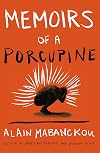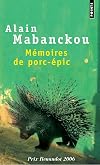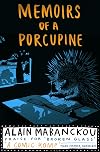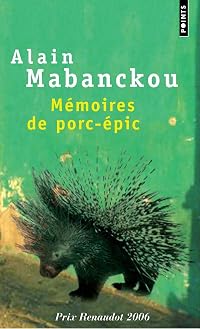
Memoirs of a Porcupine
by Alain Mabanckou
On This Page
Description
All human beings, says an African legend, have an animal double. Some doubles are benign, others wicked. When Kibandi, a boy living in a Congolese village, reaches the age of 11, his father takes him out into the night, and forces him to drink a vile liquid from a jar which has been hidden for years in the earth. This is his initiation.Tags
Recommendations








Member Reviews
I loved the voice of the porcupine: sly, perceptive, funny, even wise at times. The porcupine who relates his memoirs is the harmful double of a man named Kibandi. He tells the reader about his life with his band of porcupines (led by "the governor"), how he became a harmful double (most doubles are helpful) when Kibandi's father initiated him at age 11, and what he had to do as Kibandi's harmful double, namely killing people with his quills ("eating" them in porcupine lingo). Ultimately, and strangely, the porcupine survives after Kibandi dies in a way caused his own murderous life (said to be the result of the needs of his "other self"); usually doubles don't survive their human, and so the porcupine thinks about what this means and show more what he should do in the future.
While this novella is essentially a fable, based on an African legend, I found it difficult not to also read it as an allegory, with the porcupines and other animals, all of whom have their own communities, standing in for Africans and the "monkey cousins," or people, standing in for the European colonizers. It isn't a perfect analogy, but I did find this provocative. I enjoyed this book a lot, and will look for more of Mabanckou's work. show less
While this novella is essentially a fable, based on an African legend, I found it difficult not to also read it as an allegory, with the porcupines and other animals, all of whom have their own communities, standing in for Africans and the "monkey cousins," or people, standing in for the European colonizers. It isn't a perfect analogy, but I did find this provocative. I enjoyed this book a lot, and will look for more of Mabanckou's work. show less
According to Congolese myth, people have an animal double or spirit who is tied to them. For most people, the animal is a peaceful double that protects them. Some children, however, have a grandfather who performs a black magic ceremony in their tenth year that gives them a harmful double, an animal spirit who does their bidding...which is usually to kill anyone to whom their human takes exception. Our narrator is just such a creature: a porcupine given to social commentary, existential ponderings, reading literature and acting as the hand of fate for his master, Kibandi.
It may sound somewhat odd to say that a book about an ever-accelerating serial killer is humorous, even light, but that's exactly how I found it. The narrator's musing show more on Kibandi's missing moral compass and his sly reflections on the customs and foibles of both Westerners and Africans is told in a voice so conversational and engaging that it's if you're sitting in a room with a black sheep uncle who is telling you about the more colorful aspects of his life.
In fact, told entirely first person and meandering along using no punctuation other than commas, Mabanckou has captured a strong sense of the underlying oral tradition in this story. There's that sense of a fable where one is not asked to suspend disbelief entirely but to listen for the meaning. Or, perhaps, not a fable but a well-done satire. Either way, I enjoyed it quite a bit. show less
It may sound somewhat odd to say that a book about an ever-accelerating serial killer is humorous, even light, but that's exactly how I found it. The narrator's musing show more on Kibandi's missing moral compass and his sly reflections on the customs and foibles of both Westerners and Africans is told in a voice so conversational and engaging that it's if you're sitting in a room with a black sheep uncle who is telling you about the more colorful aspects of his life.
In fact, told entirely first person and meandering along using no punctuation other than commas, Mabanckou has captured a strong sense of the underlying oral tradition in this story. There's that sense of a fable where one is not asked to suspend disbelief entirely but to listen for the meaning. Or, perhaps, not a fable but a well-done satire. Either way, I enjoyed it quite a bit. show less
Despite the fact that I am not a huge fan of fables, I really enjoyed this tale. This is the stream of consciousness memoir of a porcupine , narrated by himself. If that doesn't grab your attention, how about the fact that the porcupine is the "harmful double" of a Congolese boy/man. Yep. Now you must be just a bit curious, right? The prose is witty, dark, thought provoking, and engaging. The ultimate question appears to be whether man or beast are more beastly? Given the dark history of the Congo, the author's native country it is not surprising that he believes the question merits some serious consideration.
There's nothing symbolic about the title. This novel is written from the point of view of a porcupine. But it's no ordinary porcupine. According to the author, in African folklore, animals can serve as a double for a human being. In this instance, the porcupine doubles for Kibandi, a Congolese boy who is paired during a ritual at the age of 11. As he ages, Kibandi has a compulsion for murder, using the porcupine as his accomplice. The novel is the porcupine's confession of his crimes. The grim and darkly comic tale is not an easy read, not least because of Mabanckou's writing style of writing in long run-on sentences with minimal capitalization and only commas for punctuation. I won't pretend that I quite get the meaning underlying this show more narrative, but it is a pointed and unique commentary on humanity. show less
Though I didn't find it necessarily humorous (it is very dark humor), I did enjoy this quirky, dark tale & its many observations & comments on mankind. I think it's an excellent mix of very traditional African belief/folklore/village life mixed with the differences/clashes of 'Western'/white beliefs. The porcupine is an affable, if somewhat evil, narrator who expounds on his life to a Baobab tree. Maybe not for everyone, but definitely different & definitely one I relished. Recommended.
Originally published on my blog (https://reallifereading.com/2016/03/09/a-very-weirdathon-read-memoirs-of-a-porcupine/)
Memoirs of a Porcupine is as its title suggests, narrated by a porcupine. But not any ordinary porcupine, this porcupine is the animal double of Kibandi. At the age of 11, Kibandi’s father takes him out into the night and makes him drink something vile that somehow triggers this bond with his animal double, a “harmful double”, the “liveliest, scariest kind of double”.
“the humans of whom we become the animal incarnation will cease to feel emotions like pity, understanding, empathy, remorse, compassion, night will enter their souls, once transmission has occurred, the harmful double must leave the animal world show more and come to live close to the initiate, performing his assignments without protest”
The porcupine soon becomes his master’s murder weapon, of sorts. He orders it to kill fellow villagers, those who wrongly cross his path, for the slightest of reasons.
The porcupine is telling this story to a baobab tree, some days after its master’s death, certain that it is due to die soon too. This porcupine is a rather amusing narrator, and it is a more readable book than I expected it to be. It does have some rather rambly bits, especially since the sentences are broken up by commas instead of full stops, and capitalizations at the start of sentences are nonexistent. But I got used to that (and I did read this as an ebook, which I’m not sure if that makes it worse) and quickly finished this quirky little book.
Is it a fable? I’m not entirely sure. Does it have a moral? Perhaps it is “don’t have an animal double”. But what I do know is that it was quite entertaining, pretty dark, somewhat comic and yet an uncomfortable read. A book that isn’t for everyone, but that drew me in with its strangeness, its different nature. show less
Memoirs of a Porcupine is as its title suggests, narrated by a porcupine. But not any ordinary porcupine, this porcupine is the animal double of Kibandi. At the age of 11, Kibandi’s father takes him out into the night and makes him drink something vile that somehow triggers this bond with his animal double, a “harmful double”, the “liveliest, scariest kind of double”.
“the humans of whom we become the animal incarnation will cease to feel emotions like pity, understanding, empathy, remorse, compassion, night will enter their souls, once transmission has occurred, the harmful double must leave the animal world show more and come to live close to the initiate, performing his assignments without protest”
The porcupine soon becomes his master’s murder weapon, of sorts. He orders it to kill fellow villagers, those who wrongly cross his path, for the slightest of reasons.
The porcupine is telling this story to a baobab tree, some days after its master’s death, certain that it is due to die soon too. This porcupine is a rather amusing narrator, and it is a more readable book than I expected it to be. It does have some rather rambly bits, especially since the sentences are broken up by commas instead of full stops, and capitalizations at the start of sentences are nonexistent. But I got used to that (and I did read this as an ebook, which I’m not sure if that makes it worse) and quickly finished this quirky little book.
Is it a fable? I’m not entirely sure. Does it have a moral? Perhaps it is “don’t have an animal double”. But what I do know is that it was quite entertaining, pretty dark, somewhat comic and yet an uncomfortable read. A book that isn’t for everyone, but that drew me in with its strangeness, its different nature. show less
There's a lot of literary references to things I haven't read, so I just read it as a kind of folk tale. It works well on that level too, and I liked the way that the normal human view of how animals exist and work for them was depicted from the other side for a change.
Members
- Recently Added By
Published Reviews
ThingScore 75
Alain Mabanckou är en burlesk berättare som älskar att vara vitsig. Det gäller som läsare att vara vaksam på främmande citat som rör sig i buskarna och gilla djur, även om de sticks.
added by Jannes
Lists

Best African Books
126 works; 46 members
Best African and African diaspora books
111 works; 4 members
Author Information

56+ Works 1,599 Members
Alain Mabanckou was born in Congo-Brazzavile in 1966. He is the author of Broken Glass (Soft Skull 2010), Memoirs of a Porcupine (Soft Skull 2006) and African Psycho (Soft Skull 2007) among others. He currently divides his time between Paris and California, where he teaches French Literature at UCLA. Sara Meli Ansari is a translator and design show more historian. She holds an undergraduate degree in French studies from the University of Michigan and a Masters degree in the history of culture and design from the Bard Graduate Center. She live with her husband in New York City. show less
Some Editions
Awards and Honors
Common Knowledge
- Canonical title
- Memoirs of a Porcupine
- Original title
- Mémoires de porc-épic
- Original publication date
- 2006 (original French) (original French); 2012 (English: Stevenson) (English: Stevenson)
- Original language
- French
Classifications
- Genres
- General Fiction, Fiction and Literature
- DDC/MDS
- 843.914 — Literature & rhetoric French Literature French fiction 1900- 20th Century 1945-1999
- LCC
- PQ3989.2 .M217 .M45 — Language and Literature French, Italian, Spanish and Portuguese literatures French literature Provincial, local, colonial, etc.
- BISAC
Statistics
- Members
- 204
- Popularity
- 159,352
- Reviews
- 15
- Rating
- (3.47)
- Languages
- 9 — English, French, German, Hebrew, Italian, Korean, Portuguese (Portugal), Spanish, Swedish
- Media
- Paper, Ebook
- ISBNs
- 16
- ASINs
- 3