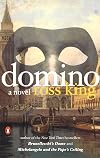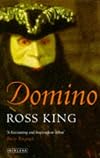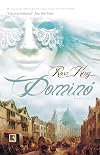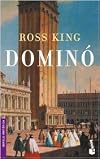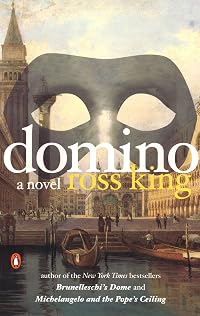
Domino
by Ross King
On This Page
Description
The first novel by the author of the acclaimed Brunelleschi’s Dome. After meeting the mysterious and beautiful Lady Beauclair at a society ball, George Cautley, a hapless young artist adrift in the gilded world of 1770s London, paints her portrait. She, in turn, tells him the scandalous story of Tristano, a castrato singer in Handel’s opera company fifty years earlier. But Cautley also meets the eminent painter Sir Endymion Starker that same evening and his mistress, Eleanora, who has show more another tragic tale to tell, one that will have George unwittingly re-enacting the fate of Tristano. show lessTags
Recommendations




















Member Recommendations
Member Reviews
Normally I would start a book review with a brief synopsis of the story. Normally. When I have a good idea what the story is about or what the logical progression of events is. In this case I have no idea what's happening. Granted, the narrative is compelling, the descriptions of the period mesmerizing and spellbinding and the sense of reality is utterly sublime. In a nutshell, with many onion layers, digressions and diversions the story probably comes down to:
An old painter has an engaging conversation at a masked ball with a young gentleman who interrogates him about about the perambulations and ideally scandals of society and in particular the most famous castrati of the period. Now the painter becomes the narrator and tells the show more story of his travels from the country side into the heart of London society. I'm not giving anything away when I say that this outer story is of no consequence at all and doesn't add anything story-wise whatsoever. We are now firmly embedded in the life of the narrator who, as the son of a clergyman, has little or no knowledge of the real world and therefore lands in various unfortunate situations of his own inexperienced devising. Much of these events feel very much like the adventures of The Idiot in the story The Idiot by Fyodor Dostoyevsky. Like the Idiot our unhappy painter-to-be doesn't learn much from his experiences and keeps stumbling on and on. He meets a stunning beauty who hires him without credentials, without experience to paint her portrait. All this leads to is the introduction of another layer of narrative when the dear lady tells the tragic story of Tristano the famous (and fictitious) Venetian Castrato. All this appears to wrap up at some point because every character finds out that every other character isn't who he or she appears to be and is either the other person or is married, engaged or related to the other person. You be the judge.
Quite frankly I shouldn't be this negative, there is some amazing writing going on and the author clearly spent a tremendous amount of time researching the period and the characters. Pretty soon you will be checking the top of your head to see if your freshly powdered wig is still in it's predetermined place. Not many other books give such a vivid depiction of a historical period and only a novel like The Nature of Monsters by Clare Clark or any of the novels by Michael Gregorio come close.
Fortunately not many writers create such and astonishing amount of confusion as Ross King. When I started reading the novel I felt the strange sensation that the chaotic jumble of events felt similar somehow. Once I managed to wade deeper into the marshes I realized that I had the same sense of confusion during the reading of Ex-Libris, also by Ross King. This time I wanted to know why exactly I had such a hard time figuring out what happened and to whom. Of course the fact that the story revolves around masks and mistaken identities didn't help.
I started searching for specific passages where the progression of events doesn't make sense or doesn't add up. Here is a very good example of how the reader gets off track, sometimes even without realizing it:
---
That is to say, in this moment I noticed many things about Eleanora that I had hitherto failed to notice or recognize; as if, before, I had seen her only like this, through the false image of some warping piece of glass. Unable to face this reflection I turned and, to the sounds of her laughter--as unpleasant and mirthless as her smile--plunged down the stair and into the rain. ...
(2 pages of narrative in which the protagonists stumbles through the streets of London, walks into a pub where he has two beers, enlightening conversations and other such miscellaneous interactions) ...
'Jealous', Eleanora was saying two minutes later. She was still seated before the glass, ...
---
If you read the text at a normal speed, which I can't, I have to read it very slowly, you might skim over this detail and think nothing of it. But unfortunately such episodes occur all over the novel and it slowly grates at the frontal lobe. Minor additional aggravations are things like many grammatical errors and misspellings, which are completely out of tune with the otherwise carefully crafted text.
The ultimate irony is that King's non-fiction books are crystal clear in their narrative and storytelling and read much more like fiction than either Ex-Libris or Domino. I recommend reading this if you're into a good period piece and if you want to be thrown head first into London and Venice of the 18th century. show less
An old painter has an engaging conversation at a masked ball with a young gentleman who interrogates him about about the perambulations and ideally scandals of society and in particular the most famous castrati of the period. Now the painter becomes the narrator and tells the show more story of his travels from the country side into the heart of London society. I'm not giving anything away when I say that this outer story is of no consequence at all and doesn't add anything story-wise whatsoever. We are now firmly embedded in the life of the narrator who, as the son of a clergyman, has little or no knowledge of the real world and therefore lands in various unfortunate situations of his own inexperienced devising. Much of these events feel very much like the adventures of The Idiot in the story The Idiot by Fyodor Dostoyevsky. Like the Idiot our unhappy painter-to-be doesn't learn much from his experiences and keeps stumbling on and on. He meets a stunning beauty who hires him without credentials, without experience to paint her portrait. All this leads to is the introduction of another layer of narrative when the dear lady tells the tragic story of Tristano the famous (and fictitious) Venetian Castrato. All this appears to wrap up at some point because every character finds out that every other character isn't who he or she appears to be and is either the other person or is married, engaged or related to the other person. You be the judge.
Quite frankly I shouldn't be this negative, there is some amazing writing going on and the author clearly spent a tremendous amount of time researching the period and the characters. Pretty soon you will be checking the top of your head to see if your freshly powdered wig is still in it's predetermined place. Not many other books give such a vivid depiction of a historical period and only a novel like The Nature of Monsters by Clare Clark or any of the novels by Michael Gregorio come close.
Fortunately not many writers create such and astonishing amount of confusion as Ross King. When I started reading the novel I felt the strange sensation that the chaotic jumble of events felt similar somehow. Once I managed to wade deeper into the marshes I realized that I had the same sense of confusion during the reading of Ex-Libris, also by Ross King. This time I wanted to know why exactly I had such a hard time figuring out what happened and to whom. Of course the fact that the story revolves around masks and mistaken identities didn't help.
I started searching for specific passages where the progression of events doesn't make sense or doesn't add up. Here is a very good example of how the reader gets off track, sometimes even without realizing it:
---
That is to say, in this moment I noticed many things about Eleanora that I had hitherto failed to notice or recognize; as if, before, I had seen her only like this, through the false image of some warping piece of glass. Unable to face this reflection I turned and, to the sounds of her laughter--as unpleasant and mirthless as her smile--plunged down the stair and into the rain. ...
(2 pages of narrative in which the protagonists stumbles through the streets of London, walks into a pub where he has two beers, enlightening conversations and other such miscellaneous interactions) ...
'Jealous', Eleanora was saying two minutes later. She was still seated before the glass, ...
---
If you read the text at a normal speed, which I can't, I have to read it very slowly, you might skim over this detail and think nothing of it. But unfortunately such episodes occur all over the novel and it slowly grates at the frontal lobe. Minor additional aggravations are things like many grammatical errors and misspellings, which are completely out of tune with the otherwise carefully crafted text.
The ultimate irony is that King's non-fiction books are crystal clear in their narrative and storytelling and read much more like fiction than either Ex-Libris or Domino. I recommend reading this if you're into a good period piece and if you want to be thrown head first into London and Venice of the 18th century. show less
Like "Ex-Libris," this book is a really fantastic piece of historical fiction. King does a great job with details, richly-interweaving narratives, and plot twists that keep you interested from the very first page.
Could be me, but the book really seemed to drag. The depiction of the era is well done, really catches the spirit of the time for a contemporary audience. Manages to create a believable but strong female character. But the themes of deception, masks and role playing aren't managed well. Too much is given too soon and the middle of the novel is more iteration than development. The book does do a lot of things well.
I don't know why I didn't like this book. The main character reminded me of someone from Goldsmith, the history was good, the sense of place was pretty good, and yet somehow I could not get very interested. Kudos to the author for the research, but something went really wrong somewhere for me to get bored with a book and give up reading it.
Nach den ausgezeichneten Sachbüchern dachte ich mir, dass die Belletristik von King ebenso lesenswert sei. Das ist allerdings nicht der Fall. Der Roman ist ein wenig schwerfällig und langatmig.
2-4 player(s), 15-25 min.
recycled, didn't read
Members
- Recently Added By
Published Reviews
ThingScore 63
Author Information

16+ Works 11,122 Members
Ross King is the award-winning and bestselling author of Brunelleschi's Dome, Michelangelo and the Popes Ceiling, The Judgment of Paris, Mad Enchantment, Leonardo and the Last Supper, and Machiavelli: Philosopher of Power, among other books. He and his wife live in Woodstock, Great Britain.
Common Knowledge
- Canonical title
- Domino
- Original title
- Domino
- Original publication date
- 1995
- People/Characters
- George Cautley; Lady Petronilla Beauclair; Tristano
- Important places
- London, England, UK; Milan, Lombardy, Italy
- Epigraph
- Conceal me what I am, and be my aid
For such disguise as haply shall become
The form of my discontent
Shakespeare, Twelfth Night - Dedication
- For Claire and in memory of James
- First words
- When was the last time, I wonder, that I had a pretty young fellow such as this for an audience?
- Last words
- (Click to show. Warning: May contain spoilers.)After a few steps I am surprised by my reflection in a shop window and, as the after-image of that lost favour yet floats before my eyes, for a second I do not recognise myself.
- Original language
- English
Classifications
Statistics
- Members
- 248
- Popularity
- 130,730
- Reviews
- 9
- Rating
- (3.29)
- Languages
- 8 — Danish, Dutch, English, German, Italian, Portuguese, Russian, Spanish
- Media
- Paper, Ebook
- ISBNs
- 16
- ASINs
- 2