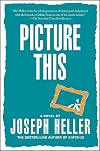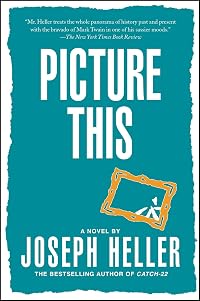
Picture This
by Joseph Heller
On This Page
Description
As Rembrandt is creating his famous painting of Aristotle contemplating the bust of Homer, Aristotle is soon able to see and hear. As the masterpiece makes its way through history, Aristotle's complicated mind finds unanswerable dilemmas.Tags
Recommendations
























Member Recommendations
Member Reviews
Joseph Heller hardly ever wrote a fairly good book; he wrote mediocre ones and excellent ones. This one is of the latter sort. A cynical, acerbic, and hilarious, look on art (and art criticism), classical Greece, wars, empire-building, democracy and more ... incuding human nature itself.
Joseph Heller is the author of my favourite book, Catch 22. But his other novels are of variable quality. None, with the exception of Closing Time, have come even close to matching the brilliance of Catch 22. Using Rembrandt's painting Aristotle Contemplating a Bust of Homer as its thread, in Picture This, Heller recites details from the lives of the Dutch painter, Aristotle, Plato and Socrates and uses them to highlight flaws in democratic theory and human nature. But this novel, though ambitious in scope and objective, fails to satisfy as a book. The considerable research that must have gone into it, and the occasional flashes of Heller's sardonic wit, unfortunately aren't enough to overcome the fact this book is poorly structured and show more lacks a coherent storyline. Ultimately, it feels more like a series of essays than a novel. show less
Well it took me a couple of goes but I made it through this book. It's an interesting concept and has many excellent soundbites and quotable passages, but it also somehow manages to be quite boring as a whole. Most of the information about Rembrandt and Aristotle is fairly unedifying.
Underrated later book of Heller, very nice ironic comparison of Dutch, Classical Greek and Ancient Greek society and economy using an imaginative perspective from Rembrandt's painting of Aristotle contemplating Homer.
A good premise for a short story; it just didn't translate well into a full-length novel. Too many side-trips into ancient Greek wars -- information that I found distracting (and not particularly edifying) in coming to know Aristotle.
An interesting approach to seemingly unconnected periods of history. I sometimes wondered of its historical accuracy.
Ratings
Members
- Recently Added By
Author Information

19+ Works 54,406 Members
American novelist and dramatist Joseph Heller was born in Brooklyn, N.Y. on May 1, 1923. Heller started off his writing career by publishing a series of short stories, but he is most famous for his satirical novel Catch-22. Set in the closing months of World War II, Catch-22 tells the story of a bombardier named Yossarian who discovers the horrors show more of war and its aftereffects. This novel brought the phrase "catch-22," defined in Webster's Dictionary as "a situation presenting two equally undesirable alternatives," into everyday use. Heller wrote Closing Time, the sequel to Catch-22, in 1994. Other novels include As Good As Gold and God Knows. He also wrote No Laughing Matter, an account of his struggles with Guillain-Barr Syndrome, a neurological disorder, in 1986. Thirty-five years after writing his first book, Heller wrote his autobiography, entitled Now and Then: From Coney Island to Here. In his memoirs, Heller reminisces about what it was like growing up in Coney Island in the 1930s and 1940s. On December 13, 1999, Heller died of a heart attack in his home on Long Island. His last novel, Portrait of the Artist as an Old Man, was published shortly after his death. (Bowker Author Biography) show less
Some Editions
Common Knowledge
- Canonical title*
- Verbeeld je
- Original title
- Picture this
- Original publication date
- 1988
- People/Characters
- Rembrandt, Harmenszoon van Rijn, 1606-1669
- Epigraph*
- Tragedy is an imitation of an action ...
ARISTOTLE, Poetics
An upright soul respects honor before wealth.
REMBRANDT
I think the Devil shits Dutchmen.
SIR WILLIAM BATTEN,
Surveyor of the Navy,
overheard by Samuel Pepys,
19 July 1667, Diary
History is bunk, says Henry Ford, the
American industrial genius, who knew almost none. - First words
- Aristotle contemplating the bust of homer thought often of Socrates while Rembrandt dressed him with paint in a white Renaissance surplice and medieval black robe and encased him in shadows.
- Last words
- (Click to show. Warning: May contain spoilers.)The man is not Aristotle.
- Original language*
- Engels
*Some information comes from Common Knowledge in other languages. Click "Edit" for more information.
Classifications
Statistics
- Members
- 779
- Popularity
- 35,970
- Reviews
- 6
- Rating
- (3.36)
- Languages
- 12 — Czech, Danish, Dutch, English, Finnish, French, Hungarian, Italian, Norwegian (Bokmål), Polish, Spanish, Swedish
- Media
- Paper
- ISBNs
- 26
- ASINs
- 8