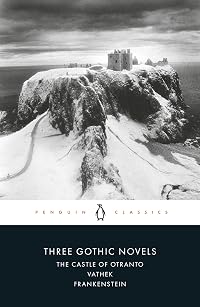
Three Gothic Novels: The Castle of Otranto / Vathek / Frankenstein
by Peter Fairclough (Editor)
On This Page
Description
The Gothic novel, which flourished from about 1765 until 1825, revels in the horrible and the supernatural, in suspense and exotic settings.This volume, with its erudite introduction by Mario Praz, presents three of the most celebrated Gothic novels- The Castle of Otranto, published pseudonymously in 1765, is one of the first of the genre and the most truly Gothic of the three. Vathek (1786), an oriental tale by an eccentric millionaire, exotically combines Gothic romanticism with the show more vivacity of The Arabian Nights and is a narrative tour de force. The story of Frankenstein (1818) and the monster he created is as spine-chilling today as it ever was; as in all Gothic novels, horror is the keynote. show lessTags
Recommendations

















Member Reviews
This is a fantastic collection of 3 novels which greatly impacted (or created) the Gothic genre, but which are also important in their own rights.
Walpole's novel The Castle of Otranto is arguably the first Gothic novel. It is a parody of the Romance genre, written before "novel" became a common part of English vocabulary. It definitely sets a standard of conventions that later Gothic novels follow: a medieval Catholic setting, contrast of science and superstition, winding passages, confined female, &c.
Penguin attempted to present Otranto as accurately as possible, therefore there are no quotation marks to indicate dialogue, nor are there very many paragraph or line breaks. This makes it difficult for the modern reader at first, but it show more is worth working through to read the very funny story.
Because, yes, Otranto is a funny novel which parodies many elements of the romances popular in the 18th century, as well as containing humourous wordplay. The image of a giant helmet crashing out of the sky and killing a bridegroom on his way to the wedding is just one of many humourous incidents in the book.
Vathek is a translation from the French and an example of the combination of foreign horror with Walpole's British Gothic. It played a strong influence for Percy Bysshe Shelley's work, seen as early as the novel Zastrozzi.
Of course, nearly everyone is probably familiar with Frankenstein (itself heavily edited by Percy Shelley), which is probably one of the greatest Gothic novels. Its themes are numerous and I've found that each time I read it (and I've done so several times for different courses), there's always something new to discover, whether it's a philosophical thread echoing Rousseau, or a literary technique previously unappreciated.
This is a fantastic addition to my personal library and a great choice for those interested in the Gothic. The only better introduction I could think of would be Four Gothic Novels, and only then because it also includes Mathew Lewis's The Monk, my favorite of all Gothic novels. show less
Walpole's novel The Castle of Otranto is arguably the first Gothic novel. It is a parody of the Romance genre, written before "novel" became a common part of English vocabulary. It definitely sets a standard of conventions that later Gothic novels follow: a medieval Catholic setting, contrast of science and superstition, winding passages, confined female, &c.
Penguin attempted to present Otranto as accurately as possible, therefore there are no quotation marks to indicate dialogue, nor are there very many paragraph or line breaks. This makes it difficult for the modern reader at first, but it show more is worth working through to read the very funny story.
Because, yes, Otranto is a funny novel which parodies many elements of the romances popular in the 18th century, as well as containing humourous wordplay. The image of a giant helmet crashing out of the sky and killing a bridegroom on his way to the wedding is just one of many humourous incidents in the book.
Vathek is a translation from the French and an example of the combination of foreign horror with Walpole's British Gothic. It played a strong influence for Percy Bysshe Shelley's work, seen as early as the novel Zastrozzi.
Of course, nearly everyone is probably familiar with Frankenstein (itself heavily edited by Percy Shelley), which is probably one of the greatest Gothic novels. Its themes are numerous and I've found that each time I read it (and I've done so several times for different courses), there's always something new to discover, whether it's a philosophical thread echoing Rousseau, or a literary technique previously unappreciated.
This is a fantastic addition to my personal library and a great choice for those interested in the Gothic. The only better introduction I could think of would be Four Gothic Novels, and only then because it also includes Mathew Lewis's The Monk, my favorite of all Gothic novels. show less
The "Three Gothic Novels" in this collection are: The Castle of Otranto, Vathek, and Frankenstein. 2 out of the 3 are rereads. Vathek was new to me. I did not find it as interesting as other novels in this collection, but it does represent the exoticism and demonism that is also part of the Gothic (e.g. The Monk). Overall, it seemed overlong. Both the Castle of Otranto and Frankenstein were refreshing to reread. Though Otranto comes across as almost naive in its horror -- it had some funny scenes with the servants, and wonderful atmosphere. I don't remember when I last read Frankenstein, but this time around I had many more questions about Frankenstein's work. He travels to England and other places to do "research" for the creation of show more the monster's mate. As I understood it before, the monster was made of parts of corpses -- so is Frankenstein carrying parts of corpses all over Europe as he does his "research"? Or were these creatures actually mechanical creations endowed somehow with life? It's not entirely clear. I can't really pity Frankenstein as he brought much of the destruction on himself, both by abandoning the monster at birth, and then by ignoring the monster's warnings. show less
Castle of Otranto by Horace Walpole
The accidental death of Manfred's, a tyrannt, son on his wedding day spirals into the dark family secrets. Putatively to be the first gothic novel, it is disappointing. The plot is just insane and doesn't and won't make sense.
Rating: 1.5 stars
Vathek by William Beckford
A better title would be Beckford on Drugs or Inversion of the Temptation of Satan. Goaded by his evil mother, Vathek, an Arabic king, makes a deal with the devil for riches despite the several warnings from God. (Like hello, you are the damn king and already have so much gold and you want more?!) There are no chapters so this book has a dreamlike, stream of consciousness quality to it. The writing is quite fine and in excess, which is show more the point of the story. (Oscar Wilde may probably have read this as I can see its influence on Picture of Dorian Gray.) I like how Beckford is rewriting an inversion of the temptation of Christ but like Otranto, the narrative is just silly.
Rating: 2.5 stars
Frankenstein
Rating: 4 stars
Average: 2.5 stars show less
The accidental death of Manfred's, a tyrannt, son on his wedding day spirals into the dark family secrets. Putatively to be the first gothic novel, it is disappointing. The plot is just insane and doesn't and won't make sense.
Rating: 1.5 stars
Vathek by William Beckford
A better title would be Beckford on Drugs or Inversion of the Temptation of Satan. Goaded by his evil mother, Vathek, an Arabic king, makes a deal with the devil for riches despite the several warnings from God. (Like hello, you are the damn king and already have so much gold and you want more?!) There are no chapters so this book has a dreamlike, stream of consciousness quality to it. The writing is quite fine and in excess, which is show more the point of the story. (Oscar Wilde may probably have read this as I can see its influence on Picture of Dorian Gray.) I like how Beckford is rewriting an inversion of the temptation of Christ but like Otranto, the narrative is just silly.
Rating: 2.5 stars
Frankenstein
Rating: 4 stars
Average: 2.5 stars show less
Gothic novel. Comparisons with 19th century novels: the prose has a breathless, breathy precipitate feel to it, helped largely by the almost non-existence of paragraphs. Punctuation is different: semi colons have a different function, used to divide the narrative voice from speakers. There are no quotations for speech and no paragraphing here either: speakers merge in and out of each other and in and out of the narrative voice in an endlessly long paragraph, which sometimes extends for a whole chapter. The text is amazingly fractured, with remarks left hanging in mid air, interruptions, inconsistencies and infelicitous innuendoes. The plotting is extremely slapdash, with crucial details added as and when they are needed, with absolutely show more no self-consciousness about the artificiality of this technique: the whole theory of narrative is different. Instead of Barthes’s “seeds planted that will later grow into fruition”, the plot lurches unsteadily from one crisis to another, with details supplied in order to extricate characters from impossible situations....
Read the full review on The Lectern.
http://thelectern.blogspot.com/2006/08/castle-of-otranto-horace-walpole.html show less
Read the full review on The Lectern.
http://thelectern.blogspot.com/2006/08/castle-of-otranto-horace-walpole.html show less
PRATELEIRA EUNICE 1 LIVRO 16
The Gothic novel, which flourished from about 1765 until 1825, revels in the horrible and the supernatural, in suspense and exotic settings. This volume, with its erudite introduction by Mario Praz, presents three of the most celebrated Gothic novels: The Castle of Otranto, published pseudonymously in 1765, is one of the first of the genre and the most truly Gothic of the three. Vathek (1786), an oriental tale by an eccentric millionaire, exotically combines Gothic romanticism with the vivacity of The Arabian Nights and is a narrative tour de force. The story of Frankenstein (1818) and the monster he created is as spine-chilling today as it ever was; as in all Gothic novels, horror is the keynote.
For more show more than seventy years, Penguin has been the leading publisher of classic literature in the English-speaking world. With more than 1,700 titles, Penguin Classics represents a global bookshelf of the best works throughout history and across genres and disciplines. Readers trust the series to provide authoritative texts enhanced by introductions and notes by distinguished scholars and contemporary authors, as well as up-to-date translations by award-winning translators. show less
The Gothic novel, which flourished from about 1765 until 1825, revels in the horrible and the supernatural, in suspense and exotic settings. This volume, with its erudite introduction by Mario Praz, presents three of the most celebrated Gothic novels: The Castle of Otranto, published pseudonymously in 1765, is one of the first of the genre and the most truly Gothic of the three. Vathek (1786), an oriental tale by an eccentric millionaire, exotically combines Gothic romanticism with the vivacity of The Arabian Nights and is a narrative tour de force. The story of Frankenstein (1818) and the monster he created is as spine-chilling today as it ever was; as in all Gothic novels, horror is the keynote.
For more show more than seventy years, Penguin has been the leading publisher of classic literature in the English-speaking world. With more than 1,700 titles, Penguin Classics represents a global bookshelf of the best works throughout history and across genres and disciplines. Readers trust the series to provide authoritative texts enhanced by introductions and notes by distinguished scholars and contemporary authors, as well as up-to-date translations by award-winning translators. show less
Ratings
Members
- Recently Added By
Author Information
All Editions
Some Editions
Awards and Honors
Notable Lists
Series
Belongs to Publisher Series
Work Relationships
Common Knowledge
- Canonical title
- Three Gothic Novels: The Castle of Otranto / Vathek / Frankenstein
- Original publication date
- 1968
- People/Characters
- Victor Frankenstein; Frankenstein's Monster; Caliph Vathek; Manfred of Otranto
- Important places
- Geneva, Geneva, Switzerland; Otranto, Lecce, Apulia, Italy; Persia
- Original language
- English
- Canonical DDC/MDS
- 823.08731
- Disambiguation notice
- This work entitled "Three Gothic Novels" contains "The Castle of Otranto", "Vathek", and Shelley's "Frankenstein" and must not be combined with "Three Gothic Novels: The Castle of Otranto, Vathek, and Polidori's The Vampyre".... (show all) Thank you.
This edition has the Penguin Books ISBN 0140430369 and associated cover for Three Gothic Novels: The Castle of Otranto; Vathek; Frankenstein. Please do not combine with the Dover edition, which has a different ISBN and includ... (show all)es The Vampyre instead of Frankenstein.
Classifications
- Genres
- Fiction and Literature, Horror, General Fiction
- DDC/MDS
- 823.08731 — Literature & rhetoric English & Old English literatures English fiction By type Genre fiction Adventure fiction Horror and ghost fiction Gothic fiction
- LCC
- PR1301 .F3 — Language and Literature English English Literature Collections of English literature
- BISAC
Statistics
- Members
- 664
- Popularity
- 43,494
- Reviews
- 5
- Rating
- (3.61)
- Languages
- Dutch, English, German
- Media
- Paper, Ebook
- ISBNs
- 5
- ASINs
- 11