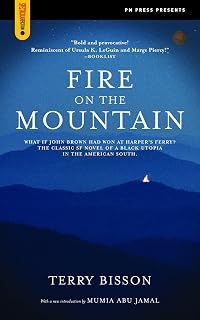
Fire on the Mountain
by Terry Bisson
On This Page
Description
It's 1959 in socialist Virginia. The Deep South is an independent Black nation called Nova Africa. The second Mars expedition is about to touch down on the red planet. And, a pregnant scientist is climbing the Blue Ridge in search of her great-great grandfather, a teenage slave who fought with John Brown and Harriet Tubman's guerrilla army. Fire on the Mountain is the story of what might have happened if John Brown's raid on Harper's Ferry had succeeded, and the Civil War had been started show more not by the slave owners, but the abolitionists. show lessTags
Recommendations















Member Reviews
An sci-fi-ish alternate history where John Brown's raid was successful and he led America to be a socialist utopia.
Loved this. Mainly because the author never lost the sense of optimism or hope, even when displaying the horrors that arise from racism and war. The three parallel stories, which occur in three different times, bounce and flow off each other. The only downside is that it's very easy to miss the point of the "current" storyline, because the other two are so dramatic. Which is a shame because it's a gorgeous tale.
Reminded me of "The Man in the High Castle" for a lot of obvious reasons, so I'd recommend highly for anyone looking for something similar.
Loved this. Mainly because the author never lost the sense of optimism or hope, even when displaying the horrors that arise from racism and war. The three parallel stories, which occur in three different times, bounce and flow off each other. The only downside is that it's very easy to miss the point of the "current" storyline, because the other two are so dramatic. Which is a shame because it's a gorgeous tale.
Reminded me of "The Man in the High Castle" for a lot of obvious reasons, so I'd recommend highly for anyone looking for something similar.
"How close the past looms, circling the present like a dead moon, lifting slow repetitious tides on the living planet."
Alternate history has, itself, a long history. I've not been particularly a fan, but Bisson's short novel from 1988 is the best I've ever read of the genre.
In an alternate year of 1959, North America includes the nations of Nova Africa and the United Socialist States of America - plus Mexico, and one or more Native nations, mentioned briefly. Clean cars cruise the roads, nonpolluting airships amble through the skies, and the Pan African Space Administration is about to land humans on Mars.
Yasmin Abraham Martin Odinga crosses the now-peaceful border, from Nova Africa into Virginia, with much on her mind - the death of show more her husband on a space expedition five years earlier, and an awkward bit of news to convey to her 12 year old daughter, Harriet. Also, in the car with her, Yasmin carries the 50 year old, typed manuscript of the memoir of her great-grandfather, Dr. Abraham, who, from when he was himself 12, served under John Brown and Harriet Tubman in the Independence War - for the historical turning point in Yasmin's world is that John Brown's raid on the Federal arsenal at Harper's Ferry, Virginia succeeded, igniting the slave revolt that he had hoped for.
In our history, Harriet Tubman became ill as the time for the raid approached. When Brown finally attacked, in October, she was no longer involved. The raid failed and Brown was hanged. In Yasmin's world, the raid happened on July 4th, 1859 as originally planned, and Tubman's contribution was crucial. The raiders escaped into the surrounding mountains, and every night burned a great beacon fire, taunting the slave holders and shining like a star in the eyes of free and enslaved Black people.
The story of the revolt is told partly through the thoughts of the contemporary characters, but mainly via textual sources. Of Dr. Abraham's recollection of his younger self, we mostly get the first year of the war, before young Abraham fully joins the fight. We see very little of Brown and Tubman themselves. We also get some of the letters of Thomas Hunt, MD, a young heir to a Southern plantation who is convinced of the evil of slavery. There is no direct narration set in 1859; the past may be known only through what history has preserved.
I enjoyed imagining the alternation of texts and present day bits as a Ken Burns documentary - seeing the panning camera and hearing the voiceovers representing combatants in a long-ago war. Long ago, but not gone - the echoes of Independence continued in Yasmin's world, as those of the Civil War do in ours. One of the characters is a disabled veteran of the 1948 civil war that added that "Socialist" to the name of the USA. Bisson is unsparing about the brutality of the Independence War, from both sides. Be warned that there are many uses of the n-word, as quoted by Dr. Abraham.
Bisson contrasts his story with rosier views of the Civil War. One character owns a trashy novel, John Brown's Body, which lays out an alternate story that is, of course, our own: a war, not for Black freedom, but for preservation of the Union, in which the freed slaves find their bondage continued in new modes. Yasmin finds this prospect quite dystopian and white-supremacist. She knows Abraham Lincoln as a freebooter who tried to reconquer the freed territories; his is remembered as the Lost Cause. It's my understanding that current historians have moved toward Bisson's 1988 view, but there's a lot of history here, both real and imagined, that I don't know nearly well enough to critique. Nova Africa is helped by brigades from Haiti, Garibaldi's Italy, and Native American nations. The world's leading nation appears to be a united, socialist Africa. Credible? Don't know.
Mumia Abu-Jamal contributed an introduction to the 2009 edition I have.
As Yasmin's world feels the tides of history raised by her Independence War, so ours is pulled by the gravity of the long contest between racism and justice. The American Civil War is possibly the most popular subject for alternate history fiction in the USA. Frequently these are fat triologies of novels, or even longer. Yet for such a huge subject, whole libraries would not suffice. Bisson's short novel captures all that vast sweep in 155 pages, by refracting an implied epic through the eyes of a handful of people. Outstanding. show less
Alternate history has, itself, a long history. I've not been particularly a fan, but Bisson's short novel from 1988 is the best I've ever read of the genre.
In an alternate year of 1959, North America includes the nations of Nova Africa and the United Socialist States of America - plus Mexico, and one or more Native nations, mentioned briefly. Clean cars cruise the roads, nonpolluting airships amble through the skies, and the Pan African Space Administration is about to land humans on Mars.
Yasmin Abraham Martin Odinga crosses the now-peaceful border, from Nova Africa into Virginia, with much on her mind - the death of show more her husband on a space expedition five years earlier, and an awkward bit of news to convey to her 12 year old daughter, Harriet. Also, in the car with her, Yasmin carries the 50 year old, typed manuscript of the memoir of her great-grandfather, Dr. Abraham, who, from when he was himself 12, served under John Brown and Harriet Tubman in the Independence War - for the historical turning point in Yasmin's world is that John Brown's raid on the Federal arsenal at Harper's Ferry, Virginia succeeded, igniting the slave revolt that he had hoped for.
In our history, Harriet Tubman became ill as the time for the raid approached. When Brown finally attacked, in October, she was no longer involved. The raid failed and Brown was hanged. In Yasmin's world, the raid happened on July 4th, 1859 as originally planned, and Tubman's contribution was crucial. The raiders escaped into the surrounding mountains, and every night burned a great beacon fire, taunting the slave holders and shining like a star in the eyes of free and enslaved Black people.
The story of the revolt is told partly through the thoughts of the contemporary characters, but mainly via textual sources. Of Dr. Abraham's recollection of his younger self, we mostly get the first year of the war, before young Abraham fully joins the fight. We see very little of Brown and Tubman themselves. We also get some of the letters of Thomas Hunt, MD, a young heir to a Southern plantation who is convinced of the evil of slavery. There is no direct narration set in 1859; the past may be known only through what history has preserved.
I enjoyed imagining the alternation of texts and present day bits as a Ken Burns documentary - seeing the panning camera and hearing the voiceovers representing combatants in a long-ago war. Long ago, but not gone - the echoes of Independence continued in Yasmin's world, as those of the Civil War do in ours. One of the characters is a disabled veteran of the 1948 civil war that added that "Socialist" to the name of the USA. Bisson is unsparing about the brutality of the Independence War, from both sides. Be warned that there are many uses of the n-word, as quoted by Dr. Abraham.
Bisson contrasts his story with rosier views of the Civil War. One character owns a trashy novel, John Brown's Body, which lays out an alternate story that is, of course, our own: a war, not for Black freedom, but for preservation of the Union, in which the freed slaves find their bondage continued in new modes. Yasmin finds this prospect quite dystopian and white-supremacist. She knows Abraham Lincoln as a freebooter who tried to reconquer the freed territories; his is remembered as the Lost Cause. It's my understanding that current historians have moved toward Bisson's 1988 view, but there's a lot of history here, both real and imagined, that I don't know nearly well enough to critique. Nova Africa is helped by brigades from Haiti, Garibaldi's Italy, and Native American nations. The world's leading nation appears to be a united, socialist Africa. Credible? Don't know.
Mumia Abu-Jamal contributed an introduction to the 2009 edition I have.
As Yasmin's world feels the tides of history raised by her Independence War, so ours is pulled by the gravity of the long contest between racism and justice. The American Civil War is possibly the most popular subject for alternate history fiction in the USA. Frequently these are fat triologies of novels, or even longer. Yet for such a huge subject, whole libraries would not suffice. Bisson's short novel captures all that vast sweep in 155 pages, by refracting an implied epic through the eyes of a handful of people. Outstanding. show less
I had such a good time reading this book!
Though I read all of it, I was tempted to skip the parts that were "present day" (in the 1950s Socialist United States) in favor of reading more about the Harriet Tubman and John Brown's guerrilla war turning into the US Civil War instead of confederate seceding states doing so.
What blew my mind was the how international solidarity could have played a part in such a real life situation: troops came by the hundreds from the Molly Maguires in Pennsylvania, the Cree, the Garibaldini, the Haitians, the Paris Communards, etc. etc.
Though I read all of it, I was tempted to skip the parts that were "present day" (in the 1950s Socialist United States) in favor of reading more about the Harriet Tubman and John Brown's guerrilla war turning into the US Civil War instead of confederate seceding states doing so.
What blew my mind was the how international solidarity could have played a part in such a real life situation: troops came by the hundreds from the Molly Maguires in Pennsylvania, the Cree, the Garibaldini, the Haitians, the Paris Communards, etc. etc.
"How close the past looms, circling the present like a dead moon, lifting slow repetitious tides on the living planet."
I admit to being very partial to this, even before starting - it would be hard for me not to like a story about a New Africa forming in the USA. But I think the book is good even leaving aside my biases. It's told through 3 perspectives - the letters of a radicalising white abolitionist from the time of the revolution, the recollections of a Black doctor who was enslaved at the time, and a modern day perspective in a world where there's an attempted landing on Mars and a widespread socialist international and pan-African league. The book doesn't go into super detail on the "contemporary world" - enough to know it's show more mostly Good - but quite a lot on the Tubman/Brown army. There's a decent amount of the n-word, although it's understandable given the historical context it's about. show less
I admit to being very partial to this, even before starting - it would be hard for me not to like a story about a New Africa forming in the USA. But I think the book is good even leaving aside my biases. It's told through 3 perspectives - the letters of a radicalising white abolitionist from the time of the revolution, the recollections of a Black doctor who was enslaved at the time, and a modern day perspective in a world where there's an attempted landing on Mars and a widespread socialist international and pan-African league. The book doesn't go into super detail on the "contemporary world" - enough to know it's show more mostly Good - but quite a lot on the Tubman/Brown army. There's a decent amount of the n-word, although it's understandable given the historical context it's about. show less
A really well-done feel-good utopian novel for radicals. Nice touch: the characters in the free, socialist, anti-racist America Bisson depicts shudder with horror when they hear about a book that posits what would have happened if John Brown had failed at Harper's Ferry--and the result is exactly the world we have...
This is an intriguing story about an alternate history where John Brown's raid was successful and the Southern United States became a Black socialist utopia. I love this premise!
Of the novel's three viewpoints, the narrative from the past was the most compelling, in that it actually told a story about a character I cared about. The letters mostly left the other guy sounding really annoying and self-absorbed, even if he didreform in some ways over time . And the narrative of the present... it was okay, but nothing really happened. Left me wanting to know more about how we got from John Brown's army raiding things in the South to a war for the South to be independent as a Black state .
Still, though, a cool premise.
Of the novel's three viewpoints, the narrative from the past was the most compelling, in that it actually told a story about a character I cared about. The letters mostly left the other guy sounding really annoying and self-absorbed, even if he did
Still, though, a cool premise.
The story takes you through a history that presupposes what life would be like if the abolitionist John Brown was successful in his attack at Harper's Ferry, Virginia (in truth they were defeated by U.S. Marines lead by Robert E. Lee and was hanged for "treason").
At first the story is a little hard to follow because it bounces back and forth between a time in 1859 when the attack took place and 1959, 100 years after the attack. But once you learn more about the characters in each time period it becomes easier to follow.
This book borders on the mundane, but it was just creative enough to keep me interested and warrant three stars.
At first the story is a little hard to follow because it bounces back and forth between a time in 1859 when the attack took place and 1959, 100 years after the attack. But once you learn more about the characters in each time period it becomes easier to follow.
This book borders on the mundane, but it was just creative enough to keep me interested and warrant three stars.
Members
- Recently Added By
Lists

Best Alternate History
111 works; 60 members

Exploration of alternative economical systems
40 works; 3 members

What Makes This Book So Great
102 works; 16 members

Read These Too
458 works; 9 members
Author Information

120+ Works 4,071 Members
Some Editions
Series
Belongs to Publisher Series
Common Knowledge
- Canonical title
- Fire on the Mountain
- Original publication date
- 1988
- Important events
- American Civil War
- Dedication
- For Kuwasi Balagoon and the Black Liberation Army past, present and future.
- First words
- Yasmin Abraham Martin Odinga drove across the border at noon.
- Quotations
- Like most teenagers, she seemed to regard museums as assaults on the very principles of youth.
How close the past looms, circling the present like a dead moon, lifting slow repetitious tides on the living planet. - Last words
- (Click to show. Warning: May contain spoilers.)Plus such beautiful shoes.
Classifications
Statistics
- Members
- 335
- Popularity
- 95,094
- Reviews
- 11
- Rating
- (3.67)
- Languages
- English, French
- Media
- Paper, Ebook
- ISBNs
- 8
- ASINs
- 3