
On This Page
Description
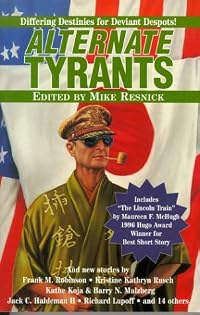
Gathers stories in which Mahatma Gandhi, Jane Austen, Albert Einstein, Saint Francis of Assisi, and others known for their peacefulness, are portrayed as warriors.Tags
Recommendations


















Member Reviews
As you might expect, we get a lot of stories that rely on the startle factor of Albert Einstein, Martin Luther King, Jr, Mother Teresa, Albert Schweitzer, and St. Francis of Assisi as warriors.
Still, there are some high points.
Resnick’s own “Mwalimu in the Squared Circle” centers on a real, if obscure, historical story. General and President-Elect-for-Life Idi Amin Dada of Uganda challenged Julius Nyerere of Tanzania to a boxing match to settle the war between their two countries. The challenge is accepted here.
Yes, Michael P. Kube-McDowell’s “Because Thou Lovest the Burning Ground” is a Ghandi gone bad story – gone Thuggee as it happens, but it’s atmospheric and has details on the Kali worshippers.
Maureen F. McHugh’s show more “Tut’s Wife” is a serious, moody look at what its heroine must do to preserve the Kingdom of Egypt. Judith Tarr’s “Queen of Asia” is a well-done look at how Persian Queen Sisygambis confronts Alexander the Great. Mercedes Lackey’s “Jihad” is a plausible seeming look at T. E. Lawrence’s conversion to Islam. However, essentially, these are “how things changed” stories which end with the reader being invited to speculate how history will develop – as if the same questions couldn’t be spurred by regular history books. Both Tarr’s and McHugh’s stories end with their heroines seeking marriages not seen in our history. Essentially, that’s just stretching out the moment-of-change concept and not a real alternate history.
Marilyn Monroe has connections to Castro and Che Guevera in Jack C. Haldeman’s II “The Cold Warrior”. Despite not being much interested in the Kennedys and Marilyn, I liked this depiction of Monroe as spurned Commie agent.
It was Resnick’s introductory notes for Beth Meacham’s “One by One” saying it was “a true alternate history” that tipped me off that these anthologies are, by and large, not real alternate histories.
Meacham’s story is probably the best in the book charting into our time the consequences of a different life for American Indian Tecumseh. It’s tale of irredentism in which the Alliance Warriors Society continues the Two Hundred Year of the Shawnee Alliance with the European invaders. Perhaps inspired by Balkan events at the time of the writing, it still, with its Army Counter Terrorism units operating in several parts of America, seems contemporary and, for me, a fictional (though I doubt Meacham intended this) argument that whites and Indians could never equally and peacefully inhabit North America.
Dishonorable mention for the book goes to David Gerrold’s “The Firebringers”, a cheap, implausible, and bad literary collage depending on odd juxtapositions. We not only get some tired arguments about the immorality of using the A-Bomb and with the following characters: President Cooper, Bogey the bombardier, General Tracy, Drs. Karloff and Lorre, Colonel Peck and Colonel Regan, and Captain Fonda, etc. show less
Still, there are some high points.
Resnick’s own “Mwalimu in the Squared Circle” centers on a real, if obscure, historical story. General and President-Elect-for-Life Idi Amin Dada of Uganda challenged Julius Nyerere of Tanzania to a boxing match to settle the war between their two countries. The challenge is accepted here.
Yes, Michael P. Kube-McDowell’s “Because Thou Lovest the Burning Ground” is a Ghandi gone bad story – gone Thuggee as it happens, but it’s atmospheric and has details on the Kali worshippers.
Maureen F. McHugh’s show more “Tut’s Wife” is a serious, moody look at what its heroine must do to preserve the Kingdom of Egypt. Judith Tarr’s “Queen of Asia” is a well-done look at how Persian Queen Sisygambis confronts Alexander the Great. Mercedes Lackey’s “Jihad” is a plausible seeming look at T. E. Lawrence’s conversion to Islam. However, essentially, these are “how things changed” stories which end with the reader being invited to speculate how history will develop – as if the same questions couldn’t be spurred by regular history books. Both Tarr’s and McHugh’s stories end with their heroines seeking marriages not seen in our history. Essentially, that’s just stretching out the moment-of-change concept and not a real alternate history.
Marilyn Monroe has connections to Castro and Che Guevera in Jack C. Haldeman’s II “The Cold Warrior”. Despite not being much interested in the Kennedys and Marilyn, I liked this depiction of Monroe as spurned Commie agent.
It was Resnick’s introductory notes for Beth Meacham’s “One by One” saying it was “a true alternate history” that tipped me off that these anthologies are, by and large, not real alternate histories.
Meacham’s story is probably the best in the book charting into our time the consequences of a different life for American Indian Tecumseh. It’s tale of irredentism in which the Alliance Warriors Society continues the Two Hundred Year of the Shawnee Alliance with the European invaders. Perhaps inspired by Balkan events at the time of the writing, it still, with its Army Counter Terrorism units operating in several parts of America, seems contemporary and, for me, a fictional (though I doubt Meacham intended this) argument that whites and Indians could never equally and peacefully inhabit North America.
Dishonorable mention for the book goes to David Gerrold’s “The Firebringers”, a cheap, implausible, and bad literary collage depending on odd juxtapositions. We not only get some tired arguments about the immorality of using the A-Bomb and with the following characters: President Cooper, Bogey the bombardier, General Tracy, Drs. Karloff and Lorre, Colonel Peck and Colonel Regan, and Captain Fonda, etc. show less
Take several characters from history and change just one little thing in their past, then write short stories about this changed history. These stories are interesting and many of them great fun. There are both good and bad in the stories but the good overwhelm the bad.
Ratings
Members
- Recently Added By
Author Information

574+ Works 14,689 Members
Mike Resnick was born on March 5, 1942. He sold his first article in 1957, his first short story in 1959, and his first book in 1962. He attended the University of Chicago from1959 through 1961. Resnick began writing stories under various pseudonyms and churned out more than 200 novels, 300 short stories and 2,000 articles, from1964 through1976. show more He edited 7 different tabloid newspapers and a pair of men's magazines, as well. Beginning with Shaggy B.E.M. Stories in 1988, Resnick has also become an anthology editor, and was nominated for a Best Editor Hugo in 1994 and 1995. His list of anthologies in print and in press totals more than 20. Since 1989, he has won four Hugo Awards, a Nebula Award, and has been nominated for 19 Hugos, eight Nebulas, a Clarke (British), and five Seiun-shos (Japanese). He has also won 10 Homer Awards, an Alexander Award, a Golden Pagoda Award, the Seiun Award (Japanese), a Hayakawa SF Award (Japanese), a Locus Award, an Ignotus Award (Spanish), a Futura Award (Croatian), the Tour Eiffel Award (French), the Prix Ozone (French), two Sfinks Awards and a Fantastyka Award (both Polish), and has topped the S. F. Chronicle Poll six times and the Asimov's Readers Poll twice. (Bowker Author Biography) show less
All Editions
Some Editions
Series

Work Relationships
Common Knowledge
- People/Characters
- Alexander the Great; Ankhesenamun (Ankhesenpaaten, Ankhsenpaaten, Ankhsenamon, 3rd daughter of Akhenaten and Nefertiti); Susan B. Anthony; Cassandra Austen; Jane Austen; Leonard Bernstein (show all 21); Lilian Carter; Neville Chamberlain; Albert Einstein; Francis of Assisi; Mohandas Gandhi; Stephen Hawking; Pope John XXIII; Martin Luther King, Jr.; T. E. Lawrence (Lawrence of Arabia); Federico García Lorca; Marilyn Monroe; Moses; Albert Schweitzer; Sisygambis; Mother Teresa
- Important places
- Africa; Egypt; England, UK; India; Middle East
- Important events
- Napoleonic Wars (1803 | 1815); World War I (1914 | 1918); World War II (1939 | 1945)
Classifications
- Genres
- Fiction and Literature, Science Fiction
- DDC/MDS
- 813.0876608 — Literature & rhetoric American literature in English American fiction in English By type Genre fiction Adventure fiction Speculative fiction Fantasy Collections
- LCC
- PS648 .S3 .A485 — Language and Literature American literature American literature Collections of American literature Prose (General)
- BISAC
Statistics
- Members
- 134
- Popularity
- 243,121
- Reviews
- 2
- Rating
- (3.32)
- Languages
- English
- Media
- Paper
- ISBNs
- 1


