
Maureen F. McHugh
Author of China Mountain Zhang
About the Author
Image credit: Catriona Sparks
Works by Maureen F. McHugh
The Lincoln Train {short story} 12 copies
The Tor SF Sampler: 1993 Hugo Nominees (A Fire upon the Deep / China Mountain Zhang) (1993) — Contributor — 10 copies
Special Economics {novelette} 9 copies
Nekropolis [novelette] 8 copies
Renascer-1 5 copies
After The Apocalypse [short story] 5 copies
Frankenstein's Daughter 5 copies
The Lost Boy: A Reporter at Large 4 copies
Renascer 2 4 copies
Whispers [short fiction] 4 copies
Virtual Love 3 copies
The Effect Of Centrifugal Forces 3 copies
The Kingdom Of The Blind 3 copies
Wicked 2 copies
Honeymoon 2 copies
Going To France 2 copies
In the Air 2 copies
Laika Comes Back Safe 2 copies
Down On the Farm 1 copy
Joss {novelette} 1 copy
The Missionary's Child 1 copy
Associated Works
The Year's Best Science Fiction: Nineteenth Annual Collection (2002) — Contributor — 558 copies, 6 reviews
The Year's Best Science Fiction: Twentieth Annual Collection (2003) — Contributor — 525 copies, 1 review
The Year's Best Science Fiction: Tenth Annual Collection (1993) — Contributor — 476 copies, 5 reviews
The Year's Best Science Fiction: Eleventh Annual Collection (1994) — Contributor — 468 copies, 2 reviews
The Year's Best Science Fiction: Thirteenth Annual Collection (1996) — Contributor — 454 copies, 4 reviews
The Year's Best Science Fiction: Fourteenth Annual Collection (1997) — Contributor — 444 copies, 2 reviews
The Best of the Best: 20 Years of the Year's Best Science Fiction (2005) — Contributor — 436 copies, 20 reviews
The Year's Best Science Fiction: Twenty-Sixth Annual Collection (2009) — Contributor — 424 copies, 2 reviews
Queen Victoria's Book of Spells: An Anthology of Gaslamp Fantasy (2013) — Contributor — 399 copies, 18 reviews
The Year's Best Science Fiction: Twenty-Seventh Annual Collection (2010) — Contributor — 321 copies, 6 reviews
The Year's Best Science Fiction: Twenty-Ninth Annual Collection (2012) — Contributor — 275 copies, 5 reviews
The Year's Best Fantasy and Horror: Seventeenth Annual Collection (2004) — Contributor — 241 copies, 9 reviews
The Best of the Best, Volume 2: 20 Years of the Best Short Science Fiction Novels (2007) — Contributor — 235 copies, 10 reviews
The Very Best of the Best: 35 Years of The Year's Best Science Fiction (2019) — Contributor — 183 copies, 1 review
Lightspeed Magazine, Issue 49 • June 2014 (Women Destroy Science Fiction! special issue) (2014) — Contributor — 174 copies, 11 reviews
The Best Science Fiction and Fantasy of the Year, Volume 5 (2011) — Contributor — 165 copies, 4 reviews
The Best Science Fiction and Fantasy of the Year, Volume 6 (2012) — Contributor — 162 copies, 4 reviews
The Year's Best Science Fiction: Thirty-Fifth Annual Collection (2018) — Contributor — 154 copies, 3 reviews
The Best Science Fiction and Fantasy of the Year, Volume 3 (2009) — Contributor — 150 copies, 2 reviews
The Del Rey Book of Science Fiction and Fantasy: Sixteen Original Works by Speculative Fiction's Finest Voices (2008) — Contributor — 140 copies, 5 reviews
The Best From Fantasy and Science Fiction: The Fiftieth Anniversary Anthology (1999) — Contributor — 128 copies, 3 reviews
The Very Best of Fantasy & Science Fiction, Volume 2 (2014) — Contributor, some editions — 109 copies, 7 reviews
Some of the Best from Tor.com: 2020 Edition: A Tor.com Original (2021) — Contributor — 102 copies, 3 reviews
Nebula Awards 31: SFWA's Choices For The Best Science Fiction And Fantasy Of The Year (Nebula Awards Showcase) (1997) — Contributor — 97 copies
Nebula Awards 30: SFWA's Choices For The Best Science Fiction And Fantasy Of The Year (Nebula Awards Showcase) (1996) — Contributor — 89 copies, 2 reviews
New Eves: Science Fiction About the Extraordinary Women of Today and Tomorrow (1994) — Contributor — 71 copies, 3 reviews
The Year's Best Science Fiction Vol. 2: The Saga Anthology of Science Fiction 2021 (2021) — Contributor — 57 copies
Nebula Awards 29: SFWA's Choices For The Best Science Fiction And Fantasy Of The Year (Nebula Awards Showcase) (1995) — Contributor — 57 copies
One Lamp: Alternate History Stories from The Magazine of Fantasy & Science Fiction (2003) — Contributor — 49 copies
The Best Science Fiction and Fantasy of the Year, Volume 12 (2018) — Contributor — 47 copies, 2 reviews
The Long List Anthology Volume 7: More Stories from the Hugo Award Nomination List (2022) — Contributor — 38 copies, 2 reviews
The Big Book of Science Fiction and Fantasy: Sixteen Great Works of Speculative Fiction (2025) — Contributor — 21 copies
The Loch Moose Monster: More Stories From Isaac Asimov's Science Fiction Magazine (1993) — Contributor — 13 copies
Isaac Asimov's Science Fiction Magazine: Vol. 16, No. 4 & 5 [April 1992] (1992) — Contributor — 12 copies
Tales of the Unanticipated 15, Fall / Winter 1995 / 1996 — Contributor — 1 copy
Tagged
Common Knowledge
- Birthdate
- 1959-02-13
- Gender
- female
- Occupations
- science fiction writer
- Nationality
- USA
- Birthplace
- Loveland, Ohio, USA
- Places of residence
- Los Angeles, California, USA
Austin, Texas, USA
Shijiazhuang, China - Associated Place (for map)
- USA
Members
Discussions
Science fiction, feminist, underwater city? in Name that Book (March 2012)
Reviews
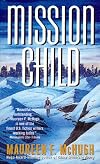
‘Mission Child’ is a thoughtful sci-fi novel by the same author as [b:China Mountain Zhang|836964|China Mountain Zhang|Maureen F. McHugh|https://images.gr-assets.com/books/1346669090s/836964.jpg|1607617], which I thought was brilliant. Despite a similar structure and themes, I didn’t find it quite as original and profound. [b:China Mountain Zhang|836964|China Mountain Zhang|Maureen F. McHugh|https://images.gr-assets.com/books/1346669090s/836964.jpg|1607617] was McHugh’s first novel, show more impressively enough. ‘Mission Child’ also follows the struggles and dilemmas of daily life in a future world, rather than focusing on some grand world-saving plot. Rather than using multiple points of view, though, ‘Mission Child’ has just one: Janna/Jan. It’s also a great deal more brutal, as Janna lives on an area of an alien planet with a low technology level. There’s some interesting subtext about this being a deliberate experiment in sustainability, however it’s also a fragile one. The arrival of more advanced technology, specifically guns, destabilises the subsistence economy and forces Janna to flee for their life. Janna’s odyssey in search of a new home is sensitively told and provokes reflection on the parallels between international and interplanetary immigration.
Another fascinating theme throughout the book is gender, as Janna/Jan feels themself to be both man and woman. (The novel is in the first person and, as far as I can tell, the equivalent in current terms would be nonbinary, so I’m using ‘they/them’ pronouns.) This is addressed thoughtfully and undramatically. I also appreciated the clever examination of how technology shapes culture and society, especially the co-existence of the very advanced and very basic. McHugh is not concerned with glorifying technology in itself, as sci-fi sometimes does, but in exploring its impact on the daily life of normal people. Janna and those they meet are not the high-flying rich of the future, in fact quite the opposite: displaced, homeless, without the skills to access decent employment. Not enough novels consider such people, except sometimes to glamorise criminal exploits. There is no glamour here. Indeed, there are some truly horrible depictions of war and plague. ‘Mission Child’ doesn’t wallow in gratuitous horror, rather it considers the unintended consequences of settling other planets through the eyes of a unique and compelling narrator. The cultural world-building is its greatest strength, one unusual enough to be worthy of comment in the sci-fi genre. show less
Another fascinating theme throughout the book is gender, as Janna/Jan feels themself to be both man and woman. (The novel is in the first person and, as far as I can tell, the equivalent in current terms would be nonbinary, so I’m using ‘they/them’ pronouns.) This is addressed thoughtfully and undramatically. I also appreciated the clever examination of how technology shapes culture and society, especially the co-existence of the very advanced and very basic. McHugh is not concerned with glorifying technology in itself, as sci-fi sometimes does, but in exploring its impact on the daily life of normal people. Janna and those they meet are not the high-flying rich of the future, in fact quite the opposite: displaced, homeless, without the skills to access decent employment. Not enough novels consider such people, except sometimes to glamorise criminal exploits. There is no glamour here. Indeed, there are some truly horrible depictions of war and plague. ‘Mission Child’ doesn’t wallow in gratuitous horror, rather it considers the unintended consequences of settling other planets through the eyes of a unique and compelling narrator. The cultural world-building is its greatest strength, one unusual enough to be worthy of comment in the sci-fi genre. show less
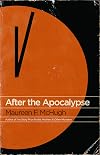
I’ve read Maureen McHugh’s “Useless Things” at least three times now, and I admire it more with each rereading. It appears just a bit less than halfway through McHugh’s thought-provoking short story collection, After the Apocalypse. The first-person narrator is a woman living well outside Albuquerque, New Mexico, in a time when the United States seems on the brink of collapse: the economy is terrible, and water is extremely scarce in the Southwest — a time that doesn’t feel show more very far away from today. The narrator lives hand-to-mouth making dolls, particularly dolls called “reborns” that look almost, but not quite, real. She’s alone in her house but for her friendly dogs most days, which only makes her nervous when South American laborers crossing the border stop by her house looking for a meal in exchange for labor. She’s apparently on some list shared by these illegal immigrants as a kind woman who always has a handout. She doesn’t like it, but she can’t bring herself to turn these men away. But when she returns from an errand one day to find that her hospitality has been abused, she makes a few decisions about how to go on. This is a quiet story, one that describes a couple of days during which something bad happens — nonviolent, but certainly distressing – and the changes that follow. But it says much about what one will do when pushed just beyond the stretched yet tolerable limits by which one lives.
“Useless Things” is typical of McHugh’s writing. Always quiet and matter-of-fact, her stories seem so real that you can hardly believe they aren’t happening in the next county over. In “The Naturalist,” for instance, we learn early on that the zombie problem has been pretty much handled by the government, with the remaining creatures — the ultimate trash, worse than guys who cooked meth or fat women on WIC — isolated in zombie preserves. These areas are isolated by water, which the zombies won’t cross, and do double-duty as prisons for the hard-core bad guys the government just wants dead. The story follows Cahill as he scavenges, kills zombies, deals with other prisoners, and tries to puzzle out how the zombies work as hunters and killers. Again, McHugh writes in an understated style, just telling her audience what happened and how. There are no big moments, just an accumulation of small ones, so that even the denouement seems natural. It’s a powerful style, and a powerful story.
The same understated style is at work in “The Lost Boy: A Reporter At Large,” the story of a boy who goes into a dissociative fugue following the detonation of two dirty bombs in Baltimore. He is separated from his family and raised in foster homes, never regaining his memory of his family until his mother shows up at his place of employment one day. The focus of the story, therefore, isn’t on the dirty bombs; it’s on the effect of those bombs on one family. The story is particularized, humanized, made into a character study instead of a thriller, and in this quiet way tells us much more about the societal effects of such an attack.
All nine of the stories in this slim but indispensable volume share this same restrained approach to storytelling, adjuring the larger story of how an apocalypse came about and its major effects on society for the personal, small stories the apocalypse created. The title story, “After the Apocalypse,” doesn’t even really have an apocalypse; as the story says, “Things didn’t exactly all go at once. First there were rolling brownouts and lots of people unemployed…. Then the power started going out, more and more often. Pete’s shifts got longer although he didn’t always get paid…. Then the fires started on the east side of town. The power went out and stayed out.” The world as we know it ends, not with a bang, but a whimper. There’s no one who’s going to fix things. McHugh writes about how a mother and her daughter survive, using the most primitive of instruments: the mother’s body.
These stories are like individually polished and cut jewels. They’re not fiery diamonds, but more like chalcedony, beautiful and unusual. Each story bears multiple readings. You’ll want this collection on your shelf. show less
“Useless Things” is typical of McHugh’s writing. Always quiet and matter-of-fact, her stories seem so real that you can hardly believe they aren’t happening in the next county over. In “The Naturalist,” for instance, we learn early on that the zombie problem has been pretty much handled by the government, with the remaining creatures — the ultimate trash, worse than guys who cooked meth or fat women on WIC — isolated in zombie preserves. These areas are isolated by water, which the zombies won’t cross, and do double-duty as prisons for the hard-core bad guys the government just wants dead. The story follows Cahill as he scavenges, kills zombies, deals with other prisoners, and tries to puzzle out how the zombies work as hunters and killers. Again, McHugh writes in an understated style, just telling her audience what happened and how. There are no big moments, just an accumulation of small ones, so that even the denouement seems natural. It’s a powerful style, and a powerful story.
The same understated style is at work in “The Lost Boy: A Reporter At Large,” the story of a boy who goes into a dissociative fugue following the detonation of two dirty bombs in Baltimore. He is separated from his family and raised in foster homes, never regaining his memory of his family until his mother shows up at his place of employment one day. The focus of the story, therefore, isn’t on the dirty bombs; it’s on the effect of those bombs on one family. The story is particularized, humanized, made into a character study instead of a thriller, and in this quiet way tells us much more about the societal effects of such an attack.
All nine of the stories in this slim but indispensable volume share this same restrained approach to storytelling, adjuring the larger story of how an apocalypse came about and its major effects on society for the personal, small stories the apocalypse created. The title story, “After the Apocalypse,” doesn’t even really have an apocalypse; as the story says, “Things didn’t exactly all go at once. First there were rolling brownouts and lots of people unemployed…. Then the power started going out, more and more often. Pete’s shifts got longer although he didn’t always get paid…. Then the fires started on the east side of town. The power went out and stayed out.” The world as we know it ends, not with a bang, but a whimper. There’s no one who’s going to fix things. McHugh writes about how a mother and her daughter survive, using the most primitive of instruments: the mother’s body.
These stories are like individually polished and cut jewels. They’re not fiery diamonds, but more like chalcedony, beautiful and unusual. Each story bears multiple readings. You’ll want this collection on your shelf. show less
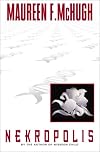
This book, set in a future Morocco, shows that, regardless of advances in technology, the basic human experience often changes very little. Her main character, the young Muslim woman Hariba, has voluntarily sold herself into servitude; her loyalty to her employers assured by chemical/biological means. However, when she falls in love with Akhmim, a lab-created biological "AI" who seems all too human, the two escape their employer/owners, risking jail or death...
Regardless of the book's exotic show more tech, Hariba's experiences are those shared by all too many refugees, poltical and otherwise, today. McHugh speaks delicately and effectively about the realities of life in an oppressive regime, the fact that even those who are extremely conservative can fall afoul of the law in such situations, about the difference in perception between well-meaning liberals with high political ideals and the priorities and concerns of those they are trying to help, about the difficulties faced by those who have left others behind to face the repercussions of their rebellion.... show less
Regardless of the book's exotic show more tech, Hariba's experiences are those shared by all too many refugees, poltical and otherwise, today. McHugh speaks delicately and effectively about the realities of life in an oppressive regime, the fact that even those who are extremely conservative can fall afoul of the law in such situations, about the difference in perception between well-meaning liberals with high political ideals and the priorities and concerns of those they are trying to help, about the difficulties faced by those who have left others behind to face the repercussions of their rebellion.... show less

I’m not entirely sure what to make of this novel. It had neither a plot nor did it need to be science fiction. And yet it was good. Janna is a teenage girl at an “appropriate technology mission” in the far north. Although the local culture resembles Inuit, the people of the region seem to be descended from northern Europeans. A local tribe wipes out the mission, and only a handful of people escape, including Janna and her husband. They trek to to another tribe, with whom they share show more kinship, but are never made entirely welcome. Then the tribe that attacked the mission attacks this other tribe, and again Janna and her husband escape. But he dies during the escape, and Janna makes it alone to a coastal city, where she is put in a refugee camp. She is mistaken for a man and chooses to impersonate that gender for reasons of safety, although later she decides she is transgender. Janna, now Jan, moves to another city and links up with another tribal person who’s a bit of wideboy, full of semi-legal schemes and deals. Jan gets a job as a technician, brings over a shaman from the refugee camp, and ends up as his helper when the wideboy is murdered after dealing in something high tech he stumbled across. Jan eventually falls out with the shaman and sets off travelling. He ends up on a tropical islands, whose inhabitants are descended from a mix of Indian and Chinese settlers, where he hires out as a bodyguard. But his employer is killed in a raid (this part of the book was originally published as a short story, I believe), and so Jan takes his employer’s daughter to her grandmother on another island, and ends up settling down there. He ends up helping offworlder medics when a plague strikes the islands as he is immune to the disease thanks to a medical implant he was given back in the first chapter. For all that the novel is about the impact of high tech offworlders on the cultures of Jan’s world, there’s no good reason I could see why the novel needed to be set on another world, or even sf. Certainly it gave McHugh free rein in envisaging cultures to make her various points, but it does all feel a bit, well, arbitrary. Which is not to say Mission Child is a bad novel. Far from it. McHugh was definitely one of US science fiction’s more interesting writers during the 1990s (she has not published anything in long-form since 2001), and I should probably give her short fiction ago (there are two collections to date, both published this century). Mission Child is a bit of a puzzler: a book that is clearly genre, but doesn’t really need to be, but works so well as genre it seems churlish to complain it didn’t have to be genre. show less
Lists
Asia (1)
Best Cyberpunk (1)
SF Masterworks (1)
Female Author (1)
First Novels (1)
Awards


You May Also Like


Associated Authors
Statistics
- Works
- 46
- Also by
- 86
- Members
- 3,679
- Popularity
- #6,881
- Rating
- 3.7
- Reviews
- 146
- ISBNs
- 47
- Languages
- 5
- Favorited
- 15