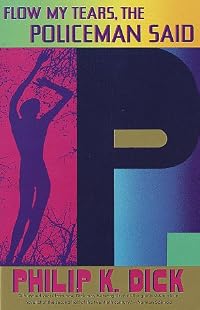
Flow My Tears, the Policeman Said
by Philip K. Dick
On This Page
Description
"Dick skillfully explores the psychological ramifications of this nightmare." - The New York Times Review of Books Flow My Tears, the Policeman Said grapples with many of the themes Philip K. Dick is best known for - identity, altered reality, drug use, and dystopia - in a rollicking chase story that earned the novel the John W. Campbell Award and nominations for the Hugo and Nebula. Jason Taverner - world-famous talk show host and man-about-town - wakes up one day to find that no one knows show more who he is - including the vast databases of the totalitarian government. And in a society where lack of identification is a crime, Taverner has no choice but to go on the run with a host of shady characters, including crooked cops and dealers of alien drugs. But do they know more than they are letting on? And just how can a person's identity be erased overnight? show lessTags
Recommendations









Member Recommendations

by JFDR
Member Reviews
Having also read Dick’s Exegesis this story made a bit more sense than it might have otherwise. As the main character, Jason Taverner, admits near the end, he was “living in a world made of rubber. Everything bounced. Changed shape as soon as it was touched or even looked at.” But just when you agree that it was all a paranoid dream, Dick comes at you with an explanation. Of course, the explanation starts off sounding reasonable, blending drugs, neuroscience, the physics of alternate realities, and more until the explanation gives you and the “policeman” a headache. But if you really can’t make sense of it all, just enjoy the passing of the scenes. I especially liked the wall-to-wall carpet depicting “Richard M. Nixon’s show more final ascent into heaven amid joyous singing above and wails of misery below.” show less
This is how phildickian a good Philip K. Dick novel is—
For a few moments, about 4/5 of the way through Flow My Tears, The Policeman Said, I sensed the kind of space-time glitch that is treated in the book. A character in the story, a television entertainer uncertain of his own existence, hears a copy of his latest record on a jukebox in a café. The song is called “Nowhere Nothin’ Fuck-Up,” which I thought Doug Martsh wrote for his band Built to Spill in 1993, as a kind of wry take on Lou Reed’s “Oh! Sweet Nuthin’” from the Velvet Underground record Loaded (1970). Insert cartoon-spring sound effect here. Turns out that Phil Dick wrote a Built to Spill song into a novel 20 years before Doug Martsh wrote the song, and that show more getting lost in space and time while reading a Phil Dick novel—despite the sometimes-clunky prose and goofy dialogue—is part of the fun, like smelling the river while reading Huckleberry Finn or walking around inside one of those giant Guia Roji maps of Mexico City while reading Valeria Luiselli’s The Story of My Teeth.
I read Flow My Tears 35 years ago in a cheap edition with the bright orange cover (a man writhing? soaring?) that I found in a paperback exchange in Boise, but I had forgotten what was inside and so took it up anew when I saw a copy recently in a Little Library book box mounted on a tree in my neighborhood. Phil Dick can mess with your head; chronologies can crumple at any time. And isn't Doug Martsh from Boise? show less
For a few moments, about 4/5 of the way through Flow My Tears, The Policeman Said, I sensed the kind of space-time glitch that is treated in the book. A character in the story, a television entertainer uncertain of his own existence, hears a copy of his latest record on a jukebox in a café. The song is called “Nowhere Nothin’ Fuck-Up,” which I thought Doug Martsh wrote for his band Built to Spill in 1993, as a kind of wry take on Lou Reed’s “Oh! Sweet Nuthin’” from the Velvet Underground record Loaded (1970). Insert cartoon-spring sound effect here. Turns out that Phil Dick wrote a Built to Spill song into a novel 20 years before Doug Martsh wrote the song, and that show more getting lost in space and time while reading a Phil Dick novel—despite the sometimes-clunky prose and goofy dialogue—is part of the fun, like smelling the river while reading Huckleberry Finn or walking around inside one of those giant Guia Roji maps of Mexico City while reading Valeria Luiselli’s The Story of My Teeth.
I read Flow My Tears 35 years ago in a cheap edition with the bright orange cover (a man writhing? soaring?) that I found in a paperback exchange in Boise, but I had forgotten what was inside and so took it up anew when I saw a copy recently in a Little Library book box mounted on a tree in my neighborhood. Phil Dick can mess with your head; chronologies can crumple at any time. And isn't Doug Martsh from Boise? show less
I loved this book, some may bellyache about it being just another romp in a Philip K. Dick universe, but I really enjoyed the absurdity of it all. The subjective / questionable reality, the commentary on identity and memory and the surreal imagery made this a memorable read.
3.5/5
Flow My Tears, the Policeman Said follows Jason Taverner, a television celebrity as his reality is replaced by another one, one which sees him as a non-entity, or a no-one. He wakes up after a medical emergency in the same police state dystopia that he was in before, but now suddenly nobody knows who he is, and more importantly he has no associated official documentation, which are of the utmost importance in this world.
I am of two minds on this one. I really loved a lot about, first and foremost the overwhelming sense of anxiety and paranoia that drips from the pages. The reader, much like our lead protagonist, isn't sure who is lying, who to believe, if their concept of reality is correct. It left me trying to put the pieces of show more the puzzle together throughout the plot, only to have my conceptions broken at multiple turns. The plot itself is well paced, speeding a long and keeping the reader engaged with the lucid set of events. While the setting for the story is mostly cut and paste from a million other dystopias, the specific obsession with documentation in this felt fresh, and reminded me of the indie video game Papers, Please. There's some interesting discussion about the role that love and grief play in our lives, what value there is in both, and about how to have one you must have the other. Dick also plays with drug use and addiction in a way that I found sincere.
My disappointment largely lies in the ending of the novel, where most things are explained clearly in black and white. Personally I think the message and the tone of the book would've been better served with something more ambiguous, where the reader is left to think about what really did happen. As it is, the ending feels at odds with the read of the book. Also, there were a few through lines, specially relating to age of consent and incest that felt rushed or completely unnecessary considering where Dick seems to be focused. Why included such heavy topics if you aren't going to do more than simply mention them in passing? Kinda weird and off-putting.
I think I enjoyed this one less than Do Androids Dream of Electric Sheep, though they were both worth the read. This novel is defiantly more lucid and coherent throughout than Androids. I excited to get to some of his other works. show less
Flow My Tears, the Policeman Said follows Jason Taverner, a television celebrity as his reality is replaced by another one, one which sees him as a non-entity, or a no-one. He wakes up after a medical emergency in the same police state dystopia that he was in before, but now suddenly nobody knows who he is, and more importantly he has no associated official documentation, which are of the utmost importance in this world.
I am of two minds on this one. I really loved a lot about, first and foremost the overwhelming sense of anxiety and paranoia that drips from the pages. The reader, much like our lead protagonist, isn't sure who is lying, who to believe, if their concept of reality is correct. It left me trying to put the pieces of show more the puzzle together throughout the plot, only to have my conceptions broken at multiple turns. The plot itself is well paced, speeding a long and keeping the reader engaged with the lucid set of events. While the setting for the story is mostly cut and paste from a million other dystopias, the specific obsession with documentation in this felt fresh, and reminded me of the indie video game Papers, Please. There's some interesting discussion about the role that love and grief play in our lives, what value there is in both, and about how to have one you must have the other. Dick also plays with drug use and addiction in a way that I found sincere.
My disappointment largely lies in the ending of the novel, where most things are explained clearly in black and white. Personally I think the message and the tone of the book would've been better served with something more ambiguous, where the reader is left to think about what really did happen. As it is, the ending feels at odds with the read of the book. Also, there were a few through lines, specially relating to age of consent and incest that felt rushed or completely unnecessary considering where Dick seems to be focused. Why included such heavy topics if you aren't going to do more than simply mention them in passing? Kinda weird and off-putting.
I think I enjoyed this one less than Do Androids Dream of Electric Sheep, though they were both worth the read. This novel is defiantly more lucid and coherent throughout than Androids. I excited to get to some of his other works. show less
This isn't one of Dick's most talked about works (maybe because there is no adaptation (that I know of?)?), but it is one of the better written. I cannot talk about what I find most fascinating about this book without spoiling it COMPLETELY, but there is a lot that I can say.
Most of your common PKD themes are here. A sudden change or revelation that makes you question everything you knew about reality. A surveillance state. Disguise. But then we get some new or less common elements as well — a lot of shade thrown at eugenics, a staggering amount of sexual content for Dick Not that there is sex on the page, exactly, but the police encounter a pedophile (but in this world, the age of consent is 13 — it's messy), two of the female show more characters are bisexual, and there is an incestuous couple? I would almost think I was reading Heinlein, except there isn't a hot tub in sight.
Not to mention Heinlein is not interested in the question of WHAT EVEN IS REALITY/HUMANITY? Which is Dick's whole thing.
Out of everything, the anti-Black edge to eugenics is probably what ages the poorest, not because dick doesn't see it or mention it, but the treatment of it feels undercooked. show less
Most of your common PKD themes are here. A sudden change or revelation that makes you question everything you knew about reality. A surveillance state. Disguise. But then we get some new or less common elements as well — a lot of shade thrown at eugenics, a staggering amount of sexual content for Dick Not that there is sex on the page, exactly, but the police encounter a pedophile (but in this world, the age of consent is 13 — it's messy), two of the female show more characters are bisexual, and there is an incestuous couple? I would almost think I was reading Heinlein, except there isn't a hot tub in sight.
Not to mention Heinlein is not interested in the question of WHAT EVEN IS REALITY/HUMANITY? Which is Dick's whole thing.
Out of everything, the anti-Black edge to eugenics is probably what ages the poorest, not because dick doesn't see it or mention it, but the treatment of it feels undercooked. show less
"La realidad negada regresa para atormentar. Para caer, sin previo aviso sobre la persona, y enloquecerla."
Jason Taverner es una súper estrella que un día despierta y nadie lo recuerda...a partir de ahí nos encontramos en la carrera de Jason para averiguar el porqué, el problema recae en que, en un mundo altamente controlado por la policia, sin identidad ni papeles, Jason terminará enrollándose con personas peligrosas y situaciones ilegales, en una carrera contra reloj para evitar su muerte o inclusión en los campos de trabajos forzados.
"Me he mezclado con un ser complicado, raro y desequilibrado[...]. Tan malo como no he encontrado aún en mis cuarenta y dos años"
Siendo Taverner el protagonista no es, ni de cerca, el personaje show more más interesante de esta historia. Entre la conversación de Ruth Rae y la misteriosa vida de Felix Buckman, Jason queda, para su suerte/infortunio, el 50% del tiempo acompañado de alguien que dará más énfasis a su historia, que permitirá ver un aspecto distinto de su personalidad y del mundo bajo el cual nos encontramos.
"Los huesos descarnados de existencia con los que todo hombre nace: ni siquiera tengo eso."
El final..creo que esté se unirá a mi pequeña lista de libros en los cuales el epílogo es lo que menos me gusto, antes de llegar a esa parte el final era abierto pero me hubiera parecido perfecto que así quedará, el epilogo nos da un vistazo a lo que sucede con todos los personajes y nos deja con la sensación de que eramos un espía durante el transcurso de la historia
"Jason Taverner y yo somos figuras de un viejo dibujo de un niño. Perdidos entre el polvo."
Esta obra es muy interiorizada, las reflexiones e inseguridades de todos los personajes están muy bien trabajados, la resolución de que es lo que sucedió con la vida de Taverner, aunque inverosímil, dentro de este mundo, podemos darla por posible, y más importante aún la paranoia que envuelve la historia, ese elemento hace que gran parte del tiempo estes pensando ¿Qué demonios está pasando? y esa pregunta va haciendo que poco a poco la historia te atrape, porque interiorizas la situación y empatizas con el terror del protagonista.
"...Pues ahora, abandonado y solitario
me siento, suspiro, sollozo,me desmayo, muero
en dolor mortal e interminable miseria"
"Oíd!, vosotras, sombras que en la oscuridad moráis,
aprended a despreciar la luz.
Felices, felices quienes en el averno
del mundo no sienten el desprecio." show less
Jason Taverner es una súper estrella que un día despierta y nadie lo recuerda...a partir de ahí nos encontramos en la carrera de Jason para averiguar el porqué, el problema recae en que, en un mundo altamente controlado por la policia, sin identidad ni papeles, Jason terminará enrollándose con personas peligrosas y situaciones ilegales, en una carrera contra reloj para evitar su muerte o inclusión en los campos de trabajos forzados.
"Me he mezclado con un ser complicado, raro y desequilibrado[...]. Tan malo como no he encontrado aún en mis cuarenta y dos años"
Siendo Taverner el protagonista no es, ni de cerca, el personaje show more más interesante de esta historia. Entre la conversación de Ruth Rae y la misteriosa vida de Felix Buckman, Jason queda, para su suerte/infortunio, el 50% del tiempo acompañado de alguien que dará más énfasis a su historia, que permitirá ver un aspecto distinto de su personalidad y del mundo bajo el cual nos encontramos.
"Los huesos descarnados de existencia con los que todo hombre nace: ni siquiera tengo eso."
El final..creo que esté se unirá a mi pequeña lista de libros en los cuales el epílogo es lo que menos me gusto, antes de llegar a esa parte el final era abierto pero me hubiera parecido perfecto que así quedará, el epilogo nos da un vistazo a lo que sucede con todos los personajes y nos deja con la sensación de que eramos un espía durante el transcurso de la historia
"Jason Taverner y yo somos figuras de un viejo dibujo de un niño. Perdidos entre el polvo."
Esta obra es muy interiorizada, las reflexiones e inseguridades de todos los personajes están muy bien trabajados, la resolución de que es lo que sucedió con la vida de Taverner, aunque inverosímil, dentro de este mundo, podemos darla por posible, y más importante aún la paranoia que envuelve la historia, ese elemento hace que gran parte del tiempo estes pensando ¿Qué demonios está pasando? y esa pregunta va haciendo que poco a poco la historia te atrape, porque interiorizas la situación y empatizas con el terror del protagonista.
"...Pues ahora, abandonado y solitario
me siento, suspiro, sollozo,me desmayo, muero
en dolor mortal e interminable miseria"
"Oíd!, vosotras, sombras que en la oscuridad moráis,
aprended a despreciar la luz.
Felices, felices quienes en el averno
del mundo no sienten el desprecio." show less
This is a small gem from one of sci-fi's most accomplished and interesting writers, Philip K. Dick. Movies based on his books keep coming out, with Blade Runner being the most famous. A new Total Recall is being released this year, and others include Minority Report and Adjustment Bureau, the latter a favorite of my wife's and mine.
OK, enough about movies, other than I could see Flow My Tears, The Policeman Said being filmed, too, if one squeam-inducing plot thread were changed.
Jason Taverner is a genetically enhanced Six, top of the heap, and the host of a hugely popular TV show. He's also full of himself and a womanizer. Our world has become a police state, with tabs kept on every citizen and problematics sent to forced labor camps. show more When one of his abandoned trystees expresses her anger and injures him with an ugh-toss, he ends up waking up in a world that doesn't know him. His fame has disappeared. His identity is missing from all databanks. In a police state, he's a disaster waiting to happen. What to do?
His quest to first acquire some identity so he can survive, and to eventually recover his own identity, connects him with some memorable characters. They include a 19 year old ID forger and police informant who craves his bod and may do him in, an old flame who likes to wax philosophical, and the whacko sister of a police captain who may be behind all that has happened.
Dick is a good writer, with a great imagination. The police state is a convincing backdrop, and the storyline is irresistible: why is his reality so changed? Will he be able to regain his identity? Will he be betrayed, chewed up and spit out into a forced labor camp? Along the way we have characters engage in deep discussions about grief, love, life, death, and what exactly is reality. Written in the 70s, drugs play a role in opening eyes and also potentially destroying lives. A bit of disturbing societal racism at the beginning comes full circle at the end.
The author does provide an occasional clunker, e.g. a character making a remark in "his doglike panting voice." But mainly the story zips along, packing a remarkable amount of ideas, developments and story into approximately 200 pages.
I also learned a good Latin phrase from it: De gustibus non disputandum est. In matters of taste there's no dispute. This may not be your cuppa, but for those who are intrigued by this sort of thing, it's a cinematic trip with a master. show less
OK, enough about movies, other than I could see Flow My Tears, The Policeman Said being filmed, too, if one squeam-inducing plot thread were changed.
Jason Taverner is a genetically enhanced Six, top of the heap, and the host of a hugely popular TV show. He's also full of himself and a womanizer. Our world has become a police state, with tabs kept on every citizen and problematics sent to forced labor camps. show more When one of his abandoned trystees expresses her anger and injures him with an ugh-toss, he ends up waking up in a world that doesn't know him. His fame has disappeared. His identity is missing from all databanks. In a police state, he's a disaster waiting to happen. What to do?
His quest to first acquire some identity so he can survive, and to eventually recover his own identity, connects him with some memorable characters. They include a 19 year old ID forger and police informant who craves his bod and may do him in, an old flame who likes to wax philosophical, and the whacko sister of a police captain who may be behind all that has happened.
Dick is a good writer, with a great imagination. The police state is a convincing backdrop, and the storyline is irresistible: why is his reality so changed? Will he be able to regain his identity? Will he be betrayed, chewed up and spit out into a forced labor camp? Along the way we have characters engage in deep discussions about grief, love, life, death, and what exactly is reality. Written in the 70s, drugs play a role in opening eyes and also potentially destroying lives. A bit of disturbing societal racism at the beginning comes full circle at the end.
The author does provide an occasional clunker, e.g. a character making a remark in "his doglike panting voice." But mainly the story zips along, packing a remarkable amount of ideas, developments and story into approximately 200 pages.
I also learned a good Latin phrase from it: De gustibus non disputandum est. In matters of taste there's no dispute. This may not be your cuppa, but for those who are intrigued by this sort of thing, it's a cinematic trip with a master. show less
Members
- Recently Added By
Lists

Best Science Fiction Novels
816 works; 430 members

S.F. Masterworks (Complete)
229 works; 15 members

Dystopian and Apocalyptic Literature
350 works; 74 members

SF Masterworks
193 works; 8 members

Franklit
95 works; 1 member

Books Read in 2024
4,623 works; 126 members
Author Information

659+ Works 146,116 Members
Phillip Kindred Dick was an American science fiction writer best known for his psychological portrayals of characters trapped in illusory environments. Born in Chicago, Illinois, on December 16, 1928, Dick worked in radio and studied briefly at the University of California at Berkeley before embarking on his writing career. His first novel, Solar show more Lottery, was published in 1955. In 1963, Dick won the Hugo Award for his novel, The Man in the High Castle. He also wrote a series of futuristic tales about artificial creatures on the loose; notable of these was Do Androids Dream of Electric Sheep?, which was later adapted into film as Blade Runner. Dick also published several collections of short stories. He died of a stroke in Santa Ana, California, in 1982. (Bowker Author Biography) show less
Some Editions
Awards and Honors
Awards
Series
Belongs to Publisher Series
Work Relationships
Common Knowledge
- Canonical title*
- Eine andere Welt
- Original title
- Flow, My Tears, the Policeman Said; Flow my Tears, the Policeman Said
- Alternate titles*
- Le prisme du néant
- Original publication date
- 1974-02; 1970-08-07 (manuscript) (manuscript)
- People/Characters
- Jason Taverner; Felix Buckman; Alys Buckman; Katharine Nelson; Heather Hart; James Joyce (show all 20); Marilyn Mason; Al Bliss; Inspector McNulty; Eddy; Herbert Maime; Jumpy Mike; Ruth Rae; Allen Mufi; Mary Anne Dominic; Peggy Beason; Chancer; Susie; Phil Westerburg; Montgomery L Hopkins
- Important places
- Los Angeles, California, USA; Las Vegas, Nevada, USA
- Epigraph
- Flow my tears, fall from your springs!
Exiled forever, let me mourn;
Where night's black bird her sad infamy sings,
There let me live forlorn.
(Part One)
Down, vain lights, shine you no more!
No nights are black enough for those
That in despair their lost fortunes deplore.
Light doth but shame disclose.
(Part Two)
Never may my woes be relieved,
Since pity is fled;
And tears and sights and groans my weary days
Of all joys have deprived.
(Part Three) - Dedication
- The love in this novel is for Tessa,
and the love in me is for her, too.
She is my little song. - First words
- On Tuesday, October 11, 1988, the Jason Taverner Show ran thirty seconds short.
- Quotations
- "Listen," he said, haltingly. "I'm going to tell you something and I want you to listen carefully. You belong in a prison for the criminally insane."
- Last words
- (Click to show. Warning: May contain spoilers.)And loved.
- Publisher's editor*
- Jeschke, Wolfgang
- Original language
- English
*Some information comes from Common Knowledge in other languages. Click "Edit" for more information.
Classifications
Statistics
- Members
- 4,810
- Popularity
- 2,936
- Reviews
- 98
- Rating
- (3.80)
- Languages
- 18 — Chinese, Czech, Danish, Dutch, English, Finnish, French, German, Hungarian, Italian, Japanese, Polish, Romanian, Russian, Spanish, Swedish, Turkish, Portuguese (Portugal)
- Media
- Paper, Audiobook, Ebook
- ISBNs
- 75
- ASINs
- 32