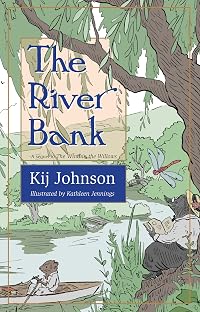
The River Bank: A sequel to Kenneth Grahame's The Wind in the Willows
by Kij Johnson
On This Page
Description
"In this delightful dive into the bygone world of Kenneth Grahame's The Wind in the Willows staunch Mole, sociable Water Rat, severe Badger, and troublesome and ebullient Toad of Toad Hall are joined by a young mole lady, Beryl, and her dear friend, Rabbit. There are adventures, kidnappings, lost letters, and family secrets-lavishly illustrated throughout by award-winning artist Kathleen Jennings. Praise for Kij Johnson: "The Fox Woman immediately sets the author in the front rank of today's show more novelists." -Lloyd Alex-ander "Johnson has a singular vision and I'm going to be borrowing (stealing) from her." -Sherman Alexie "Johnson's language is beautiful, her descriptions of setting visceral, and her characters compellingly drawn." -Publishers Weekly (starred re-view) "Johnson would fit quite comfortably on a shelf with Karen Russell, Erin Morgen-stern and others who hover in the simultaneous state of being both "literary" and "fantasy" writ-ers." -Shelf Awareness Kij Johnson's stories have won the Sturgeon, World Fantasy, and Nebula awards. She has taught writing and has worked at Dark Horse, Microsoft, and Real Networks. She has run bookstores, worked as a radio announcer and engineer, edited cryptic crosswords, and waitressed in a strip bar. Kathleen Jennings was raised on fairytales in western Queensland. She trained as a lawyer and filled the margins of her notes with pen-and-ink illustrations. She has been nominated for the World Fantasy award and has received several Ditmar Awards. She lives in Brisbane, Australia"-- show lessTags
Recommendations
















Member Recommendations
Member Reviews
Johnson, in her Author’s Note says this book is "an imperfect attempt to open up the world of … [Kenneth Grahame’s, 'The Wind in the Willows'] , and "avoid some of its "entrenched assumptions about privilege, class, and gender." The book succeeds in this, and at the same time reads to my ear as if it were written by Grahame himself, if he had written in a more inclusive way.
The story is greatly enhanced by Kathleen Jennings' clever, precise but dreamy, drawings of the characters, landscapes, and the river.
There are still class distinctions, some animals wear clothing and interact with humans. Sheep and cows are just animals. Moles, water rats and others are gentle, and live in houses. Others, like stoats and foxes are still show more villains and mostly live in the Wild Woods.
There is still much messing around in boats, and Toad is up to his usual misadventures.
Grahame’s females were only minor or incidental to his story, but Johnson introduces Beryl Mole, a writer, and her friend the Rabbit, who share a cottage near the river. They each, in their own ways, are the characters who solve problems and control the flow of this book, which is all to the better.
Pan, who appeared briefly, but to great effect, in only one chapter of 'Wind in the Willows', shows up again, this time to Beryl, in Johnson's book.
I missed 'Wind in the Willows' in childhood, read it as an adult, loved it then, and now like 'The River Bank' even more.
. show less
The story is greatly enhanced by Kathleen Jennings' clever, precise but dreamy, drawings of the characters, landscapes, and the river.
There are still class distinctions, some animals wear clothing and interact with humans. Sheep and cows are just animals. Moles, water rats and others are gentle, and live in houses. Others, like stoats and foxes are still show more villains and mostly live in the Wild Woods.
There is still much messing around in boats, and Toad is up to his usual misadventures.
Grahame’s females were only minor or incidental to his story, but Johnson introduces Beryl Mole, a writer, and her friend the Rabbit, who share a cottage near the river. They each, in their own ways, are the characters who solve problems and control the flow of this book, which is all to the better.
Pan, who appeared briefly, but to great effect, in only one chapter of 'Wind in the Willows', shows up again, this time to Beryl, in Johnson's book.
I missed 'Wind in the Willows' in childhood, read it as an adult, loved it then, and now like 'The River Bank' even more.
. show less
The subtitle to Kij Johnson’s "The River Bank" is “A sequel to The Wind in the Willows,” and that’s just what it is. Taking place the summer after the events in that classic, we again encounter Mole, Water Rat, Badger, Otter and, of course, Toad of Toad Hall, who is up to his usual shenanigans. Newcomers to the neighbourhood are Beryl (a female Mole and an Authoress) and her companion, a young Rabbit; initially the objects of suspicion from the old inhabitants, they slowly are integrated into the world of the River Bank…. Whether one would like this book depends largely on his or her relationship to the original; me, I loved it. I think Ms. Johnson did a great job of continuing Kenneth Grahame’s story in a voice similar to show more his, while at the same time updating the attitudes described in the earlier book. Recommended! show less
Ratings
Members
- Recently Added By
Lists

Nonhuman Protagonists
243 works; 35 members

2018 Hugo Eligible Novels
170 works; 16 members
Author Information

47+ Works 3,482 Members
All Editions
Awards and Honors
Distinctions
Work Relationships
Is a (non-series) sequel to
Has as a study
Classifications
Statistics
- Members
- 118
- Popularity
- 276,303
- Reviews
- 2
- Rating
- (4.41)
- Languages
- English
- Media
- Paper, Audiobook, Ebook
- ISBNs
- 3
- ASINs
- 2