The Monitors
by Keith Laumer
On This Page
Description
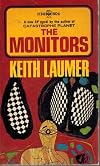
Even after the set had been turned off, the TV blared the announcement: ""Citizens of Earth, I am Tersh Jetterax. It is my pleasure to announce to you that a new government has taken over the conduct of all public affairs.""And thus the US was in the hands of the Monitors, the strangely polite yellow-clad beings whose powers were such that they could render everyone helpless - without shedding one drop of blood. Who are they? The Russians? An alien race from another planet?Tags
Recommendations











Member Recommendations


Member Reviews
review of
Keith Laumer's The Monitors
by tENTATIVELY, a cONVENIENCE - June 26, 2013
How many people start off their day w/ the intention of writing 3 reviews of SF novels written in the '60s by one author? Knowing that there's no pay involved, knowing that money is going to be very scarce in their life very soon. & listening to the music of Arthur Berger & Edward Burlingame Hill on a CBS Special Service Records Collectors', Modern American Music, Series. Only a fool, someone might say. Only a scholar, someone else might say. Whatevs, as my friend etta cetera might say.
The Monitors main character starts off pretty ambiguous as far as heroic qualities or clarity of thinking goes. That seems to characterize all the Laumer heros I've read show more stories of so far - I reckon this is Laumer's 'realism'. Nonetheless, Blondel manages to be a sympathetic character for me immediately: ""Just squeeze me one out of the bar rag, Harry." Blondel slid onto a stool as far as possible from the sound of the telly. "That's all the budget allows for at the moment."" (p 6) Broke & hating TV - my kinda guy. Alas, today's a day when the TV will keep on keepin' on.. no matter whether it's turned off or not:
""Attention, a strong he-man voice said from the TV. "Your attention, please! An announcement of vital importance will be made in five minutes. All persons are requested to go at once to a radio or television set and stand by. Attention! An announcement of vital importance . . ."
"There were echoes from outside; the voice was coming in strongly on a distant PA system. harry reached for the volume, turned it down—but the voice continued loud and clear. harry flipped the set off; there was a click. But the Voice kept: ". . . stand by! An announcement of vital importance . . ." - p 7
The stage is set for the way people's biases will influence their perception of an invasion from another planet. The main character might just be annoyed by the initial manifestation as more shit-from-the-tv. Later characters might not even notice it or might think of it as the commies or the republicans. The invaders, "The Monitors", question Blondel's kneejerk rejection of the invaders' replacement of existing government, etc..:
""Be candid, Mr. Blondel. Can you in conscience support a system which levies arrest quotas on uneducated and underpaid factota who busy themselves by subjecting you to embarrassment, inconvenience, discourtesy, detention and twenty-dollar fines for merely slowing to two miles per hour instead of coming to a full stop when crossing a deserted intersection—an intersection built with your tax money—while the theft of your bicycle or the rifling of your home by burglars goes uncorrected, nine times out of ten?"" - p 32
Blondel accuses the invaders of planning to enforce labor:
""Slave labor camps, eh?"
"Frokinil tsked impatiently. "Mr. Blondel, can't you rid your mind of these grotesque stereotypes? Surely you're too rational a man to be governed by mystical allegiances to symbols that are violated daily, publicly, without so much as a blush!" - p 36
&, indeed, the invaders are very persuasive & use examples that resonate w/ my own personal experience. Stereotypes being a pet peeve of mine that've lowered the quality of my life throughout it. & then there's the mindless worship of symbols:
"[..] obviously an elementary school room, with cut-outs of witches and pumpkins pasted on the windows, and rows of children with faces as bright as toy lanterns sitting with their hands folded, chanting raggedly together:
"". . . one-nation-inavisable-with-liberty-and-justice-for-all."
""All right, you, Walter. I got my eye on you," a lumpy-bodied little woman with an untidy bun of gray hair said in a voice like a shutter on a haunted house. "You just set quiet today, or you'll be back down to Mr. Funder's office quicker'n a nigger'll steal whiskey." - p 36
Ah.. I'm reminded of my own childhood when I started refusing, aged 9 or so, to stand & recite the pledge-of-allegiance anymore. Was I really that precocious of an anti-authoritarian? Probably - but I might've also been influenced by my parents's Republican distaste for JFK's presidency. & that tab of racism that's thrown in was meant to make Blondel wake up to the realities. But, still, persuasive as the invaders are about the dysfunctionality of the society that Blondel tries to defend, the invaders reference the "new order" (p 37) wch hearkens back to Hitler's lesser-know sequel to Mein Kamof, My New Order, & hearkens forward to President Reagan's "New World Order". As such, the reader is till uncertain whether the invaders are beneficial or bullshitting.
""Your institutions for these unfortunates are little more than zoos," Frokinil stated. "Those few capable of absorbing the skills of table waiting or fruit picking are released on society to make their own way, to breed freely, reinfecting the stock with their defective genes. Under the new system, they will receive appropriate training, and will carefully-controlled and supervised lives—without the opportunity of propagating their tragedies."
""Kind of tough on the free idiots of the world," Blondel noted." - pp 37-38
Yep, seems more than a little nazi to me. "Defective" is in the mind of the beholder. Frokinil of the invaders represents a position of justified hierarchy. Don't think I'll ever agree w/ that. Still, he makes his case very well otherwise:
"". . . owe the hospital for the last confinement, Mr. Orosco," the sharp-faced woman was saying. "If you can't make advance payment, you'll have to take her elsewhere."
""You goddam crazy, woman!" the man yelled. "Rachel's gonna have the baby right now, maybe in one minute! Where's a doctor?"" - p 38
Seem unrealistic to some of you? You probably have health insurance or live in a country w/ socialized health care. when I was in high school, there was a substitute teacher for one of my classes, an older German immigrant. She explained that her husband had died in the Emergency Room Waiting Room in an American hospital b/c the medical personnel refused to attend to him, despite his being in the midst of a heart attack, b/c e didn't have health insurance. & that was around the time this novel was written.
[Time to change the music to the CD version of Bonzo Dog Band's "Tadpoles"]
The Monitors cd be sd to be a satire.. but I'm inclined to think not.. satires usually have clear targets. The back cover of this edition calls this "even funnier than DR. STRANGELOVE" & that's a fair comparison except that STRANGELOVE is a clear parody of cold war paranoia while The Monitors covers a broader & vaguer spectrum of human behavior. There IS a tangential poke at US aid programs (perhaps à là what we'd now know as the World Bank or the IMF):
""What about our allies—Britain, Liberia, Tierra del Fuego?"
""You forgot Lebanon." Maxwell looked grave. "All occupied, it appears. None of them have cashed their first-of-the-month aid checks."
""This is really serious!" Blondel exclaimed." - p 53
As I pointed out in my review of The Great Time Machine Hoax ( http://www.goodreads.com/book/show/15767245-the-great-time-machine-hoax ), "Crmblznski, by the by, is a recurring figure in Laumer's fiction - at least he's referred to on p 69 of The Monitors": "The physical actuality of their mutual attraction / repulsion syndrome—the death and rebirth cycle, as Crmblnsky put it". (p 69) &, yes, one spells the name w/ a "z" & an "i" & one w/ a "y" but I think the names are meant to be inter-referential, if not 'identical'.
The bks that I've read by Laumer so far have tended toward the sexual fantasies of straight boys. CHAPTER SIX here exemplifies this w/ its naked girl appearing in the hero's bed for immediate fornication. Few boys wd be likely to've ever believed in such a fantasy but, no doubt, many have probably enjoyed it.
It's common practice for Sf writers's works to be appraised in terms of how well the future is predicted. In The Monitors, the invaders bring exciting consumer goods: ""Perhaps you'd like to try one of our personalized earplug tape players," the clerk suggested. "Weighs two grams and plays nine hours of your favorite music without changing settings." (p 97) Well, not quite an iPod but close enuf for 1966.
In the end, what The Monitors scrutinizes more than anything else is the way humans hold onto old & bad habits regardless of how painfree the alternatives to them are offered:
""Doesn't the prospect of a spacious new apartment, comfortable and attractive clothing, improved health, greater intellectual vigor, and a meaningful role in the world's affairs attract you?"
""Nope."" - p 111
I even see shades of myself in these negative characterizations. Lesson learned? show less
Keith Laumer's The Monitors
by tENTATIVELY, a cONVENIENCE - June 26, 2013
How many people start off their day w/ the intention of writing 3 reviews of SF novels written in the '60s by one author? Knowing that there's no pay involved, knowing that money is going to be very scarce in their life very soon. & listening to the music of Arthur Berger & Edward Burlingame Hill on a CBS Special Service Records Collectors', Modern American Music, Series. Only a fool, someone might say. Only a scholar, someone else might say. Whatevs, as my friend etta cetera might say.
The Monitors main character starts off pretty ambiguous as far as heroic qualities or clarity of thinking goes. That seems to characterize all the Laumer heros I've read show more stories of so far - I reckon this is Laumer's 'realism'. Nonetheless, Blondel manages to be a sympathetic character for me immediately: ""Just squeeze me one out of the bar rag, Harry." Blondel slid onto a stool as far as possible from the sound of the telly. "That's all the budget allows for at the moment."" (p 6) Broke & hating TV - my kinda guy. Alas, today's a day when the TV will keep on keepin' on.. no matter whether it's turned off or not:
""Attention, a strong he-man voice said from the TV. "Your attention, please! An announcement of vital importance will be made in five minutes. All persons are requested to go at once to a radio or television set and stand by. Attention! An announcement of vital importance . . ."
"There were echoes from outside; the voice was coming in strongly on a distant PA system. harry reached for the volume, turned it down—but the voice continued loud and clear. harry flipped the set off; there was a click. But the Voice kept: ". . . stand by! An announcement of vital importance . . ." - p 7
The stage is set for the way people's biases will influence their perception of an invasion from another planet. The main character might just be annoyed by the initial manifestation as more shit-from-the-tv. Later characters might not even notice it or might think of it as the commies or the republicans. The invaders, "The Monitors", question Blondel's kneejerk rejection of the invaders' replacement of existing government, etc..:
""Be candid, Mr. Blondel. Can you in conscience support a system which levies arrest quotas on uneducated and underpaid factota who busy themselves by subjecting you to embarrassment, inconvenience, discourtesy, detention and twenty-dollar fines for merely slowing to two miles per hour instead of coming to a full stop when crossing a deserted intersection—an intersection built with your tax money—while the theft of your bicycle or the rifling of your home by burglars goes uncorrected, nine times out of ten?"" - p 32
Blondel accuses the invaders of planning to enforce labor:
""Slave labor camps, eh?"
"Frokinil tsked impatiently. "Mr. Blondel, can't you rid your mind of these grotesque stereotypes? Surely you're too rational a man to be governed by mystical allegiances to symbols that are violated daily, publicly, without so much as a blush!" - p 36
&, indeed, the invaders are very persuasive & use examples that resonate w/ my own personal experience. Stereotypes being a pet peeve of mine that've lowered the quality of my life throughout it. & then there's the mindless worship of symbols:
"[..] obviously an elementary school room, with cut-outs of witches and pumpkins pasted on the windows, and rows of children with faces as bright as toy lanterns sitting with their hands folded, chanting raggedly together:
"". . . one-nation-inavisable-with-liberty-and-justice-for-all."
""All right, you, Walter. I got my eye on you," a lumpy-bodied little woman with an untidy bun of gray hair said in a voice like a shutter on a haunted house. "You just set quiet today, or you'll be back down to Mr. Funder's office quicker'n a nigger'll steal whiskey." - p 36
Ah.. I'm reminded of my own childhood when I started refusing, aged 9 or so, to stand & recite the pledge-of-allegiance anymore. Was I really that precocious of an anti-authoritarian? Probably - but I might've also been influenced by my parents's Republican distaste for JFK's presidency. & that tab of racism that's thrown in was meant to make Blondel wake up to the realities. But, still, persuasive as the invaders are about the dysfunctionality of the society that Blondel tries to defend, the invaders reference the "new order" (p 37) wch hearkens back to Hitler's lesser-know sequel to Mein Kamof, My New Order, & hearkens forward to President Reagan's "New World Order". As such, the reader is till uncertain whether the invaders are beneficial or bullshitting.
""Your institutions for these unfortunates are little more than zoos," Frokinil stated. "Those few capable of absorbing the skills of table waiting or fruit picking are released on society to make their own way, to breed freely, reinfecting the stock with their defective genes. Under the new system, they will receive appropriate training, and will carefully-controlled and supervised lives—without the opportunity of propagating their tragedies."
""Kind of tough on the free idiots of the world," Blondel noted." - pp 37-38
Yep, seems more than a little nazi to me. "Defective" is in the mind of the beholder. Frokinil of the invaders represents a position of justified hierarchy. Don't think I'll ever agree w/ that. Still, he makes his case very well otherwise:
"". . . owe the hospital for the last confinement, Mr. Orosco," the sharp-faced woman was saying. "If you can't make advance payment, you'll have to take her elsewhere."
""You goddam crazy, woman!" the man yelled. "Rachel's gonna have the baby right now, maybe in one minute! Where's a doctor?"" - p 38
Seem unrealistic to some of you? You probably have health insurance or live in a country w/ socialized health care. when I was in high school, there was a substitute teacher for one of my classes, an older German immigrant. She explained that her husband had died in the Emergency Room Waiting Room in an American hospital b/c the medical personnel refused to attend to him, despite his being in the midst of a heart attack, b/c e didn't have health insurance. & that was around the time this novel was written.
[Time to change the music to the CD version of Bonzo Dog Band's "Tadpoles"]
The Monitors cd be sd to be a satire.. but I'm inclined to think not.. satires usually have clear targets. The back cover of this edition calls this "even funnier than DR. STRANGELOVE" & that's a fair comparison except that STRANGELOVE is a clear parody of cold war paranoia while The Monitors covers a broader & vaguer spectrum of human behavior. There IS a tangential poke at US aid programs (perhaps à là what we'd now know as the World Bank or the IMF):
""What about our allies—Britain, Liberia, Tierra del Fuego?"
""You forgot Lebanon." Maxwell looked grave. "All occupied, it appears. None of them have cashed their first-of-the-month aid checks."
""This is really serious!" Blondel exclaimed." - p 53
As I pointed out in my review of The Great Time Machine Hoax ( http://www.goodreads.com/book/show/15767245-the-great-time-machine-hoax ), "Crmblznski, by the by, is a recurring figure in Laumer's fiction - at least he's referred to on p 69 of The Monitors": "The physical actuality of their mutual attraction / repulsion syndrome—the death and rebirth cycle, as Crmblnsky put it". (p 69) &, yes, one spells the name w/ a "z" & an "i" & one w/ a "y" but I think the names are meant to be inter-referential, if not 'identical'.
The bks that I've read by Laumer so far have tended toward the sexual fantasies of straight boys. CHAPTER SIX here exemplifies this w/ its naked girl appearing in the hero's bed for immediate fornication. Few boys wd be likely to've ever believed in such a fantasy but, no doubt, many have probably enjoyed it.
It's common practice for Sf writers's works to be appraised in terms of how well the future is predicted. In The Monitors, the invaders bring exciting consumer goods: ""Perhaps you'd like to try one of our personalized earplug tape players," the clerk suggested. "Weighs two grams and plays nine hours of your favorite music without changing settings." (p 97) Well, not quite an iPod but close enuf for 1966.
In the end, what The Monitors scrutinizes more than anything else is the way humans hold onto old & bad habits regardless of how painfree the alternatives to them are offered:
""Doesn't the prospect of a spacious new apartment, comfortable and attractive clothing, improved health, greater intellectual vigor, and a meaningful role in the world's affairs attract you?"
""Nope."" - p 111
I even see shades of myself in these negative characterizations. Lesson learned? show less
This novel was not what I was expecting given the jacket summary or the cover. It's pure, hilarious, laugh-out-loud satire--reminiscent of his Retief stories, but in my opinion more funny throughout. (The Retief stories were often funny satire at the beginning, then turned into so-so action-adventures, then back into great satire.) Also unlike the Retief stories, The Monitors is about the United States--slightly dated, now, since it was written in 1966, but most of the stuff he's making fun of is still quite recognizable today. It's not Cold War satire, by any means; all the attitudes here are still abundant today, and there's hardly anything about the particular political situation of that time (unlike, say, Dr. Strangelove).
It's show more pretty much equal-opportunity satire--just about every group gets its comeuppance. Democrat, Republican, lowbrow worker, hippie, professor, postmodern academic (yes, in a book written in 1966), militaristic conservative, do-gooder social worker, 12-step program, evangelist, even organized criminal. All the types are there (and some stereotypes, too--it does feel a lot like classic SF literature in that respect).
It's a great premise: somebody bloodlessly takes over the entire world, begins fixing everything that is unjust and wrong, and we just can't tolerate it, but for a whole variety of inconsistent and venial reasons. The Monitors begin to realize they don't quite understand what humans really are like.
All the action is pretty much spoof, not serious drama (even more so than a James Bond movie or the Retief novels; it's closer to Get Smart, but satirical). The main character is not a super-spy or a typical action hero, just an alert out-of-work, ornery ordinary guy who's trying to help save the human race, but is repeatedly thwarted by the comical foibles of the various resistance movements he encounters, or else just the preposterousness of the situation. For example, in one episode, he is running all day from various Monitor patrols, trying to ferry secret documents to the resistance. The ever noble Monitors finally catch up to him, and in good-neighborly fashion hand him the papers which he accidentally dropped hours ago, saying they've been trying for hours to find him to give them back.
So this is not a novel where the plot is supposed to be taken at all seriously. It will not keep you on the edge of your seat with suspense. But it might make you fall out of your seat laughing. show less
It's show more pretty much equal-opportunity satire--just about every group gets its comeuppance. Democrat, Republican, lowbrow worker, hippie, professor, postmodern academic (yes, in a book written in 1966), militaristic conservative, do-gooder social worker, 12-step program, evangelist, even organized criminal. All the types are there (and some stereotypes, too--it does feel a lot like classic SF literature in that respect).
It's a great premise: somebody bloodlessly takes over the entire world, begins fixing everything that is unjust and wrong, and we just can't tolerate it, but for a whole variety of inconsistent and venial reasons. The Monitors begin to realize they don't quite understand what humans really are like.
All the action is pretty much spoof, not serious drama (even more so than a James Bond movie or the Retief novels; it's closer to Get Smart, but satirical). The main character is not a super-spy or a typical action hero, just an alert out-of-work, ornery ordinary guy who's trying to help save the human race, but is repeatedly thwarted by the comical foibles of the various resistance movements he encounters, or else just the preposterousness of the situation. For example, in one episode, he is running all day from various Monitor patrols, trying to ferry secret documents to the resistance. The ever noble Monitors finally catch up to him, and in good-neighborly fashion hand him the papers which he accidentally dropped hours ago, saying they've been trying for hours to find him to give them back.
So this is not a novel where the plot is supposed to be taken at all seriously. It will not keep you on the edge of your seat with suspense. But it might make you fall out of your seat laughing. show less
Fun, silly Keith Laumer adventure. This entire book is written "tongue in cheek" for futuristic fun. If you like that kind of thing it's pretty good. It has one over the top racial comment by one of the characters but otherwise it's harmless humor.
This book could be the plot/dialogue for a B-level gangster movie.
Ratings
Members
- Recently Added By
Author Information

266+ Works 17,437 Members
Keith Laumer was born John Keith Laumer in Syracuse, New York on June 9, 1925. Before becoming a full-time writer, he was an officer in the U.S. Air Force and a U.S. diplomat. He is best known for the Bolo stories and Retief series. His other works include The Other Side of Time, A Trace of Memory, Dinosaur Beach, and A Plague of Demons. He show more suffered a stroke in 1971, which negatively affected the quality of his work and his career declined. He was also a model airplane enthusiast, and published two dozen designs between 1956 and 1962 in the magazines Air Trails, Model Airplane News, Flying Models, and Aero Modeler. In 1960, he published How to Design and Build Flying Models. He died on January 23, 1993 at the age of 67. (Bowker Author Biography) show less
Common Knowledge
- Related movies
- The Monitors (1969 | IMDb)
- First words
- It was a warm afternoon in the city. A fitful wind whirled its burden of gaily-coloured aspirin and tranquilizer cartons and gum and cigarette wrappers into the faces of the well-fed burghers and their mates who puffed along ... (show all)on bunioned feet, their life-blunted features set in expressions of opaque anonymity, oblivious of the mixed chorus of auto horns, the spirited cries of impatient taxi drivers, and the merry voices of news vendors hawking details of the latest disaster.
- Last words
- (Click to show. Warning: May contain spoilers.)"Well, maybe just a little bit just for the hell of it" Blondel admitted, and together they slid off the bench to a softer resting place among the pink daisies.
Classifications
Statistics
- Members
- 182
- Popularity
- 179,473
- Reviews
- 4
- Rating
- (2.62)
- Languages
- English, German
- Media
- Paper, Ebook
- ISBNs
- 5
- ASINs
- 7