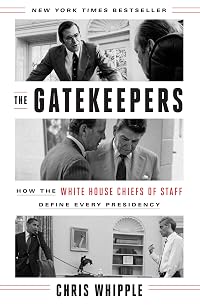
The Gatekeepers: How the White House Chiefs of Staff Define Every Presidency
by Chris Whipple
On This Page
Description
"The first in-depth, behind-the-scenes look at the White House Chiefs of Staff, whose actions--and inactions--have defined the course of our country What do Dick Cheney and Rahm Emanuel have in common? Aside from polarizing personalities, both served as chief of staff to the president of the United States--as did Donald Rumsfeld, Leon Panetta, and a relative handful of others. The chiefs of staff, often referred to as "the gatekeepers," wield tremendous power in Washington and beyond; they show more decide who is allowed to see the president, negotiate with Congress to push POTUS's agenda, and--most crucially--enjoy unparalleled access to the leader of the free world. Each chief can make or break an administration, and each president reveals himself by the chief he picks. Through extensive, intimate interviews with all seventeenliving chiefs and two former presidents, award-winning journalist and producer Chris Whipple pulls back the curtain on this unique fraternity. In doing so, he revises our understanding of presidential history, showing us how James Baker's expert managing of the White House, the press, and Capitol Hill paved the way for the Reagan Revolution--and, conversely, how Watergate, the Iraq War, and even the bungled Obamacare rollout mighthave been prevented by a more effective chief. Filled with shrewd analysis and never-before-reported details,The Gatekeepersoffers an essential portrait of the toughest job in Washington"-- show lessTags
Recommendations

























Member Reviews
This book is remarkable. Not only is it a very well researched look at the Chiefs of Staff from Nixon to Trump, but it is remarkably non-partisan. The author has interviewed both Democrats and Republicans and I think he treats them both incredibly fairly, giving them both credit and criticism where it is due. It is often difficult to really be able to judge successes and failures within the first few decades after events happen, but I think he does an excellent job of it. It's such an illuminating portrait, not just of what makes an effective Chief of Staff, but also of the inside of the last 10 administrations.
One of my favorite do-it-yourself therapies for the everyday grind is to put on my grungy clothes, plug in my headphones, and fire up the lawn mower. I mow, and I listen to a book, and then when I start to run out of grass, I find other yard work. On a good Saturday, I can crank through a novel or a history and get some yard work done, and it makes for a good Saturday.
As I listened to "The Gatekeepers: How the White House Chiefs of Staff Define Every Presidency" this last week, I couldn't help but wonder if it's a Saturday that almost no one in the book has ever experienced. The level of octane and devotion and time--the sheer amount of time--required to work in the White House in the modern presidency makes it difficult to believe that show more anyone there has any semblance of a life anything like most Americans (not to self: because I mow my lawn and do yard work, does that mean I'm like "most Americans? To be filed away and answered later). And the stakes? The stakes are the highest in the world, a veritable Game of Thrones, or House of Cards...minus the beheadings and murders.
Well, at least as far as anyone knows. (And yes, I know comparison to either of those tv dramas is more than a bit cliche.)
In any case, The Gatekeepers was a great read. Starting with the opening of the Nixon Administration and H.R. Haldeman and finishing with the Obama Administration's Rahm Emmanual, Bill Daley, Jack Lew, and Denis McDonough, Chris Whipple tells the story of each Administration through the lens of how that chief of staff addressed the problems each president faced. There are greats here, like the incomparable James Baker, as well as others who were either failures or just men out of their depth, like John Sununu, Donald Regan, or Bill Daley. Through their eyes you see war, domestic policy, and the internecine warfare of Washington politics.
It's a fascinating and enjoyable history, one I readily recommend. show less
As I listened to "The Gatekeepers: How the White House Chiefs of Staff Define Every Presidency" this last week, I couldn't help but wonder if it's a Saturday that almost no one in the book has ever experienced. The level of octane and devotion and time--the sheer amount of time--required to work in the White House in the modern presidency makes it difficult to believe that show more anyone there has any semblance of a life anything like most Americans (not to self: because I mow my lawn and do yard work, does that mean I'm like "most Americans? To be filed away and answered later). And the stakes? The stakes are the highest in the world, a veritable Game of Thrones, or House of Cards...minus the beheadings and murders.
Well, at least as far as anyone knows. (And yes, I know comparison to either of those tv dramas is more than a bit cliche.)
In any case, The Gatekeepers was a great read. Starting with the opening of the Nixon Administration and H.R. Haldeman and finishing with the Obama Administration's Rahm Emmanual, Bill Daley, Jack Lew, and Denis McDonough, Chris Whipple tells the story of each Administration through the lens of how that chief of staff addressed the problems each president faced. There are greats here, like the incomparable James Baker, as well as others who were either failures or just men out of their depth, like John Sununu, Donald Regan, or Bill Daley. Through their eyes you see war, domestic policy, and the internecine warfare of Washington politics.
It's a fascinating and enjoyable history, one I readily recommend. show less
More reviews at TheBibliophage.com.
As I was reading Chris Whipple’s book, The Gatekeepers, I couldn’t help but notice how much access he had to the group of 17 White House Chiefs of Staff since Nixon’s H.R. Haldeman. Then I learned that the book was the byproduct of a documentary series on Discovery. That explains a lot about the number of interviews Whipple was given by this large group of political insiders. However, it should only serve to make you more interested in reading the book, not less.
We spend so much time in history class discussing the accomplishments of various Presidents. But unless you’re a political wonk, you may not know much about the Chief of Staff, who’s essentially the Chief Operating Officer of the show more White House. The President is the visionary, and the Chief is the guy who takes the vision and translates it to action. And as we know from experience during the last eight-plus years, creating results from those actions isn’t easy or quick.
I think that’s what struck me the most from Whipple’s research and interviews. Being Chief of Staff is a massive amount of work. It’s truly 24/7/365. So much so that most Chiefs are only in that position for two years. The Chief needs to be political, and have connections all over Washington. It’s how things get accomplished. But some Presidents have chosen people from their home territory as their Chief. Whipple explains the pitfalls of such a choice.
The other thing Whipple makes clear is the relationship that Presidents have with their Chiefs. The Chief is the guy who’s willing to tell the President when something is a bad idea. Again, the interviewees shared the good, the bad, and the ugly. Reading the book felt like I had a side chair alongside the Oval Office’s iconic Resolute desk.
Whipple’s writing style is conversational and smooth. He takes one long chapter for each administration, starting with the transition period where one administration plans to replace the last. He finds just the right balance between details and overview, never getting lost in the minutiae. Somehow Whipple remains focused on the Chief’s perspective, which was unique and enlightening for me.
After reading The Gatekeepers, my appreciation for Chiefs of Staff (especially those holding the position for more than two years) has grown exponentially. This unelected and unconfirmed (by the Senate) position is held by men with tremendous power and responsibility. They are wranglers, negotiators, power brokers, and insomniacs. I highly recommend this captivating view into the corridors of the West Wing.
Thanks to NetGalley and Crown Publishing for the opportunity to read the digital ARC in exchange for this honest review. show less
As I was reading Chris Whipple’s book, The Gatekeepers, I couldn’t help but notice how much access he had to the group of 17 White House Chiefs of Staff since Nixon’s H.R. Haldeman. Then I learned that the book was the byproduct of a documentary series on Discovery. That explains a lot about the number of interviews Whipple was given by this large group of political insiders. However, it should only serve to make you more interested in reading the book, not less.
We spend so much time in history class discussing the accomplishments of various Presidents. But unless you’re a political wonk, you may not know much about the Chief of Staff, who’s essentially the Chief Operating Officer of the show more White House. The President is the visionary, and the Chief is the guy who takes the vision and translates it to action. And as we know from experience during the last eight-plus years, creating results from those actions isn’t easy or quick.
I think that’s what struck me the most from Whipple’s research and interviews. Being Chief of Staff is a massive amount of work. It’s truly 24/7/365. So much so that most Chiefs are only in that position for two years. The Chief needs to be political, and have connections all over Washington. It’s how things get accomplished. But some Presidents have chosen people from their home territory as their Chief. Whipple explains the pitfalls of such a choice.
The other thing Whipple makes clear is the relationship that Presidents have with their Chiefs. The Chief is the guy who’s willing to tell the President when something is a bad idea. Again, the interviewees shared the good, the bad, and the ugly. Reading the book felt like I had a side chair alongside the Oval Office’s iconic Resolute desk.
Whipple’s writing style is conversational and smooth. He takes one long chapter for each administration, starting with the transition period where one administration plans to replace the last. He finds just the right balance between details and overview, never getting lost in the minutiae. Somehow Whipple remains focused on the Chief’s perspective, which was unique and enlightening for me.
After reading The Gatekeepers, my appreciation for Chiefs of Staff (especially those holding the position for more than two years) has grown exponentially. This unelected and unconfirmed (by the Senate) position is held by men with tremendous power and responsibility. They are wranglers, negotiators, power brokers, and insomniacs. I highly recommend this captivating view into the corridors of the West Wing.
Thanks to NetGalley and Crown Publishing for the opportunity to read the digital ARC in exchange for this honest review. show less
I really enjoy nonfiction that reads like fiction -- and this one does. It was fascinating to see starkly different personalities approach the same job, and how no two chiefs operated in quite the same way. Adding to the appeal of the book for me was the explanation of how the individual characteristics of the presidents they served both guided and determined the success or failure of each chief. I will definitely be recommending this one.
 This review was written for LibraryThing Early Reviewers.
Summary: A study of the White House Chiefs of Staff, from the Nixon through Obama administrations, and how critical the effective execution of this role is to an effective presidency.
During the final weeks of the Bush (43) administration, an unprecedented meeting took place in the office of Josh Bolten, Bush's last Chief of Staff. Eleven of the thirteen living former Chiefs showed up (absent were James Baker and Erskine Bowles). People like Donald Rumsfeld, Dick Cheney, Leon Panetta, Howard Baker, and Andy Card came together with incoming Chief of Staff Rahm Emmanuel to share the benefit of their experience.
Chris Whipple uses the narrative of this meeting as a starting point of a study of the critical role the Chief of Staff plays that show more marks a Presidency as effective or not, as able to skirt dangerous pitfalls, or tumble into them. His description and quotes of Leon Panetta from this meeting captures the critical essence of the book's thesis:
"Leon Panetta was probably the most popular person in the room. The son of Italian immigrants, jovial and outgoing, he was equally at home on his walnut farm in Monterey, California, and in the corridors of the West Wing. But as Bill Clinton's second chief--replacing McLarty--Panetta had wielded an iron fist inside a velvet glove. When he arrived, Clinton's presidency was on the ropes, his ambitious agenda threatened by fights over gays in the military, the Whitewater scandal, and other distractions. The damage was self-inflicted, caused by Clinton's indiscipline and sloppy staff work. Panetta stepped in and brought discipline and focus to the White House--enabling Clinton to regain his traction and go on to win a second term. Now it was Panetta's turn to tutor Obama's incoming chief: 'Always, always be straight and honest with the president of the United States,' he said. 'Always tell him what he may not want to hear--because frankly, a lot of people in the White House will always tell the President what he wants to hear' " (p. 7).
Whipple paints a portrait of effective chiefs as those who combine candor, focus, organizational discipline, the confidence of their president, emotional intelligence, and a tireless work ethic. Too friendly with the president, and they often end up shielding him from essential truths that can bring down a presidency. Too indisciplined or administratively unskilled, and they squander the opportunities of leadership. Too harsh, and they alienate the people who they need to work with to enact a president's vision. Most of all, they are skillful gatekeepers, making sure those who need to see the president do, while protecting the president's energies and focus and time to think, and from powerful individuals who would unduly influence a president outside established executive branch processes.
The study begins with H.R. Haldeman, who in fact shaped the staff system that every effective chief has practiced. It was lapses in Haldeman's discipline, allowing Erhlichman and the plumbers free reign, as well as his unwillingness to tell Nixon the hard truth about Watergate at the start, that brought down his presidency. Strong staff leadership by Rumsfeld and Cheney enabled Ford to nearly defeat Jimmy Carter, despite the tarnish of Watergate and the Nixon pardon. Carter's decision to be his own chief of staff for the first years of his presidency, and the influence of Jordan and Powell that reinforced the indiscipline that resulted weakened his presidency. Only bringing in Jack Watson, the disciplined yet sociable ex-Marine, established some order, but too little, too late. James Baker was probably key to the presidency of Ronald Reagan, as well as recovery momentum in the later Bush (41) presidency. Baker brought all the skills discussed to provide a president inexperienced internationally with the counsel needed to shrewdly confront the Soviet threat. Later, Ken Duberstein was the chief who encouraged Reagan to retain the most famous words (against State Department advice) for which Reagan is remembered when he said at the Brandenburg Gate, "Mr Gorbachev, tear down this wall."
Mack McLarty was Clinton's first chief, and as a close friend of Clinton, presided over chaos, that was only reversed when he was replaced by Panetta. In the Bush (43) presidency, the likable Andy Card was no match for Bush's Vice President Dick Cheney. It was obvious that Bush didn't place the same confidence in him as in Cheney, which Whipple connects to the failures of in the decision to invade Iraq, over the reservations of Secretary of State Colin Powell, whose reputation was tarnished as victory gave way to chaos and a prolonged and costly occupation. Again, after Rahm Emmanuel left to run for mayor of Chicago, Bill Daly illustrated the pitfalls of a weak chief, in contrast to Denis McDonough, who helped Obama keep his political promises through executive order when faced with a recalcitrant Congress.
The book also underscores how critical it is that presidents choose strong chiefs they trust with the requisite skills and qualities of character. Whipple observes that this may be especially important with Donald Trump, as an outsider with limited political experience. It is an interesting question whether Reince Priebus enjoys the president's confidence and is able to exercise the gate-keeping and organizational disciplines necessary to an effective presidency. If Whipple is right, it seems to me that one of the most important lessons President Trump can learn is getting the right person in this position and then being willing to listen to that person.
Before reading Whipple's account, I thought of the Chief of Staff as just another member of the President's inner circle, but I hadn't reckoned with the importance of this position in the modern presidency where economic policy vies with natural disasters, human tragedies, and international drama on a daily basis. To execute vision, to maintain focus when faced with dozens of possible priorities, to keep "teams of rivals" in harness rather than going rogue, to be both the needed sounding board, and the honest voice are critical ingredients in helping presidents be effective. It also takes a rare blend of leadership and humility. As one of the chiefs remarked, the danger of the office is to emphasize the "chief" part (as Donald Regan did), rather than the "of staff" part. Whipple's book helps us appreciate this rare blend, and the figures who have served us well, or less well, in this role.
____________________________
Disclosure of Material Connection: I received this book free from the publisher through Blogging for Books. I was not required to write a positive review. The opinions I have expressed are my own. show less
During the final weeks of the Bush (43) administration, an unprecedented meeting took place in the office of Josh Bolten, Bush's last Chief of Staff. Eleven of the thirteen living former Chiefs showed up (absent were James Baker and Erskine Bowles). People like Donald Rumsfeld, Dick Cheney, Leon Panetta, Howard Baker, and Andy Card came together with incoming Chief of Staff Rahm Emmanuel to share the benefit of their experience.
Chris Whipple uses the narrative of this meeting as a starting point of a study of the critical role the Chief of Staff plays that show more marks a Presidency as effective or not, as able to skirt dangerous pitfalls, or tumble into them. His description and quotes of Leon Panetta from this meeting captures the critical essence of the book's thesis:
"Leon Panetta was probably the most popular person in the room. The son of Italian immigrants, jovial and outgoing, he was equally at home on his walnut farm in Monterey, California, and in the corridors of the West Wing. But as Bill Clinton's second chief--replacing McLarty--Panetta had wielded an iron fist inside a velvet glove. When he arrived, Clinton's presidency was on the ropes, his ambitious agenda threatened by fights over gays in the military, the Whitewater scandal, and other distractions. The damage was self-inflicted, caused by Clinton's indiscipline and sloppy staff work. Panetta stepped in and brought discipline and focus to the White House--enabling Clinton to regain his traction and go on to win a second term. Now it was Panetta's turn to tutor Obama's incoming chief: 'Always, always be straight and honest with the president of the United States,' he said. 'Always tell him what he may not want to hear--because frankly, a lot of people in the White House will always tell the President what he wants to hear' " (p. 7).
Whipple paints a portrait of effective chiefs as those who combine candor, focus, organizational discipline, the confidence of their president, emotional intelligence, and a tireless work ethic. Too friendly with the president, and they often end up shielding him from essential truths that can bring down a presidency. Too indisciplined or administratively unskilled, and they squander the opportunities of leadership. Too harsh, and they alienate the people who they need to work with to enact a president's vision. Most of all, they are skillful gatekeepers, making sure those who need to see the president do, while protecting the president's energies and focus and time to think, and from powerful individuals who would unduly influence a president outside established executive branch processes.
The study begins with H.R. Haldeman, who in fact shaped the staff system that every effective chief has practiced. It was lapses in Haldeman's discipline, allowing Erhlichman and the plumbers free reign, as well as his unwillingness to tell Nixon the hard truth about Watergate at the start, that brought down his presidency. Strong staff leadership by Rumsfeld and Cheney enabled Ford to nearly defeat Jimmy Carter, despite the tarnish of Watergate and the Nixon pardon. Carter's decision to be his own chief of staff for the first years of his presidency, and the influence of Jordan and Powell that reinforced the indiscipline that resulted weakened his presidency. Only bringing in Jack Watson, the disciplined yet sociable ex-Marine, established some order, but too little, too late. James Baker was probably key to the presidency of Ronald Reagan, as well as recovery momentum in the later Bush (41) presidency. Baker brought all the skills discussed to provide a president inexperienced internationally with the counsel needed to shrewdly confront the Soviet threat. Later, Ken Duberstein was the chief who encouraged Reagan to retain the most famous words (against State Department advice) for which Reagan is remembered when he said at the Brandenburg Gate, "Mr Gorbachev, tear down this wall."
Mack McLarty was Clinton's first chief, and as a close friend of Clinton, presided over chaos, that was only reversed when he was replaced by Panetta. In the Bush (43) presidency, the likable Andy Card was no match for Bush's Vice President Dick Cheney. It was obvious that Bush didn't place the same confidence in him as in Cheney, which Whipple connects to the failures of in the decision to invade Iraq, over the reservations of Secretary of State Colin Powell, whose reputation was tarnished as victory gave way to chaos and a prolonged and costly occupation. Again, after Rahm Emmanuel left to run for mayor of Chicago, Bill Daly illustrated the pitfalls of a weak chief, in contrast to Denis McDonough, who helped Obama keep his political promises through executive order when faced with a recalcitrant Congress.
The book also underscores how critical it is that presidents choose strong chiefs they trust with the requisite skills and qualities of character. Whipple observes that this may be especially important with Donald Trump, as an outsider with limited political experience. It is an interesting question whether Reince Priebus enjoys the president's confidence and is able to exercise the gate-keeping and organizational disciplines necessary to an effective presidency. If Whipple is right, it seems to me that one of the most important lessons President Trump can learn is getting the right person in this position and then being willing to listen to that person.
Before reading Whipple's account, I thought of the Chief of Staff as just another member of the President's inner circle, but I hadn't reckoned with the importance of this position in the modern presidency where economic policy vies with natural disasters, human tragedies, and international drama on a daily basis. To execute vision, to maintain focus when faced with dozens of possible priorities, to keep "teams of rivals" in harness rather than going rogue, to be both the needed sounding board, and the honest voice are critical ingredients in helping presidents be effective. It also takes a rare blend of leadership and humility. As one of the chiefs remarked, the danger of the office is to emphasize the "chief" part (as Donald Regan did), rather than the "of staff" part. Whipple's book helps us appreciate this rare blend, and the figures who have served us well, or less well, in this role.
____________________________
Disclosure of Material Connection: I received this book free from the publisher through Blogging for Books. I was not required to write a positive review. The opinions I have expressed are my own. show less
The White House chief of staff seems to be the MC of the political swamp. The Gatekeepers is a readable, entertaining look at what's been called " the worst job in politics." This book has a plethora of fascinating stories, mixed with heightened political intrigue and behind-the-scenes strategy. The human aspect to all of these individuals, often thought of as bland figureheads, Demi-gods, makes this an enlightening look at American political history. There's a great cast of egomaniacal men and intelligent ideologues in this book, some familiar, others not so much. This book is well researched and at times frightening, considering some of the characters pulling the strings in the shadows of the Oval Office. I would definitely recommend show more to anyone interested in politics, history, etc. show less
This review was written for LibraryThing Early Reviewers.I really enjoyed this book! I found it to be very short when you consider the subject matter. I feel like the author could've make the book twice as long and still be missing something. It merely touches on some of the big events that have shaped our country since Nixon.
Gatekeepers covers the Chiefs of Staff for the President from Nixon to Obama, each with his own chapter (the Reagan Era earned 2 mostly due to his first Chief of Staff, James Baker), highlighting a known but not too well known character in the story that is the American government. Some lasted a long time (5 1/2 years) some not quite a long time (I believe one lasted less than year). It is not an easy job, not even when the country isn't in crisis. Trying to help the man show more governing a country of 300 million is not an easy task as 300 million people will all try to tell you how you are doing it wrong.
Whipple shows how the chief of staff helped (or hurt) the president during major events that have happened over the last 50 years such as Watergate, 9/11, and various financial crises. Watching these events from the outside, it was eye opening to see how it worked from the inside.
The Chief of Staff is a position many American's know about, mainly due to the West Wing tv show, but that was just a show and I found it enthralling to learn the history of the position and how it changed with the man behind the title.
I found it easier to read once I got towards the end of the chapter on Bush and into the Clinton chapter as these were presidents I remember, events I remember. While I was alive during Reagan, I was barely 6 when he left the office. I'm not sure if that will be the case for everyone else but reading about things you remember sometimes provides you with a visual that really gets you into the work.
I highly recommend this book to anyone who wants to know more about how the executive branch functions, heck any branch of our government. I really feel like in the future, political science professors will be assigning this book to their students. It made me want to go out and read biographies on the various presidents discussed. show less
Gatekeepers covers the Chiefs of Staff for the President from Nixon to Obama, each with his own chapter (the Reagan Era earned 2 mostly due to his first Chief of Staff, James Baker), highlighting a known but not too well known character in the story that is the American government. Some lasted a long time (5 1/2 years) some not quite a long time (I believe one lasted less than year). It is not an easy job, not even when the country isn't in crisis. Trying to help the man show more governing a country of 300 million is not an easy task as 300 million people will all try to tell you how you are doing it wrong.
Whipple shows how the chief of staff helped (or hurt) the president during major events that have happened over the last 50 years such as Watergate, 9/11, and various financial crises. Watching these events from the outside, it was eye opening to see how it worked from the inside.
The Chief of Staff is a position many American's know about, mainly due to the West Wing tv show, but that was just a show and I found it enthralling to learn the history of the position and how it changed with the man behind the title.
I found it easier to read once I got towards the end of the chapter on Bush and into the Clinton chapter as these were presidents I remember, events I remember. While I was alive during Reagan, I was barely 6 when he left the office. I'm not sure if that will be the case for everyone else but reading about things you remember sometimes provides you with a visual that really gets you into the work.
I highly recommend this book to anyone who wants to know more about how the executive branch functions, heck any branch of our government. I really feel like in the future, political science professors will be assigning this book to their students. It made me want to go out and read biographies on the various presidents discussed. show less
Members
- Recently Added By
Author Information
5 Works 762 Members
Chris Whipple is a writer, documentary filmmaker, journalist, and speaker. He is a graduate of Yale University with a B.A. in History. He has been a producer for CBS's 60 Minutes and ABC's Primetime. He has won Multiple Peabody and Emmy Awards. He was the creator and executive producer for the ABC show What Would You Do. He was the writer and show more executive producer of The Spymasters: CIA in the Crosshairs, seen on Showtime. He is the chief executive officer of CCWHIP Productions. His book, The Gatekeepers: How the White House Chiefs of Staff Define Every Presidency, is a New York Times best seller. (Bowker Author Biography) show less
Awards and Honors
Distinctions
Common Knowledge
- Canonical title*
- The Gatekeepers : How the White House Chiefs of Staff Define Every Presidency
- Canonical DDC/MDS
- 973.920922
- Canonical LCC
- JK552.W55
*Some information comes from Common Knowledge in other languages. Click "Edit" for more information.
Classifications
- Genres
- General Nonfiction, History, Nonfiction, Politics and Government, Biography & Memoir
- DDC/MDS
- 973.920922 — History & geography History of North America United States 1901- Cold War, Vietnam War, Digital Age (1953-2001) Cold War, Vietnam War, Digital Age Biography
- LCC
- JK552 .W55 — Political Science Political institutions and public administration (United States) Political institutions and public administration United States Government. Public administration Executive branch
- BISAC
Statistics
- Members
- 543
- Popularity
- 54,575
- Reviews
- 35
- Rating
- (4.28)
- Languages
- English, Spanish
- Media
- Paper, Audiobook, Ebook
- ISBNs
- 11
- ASINs
- 2