
On This Page
Description
Mesklin is a vast, inhospitable, disc-shaped planet, so cold that its oceans are liquid methane and its snows are frozen ammonia. It is a world spinning dizzyingly, a world where gravity can be a crushing 700 times greater than Earth's, a world too hostile for human explorers. But the planet holds secrets of inestimable value, and an unmanned probe that has crashed close to one of its poles must be recovered. Only the Mesklinites, the small creatures so bizarrely adapted to their harsh show more environment, can help. And so Barlennan, the resourceful and courageous captain of the Mesklinite ship Bree, sets out on an heroic and appalling journey into the terrible unknown. For him and his people, the prize to be gained is as great as that for mankind... Hal Clement's Mission of Gravity is universally regarded as one of the most important and best loved novels in the genre. The remarkable and sympathetic depiction of an alien species and the plausible and scientifically based realization of the strange world they inhabit make it a major landmark in the history of hard sf. show lessTags
Recommendations



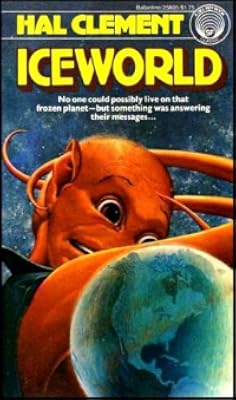

















Member Recommendations
Member Reviews
King Solomon's Mines in Space
Mission of Gravity is a sf classic because of its compelling world building: an extremely fast-spinning planet with a gravity 700 times that of earth at its poles. It is marred however by totally unconvincing inhabitants. The Mesklinites encountered by the "Earthmen"--back in 1953, the idea of female scientists or astronauts apparently was inconceivable even for a science fiction author--speak better English than most native speakers on earth, and they behave and think like humans. Also their civilization is entirely human even though they are caterpillars. With a captain and first mate, even the command structure of the raft Bree is that of a western European/American ship. Convincing alien life is also show more part of compelling world building and the novel entirely fails in that respect. Nothing on Mesklin feels really alien.
An even bigger problem is the absence of any conflict to drive the story. The leading earthman, Lackland, and leading Mesklinite, Barlennan (yes, the aliens have human names, too), interact so awfully friendly and harmoniously that it becomes boring from very early on. In the beginning there is a hint that Barlennan has a hidden agenda; but in the end that turns out to be nothing bad really. Also, the title's second meaning of "something of great importance" doesn't come into its own: the information gathered about the planet by the lost probe that the Mesklinites have to recover is no doubt scientifically interesting but not really a matter of life and death.
One could also mention the colonialist subtext of the novel. The Mesklinite explorers and their superior Terran mentors behave like European explorers in "Dark Africa". They hunt big game, are attacked by primitive natives and trade peacefully with friendly primitives, making maps along the way to make the unknown territory controllable. But I guess all that was only normal in the 1950s western view of the world. show less
Mission of Gravity is a sf classic because of its compelling world building: an extremely fast-spinning planet with a gravity 700 times that of earth at its poles. It is marred however by totally unconvincing inhabitants. The Mesklinites encountered by the "Earthmen"--back in 1953, the idea of female scientists or astronauts apparently was inconceivable even for a science fiction author--speak better English than most native speakers on earth, and they behave and think like humans. Also their civilization is entirely human even though they are caterpillars. With a captain and first mate, even the command structure of the raft Bree is that of a western European/American ship. Convincing alien life is also show more part of compelling world building and the novel entirely fails in that respect. Nothing on Mesklin feels really alien.
An even bigger problem is the absence of any conflict to drive the story. The leading earthman, Lackland, and leading Mesklinite, Barlennan (yes, the aliens have human names, too), interact so awfully friendly and harmoniously that it becomes boring from very early on. In the beginning there is a hint that Barlennan has a hidden agenda; but in the end that turns out to be nothing bad really. Also, the title's second meaning of "something of great importance" doesn't come into its own: the information gathered about the planet by the lost probe that the Mesklinites have to recover is no doubt scientifically interesting but not really a matter of life and death.
One could also mention the colonialist subtext of the novel. The Mesklinite explorers and their superior Terran mentors behave like European explorers in "Dark Africa". They hunt big game, are attacked by primitive natives and trade peacefully with friendly primitives, making maps along the way to make the unknown territory controllable. But I guess all that was only normal in the 1950s western view of the world. show less
This book surely must be the record-holder for having the most endearing arthropodic character in fiction and possibly for weirdest planet in fiction! Of course the two are connected; if a planet has a surface gravitational pull never less than three times that of Earth and varying up to 700x that of Earth, intelligent life isn't going to look just like a human with maybe a weird looking forehead or nose.
Clement has very carefully worked out what the consequences of his rapidly spinning, exceedingly cold planet are and built a jolly adventure story round them, with a somewhat piratical, canny, mischievous explorer-trader as the protagonist asked to rescue the science probe visiting humans have lost and are unable to rescue show more themselves.
Long considered a genre classic and deservingly so. show less
Clement has very carefully worked out what the consequences of his rapidly spinning, exceedingly cold planet are and built a jolly adventure story round them, with a somewhat piratical, canny, mischievous explorer-trader as the protagonist asked to rescue the science probe visiting humans have lost and are unable to rescue show more themselves.
Long considered a genre classic and deservingly so. show less
Mission of Gravity is, I believe, the granddaddy of hard science fiction. It is often mentioned when discussions of hard sf come up. For some reason the label hard sf usually lead me to expect serious moody novels. For no good reason I tend to equate serious science with serious stories, imagine my surprise when Mission of Gravity turns out to be something of a romp, a good one too. Another point worth mentioning is that while the book was first published in 1953 it still holds up well today because the real world science Clement employs is still valid today.
The main attraction of the book for hard sf fans is probably the world building. The planet Mesklin is an “oblate spheroid” in shape resulting in different gravity levels from show more the poles to equator. The minimum gravity there is still three times that of earth (3g) and the max is all of 700g. The native intelligent race of this planet, the “Mesklinites”, is consequently centipede like in shape to stay close to the ground where a small drop of a foot in a high gravity area can be fatal. Building on this great scenario Hal Clement creates a culture where the concept of flying and throwing is unheard of and all the natives are afraid of height. The science makes all these details very plausible without sacrificing the sense of wonder, enhancing it even.
Another great gimmick of this novel is that the narrative is mostly told from an alien point of view, one specific alien protagonist named Barlennan. A rather roguish, cunning, and likable captain of a raft called The Bree.
character. The Mesklinites remind me a little of the primitive aliens in Le Guin’s [b:The Word for World Is Forest|276767|The Word for World is Forest|Ursula K. Le Guin|https://d202m5krfqbpi5.cloudfront.net/books/1283091038s/276767.jpg|3256815] and [b:Little Fuzzy|1440148|Little Fuzzy (Fuzzy Sapiens, #1)|H. Beam Piper|https://d202m5krfqbpi5.cloudfront.net/books/1348972417s/1440148.jpg|1876891] by H. Beam Piper. Fortunately they are gifted linguists and adaptable to new concepts and experiences so they are able to work with and learn from the humans. I really love this kind of good natured sf story where species learn to work together for mutual benefits. Stories where hideous aliens are blasted to smithereens by super weapons are fun but a change is as good as a rest.
The plot mainly concerns a mission to retrieve a stranded manmade rocket containing valuable information which accidentally landed on one of the planet’s poles. Barlennan and his crew undertake to retrieve this rocket in exchange for knowledge for the advancement of their people. A lot of exploration and adventure ensues and while the ending is not exactly unpredictable I find it quite pleasing.
Mission of Gravity is a short novel of less than 200 pages in length. The book by itself is out of print but as part of the [b:Heavy Planet The Classic Mesklin Stories|939762|Heavy Planet The Classic Mesklin Stories|Hal Clement|https://d202m5krfqbpi5.cloudfront.net/books/1312045901s/939762.jpg|924737] omnibus volume which contains a sequel called Star Light, some short stories and an essay; all for the price of one book. An offer you can’t refuse I think. I’m looking forward to reading the rest of the volume soon. Great fun and educational, what’s not to like? show less
The main attraction of the book for hard sf fans is probably the world building. The planet Mesklin is an “oblate spheroid” in shape resulting in different gravity levels from show more the poles to equator. The minimum gravity there is still three times that of earth (3g) and the max is all of 700g. The native intelligent race of this planet, the “Mesklinites”, is consequently centipede like in shape to stay close to the ground where a small drop of a foot in a high gravity area can be fatal. Building on this great scenario Hal Clement creates a culture where the concept of flying and throwing is unheard of and all the natives are afraid of height. The science makes all these details very plausible without sacrificing the sense of wonder, enhancing it even.
Another great gimmick of this novel is that the narrative is mostly told from an alien point of view, one specific alien protagonist named Barlennan. A rather roguish, cunning, and likable captain of a raft called The Bree.
character. The Mesklinites remind me a little of the primitive aliens in Le Guin’s [b:The Word for World Is Forest|276767|The Word for World is Forest|Ursula K. Le Guin|https://d202m5krfqbpi5.cloudfront.net/books/1283091038s/276767.jpg|3256815] and [b:Little Fuzzy|1440148|Little Fuzzy (Fuzzy Sapiens, #1)|H. Beam Piper|https://d202m5krfqbpi5.cloudfront.net/books/1348972417s/1440148.jpg|1876891] by H. Beam Piper. Fortunately they are gifted linguists and adaptable to new concepts and experiences so they are able to work with and learn from the humans. I really love this kind of good natured sf story where species learn to work together for mutual benefits. Stories where hideous aliens are blasted to smithereens by super weapons are fun but a change is as good as a rest.
The plot mainly concerns a mission to retrieve a stranded manmade rocket containing valuable information which accidentally landed on one of the planet’s poles. Barlennan and his crew undertake to retrieve this rocket in exchange for knowledge for the advancement of their people. A lot of exploration and adventure ensues and while the ending is not exactly unpredictable I find it quite pleasing.
Mission of Gravity is a short novel of less than 200 pages in length. The book by itself is out of print but as part of the [b:Heavy Planet The Classic Mesklin Stories|939762|Heavy Planet The Classic Mesklin Stories|Hal Clement|https://d202m5krfqbpi5.cloudfront.net/books/1312045901s/939762.jpg|924737] omnibus volume which contains a sequel called Star Light, some short stories and an essay; all for the price of one book. An offer you can’t refuse I think. I’m looking forward to reading the rest of the volume soon. Great fun and educational, what’s not to like? show less
This was a feast and a treat for my inner science nerd. Scientists from earth have sent an enormously expensive probe to gather unique data from near the pole of a tremendously high gravity planet. They have high hopes that this data will help them solve a number of thorny scientific problems and provide the next great leap forward in technological advancement. Unfortunately, the probe has malfunctioned, and although they know it completed the data gather, and can see that its there, and intact, its not coming back. No one can go repair it or collect the data from it because humans can only survive at the equator of this planet. When they travel into the higher latitudes the gravity is too much for them and anyone who tried to travel to show more the pole would implode before he got there.
Fortunately, the higher latitudes are inhabited. By intelligent foot and a half long lobster/caterpiller creatures who are adapted to the high gravity and perfectly capable of retrieving the probe. If they can be persuaded to travel the thousands of miles over unknown territory through hurricanes and floods and encounter previously undiscovered beasts and civilizations. Luckily the Earthers manage to find a flotilla of traders with a strong sense of adventure who are willing to take on the mad task.
The rest of the book is the joint exploration and trade mission of the lobster creatures, with much advice and kibbitzing from the scientist liason assigned to work with them via radio. A lot of very geeky fun can be had reading the attempts of the two species to understand one another and strategize as the creatures travel along the route to the probe. I found the creatures to be charming, and the ways both parties had to work through mutual incomprehension due to the very different physical laws of their two worlds was often very funny in a geeky sort of a way. I also loved the goodwill with which these very different creatures tried to work together and understand each other.
This is a very specific kind of book however. If you are not a person who likes trying to understand how a radio works, or why light bends or how having methane seas would affect buoyancy, this may not be for you. For me, it was great fun. show less
Fortunately, the higher latitudes are inhabited. By intelligent foot and a half long lobster/caterpiller creatures who are adapted to the high gravity and perfectly capable of retrieving the probe. If they can be persuaded to travel the thousands of miles over unknown territory through hurricanes and floods and encounter previously undiscovered beasts and civilizations. Luckily the Earthers manage to find a flotilla of traders with a strong sense of adventure who are willing to take on the mad task.
The rest of the book is the joint exploration and trade mission of the lobster creatures, with much advice and kibbitzing from the scientist liason assigned to work with them via radio. A lot of very geeky fun can be had reading the attempts of the two species to understand one another and strategize as the creatures travel along the route to the probe. I found the creatures to be charming, and the ways both parties had to work through mutual incomprehension due to the very different physical laws of their two worlds was often very funny in a geeky sort of a way. I also loved the goodwill with which these very different creatures tried to work together and understand each other.
This is a very specific kind of book however. If you are not a person who likes trying to understand how a radio works, or why light bends or how having methane seas would affect buoyancy, this may not be for you. For me, it was great fun. show less
This is quintessential 1950s geek science fiction: it's a story—but, really, the story exists to provide a vehicle for the science. Evidently, Clement liked challenges along the lines of "such-and-such couldn't exist." In this particular case, he tackled the premise that there was plenty of science fiction about low gravity planets and even more science fiction about high gravity planets…but everyone agreed you couldn't have a planet that was both, right?
Enter Mesklin, a world that is several times more massive than Earth but spins so quickly that its day is only 18 minutes long and its shape is a severely flattened ball. The result is hundreds of gravities at the poles and only three gravities at the equator. Its inhabitants can show more survive in the polar regions and feel like there is almost no gravity as they move toward Rim: high and low gravity in the same planet. Humans have lost an exploration probe on the planet and, since they cannot survive on most of it, they form an alliance with the natives to perform a salvage operation.
It's fun to watch Clement both explain and explore the physics, which he does in easily digested terminology. It's even more fun to watch him explore the psychological aspects of the inhabitants. Severe acrophobia and a pathological dread of having anything solid above them are just two of the characteristics that make total sense given the world but are difficult for humans to remember.
However, typical of this particular era, the book will seem a little flat by today's standards. There's little excitement or drama, and the movement toward social science fiction is still a decade away.
It's fun. It's certainly interesting from the perspective of seeing the development of science fiction. I think it's worth reading if you're a fan of the genre. However, I doubt it would make a Top Ten Entertaining SF Books of All Time list. show less
Enter Mesklin, a world that is several times more massive than Earth but spins so quickly that its day is only 18 minutes long and its shape is a severely flattened ball. The result is hundreds of gravities at the poles and only three gravities at the equator. Its inhabitants can show more survive in the polar regions and feel like there is almost no gravity as they move toward Rim: high and low gravity in the same planet. Humans have lost an exploration probe on the planet and, since they cannot survive on most of it, they form an alliance with the natives to perform a salvage operation.
It's fun to watch Clement both explain and explore the physics, which he does in easily digested terminology. It's even more fun to watch him explore the psychological aspects of the inhabitants. Severe acrophobia and a pathological dread of having anything solid above them are just two of the characteristics that make total sense given the world but are difficult for humans to remember.
However, typical of this particular era, the book will seem a little flat by today's standards. There's little excitement or drama, and the movement toward social science fiction is still a decade away.
It's fun. It's certainly interesting from the perspective of seeing the development of science fiction. I think it's worth reading if you're a fan of the genre. However, I doubt it would make a Top Ten Entertaining SF Books of All Time list. show less
A decent enough hard SF novel which I can understand why it is so popular and influential on writers and scientists. The concept is excellent - even if it could have been fleshed out a bit more coherently in places - and provides some intriguing problem solving for the adventurers to have to overcome.
In fact this is perhaps more of an adventure/exploration sci fi story than anything else as the natives chart through unknown areas to find a rocket their new human friends have lost in the polar regions where gravity is 700 times that of Earth and are consequently unable to retrieve themselves. Most of the science of the planet is quite subtly communicated which I appreciated despite it reducing the level of awe, albeit when Clement did show more get descriptive, that's when it got muddled and contradictory and showed some of his weaknesses as a writer.
Despite these misgivings about his writing, his strength lies in pairing Earth people with imaginatively created, yet believable alien races that have great differences in biology and homeworlds with unusual chemistry and physics. He does this to great effect in Iceworld, even though that also suffered from weak storytelling. There is a strong point about the Meskinites (like all Clement's creations) having too human a personality and motivations, but it does prevent the narrative getting too bogged down. Mission of Gravity was originally serialised, so any further complexity beyond the science would have made it too slow for that format. It's also hard to not root for Barlemann and his crew who show real invention, quick thinking and courage in their mission.
Overall I enjoyed enough of it to overcome some of the more annoying flaws and am keen to continue with his essays and sequels. It's an easy book to recommend if you like hard SF. just keep in mind that although it is plausible and well researched for its time, it has dated - just not to any real detriment in my mind. show less
In fact this is perhaps more of an adventure/exploration sci fi story than anything else as the natives chart through unknown areas to find a rocket their new human friends have lost in the polar regions where gravity is 700 times that of Earth and are consequently unable to retrieve themselves. Most of the science of the planet is quite subtly communicated which I appreciated despite it reducing the level of awe, albeit when Clement did show more get descriptive, that's when it got muddled and contradictory and showed some of his weaknesses as a writer.
Despite these misgivings about his writing, his strength lies in pairing Earth people with imaginatively created, yet believable alien races that have great differences in biology and homeworlds with unusual chemistry and physics. He does this to great effect in Iceworld, even though that also suffered from weak storytelling. There is a strong point about the Meskinites (like all Clement's creations) having too human a personality and motivations, but it does prevent the narrative getting too bogged down. Mission of Gravity was originally serialised, so any further complexity beyond the science would have made it too slow for that format. It's also hard to not root for Barlemann and his crew who show real invention, quick thinking and courage in their mission.
Overall I enjoyed enough of it to overcome some of the more annoying flaws and am keen to continue with his essays and sequels. It's an easy book to recommend if you like hard SF. just keep in mind that although it is plausible and well researched for its time, it has dated - just not to any real detriment in my mind. show less
I've had an itch to read some classic science fiction. Reading old SF novels can be a little hit or miss. Sometimes I choose a random oldie, but I chose this one expecting it to be a hit (it has an excellent reputation) and got a hit. This novel is as old as me, and seems to have held up better. Hal Clement was an author who I didn't read when I was younger. No particular reason, but I was certainly aware of him. I really enjoyed his novel Cycle of Fire that I read a few years ago. On the strength of this one I'll be reading more.
This is hard science fiction in the sense of the subject, but I found the story very readable. It gets a little engineering heavy in spots, but never too much, and the world building of life on an unusual show more methane planet with hugely different gravities across the surface, and the interaction between humans and the little intelligent centipede-like critters who live on this heavy planet just had me very interested. I was never the least bit bored reading this. Earthmen have limitations on the planet and they need to recover an expensive probe from an area they cannot go. Thus they recruit some locals for the adventure. We are repeatedly made aware that the very helpful locals have something else on the agenda. I really came to like the native sea trading captain who was enlisted by humans for the adventure.
The writing is a little clunky here and there and a bit of that I might attribute to style 60 years ago. Still, this gets a high rating by me for classics in the genre. show less
This is hard science fiction in the sense of the subject, but I found the story very readable. It gets a little engineering heavy in spots, but never too much, and the world building of life on an unusual show more methane planet with hugely different gravities across the surface, and the interaction between humans and the little intelligent centipede-like critters who live on this heavy planet just had me very interested. I was never the least bit bored reading this. Earthmen have limitations on the planet and they need to recover an expensive probe from an area they cannot go. Thus they recruit some locals for the adventure. We are repeatedly made aware that the very helpful locals have something else on the agenda. I really came to like the native sea trading captain who was enlisted by humans for the adventure.
The writing is a little clunky here and there and a bit of that I might attribute to style 60 years ago. Still, this gets a high rating by me for classics in the genre. show less
Members
- Recently Added By
Lists

Best Science Fiction Novels
816 works; 430 members

S.F. Masterworks (Complete)
229 works; 15 members

David Pringle's Science Fiction: The 100 Best Novels
101 works; 9 members

SF Masterworks
193 works; 8 members

Want to Read — open list
55 works; 2 members

Books Read in 2022
5,168 works; 114 members

AbeBooks: 50 essential science fiction books
50 works; 6 members
Favorite Science Fiction
456 works; 218 members
Author Information

97+ Works 6,388 Members
Some Editions
Awards and Honors
Awards
Distinctions
Notable Lists
Series

Belongs to Publisher Series
Work Relationships
Common Knowledge
- Canonical title
- Mission of Gravity
- Original title
- Mission of Gravity
- Alternate titles*
- Schwerkraft
- Original publication date
- 1953 (serial) (serial); 1954 (book) (book)
- People/Characters
- Barlennan; Dondragmer; Lackland
- Important places
- Mesklin; Bree (a ship)
- First words
- The wind came across the bay like something living.
- Last words
- (Click to show. Warning: May contain spoilers.)Gently, her forty-foot sphere of fabric bulging with hot air, the new Bree lifted from the plateau and drifted riverward on the light breeze.
- Blurbers
- Disch, Thomas M.
- Original language
- English
*Some information comes from Common Knowledge in other languages. Click "Edit" for more information.
Classifications
Statistics
- Members
- 1,585
- Popularity
- 14,369
- Reviews
- 34
- Rating
- (3.78)
- Languages
- 13 — Dutch, English, Finnish, French, German, Hebrew, Hungarian, Italian, Polish, Russian, Spanish, Swedish, Turkish
- Media
- Paper, Ebook
- ISBNs
- 28
- ASINs
- 44