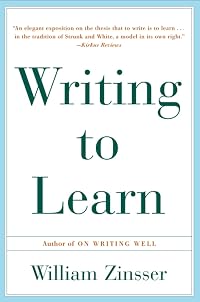
Writing to Learn
by William Zinsser
On This Page
Description
This is an essential book for everyone who wants to write clearly about any subject and use writing as a means of learning.Tags
Recommendations








Member Reviews
While alive, Zinsser was our era’s guru on writing. Besides bestselling On Writing Well, he left us with a cadre of lesser-known works on how to communicate effectively. This work chronicles how to write educational pieces and is replete with examples from a variety of fields, ranging from music to geology and from physics to art.
Zinsser’s authority is relatively unquestioned in the popular sphere. I do question whether his writing principles are indeed universal, especially when it comes to worlds like poetry and religion in which ambiguity is sometimes part and parcel of the game. Nonetheless, for mainstream communication, it doesn’t get any better than Zinsser.
This work functions as a cross between a general communications show more guide and an anthology of examples of general communications. Kudos are granted for exploring difficult academic subjects (like science, music, and art) that many claim to be exempt from rules of good writing. In the examples, he illustrates how effective writing can advance the technical nature of a field and still empathetically engage a reader.
This work has its limitations. It is less of a how-to an more of an inspirational guide. There are ample resources available on how to write for specialized audiences (like science). This work is not one of them. Rather, it is the diligent and careful work of a generalist teaching others how to write for general audiences. He admits his personal shortcomings, especially when it comes to science, but demonstrates how joy can be found in reading about these subjects – even for those who didn’t “get it” in school. As such, this work is a fun read for generalists like myself who like dabbling in good works from other fields. show less
Zinsser’s authority is relatively unquestioned in the popular sphere. I do question whether his writing principles are indeed universal, especially when it comes to worlds like poetry and religion in which ambiguity is sometimes part and parcel of the game. Nonetheless, for mainstream communication, it doesn’t get any better than Zinsser.
This work functions as a cross between a general communications show more guide and an anthology of examples of general communications. Kudos are granted for exploring difficult academic subjects (like science, music, and art) that many claim to be exempt from rules of good writing. In the examples, he illustrates how effective writing can advance the technical nature of a field and still empathetically engage a reader.
This work has its limitations. It is less of a how-to an more of an inspirational guide. There are ample resources available on how to write for specialized audiences (like science). This work is not one of them. Rather, it is the diligent and careful work of a generalist teaching others how to write for general audiences. He admits his personal shortcomings, especially when it comes to science, but demonstrates how joy can be found in reading about these subjects – even for those who didn’t “get it” in school. As such, this work is a fun read for generalists like myself who like dabbling in good works from other fields. show less
'Writing to Learn' was precisely the book I needed to read at precisely this time. It is another classic by the scholarly-yet-approachable William Zinsser that both motivates and instructs. I feel two things right now: a pressing and urgent need to write about anything and everything, and a great desire to go out and teach good composition to anyone who will listen. Thank you, Mr Zinsser.
Zinsser's book is both an anthology and a narrative about his experience with the concept of "writing across the curriculum." He recounts how good writing in other fields helped break down his misconception that certain subjects were, at best boring, or at worst, unlearnable. He posits that writing is the best way for students to engage with material--any material.
Through carefully selected reading examples and personal examples, Zinsser engages with the natural world, art, physics, music, chemistry, mathematics, anthropology, etc...the world of learning becomes limitless and accessible. Zinsser defines three "R"s for writing: No matter the subject, good writing will have Resonance, Relevancy and Responsibility (Accountability).
Through carefully selected reading examples and personal examples, Zinsser engages with the natural world, art, physics, music, chemistry, mathematics, anthropology, etc...the world of learning becomes limitless and accessible. Zinsser defines three "R"s for writing: No matter the subject, good writing will have Resonance, Relevancy and Responsibility (Accountability).
I thought I would like this more.
The book opens brilliantly. But the carry through suffers.
The permiss is utterly important. That it is important to write about a range of topics and fields. And I'm taking that idea with me, as a new personal learning project.
I just wish this book did it better.
The book opens brilliantly. But the carry through suffers.
The permiss is utterly important. That it is important to write about a range of topics and fields. And I'm taking that idea with me, as a new personal learning project.
I just wish this book did it better.
TLDR: I was already convinced of the main points, writing is thinking, writing is for everyone, we should teach writing, before borrowing this book from the library. I wanted some more reflection on the process of writing as thinking. My engineering conditioning prevents me from spending the time pouring through all of the anecdotes to get the nuggets that might be generalizable. I can find them in other books, like Write to Learn by Donald M. Murray. There are a couple chapters I will photocopy/take notes from.
I'm still left with the question: What constitutes as writing?
I'm still left with the question: What constitutes as writing?
Great writing about writing. Very engaging book and helped me clear my thoughts about good writing and how to achieve it in everyday life and work.
I do not recommend this book. The book focuses on well-written passages that the author comments on instead of the Title concept. At the end of part 1, page 72, he tells us that he will only demonstrate writing as a method in chapters 9 and 11. Chapter 9 was the best attempt at this, and Chapter 11 fell short. It would have been better if he had titled it differently, but his book does not follow his title.
Members
- Recently Added By
Lists

Best Books on Writing for Writers
36 works; 19 members

Books Read in 2024
4,623 works; 126 members
Author Information

34+ Works 10,826 Members
William Knowlton Zinsser (October 7, 1922 - May 12, 2015) was an American writer, editor, literary critic, and teacher. He began his career as a journalist for the New York Herald Tribune, where he worked as a feature writer, drama editor, film critic and editorial writer. Throughout the 1970s, Zinsser taught writing at Yale University. He wrote show more 18 books, including On Writing Well, which is in its 17th edition. Zinsser died at the age of 92 in Manhattan on May 12, 2015. (Bowker Author Biography) show less
Common Knowledge
- Canonical title
- Writing to Learn
- First words
- Preface I wrote this book to try to ease two fears that American education seems to inflict on all of us in some form.
(Chapter 1) As a boy I spent four years at a boarding school in Massachusetts called Deerfield Academy that had two legends attached to it.
Classifications
Statistics
- Members
- 1,064
- Popularity
- 23,965
- Reviews
- 8
- Rating
- (3.78)
- Languages
- English
- Media
- Paper, Audiobook, Ebook
- ISBNs
- 6
- ASINs
- 7