On This Page
Description
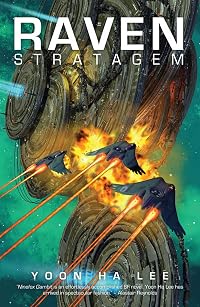
Fiction. Science Fiction. When the hexarchate's gifted young captain Kel Cheris summoned the ghost of the long-dead General Shuos Jedao to help her put down a rebellion, she didn't reckon on his breaking free of centuries of imprisonment - and possessing her. Even worse, the enemy Hafn are invading, and Jedao takes over General Kel Khiruev's fleet, which was tasked with stopping them. Only one of Khiruev's subordinates, Lieutenant Colonel Kel Brezan, seems to be able to resist the influence show more of the brilliant but psychotic Jedao. Jedao claims to be interested in defending the hexarchate, but can Khiruev or Brezan trust him? For that matter, will the hexarchate's masters wipe out the entire fleet to destroy the rogue general? show lessTags
Recommendations












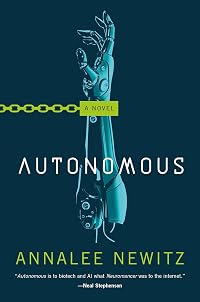
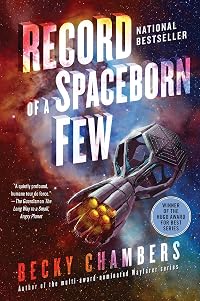
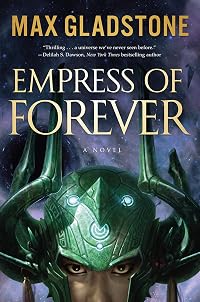
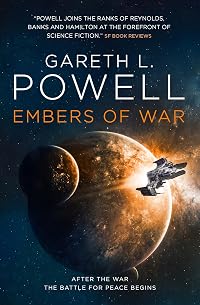




Member Recommendations

g33kgrrl Complex worlds, political machinations, and cutting edge sci-fi. This is the evolution of sci-fi and space opera.
20
Member Reviews
I completely bounced off Ninefox Gambit, the book to which this is a sequel, and picked it up with a feeling of undertaking a dreaded duty when it was revealed as a finalist for the 2018 Hugo Awards. Well, I don't know if it was me or the book, but as I read it, I found myself enjoying it more and more, and then once a nice twist came along around the two-thirds mark, I was definitely on board. Raven Stratagem picks up only loosely from the end of Ninefox Gambit: basically the dead genocidal general Shuos Jedao has taken over the body of naval captain Kel Charis, and outside of "them," no other characters recur between the two books. (As far as I noticed anyway; my memories of Ninefox are a little vague.) Jedao is never a viewpoint show more character; the focal characters of Raven are the general of the fleet Jedao takes over, a personnel officer from that fleet who defies his takeover, and the leader of the Shuos faction.
Whereas I felt Ninefox focused on space combat that might as well be magic, Raven focuses much more on character and politics. I especially really liked Kel Brezan, the personnel officer. The Kel, the military faction of the hexarchate, are all ingrained with "formation instinct," which causes them to obey any order given. But Brezan is a "crashhawk," a Kel whose formation instinct is very weak. So on the one hand, he can defy the unlawful orders of Jedao, but on the other hand, in doing so, he reveals himself as a failure of a Kel. Dutiful and loyal, but self-deprecating for not being dutiful and loyal enough: that's my kind of character. The flashbacks peppered throughout to the various characters' training are especially interesting, as they reveal both personality and the rules and customs of the six factions of the hexarchate.
There are two things I wish for more of: I like the idea that belief in an exotic math system allows you to use it to devastating effect (shades of Christopher H. Bidmead's block transfer computation there), but why belief in a math system is dependent on using a particular calendar remains frustratingly obscure. Though maybe spelling it out would be even less convincing! And also once the twist comes two-thirds of the way in, things proceed a little too perfunctorily; the ending wasn't quite climactic enough to live up to the twist. But still, I enjoyed it.
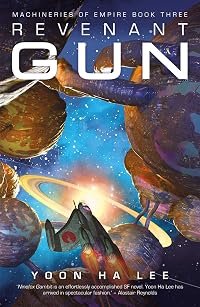
If you didn't like Ninefox Gambit, I recommend still giving Raven Stratagem a try. I don't know if Raven is actually better than Ninefox, or if I just acclimated to the world more. Or if maybe reading Ninefox near the end of my 2017 Hugos reading just meant I was burnt out by the time I got to it. I'd be curious to reread Ninefox now in any case, but I will also be ordering Revenant Gun to finish off the Machineries of Empire trilogy. show less
Whereas I felt Ninefox focused on space combat that might as well be magic, Raven focuses much more on character and politics. I especially really liked Kel Brezan, the personnel officer. The Kel, the military faction of the hexarchate, are all ingrained with "formation instinct," which causes them to obey any order given. But Brezan is a "crashhawk," a Kel whose formation instinct is very weak. So on the one hand, he can defy the unlawful orders of Jedao, but on the other hand, in doing so, he reveals himself as a failure of a Kel. Dutiful and loyal, but self-deprecating for not being dutiful and loyal enough: that's my kind of character. The flashbacks peppered throughout to the various characters' training are especially interesting, as they reveal both personality and the rules and customs of the six factions of the hexarchate.
There are two things I wish for more of: I like the idea that belief in an exotic math system allows you to use it to devastating effect (shades of Christopher H. Bidmead's block transfer computation there), but why belief in a math system is dependent on using a particular calendar remains frustratingly obscure. Though maybe spelling it out would be even less convincing! And also once the twist comes two-thirds of the way in, things proceed a little too perfunctorily; the ending wasn't quite climactic enough to live up to the twist. But still, I enjoyed it.
If you didn't like Ninefox Gambit, I recommend still giving Raven Stratagem a try. I don't know if Raven is actually better than Ninefox, or if I just acclimated to the world more. Or if maybe reading Ninefox near the end of my 2017 Hugos reading just meant I was burnt out by the time I got to it. I'd be curious to reread Ninefox now in any case, but I will also be ordering Revenant Gun to finish off the Machineries of Empire trilogy. show less
Rereading this series was the right decision, I’m so glad. Just like during my first read, I enjoyed the second book of The Machineries of Empire much more than the first. There are more memorable characters, the plotting is tighter, and the intrigues abound. It also helps that the reader is more familiar with this universe ;), and the world building is done more seamlessly. Thanks to the latter, you appreciate the details. I’ve been in other book universes with cool spaceships’ names, but Yoon Ha Lee’s should have one of the top spots: Hierarchy of Feasts, Beneath the Orchid… Also, how about space battle formations called Knives Are Our Walls or Mountains Never Whisper? Awesome!
Chapter one lands you right in the middle of the show more action. I like Brezan’s voice and his story arc is quite fascinating (I had also forgotten nearly all of it). Serving the hexarchate is not a great choice to make; yet I could understand Brezan’s reasoning:
“...it was that the hexarchate was a terrible place to live, but it would be an even worse one if no one with a conscience consented to serve it.”
You cannot help but love watching Cheris/Jedao being badass. There are so many great conversations with a twist in this book (not to mention space battles!). General Khiruev’s storyline was also something I managed to forget. How could I? It’s heartbreaking!
I find that I’m fond of Mikodez – meaning that when you are exploring a vipers’ nest you might say “they are all scary, but *that* scary viper is more interesting to watch.” So I need to put in some Mikodez quotes, obviously:
“I don’t object to atrocities because of ethics, which we are never taught at Shuos academy anyway… I object to atrocities because they’re terrible policy.”
“Are you trying to make me feel guilty?” Mikodez said incredulously. “That only works on people with consciences, so both of us are immune.”
About 40% in, I had an idea that Mikodez was this universe’s fiendishly twisted version of Cliopher. (Those in the know, do you agree? ;) It’s weird and interesting how completely different books end up shaking hands in your head.)
“I do my job,” Mikodez said, “because after all the trouble I went through to get it, it would be irresponsible not to.”
I loved how all the plot threads came together by the end, with the bigger picture revealed. I’m looking forward to my reread of book 3! show less
Chapter one lands you right in the middle of the show more action. I like Brezan’s voice and his story arc is quite fascinating (I had also forgotten nearly all of it). Serving the hexarchate is not a great choice to make; yet I could understand Brezan’s reasoning:
“...it was that the hexarchate was a terrible place to live, but it would be an even worse one if no one with a conscience consented to serve it.”
You cannot help but love watching Cheris/Jedao being badass. There are so many great conversations with a twist in this book (not to mention space battles!). General Khiruev’s storyline was also something I managed to forget. How could I? It’s heartbreaking!
I find that I’m fond of Mikodez – meaning that when you are exploring a vipers’ nest you might say “they are all scary, but *that* scary viper is more interesting to watch.” So I need to put in some Mikodez quotes, obviously:
“I don’t object to atrocities because of ethics, which we are never taught at Shuos academy anyway… I object to atrocities because they’re terrible policy.”
“Are you trying to make me feel guilty?” Mikodez said incredulously. “That only works on people with consciences, so both of us are immune.”
About 40% in, I had an idea that Mikodez was this universe’s fiendishly twisted version of Cliopher. (Those in the know, do you agree? ;) It’s weird and interesting how completely different books end up shaking hands in your head.)
“I do my job,” Mikodez said, “because after all the trouble I went through to get it, it would be irresponsible not to.”
I loved how all the plot threads came together by the end, with the bigger picture revealed. I’m looking forward to my reread of book 3! show less
Immediately following up on the previous book, Raven Strategem follows General Shuos Jedao, who having escaped the government's assassination attempt, has commandeered a war fleet using Formation Instinct, the loyalty programming that forces the soldiers to recognize him as a General. While everyone expects Jedao to move against the Hexarchate that tried to off him, he instead continues the fleet's original mission of fighting off the invading Hafn. Meanwhile, Hexarch Shuos Mikodez, the most cunning of the six co-leaders of the Hexarchate, takes a more nuanced approach to Jedao's action, possibly to advance his own political machinations. Unlike Ninefox Gambit, this book focuses more on politics than the details of battles, but it still show more highlights the atrocities the Hexarchate is willing to commit to achieve its goals (which are often the personal goals of the individual Hexarchs). By focusing on the Jedao and Mikodez, who are both highly intelligent but whose end goals are obscure, the intrigue the writer creates is very compelling. show less
So this one managed to surpass the first book in almost every way that matters. And I loved the first book. But this one? This one is incredible. Trans and non-binary characters everywhere. Some opting for future sci-fi versions of HRT and Gender-affirming surgery, some not. All of them accepted and treated as their true gender without question.
And beyond that, the story is brilliant, the characters are full and interesting and have amazing arcs through the story. Reveals are handled beautifully and keep the story engaging and exciting. Everything about this is just so well done, I can't wait to pick up the 3rd one and see how this ends.
And beyond that, the story is brilliant, the characters are full and interesting and have amazing arcs through the story. Reveals are handled beautifully and keep the story engaging and exciting. Everything about this is just so well done, I can't wait to pick up the 3rd one and see how this ends.
A fun book, and certainly an easier read than Ninefox Gambit. Lee still makes the reader do a lot of the work, but the first few chapters do contain some strategic exposition to get us up to speed.
I thought the stratagem in question was pulled off pretty effectively, making for a tense and engaging read. The hexarchate is perhaps not the most menacing antagonist, and there were moments when I wish I had a better sense of the rules of the world, but it was still an entertaining mix of political and military strategy. Khiruev and Brezan, our protagonists in this volume, are competent and sympathetic, and I genuinely want to know what happens next to them.
I think I love the Kel, despite not generally being a fan of military SF. This entire show more book hinges on the fact that the Kel power structure is absurdly easy to hijack, and while I find this a bit silly, it's a flavor of silly that is extremely on-brand for the Kel. Really this series could just be one continuous Kel joke and I would enjoy it.
I did miss the elements of horror that permeated Ninefox Gambit. There are effective moments here—a man folding up like origami, the weird semi-organic constructs in the Hofn ships—but on the whole I did not have the same visceral sense of the brutality of this world. Mikodez, of course, is a bleak character, but I found his arc slow and difficult to engage with, and perhaps because I bounced off him, I just did not find the hexarchs very compelling.
I do enjoy the tone of these novels—not exactly grimdark, as the novels have a pretty clear sense of morality, but certainly a world where there aren't good choices available. I'll be interested to see how the trilogy concludes. show less
I thought the stratagem in question was pulled off pretty effectively, making for a tense and engaging read. The hexarchate is perhaps not the most menacing antagonist, and there were moments when I wish I had a better sense of the rules of the world, but it was still an entertaining mix of political and military strategy. Khiruev and Brezan, our protagonists in this volume, are competent and sympathetic, and I genuinely want to know what happens next to them.
I think I love the Kel, despite not generally being a fan of military SF. This entire show more book hinges on the fact that the Kel power structure is absurdly easy to hijack, and while I find this a bit silly, it's a flavor of silly that is extremely on-brand for the Kel. Really this series could just be one continuous Kel joke and I would enjoy it.
I did miss the elements of horror that permeated Ninefox Gambit. There are effective moments here—a man folding up like origami, the weird semi-organic constructs in the Hofn ships—but on the whole I did not have the same visceral sense of the brutality of this world. Mikodez, of course, is a bleak character, but I found his arc slow and difficult to engage with, and perhaps because I bounced off him, I just did not find the hexarchs very compelling.
I do enjoy the tone of these novels—not exactly grimdark, as the novels have a pretty clear sense of morality, but certainly a world where there aren't good choices available. I'll be interested to see how the trilogy concludes. show less
It was still very enjoyable, but the Cheris/Jedao sessions were probably my least favorite this time. Maybe it was Khiruev's POV, but I found most of it pretty boring. The space battles were cool, just that particular brand of philosophizing.
Mikodez was great, awesome, amazing. He was definitely the best part of this book, absolutely made up for the lack of "Yours in calendrical heresy" notes.
And it's not too surprising considering the author, but I love the way that everybody deals with gender here. It's so refreshing.
I have no idea what's going to come next (Kujen?), but I'm looking forward to it!
Mikodez was great, awesome, amazing. He was definitely the best part of this book, absolutely made up for the lack of "Yours in calendrical heresy" notes.
And it's not too surprising considering the author, but I love the way that everybody deals with gender here. It's so refreshing.
I have no idea what's going to come next (Kujen?), but I'm looking forward to it!
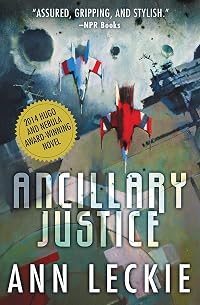
I read [b:Ninefox Gambit|26118426|Ninefox Gambit (The Machineries of Empire #1)|Yoon Ha Lee|https://images.gr-assets.com/books/1446557461s/26118426.jpg|46065520] more than two years ago, so was concerned that I would struggle to follow ‘Raven Stratagem’. Thankfully, the 'Machineries of Empire' series is gentler with the reader than [b:Terra Ignota|38608229|Terra Ignota (3 Book Series)|Ada Palmer|https://images.gr-assets.com/books/1542736521s/38608229.jpg|60217700]. In fact, I was reminded of [b:Ancillary Justice|17333324|Ancillary Justice (Imperial Radch, #1)|Ann Leckie|https://images.gr-assets.com/books/1397215917s/17333324.jpg|24064628] and sequels, another sci-fi trilogy with excellent world building and dialogue set in a show more predominantly military context. A great strength that both share is that their plots are, essentially, office politics writ interstellar. The details of each series are very different, though. Yoon Ha Lee’s universe relies upon an oppressive calendar system to impose military hierarchy and enable the use of strange technologies. Although ‘Raven Stratagem’ picks up where the previous novel left off, I had no trouble diving back into the Hexarchate. Detailed recollection of prior events was not necessary. I may have missed some nuances, but still rapidly became immersed and read the whole thing in an evening. Lee is particularly skilled at pacing, such that meetings to debate political questions never pall and space battles do not become overwhelming.
Of the point of view characters, the only one I recalled from the previous book was Jedao. Khiruev, Brezan, and Mikodez provided an excellent range of alternative points of view, both within Kel hierarchy and without. Their perspectives raise interesting questions about what it means to be loyal to an irrational collective hivemind. The world-building was consistently great and depicted an appealing interplay between technology and culture.I was not expecting the twist that Jedao was in fact Cheris, but liked it very much. Her calendrical revolution seemed quite sudden, although the hints may have been there had I been paying closer attention rather than rushing to find out what happened next. It was very neatly done, though, and a satisfying payoff for several hundred pages spent wondering what the heck Jedao was up to.
I’ve no idea where the third book will take the story as, unusually, this second volume ends on a note of resolution rather than a cliffhanger. I want to read it, though, of course. I seem to run through books in this series very quickly, as they are exceedingly readable, exciting, and plot-led. show less
Of the point of view characters, the only one I recalled from the previous book was Jedao. Khiruev, Brezan, and Mikodez provided an excellent range of alternative points of view, both within Kel hierarchy and without. Their perspectives raise interesting questions about what it means to be loyal to an irrational collective hivemind. The world-building was consistently great and depicted an appealing interplay between technology and culture.
I’ve no idea where the third book will take the story as, unusually, this second volume ends on a note of resolution rather than a cliffhanger. I want to read it, though, of course. I seem to run through books in this series very quickly, as they are exceedingly readable, exciting, and plot-led. show less
Members
- Recently Added By
Published Reviews
ThingScore 92
It’s a novel that balances the deeply personal and the wider world. It also prompts big questions about genocide, the idea of what immortality and everlasting power does to people, and whether anything is excusable in pursuit of the greater good.
added by g33kgrrl
There’s always the question with sequels of whether they will live up to the first book in the trilogy. Happily, Raven Stratagem delivers more of Lee’s signature mixture of military matters and mathematics in spades.
added by g33kgrrl
Raven Stratagem certainly shows symptoms of Middle Book Syndrome—with the bulk of the novel made of of political maneuvering required to set up the following novel—and some readers might find its shift from Ninefox Gambit’s more frenetic and action-packed plot to something slower and more philosophical a tad disappointing. It worked for me, however, and I thought that Lee found a nice show more sense of balance between big SF and personal conflict, which was rather precarious during Ninefox Gambit. As any good sequel does, Raven Stratagem doubles down on what made Ninefox Gambit so great, and polishes away its imperfections. show less
added by g33kgrrl
Lists

Best Science Fiction Novels
816 works; 430 members

2018 Hugo Eligible Novels
170 works; 16 members

2017 Locus recommended reading list SciFi
28 works; 2 members

LGBTQ+ Speculative Fiction
821 works; 51 members

Speculative Fiction to Read
706 works; 32 members

Hugo Award 2019 Reading List
126 works; 4 members

Books Read in 2017
4,249 works; 130 members
Books Read in 2018
4,360 works; 110 members

Animals in the Title
498 works; 11 members

Books Read in 2019
4,052 works; 110 members
Author Information

87+ Works 7,256 Members
Some Editions
Awards and Honors
Awards
Series

Belongs to Publisher Series
Gallimard, Folio SF (676)
Common Knowledge
- Canonical title
- Raven Stratagem
- Original title
- Raven Stratagem
- Original publication date
- 2017-06-13
- People/Characters
- Shuos Jedao; Kel Cheris; Nirai Kujen
- First words
- Lieutenant Colonel Kel Brezan’s general had just been tapped to deal with the Hafn invasion.
- Last words
- (Click to show. Warning: May contain spoilers.)“No,” Cheris said. “The war never ends.”
- Publisher's editor
- Oliver, Jonathan
- Original language
- English
Classifications
Statistics
- Members
- 864
- Popularity
- 31,548
- Reviews
- 38
- Rating
- (4.09)
- Languages
- English, French, Turkish
- Media
- Paper, Audiobook, Ebook
- ISBNs
- 10
- ASINs
- 4