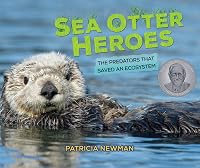
Sea Otter Heroes: The Predators That Saved an Ecosystem
by Patricia Newman
On This Page
Description
"Marine biologist Brent Hughes discovered a surprising connection between sea otters and sea grass at an estuary in northern California. Follow science in action as Hughes conducts the research that led to this major discovery."--Tags
Recommendations






Member Reviews
This book is full of sea otters. Squeeee!!!
Ok, now that we've gotten that out of the way, it's also full of fascinating science! Newman explores sea otters, seagrass, and the scientific method through the research of marine biologist Brent Hughes. After introducing the basics of the scientific method, the extreme cuteness of sea otters, and the place where the research is centered, Newman follows Hughes' investigations step by step.
The main narrative is Hughes' investigation of the unusual healthiness of the seagrass in Elkhorn Slough. One by one, he tests out different theories until he discovers the secret - sea otters! There's more than just a simple retelling of a scientific experiment here though; the history of pollution and show more treatment of sea otters, information about the various creatures that live in the area, and pivotal questions about environmental concerns are all included in this fascinating science mystery.
Back matter includes activities like creating your own science experiments, discussion of ways to be involved in environmental cleanup and studying varying viewpoints on environmental issues, source notes, glossary, and bibliography.
I love the Scientists in the Field series, but they're often too difficult for my lower level readers who are interested in science. This book hits a great in-between point between beginning readers and those who are more fluent. It's accessible and challenging, an interesting topic, and also includes practical applications for kids to explore their own science.
Verdict: This is a great read on its own, but I can also see so many applications for it; it fits in well with our new curriculum requirements in the school district, would make a great book club choice, and also fit in with a science program or some of the garden programs we're planning for the future. Highly recommended.
ISBN: 9781512426311; Published 2017 by Milbrook; Review copy provided by publisher; Donated to the library show less
Ok, now that we've gotten that out of the way, it's also full of fascinating science! Newman explores sea otters, seagrass, and the scientific method through the research of marine biologist Brent Hughes. After introducing the basics of the scientific method, the extreme cuteness of sea otters, and the place where the research is centered, Newman follows Hughes' investigations step by step.
The main narrative is Hughes' investigation of the unusual healthiness of the seagrass in Elkhorn Slough. One by one, he tests out different theories until he discovers the secret - sea otters! There's more than just a simple retelling of a scientific experiment here though; the history of pollution and show more treatment of sea otters, information about the various creatures that live in the area, and pivotal questions about environmental concerns are all included in this fascinating science mystery.
Back matter includes activities like creating your own science experiments, discussion of ways to be involved in environmental cleanup and studying varying viewpoints on environmental issues, source notes, glossary, and bibliography.
I love the Scientists in the Field series, but they're often too difficult for my lower level readers who are interested in science. This book hits a great in-between point between beginning readers and those who are more fluent. It's accessible and challenging, an interesting topic, and also includes practical applications for kids to explore their own science.
Verdict: This is a great read on its own, but I can also see so many applications for it; it fits in well with our new curriculum requirements in the school district, would make a great book club choice, and also fit in with a science program or some of the garden programs we're planning for the future. Highly recommended.
ISBN: 9781512426311; Published 2017 by Milbrook; Review copy provided by publisher; Donated to the library show less
A terrific resource for children interested in science and nature. This book is well-organized and informative, and the writing is clear without every being condescending. The book explains not just the characteristics of sea otters and their role in their ecosystem, but also other plants and animals in the environment, the history of human interaction with the otters, the individual scientists who study them now, and even the different steps of the scientific method. It covers a lot of ground without being long-winded, and it's never boring. I know I'm older than the target audience, but I enjoyed it at great deal as well. Fun and educational!
We did read parts of this book in class but I wanted to go back and read the whole thing because otters are one of my favorite animals. What Newman does really really well in this book is contrast factual and scientific information that can sometimes bog down a story with cute photos and cute lil fact pages about ocean animals. She also includes table and charts that allow children to see these types of things related to a subject that is for fun and unrelated to school stress. The whole concept of played out trial and error shows the steps of critical thinking and the scientific method completely applied for children who learn more from 'doing' rather than 'studying'. They also address issues related to animals who suffer from show more coexisting with human such as wolves and of course the otters. At the end Newman also includes how the reader can get involved and of course a great glossary and bibliography. Really cute book that makes science so much more approachable and applicable. show less
Sea Otter Heroes has an interesting story to tell. Brent Hughes uses the scientific method to solve a coastal mystery. Why was the sea grass in California’s Elkhorn Slough (pronounced Slew) flourishing when it should have been dead or covered with slimy algae. The farms in the area used pesticides which ran off into the slough and promoted algae growth. He tried again and again to determine why. He began from the bottom up as scientists usually do, but eventually, he used data from a tour boat captain and began to look top down, specifically, the Sea Otters. After many tests and experiments, Brent came to the following conclusion. It turns out that otters eat crabs that eat sea hares that eat algae growing on the grass. Because algae show more blocks sea grass photosynthesis, the expectation that the sea grass would die does not happen. When more otters eat more crabs, more sea hares survive to eat more algae, resulting in healthier sea grass—a process called trophic cascade. This same process was evident in Yellowstone when the wolves were brought back and the ecosystem became healthier.
The book is not for young children as there is a lot of text and detail, but certainly middlegrade students studying ecosystems would get a lot out of this book. The photographs add so much to the book and make it easier to understand. A good book to have in school and public libraries. The publisher generously provided me with a copy of this book via Netgalley. show less
The book is not for young children as there is a lot of text and detail, but certainly middlegrade students studying ecosystems would get a lot out of this book. The photographs add so much to the book and make it easier to understand. A good book to have in school and public libraries. The publisher generously provided me with a copy of this book via Netgalley. show less
I learned so much about otters! This is a super informative book with delightful otter photos. It's a tiny bit dry, but not too bad and would be great for a school project.
Sea Otter Heroes tells the story of how these cuddly looking, meat eating predators helped save an ecosystem that was being destroyed by man through chemicals and pesticides being deposited by nearby farmers. The book has a problem and solution narrative that keeps the reader reading in order to discover the solution to this mystery.
This book tells about a sea grass problem happening in California. Scientists thought the grass would be dead because it should have been covered in algae, but it was not. Scientist, Brent Hughes, came to a conclusion that Sea Otters were the predators that kept the grass clean. Sea Otters eat the crabs, so there was more sea hare to eat the algae that would kill the sea grass. This is a great science book for students learning about predators, ecosystem, or a food chain.
Members
- Recently Added By
Lists

Robert F. Sibert Informational Book Medal
102 works; 1 member
Author Information

26 Works 394 Members
Awards and Honors
Awards
Distinctions
Notable Lists
Classifications
Statistics
- Members
- 66
- Popularity
- 472,632
- Reviews
- 11
- Rating
- (4.42)
- Languages
- English
- Media
- Paper, Ebook
- ISBNs
- 8
- ASINs
- 1