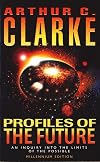
Profiles of the Future
by Arthur C. Clarke
On This Page
Description
This book originally appeared in 1962, and was based on essays written during the period 1959 - 1961. Since it was concerned with ultimate possibilities, and not with achievements to be expected in the near future, even the remarkable events of the last decade have dated it very little. But Arthur Clarke has gone over the book making corrections and comments where necessary in order to bring it right up-to-date. The author, amongst many fascinating excursions into what the future may hold, show more discusses the fourth dimension and the obsolescence of the law of gravity, the exploration of the entire solar system and the colonisation of some of it; seas will mined for energy and minerals, and asteroids will be pulled to Earth to supply needed materials; men, already bigger than they need be, may be bred smaller to be more efficient on less food. show lessTags
Recommendations










Member Reviews
Arthur C Clarke's "Profiles of The Future" is a mind-bending book worth reading for several reasons. I always guessed he had an excellent scientific background. Still, when I read his biography, I realized he has a physics and mathematics degree combined with a natural flair for writing.
He stated that scientists must be imaginative, and I agree because, without imagination and a willingness to push boundaries, we cannot progress. Therefore, his objections to those who dismiss science fiction writing as speculative are valid. You cannot write excellent science fiction based on woolly science and idle speculation.
In this fabulous book, he exposed the limitations of many people in authority who refused to see beyond the realm of show more possibility. However, progress and the inventiveness of several people, like the Wright Brothers, proved them wrong. He gave us the example of Thomas Edison, who was willing to push boundaries when young but allowed his thinking to become rigid as he grew older.
Throughout the book, he picked up themes, one per chapter, and explored them in depth, stating his perspective on what he considered possible and impossible. Arthur Clarke states one principle: if a developer obeys the laws of science and nature, then, theoretically, it is possible to continue work down that path.
He does not believe time travel is possible and may be correct. Also, he does not think it is possible to miniaturize the world, mainly because our brains would shrink. I am unsure of this perspective because our brain size would remain the same in proportion to our body weight. He does not believe inhabiting other planets within our solar system is possible. You may agree or disagree with his assertions; however, in a debate with people like him, come armed with facts and logical arguments. His prediction about the rise of machines is the scariest and most prescient, something we see happening today.
His writing is lucid, and if you are willing to read the book slowly and digest the material, you will be amazed at his vision and understand that you are privileged to peek into one of the century's great minds. show less
He stated that scientists must be imaginative, and I agree because, without imagination and a willingness to push boundaries, we cannot progress. Therefore, his objections to those who dismiss science fiction writing as speculative are valid. You cannot write excellent science fiction based on woolly science and idle speculation.
In this fabulous book, he exposed the limitations of many people in authority who refused to see beyond the realm of show more possibility. However, progress and the inventiveness of several people, like the Wright Brothers, proved them wrong. He gave us the example of Thomas Edison, who was willing to push boundaries when young but allowed his thinking to become rigid as he grew older.
Throughout the book, he picked up themes, one per chapter, and explored them in depth, stating his perspective on what he considered possible and impossible. Arthur Clarke states one principle: if a developer obeys the laws of science and nature, then, theoretically, it is possible to continue work down that path.
He does not believe time travel is possible and may be correct. Also, he does not think it is possible to miniaturize the world, mainly because our brains would shrink. I am unsure of this perspective because our brain size would remain the same in proportion to our body weight. He does not believe inhabiting other planets within our solar system is possible. You may agree or disagree with his assertions; however, in a debate with people like him, come armed with facts and logical arguments. His prediction about the rise of machines is the scariest and most prescient, something we see happening today.
His writing is lucid, and if you are willing to read the book slowly and digest the material, you will be amazed at his vision and understand that you are privileged to peek into one of the century's great minds. show less
The 1973 Pan pb was expanded with some additional chapters.
It was odd to read this work of futurology fifty years after it was first written. It did not stack up well - until I got to the 1973 chapter on future communications and computing. That chapter was almost totally prescient!
It was odd to read this work of futurology fifty years after it was first written. It did not stack up well - until I got to the 1973 chapter on future communications and computing. That chapter was almost totally prescient!
Profiles of the Future is a sort of hybrid science fiction and science book in which Arthur C. Clarke speculates upon possible future advances in technology. Originally published in 1962, this edition was updated and revised through 1984, and thus much of the original speculation has been replaced by concrete fact, and new speculation has been added that accounts for, among other things, the massive advances in communications and computing technology that took place in the interim. Clarke makes clear that he is not attempting to make (or limiting himself to) a prediction of what is likely to happen, but rather setting forth a wide ranging set of possible futures that might come about.
Clarke tackles a different general area of technology show more in each chapter, and speculates upon the future development of that technology with musings ranging from the relatively modest and highly possible, to some extremely outlandish ideas, some of which would require a violation of the currently known laws of physics to accomplish. Clarke is careful to distinguish between advances that would merely require an improvement in our engineering capabilities from advances that would require us to master entirely new technologies (but would not do violence to the laws of nature as we understand them today), from advances that would require a modification to our current understanding of the workings of the universe.
Using this metric, Clarke is able to distinguish between what he considers to be reasonably probable and what is purely speculative. In fact, in this revised edition, many of the near future advances that Clarke originally predicted in some areas had actually come to pass. The only caveat being that in many cases they transpired much more quickly than Clarke had anticipated, because, in my opinion, Clarke's somewhat utopian socialist leanings blinded him to the fact that commercial usefulness would drive some technologies to advance quickly. On the other hand, the advances in some areas, such as space flight and exploration, have proceeded much more slowly than Clarke believed, and once again it seems, for much the same reason - Clarke believed in a somewhat utopian vision of humanity that made him believe that we would develop technologies that would elevate and enhance what he saw as the better elements of human nature, rather than ones that would have purely crass commercial goals. In short, Clarkes speculations are too hesitant in some areas, and too optimistic in others due to his somewhat starry-eyed vision of humanity.
As an interesting side element, it is clear that the speculations about the future fueled Clarke's science fiction stories. Several of the technologies he speculated upon crop in in various forms in his books, a fact that he comments upon from time to time in this volume. Technologies that drive the plots of The City and the Stars, Imperial Earth, The Fountains of Paradise and numerous other works by Clarke are highlighted in the pages of this book. In his fiction, of course, all of these technolgoies are used in ways that Clakre believed would exalt the human spirit, which makes his fiction substantially different from the more recent grittier Alien influenced material that has been produced since the 1980s, leaving Clarke's utopian vision behind in a world of dark corporate dominated science fiction laden with cyberpunk-style overtones. From a certain perspective, Clarke as a writer is the anti-Michael Crichton. Whereas in Crichton's books the technological advances always turn into nightmarish disasters that threaten to maim or kill the characters, in Clarke's books, technology is a helpful tool that aids humanity and provides endless benefits. I think I prefer Clarke's vision of the future, even if it is a little overoptimistic.
For a book originally written in the 1960s, and last updated in the early 1980s, Profiles of the Future holds up remarkably well. This is probably to be expected, as Clarke had a fundamentally sound grounding in the sciences, and thus was able to imagine fairly well what was possible, and connect those possibilities to the needs of humans. The only flaw in the book that that Clarke's vision of what humans want is probably more high-class than the actual wants displayed by our actions. Of course, Clarke does not pretend to be predicting the future, only speculating about what is possible, what is plausible, and what can be dreamed about. On this score, the book is quite good. Anyone looking for a guidebook to how technology will develop in the future is likely to be disappointed. On the other hand, anyone looking for a view into how Clarke viewed humanity, and what the future could look like if we become better people will find this book quite interesting.
This review has also been posted to my blog Dreaming About Other Worlds. show less
Clarke tackles a different general area of technology show more in each chapter, and speculates upon the future development of that technology with musings ranging from the relatively modest and highly possible, to some extremely outlandish ideas, some of which would require a violation of the currently known laws of physics to accomplish. Clarke is careful to distinguish between advances that would merely require an improvement in our engineering capabilities from advances that would require us to master entirely new technologies (but would not do violence to the laws of nature as we understand them today), from advances that would require a modification to our current understanding of the workings of the universe.
Using this metric, Clarke is able to distinguish between what he considers to be reasonably probable and what is purely speculative. In fact, in this revised edition, many of the near future advances that Clarke originally predicted in some areas had actually come to pass. The only caveat being that in many cases they transpired much more quickly than Clarke had anticipated, because, in my opinion, Clarke's somewhat utopian socialist leanings blinded him to the fact that commercial usefulness would drive some technologies to advance quickly. On the other hand, the advances in some areas, such as space flight and exploration, have proceeded much more slowly than Clarke believed, and once again it seems, for much the same reason - Clarke believed in a somewhat utopian vision of humanity that made him believe that we would develop technologies that would elevate and enhance what he saw as the better elements of human nature, rather than ones that would have purely crass commercial goals. In short, Clarkes speculations are too hesitant in some areas, and too optimistic in others due to his somewhat starry-eyed vision of humanity.
As an interesting side element, it is clear that the speculations about the future fueled Clarke's science fiction stories. Several of the technologies he speculated upon crop in in various forms in his books, a fact that he comments upon from time to time in this volume. Technologies that drive the plots of The City and the Stars, Imperial Earth, The Fountains of Paradise and numerous other works by Clarke are highlighted in the pages of this book. In his fiction, of course, all of these technolgoies are used in ways that Clakre believed would exalt the human spirit, which makes his fiction substantially different from the more recent grittier Alien influenced material that has been produced since the 1980s, leaving Clarke's utopian vision behind in a world of dark corporate dominated science fiction laden with cyberpunk-style overtones. From a certain perspective, Clarke as a writer is the anti-Michael Crichton. Whereas in Crichton's books the technological advances always turn into nightmarish disasters that threaten to maim or kill the characters, in Clarke's books, technology is a helpful tool that aids humanity and provides endless benefits. I think I prefer Clarke's vision of the future, even if it is a little overoptimistic.
For a book originally written in the 1960s, and last updated in the early 1980s, Profiles of the Future holds up remarkably well. This is probably to be expected, as Clarke had a fundamentally sound grounding in the sciences, and thus was able to imagine fairly well what was possible, and connect those possibilities to the needs of humans. The only flaw in the book that that Clarke's vision of what humans want is probably more high-class than the actual wants displayed by our actions. Of course, Clarke does not pretend to be predicting the future, only speculating about what is possible, what is plausible, and what can be dreamed about. On this score, the book is quite good. Anyone looking for a guidebook to how technology will develop in the future is likely to be disappointed. On the other hand, anyone looking for a view into how Clarke viewed humanity, and what the future could look like if we become better people will find this book quite interesting.
This review has also been posted to my blog Dreaming About Other Worlds. show less
http://nwhyte.livejournal.com/1402031.html
Classic book of essays by Clarke, originally written in 1962 mostly for Playboy, and updated by him in 1999 - so the first edition was written when he was a little older than I am now, and the revision when he was 82; will I be reviewing old blog posts for republication in 2049? It is all good solid stuff about the future of technology and space flight, and the nature of the universe. One notable miss is that he doesn't seem to have been very worried about environmental concerns, at that stage anyway. One remarkable hit is the chapter 'Voices from the Sky', where he looks at the coming revolution in worldwide communication and predicts global media, GPS, fax machines, teleconferencing and ebooks show more (and admits in an afterword that the biggest mistake of the essay is not realising how quickly it would happen). Anyway, it's yet another reminder of how Clarke shaped our world. show less
Classic book of essays by Clarke, originally written in 1962 mostly for Playboy, and updated by him in 1999 - so the first edition was written when he was a little older than I am now, and the revision when he was 82; will I be reviewing old blog posts for republication in 2049? It is all good solid stuff about the future of technology and space flight, and the nature of the universe. One notable miss is that he doesn't seem to have been very worried about environmental concerns, at that stage anyway. One remarkable hit is the chapter 'Voices from the Sky', where he looks at the coming revolution in worldwide communication and predicts global media, GPS, fax machines, teleconferencing and ebooks show more (and admits in an afterword that the biggest mistake of the essay is not realising how quickly it would happen). Anyway, it's yet another reminder of how Clarke shaped our world. show less
I found this (the 1966 edition!) at a book sale for 50 cents and couldn't resist. A lot of Clarke's predictions were, not surprisingly, far too optimistic, particularly the ones involving space exploration. But overall, it was a fun read and an interesting look at science and the potential of future technology.
Ratings
Members
- Recently Added By
Lists

The Non-Fiction Works of Arthur C. Clarke
27 works; 2 members

Mind Expanding Books by hackerkid
581 works; 8 members

Books in the Bibliography of The Illusion of Conscious Will by Daniel Wegne
273 works; 1 member
Author Information

863+ Works 130,290 Members
Arthur C. Clarke was born in Minehead, Somerset, England, on December 16, 1917. During World War II, he served as a radar specialist in the RAF. His first published piece of fiction was Rescue Party and appeared in Astounding Science, May 1946. He graduated from King's College in London with honors in physics and mathematics, and worked in show more scientific research before turning his attention to writing fiction. His first book, Prelude to Space, was published in 1951. He is best known for his book 2001: A Space Odyssey, which was later turned into a highly successful and controversial film under the direction of Stanley Kubrick. His other works include Childhood's End, Rendezvous with Rama, The Garden of Rama, The Snows of Olympus, 2010: A Space Odyssey II, 2062: Odyssey III, and 3001: The Final Odyssey. During his lifetime, he received at least three Hugo Awards and two Nebula Awards. He died of heart failure on March 19, 2008 at the age of 90. (Bowker Author Biography) show less
Common Knowledge
- Canonical title
- Profiles of the Future: An Inquiry into the Limits of the Possible; Profiles of the Future
- Original title
- Profiles of the Future
- Original publication date
- 1962
- Quotations
- Any sufficiently advanced technology is indistinguishable from magic.
- Original language
- English
Classifications
Statistics
- Members
- 634
- Popularity
- 45,815
- Reviews
- 5
- Rating
- (3.69)
- Languages
- 6 — Dutch, English, French, German, Portuguese, Spanish
- Media
- Paper, Ebook
- ISBNs
- 15
- ASINs
- 29