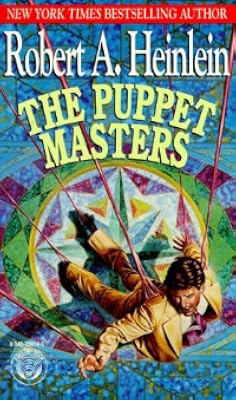
The Puppet Masters
by Robert A. Heinlein
There is 1 current discussion about this work.
On This Page
Description
First came the news that a flying saucer had landed in Iowa. Then came the announcement that the whole thing was a hoax. End of story. Case closed. Except that two agents of the most secret intelligence agency in the US government were on the scene and disappeared without reporting in. And four more agents who were sent in also disappeared. So the head of the agency and his two top agents went in and managed to get out with their discovery: an invasion is underway by slug-like aliens who can show more touch a human and completely control his or her mind. What the humans know, they know. What the slugs want, no matter what, the human will do. And most of Iowa is already under their control. Sam Cavanaugh was one of the agents who discovered the truth. Unfortunately, that was just before he was taken over by one of the aliens and began working for the invaders, with no will of his own. And he has just learned that a high official in the Treasury Department is now under control of the aliens. Since the Treasury Department includes the Secret Service, which safeguards the President of the United States, control of the entire nation is near at hand. show lessTags
Recommendations































Member Reviews
I don't think this was the first 'mind controlling alien invasion' story, but it's the best. Earth is attacked by slug-like creatures, who infiltrate important sectors of society, take over communications, and then expand at an exponential rate until the entire population has been parasitized. The midwest falls in weeks, Russia is taken over almost immediately, and it's up to super-spy 'Sam Cavanaugh' to foil the invasion.
There's a lot of action and excitement, as well those Heinleinian world-building moments, like the dense, post-nuclear war cities, or the 'not a sparrow-fall' radar network. The puppet masters are an appropriately horrifying enemy, and one as scary as anything short of a Berserker/Reaper-esque extinction machine. show more Sure, the gender politics are pretty retrograde, but that doesn't detract from a tight, terrifying, and damn near perfect scifi adventure story. show less
There's a lot of action and excitement, as well those Heinleinian world-building moments, like the dense, post-nuclear war cities, or the 'not a sparrow-fall' radar network. The puppet masters are an appropriately horrifying enemy, and one as scary as anything short of a Berserker/Reaper-esque extinction machine. show more Sure, the gender politics are pretty retrograde, but that doesn't detract from a tight, terrifying, and damn near perfect scifi adventure story. show less
Re-reading this after a hiatus of more than 40 years. Back in the 1980s I read a lot of Heinlein. I wouldn't say that I was ever a fan, but he was one of the core bloc of SF writers which made up my library along with Silverberg, Arthur C Clarke and Ursula Le Guin. Of all of the Heinlein I read back then, I think that The Puppet Masters was the one that I enjoyed the most.
The version I read back then was the original edited version which had some of the more troublesome sections (in the context of 1950s moral attitudes) removed, making it acceptable for the school library from which I borrowed it. The story is to more sophisticated modern eyes, rather basic. Bad, parasitic aliens land in a flying saucer and use mind-control to take over show more the world. Good guys from an unspecified agency go rogue to try and stop them.
Unsophisticated and somewhat predictable, the plot still has the potential to excite and compel the reader to keep turning the page. However, the big problem with Heinlein is his attitude towards women and sexuality. His books are heavily laden with sex- not in an explicit way- and this is gratuitous, rarely adding to the storylines. His women are always of a type- typically red-headed, curvaceous - and they always know their place, which is of course to keep their male counterparts satisfied and to play second-fiddle in defeating the baddies. The Puppet Masters is no different to other Heinlein novels (Stranger in a Strange Land, Time Enough for Love, The Door Into Summer, Friday- a particularly egregious example).
Re-reading Silverberg has been equally challenging as his attitudes are very similar to Heinlein's. Science Fiction has moved on, just as social attitudes have moved on. These books have not retained whatever fascination and excitement they held for me in my youth. show less
The version I read back then was the original edited version which had some of the more troublesome sections (in the context of 1950s moral attitudes) removed, making it acceptable for the school library from which I borrowed it. The story is to more sophisticated modern eyes, rather basic. Bad, parasitic aliens land in a flying saucer and use mind-control to take over show more the world. Good guys from an unspecified agency go rogue to try and stop them.
Unsophisticated and somewhat predictable, the plot still has the potential to excite and compel the reader to keep turning the page. However, the big problem with Heinlein is his attitude towards women and sexuality. His books are heavily laden with sex- not in an explicit way- and this is gratuitous, rarely adding to the storylines. His women are always of a type- typically red-headed, curvaceous - and they always know their place, which is of course to keep their male counterparts satisfied and to play second-fiddle in defeating the baddies. The Puppet Masters is no different to other Heinlein novels (Stranger in a Strange Land, Time Enough for Love, The Door Into Summer, Friday- a particularly egregious example).
Re-reading Silverberg has been equally challenging as his attitudes are very similar to Heinlein's. Science Fiction has moved on, just as social attitudes have moved on. These books have not retained whatever fascination and excitement they held for me in my youth. show less
Before reading this, I didn't realize I hadn’t read a NON-juvenile Heinlein novel- I was beginning to think they all had spunky pre-teen protagonists thrown into gee-whiz scenarios where they nonetheless manage to outshine the adults. My previous two RAH novels, “Time for the Stars” and “Have Space Suit, Will Travel”, share all the same 1950’s cultural colorations seen here, but are restrained in their violence, profanity, and sexual content due to his audience. Reading Heinlein less restrained in these areas was enjoyably disturbing. There’s something odd about the juxtaposition of 1950’s gender chivalry in one scene followed quickly by man-bisecting ray gun violence in the next that held my attention like a cold war show more “red alert” duck-and-cover drill. As in “Have Space Suit”, this story is about the early detection of an alien invasion, although what comes out of the saucers is much more gruesome this time. A lot of thought went into the methods a mid-controlling invader would use to subjugate the human race, and I appreciate the subtleties of counter-insurgence played out between the opposing species. The theme of personal freedom plays out on at least two levels: the struggle against literal slavery at the hands (psuedopods?) of aliens, and the second struggle against bureaucratic and paternalistic government authority. The final denouement chapter provides the satisfying full-throated vengeance on both that Heinlein, in his Libertarian zeal, must have fantasized about. I kept expecting a more direct parallel on McCarthyism and Red Scare politics, but found it only passingly mentioned; seemingly a missed opportunity. Just as you can never be immediately sure if the stranger seated beside you on the subway is an alien agent, you can likewise not discover a communist sympathizer with superficial inspection. show less
I must have read Robert A. Heinlein's The Puppet Masters twenty or thirty times, easily, since the first time I read it in my mid-to-late teens. I can't say it's his best, but it's certainly one of the better works from what I consider to be his golden period. But in all those re-readings, I somehow failed to catch a rather huge logic hole in the plot - until realization suddenly burst in on me today.
The Puppet Masters is, arguably, the classic mind-controlling-aliens-invade story (if anyone has another candidate to suggest, please do). The Titans control their hosts (human and otherwise) through physical contact, most often at the spine just below the neck. They reproduce extremely rapidly, and soon posses an extremely large percentage show more of the population - large enough that the protagonist, Sam, calls it a "saturation" point, and the Titans actually drop the masquerade.
The goal of the Titans is to possess the entire human race - effectively, to spread themselves and their control to the uncontrolled portion of humanity. In North America, that uncontrolled population resides on the East and West coasts. They primarily advance this goal through infiltration, and also by using dogs and some other animals as carriers at night out of the Red (i.e. Titan-saturated) zone into the Green (free human) zone.
The goal of the uncontrolled humans, on the other hand, is to resist takeover, to free the enslaved population, and to kill the Titans.
Now here's the problem: early in the book, in chapter three, Heinlein introduces a drug called "tempus fugit". It's freely available in pill or injectable liquid. It increases subjective perception and reaction time by - well, Heinlein contradicts himself within the same paragraph:
Note that ten-to-one is given as the minimum alteration (despite Heinlein's earlier referral to an effective seven-to-one ratio). In chapter 21, Sam says "Suppose we have just twenty-four more hours; we could fine it down to a month, subjective time." Since he's proposing this to his new wife, this thirty-to-one dose is presumably not dangerous. Even higher subjective speeds are specified later, in chapter 24:
That is, at a minimum, a 72-to-1 increase in perceived time, and when he takes it, he's recuperating from serious burns. I'm afraid I've over-explained, but here's the basic point: why weren't the free humans dosed with tempus every time they invaded the infected zone? From the first time, when they were trying to get video proof of the titans' existence, to the last, when they went in to give antitoxin to the human population, tempus would have made their task about a thousand times easier. And yet they didn't use it, or even discuss using it.
And what about the Titans? They have access to tempus too, but are never mentioned as using it at all. Which raises an interesting point: does tempus affect the Titan who is controlling a human, if the human takes it? If so, the Titans could have created high-speed assault & infection agents very easily. On the other hand, if the tempus does not affect Titans, then that raises a whole new interesting question. What happens when a human being controlled by a Titan is dosed with tempus? Suddenly they're thinking and reacting ten to 72 (or more) times faster than their master. Can the Titans exert meaningful control over their host under those conditions? If so, virtually unstoppable high-speed infectors seem to be an obvious option for them.
And if not, why didn't the free humans send tempus-dosed troops to inject tempus into infected humans in zone Red?
Yet another odd lapse in the story appears in chapter 24:
But when we go back to chapter 8, when the Titan-ridden Sam is recaptured much earlier in the story:
Okay, it's an injection rather than a gas. But it knocks out a highly trained agent before he can do anything about it. It's even called "Morpheus", for god's sake! Leaving out the absolutely obvious possibility (which absolutely nothing in the book rules out) of sending tempus-dosed troops with Morpheus injectors to knock out the population, Morpheus alone seems to be an invaluable weapon for either side. They're obviously both aware of the drug. And yet it is only used once, in the above passage.
Perhaps I'm being unfair to Heinlein. But he himself described the care that he put into his work - I recall an anecdote he wrote about spending a week with his wife writing calculation after calculation on huge rolls of butcher paper, in order to derive a point about an orbit or trajectory that went into only one line in a novel. Two logic holes such as this in one of his golden age novels...well, that's just astonishing.
Or perhaps this is one of those occasions where his editors overrode his wishes and forced him to self-censor? I've only read the original edition, so I can't be sure.
Another minor point that occurred to me: To defend themselves from the Titans, the free humans adopt mandatory nudity. Several times, they mention a concern that the weather will soon be getting colder. Why wasn't transparent clothing ever considered?
It's still a great read. Heinlein was, without question, a master storyteller. Which may explain why I never noticed these gaping logic holes before! show less
The Puppet Masters is, arguably, the classic mind-controlling-aliens-invade story (if anyone has another candidate to suggest, please do). The Titans control their hosts (human and otherwise) through physical contact, most often at the spine just below the neck. They reproduce extremely rapidly, and soon posses an extremely large percentage show more of the population - large enough that the protagonist, Sam, calls it a "saturation" point, and the Titans actually drop the masquerade.
The goal of the Titans is to possess the entire human race - effectively, to spread themselves and their control to the uncontrolled portion of humanity. In North America, that uncontrolled population resides on the East and West coasts. They primarily advance this goal through infiltration, and also by using dogs and some other animals as carriers at night out of the Red (i.e. Titan-saturated) zone into the Green (free human) zone.
The goal of the uncontrolled humans, on the other hand, is to resist takeover, to free the enslaved population, and to kill the Titans.
Now here's the problem: early in the book, in chapter three, Heinlein introduces a drug called "tempus fugit". It's freely available in pill or injectable liquid. It increases subjective perception and reaction time by - well, Heinlein contradicts himself within the same paragraph:
...I took them occasionally to make a twenty-four-hour leave seem like a week. ... Primarily, though, they just stretch your subjective time by a factor of ten or more - chop time into finer bits so that you live longer for the same amount of clock-and-calendar. Sure, I know the horrible example of the man who died of old age in a month through taking the pills steadily...
Note that ten-to-one is given as the minimum alteration (despite Heinlein's earlier referral to an effective seven-to-one ratio). In chapter 21, Sam says "Suppose we have just twenty-four more hours; we could fine it down to a month, subjective time." Since he's proposing this to his new wife, this thirty-to-one dose is presumably not dangerous. Even higher subjective speeds are specified later, in chapter 24:
The doctor gave me a short shot of tempus and I spent the time - subjective, about three days; objective, less than an hour - studying stereo tapes through an overspeed scanner.
That is, at a minimum, a 72-to-1 increase in perceived time, and when he takes it, he's recuperating from serious burns. I'm afraid I've over-explained, but here's the basic point: why weren't the free humans dosed with tempus every time they invaded the infected zone? From the first time, when they were trying to get video proof of the titans' existence, to the last, when they went in to give antitoxin to the human population, tempus would have made their task about a thousand times easier. And yet they didn't use it, or even discuss using it.
And what about the Titans? They have access to tempus too, but are never mentioned as using it at all. Which raises an interesting point: does tempus affect the Titan who is controlling a human, if the human takes it? If so, the Titans could have created high-speed assault & infection agents very easily. On the other hand, if the tempus does not affect Titans, then that raises a whole new interesting question. What happens when a human being controlled by a Titan is dosed with tempus? Suddenly they're thinking and reacting ten to 72 (or more) times faster than their master. Can the Titans exert meaningful control over their host under those conditions? If so, virtually unstoppable high-speed infectors seem to be an obvious option for them.
And if not, why didn't the free humans send tempus-dosed troops to inject tempus into infected humans in zone Red?
Yet another odd lapse in the story appears in chapter 24:
What we needed was [...] something that would disable humans or render them unconscious without killing, and thereby permit us to rescue our compatriots. No such weapon was available, though the scientists were all busy on the problem. A "sleep" gas would have been perfect, but it is lucky that no such gas was known before the invasion, or the slugs could have used it against us.
But when we go back to chapter 8, when the Titan-ridden Sam is recaptured much earlier in the story:
With his other hand he thrust something against my side; I felt a prick, and then through me spread the warm tingle of a jolt of "Morpheus" taking hold. I made one more attempt to pull my gun free and sank forward.
Okay, it's an injection rather than a gas. But it knocks out a highly trained agent before he can do anything about it. It's even called "Morpheus", for god's sake! Leaving out the absolutely obvious possibility (which absolutely nothing in the book rules out) of sending tempus-dosed troops with Morpheus injectors to knock out the population, Morpheus alone seems to be an invaluable weapon for either side. They're obviously both aware of the drug. And yet it is only used once, in the above passage.
Perhaps I'm being unfair to Heinlein. But he himself described the care that he put into his work - I recall an anecdote he wrote about spending a week with his wife writing calculation after calculation on huge rolls of butcher paper, in order to derive a point about an orbit or trajectory that went into only one line in a novel. Two logic holes such as this in one of his golden age novels...well, that's just astonishing.
Or perhaps this is one of those occasions where his editors overrode his wishes and forced him to self-censor? I've only read the original edition, so I can't be sure.
Another minor point that occurred to me: To defend themselves from the Titans, the free humans adopt mandatory nudity. Several times, they mention a concern that the weather will soon be getting colder. Why wasn't transparent clothing ever considered?
It's still a great read. Heinlein was, without question, a master storyteller. Which may explain why I never noticed these gaping logic holes before! show less
What a great tale on so many levels! This novel works as a straight science-fiction alien invasion story, but there are also the philosophical questions to consider. How much freedom is a person willing to surrender for peace of mind? How do you know what is true when you cannot see events yourself? When does a war end?
I picked this book to re-read (I read it first decades ago) after another novel mentioned it in passing. I am glad I did as the more experienced me saw the multi-layered novel with fresh eyes. Heinlein fans have no doubt already read the novel, but I think it is worth reading again.
I picked this book to re-read (I read it first decades ago) after another novel mentioned it in passing. I am glad I did as the more experienced me saw the multi-layered novel with fresh eyes. Heinlein fans have no doubt already read the novel, but I think it is worth reading again.
The puppet masters
Vabbè, per una volta la sesta luna c'entra, visto che gli invasori provengono dalla sesta luna di Titano, ma nonostante ciò proprio non si capisce come mai questo titolo al posto dell'originale, traducibile con un elegante "I burattinai", o col più drastico ma ugualmente pertinente "I dominatori".
La trama è abbastanza ben sostenuta, anche se un po' datata, con un macho tutto muscoli e giusto un briciolo di buon senso, sufficiente però per farlo apparire un genio in confronto dei soliti militari americani, una agente donna superefficiente che diventa una svenevole gattina non appena si innamora, un mondo che diventa naturista di necessità per difendersi dagli invasori alieni.
Discreto libro da leggere in un show more pomeriggio di gran nebbione, anche se l'ultima pagina Heinlein se la poteva risparmiare. show less
Vabbè, per una volta la sesta luna c'entra, visto che gli invasori provengono dalla sesta luna di Titano, ma nonostante ciò proprio non si capisce come mai questo titolo al posto dell'originale, traducibile con un elegante "I burattinai", o col più drastico ma ugualmente pertinente "I dominatori".
La trama è abbastanza ben sostenuta, anche se un po' datata, con un macho tutto muscoli e giusto un briciolo di buon senso, sufficiente però per farlo apparire un genio in confronto dei soliti militari americani, una agente donna superefficiente che diventa una svenevole gattina non appena si innamora, un mondo che diventa naturista di necessità per difendersi dagli invasori alieni.
Discreto libro da leggere in un show more pomeriggio di gran nebbione, anche se l'ultima pagina Heinlein se la poteva risparmiare. show less
A flawed but highly influential tale of alien invasion. The main comparison this book sees is between it and The Body Snatchers as both describe an alien invasion where aliens take the place of normal people. This book actually came first so if you are interested in sci fi history this is a good pick.
First off, I must say this was one of the fastest paced novels I’ve ever read. It gets into the action quickly and keeps moving. The dialogue and action reminds me a bit of film noir or hard boiled detective stories.
This book definitely shows it’s age especially with all the beautiful babes surrounding the main character. Speaking of which, the romance in this is really bizarre as it starts as a highly flirtatious and racy but ends show more very domestically and wholesome. Leads to some tonal whiplash.
In this novel aliens take power quick and the rest of the book covers the conflict between humans and the mind controlled. It does make the reader think about how we actually would combat hidden aliens. There’s some interesting segments about what the aliens are doing with their human hosts and how they are trying to disguise themselves. Also there are some point of view sections from a character being controlled which were intriguing. It should be mentioned that the things they do with clothing throughout the novel are …uh… unique to say the least.
A bizarre but memorable tale of mind controlling slugs. show less
First off, I must say this was one of the fastest paced novels I’ve ever read. It gets into the action quickly and keeps moving. The dialogue and action reminds me a bit of film noir or hard boiled detective stories.
This book definitely shows it’s age especially with all the beautiful babes surrounding the main character. Speaking of which, the romance in this is really bizarre as it starts as a highly flirtatious and racy but ends show more very domestically and wholesome. Leads to some tonal whiplash.
In this novel aliens take power quick and the rest of the book covers the conflict between humans and the mind controlled. It does make the reader think about how we actually would combat hidden aliens. There’s some interesting segments about what the aliens are doing with their human hosts and how they are trying to disguise themselves. Also there are some point of view sections from a character being controlled which were intriguing. It should be mentioned that the things they do with clothing throughout the novel are …uh… unique to say the least.
A bizarre but memorable tale of mind controlling slugs. show less
Members
- Recently Added By
Published Reviews
Met een uitgebreide produktie, die gaat van de klassiek gebleven korte verhalen van zijn "Future History" tot de langere, meer ambitieuze, maar ook meer controversiele romans als "Vreemdeling in een vreemd land", hoort Robert Heinlein tot de bekendste namen in sf. Zijn wel erg populaire "Puppet Masters" (1951) dat eerst in een Bruna-Omnibus verscheen, is hier als pocket ook al weer aan herdruk show more toe. Het boek verhaalt de strijd tegen een buitenaardse invasie, in de vorm van parasitaire symbioten, die zich op de rug van de mens vastzetten en hem via het zenuwstelsel volledig overmeesteren. Pretentieloos, dynamisch en vlot geschreven.
(NBD|Biblion recensie, R.C.L. Smets) show less
(NBD|Biblion recensie, R.C.L. Smets) show less
added by karnoefel
Lists

David Pringle's Science Fiction: The 100 Best Novels
101 works; 9 members

75 Books Challenge Halloween Read "Official" Selections
71 works; 7 members

Favorite Childhood Books
1,646 works; 518 members

Books Read in 2017
4,249 works; 130 members

Books Read in 2019
4,052 works; 110 members
1950s
340 works; 22 members

Les 100 principaux titres de la science-fiction (1981)
126 works; 3 members
Talk Discussions
Current Discussions
The Puppet Masters in Good Show Sir! — bad science fiction and fantasy covers (November 2025)
Author Information

456+ Works 174,325 Members
Robert Anson Heinlein was born on July 7, 1907 in Butler, Mo. The son of Rex Ivar and Bam Lyle Heinlein, Robert Heinlein had two older brothers, one younger brother, and three younger sisters. Moving to Kansas City, Mo., at a young age, Heinlein graduated from Central High School in 1924 and attended one year of college at Kansas City Community show more College. Following in his older brother's footsteps, Heinlein entered the Navel Academy in 1925. After contracting pulmonary tuberculosis, of which he was later cured, Heinlein retired from the Navy and married Leslyn MacDonald. Heinlein was said to have held jobs in real estate and photography, before he began working as a staff writer for Upton Sinclair's EPIC News in 1938. Still needing money desperately, Heinlein entered a writing contest sponsored by the science fiction magazine Thrilling Wonder Stories. Heinlein wrote and submitted the story "Life-Line," which went on to win the contest. This guaranteed Heinlein a future in writing. Using his real name and the pen names Caleb Saunders, Anson MacDonald, Lyle Monroe, John Riverside, and Simon York, Heinlein wrote numerous novels including For Us the Living, Methuselah's Children, and Starship Troopers, which was adapted into a big-budget film for Tri-Star Pictures in 1997. The Science Fiction Writers of America named Heinlein its first Grand Master in 1974, presented 1975. Officers and past presidents of the Association select a living writer for lifetime achievement. Also, the Science Fiction and Fantasy Hall of Fame inducted Heinlein in 1998. Heinlein died in 1988 from emphysema and other related health problems. Heinlein's remains were scattered from the stern of a Navy warship off the coast of California. (Bowker Author Biography) show less
Some Editions
Awards and Honors
Series
Belongs to Publisher Series
Yeni Dünyalarda (3)
Tempus fugit (2)
Signet SF (T3752)
Work Relationships
Common Knowledge
- Canonical title
- The Puppet Masters
- Original title
- The Puppet Masters
- Alternate titles*
- Les Maîtres du monde
- Original publication date
- 1951
- People/Characters
- Sam Cavanaugh
- Related movies
- The Brain Eaters (1958 | IMDb); The Puppet Masters (1994 | IMDb)
- Dedication
- to
Lurton Blassingame - First words
- Were they truly intelligent?
- Last words
- (Click to show. Warning: May contain spoilers.)Death and Destruction!
- Original language
- English
*Some information comes from Common Knowledge in other languages. Click "Edit" for more information.
Classifications
Statistics
- Members
- 3,951
- Popularity
- 3,973
- Reviews
- 53
- Rating
- (3.64)
- Languages
- 17 — Czech, Danish, Dutch, English, Estonian, French, German, Hebrew, Hungarian, Italian, Lithuanian, Polish, Portuguese, Russian, Spanish, Swedish, Ukrainian
- Media
- Paper, Audiobook, Ebook
- ISBNs
- 67
- UPCs
- 1
- ASINs
- 56