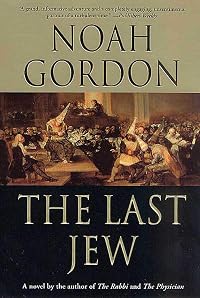
The Last Jew
by Noah Gordon
On This Page
Description
In the year 1492, the Inquisition has all of Spain in its grip. After centuries of pogrom-like riots encouraged by the Church, the Jews - who have been an important part of Spanish life since the days of the Romans - are expelled from the country by royal edict. Many who wish to remain are intimidated by Church and Crown and become Catholics, but several hundred thousand choose to retain their religion and depart; given little time to flee, some perish even before they can escape from Spain. show more Yonah Toledano, the 15-year-old son of a celebrated Spanish silversmith, has seen his father and brother die during these terrible days - victims whose murders go almost unnoticed in a time of mass upheaval. Trapped in Spain by circumstances, he is determined to honor the memory of his family by remaining a Jew. On a donkey named Moise, Yonah begins a meandering journey, a young fugitive zigzagging across the vastness of Spain. Toiling at manual labor, he desperately tries to cling to his memories of a vanished culture. As a lonely shepherd on a mountaintop he hurls snatches of almost forgotten Hebrew at the stars, as an apprentice armorer he learns to fight like a Christian knight. Finally, as a man living in a time and land where danger from the Inquisition is everywhere, he deals with the questions that mark his past. How he discovers the answers, how he finds his way to a singular and strong Marrano woman, how he achieves a life with the outer persona of a respected Old Christian physician and the inner life of a secret Jew, is the fabric of this novel. The Last Jew is a glimpse of the past, an authentic tale of high adventure, and a tender and unforgettable love story. In it, Noah Gordon utilizes his greatest strengths, and the result is remarkable and moving. show lessTags
Recommendations












Member Reviews
Beautiful writing, clear and clean. Gordon takes you into Medieval Spain with a believable story and terrific character development. The story is sad yet triumphant. Looking forward to exploring more of Gordon's works.
It was supposed to be a heart wrenching story of a jewish youth who lost his entire family and friends to the Expulsion of Jews from Spain. Or maybe it should have been a detective story, a theft and murder perpetrated by a cleric and the truth is discovered by the protagonist, and maybe even vengeance delivered. It could have been a self-search story of a Jew stuck alone in Spain, facing discovery by the Inquisition and still choosing to be a devoted Jew.
It is neither.
Though very detailed and full of explanations, the book fails to convey the severity of protagonist's loss, the story of the expelled Jews remains mainly untold and the atrocities of the Inquisition are shown but little.
The deeds, the travels, the decision makings of show more Yonah, the protagonist, are also detailed, ad nauseam. But the descriptions are dry, the motives and the logics are extremely weak. We do not see a character development, but have to believe to the author stating it does so.
Any hopes for a detective story in style of Eco's [b:The Name of the Rose|119073|The Name of the Rose|Umberto Eco|https://i.gr-assets.com/images/S/compressed.photo.goodreads.com/books/1415375471l/119073._SY75_.jpg|3138328] are vanquished promptly: the killer is mentioned in the very beginning of the book and even the vengeance doesn't come and the excuse is lousy.
Though the book is fast-pasing and promises a lot of excitement just on the next page, it never delivers. Instead of human drama we get a sugar-coated story of the Expulsion. show less
It is neither.
Though very detailed and full of explanations, the book fails to convey the severity of protagonist's loss, the story of the expelled Jews remains mainly untold and the atrocities of the Inquisition are shown but little.
The deeds, the travels, the decision makings of show more Yonah, the protagonist, are also detailed, ad nauseam. But the descriptions are dry, the motives and the logics are extremely weak. We do not see a character development, but have to believe to the author stating it does so.
Any hopes for a detective story in style of Eco's [b:The Name of the Rose|119073|The Name of the Rose|Umberto Eco|https://i.gr-assets.com/images/S/compressed.photo.goodreads.com/books/1415375471l/119073._SY75_.jpg|3138328] are vanquished promptly: the killer is mentioned in the very beginning of the book and even the vengeance doesn't come and the excuse is lousy.
Though the book is fast-pasing and promises a lot of excitement just on the next page, it never delivers. Instead of human drama we get a sugar-coated story of the Expulsion. show less
Gordon's scathing denunciation of prejudice and its effects, couched in a moving narrative. Yonah, a young Jew in 15th century Spain, is forced to flee his home of Toledo after his brother and father, the latter a talented silversmith, are killed in what we'd call a pogrom which followed Ferdinand and Isabella's infamous Order of Expulsion of Jews from Spain. Yes, THOSE monarchs! Yonah, through his life, holds on to his religion and stays one step ahead of the horrible Inquisition. He represents himself as a Christian under an assumed name, Ramón. The novel recounts his flight, his years of manual [and menial] labor as farm hand, seaman, and shepherd. He finally apprentices himself to an armorer. Each time, some incident forces him to show more keep on the move. He finally ends up in Saragossa, and becomes a physician. Can he maintain his integrity and his false identity?
The novel gave me a lot to think about, which might be simplistic--why are men prejudiced in matters of religion? To me it is a matter of one's personal belief--a matter of faith--and should be respected. I got a feeling for the times at which the story took place, through the author's vivid descriptions. The action seemed too fortuitous and on occasion contrived; Yonah would meet just the right person at the right time.
The author's research into the period was thorough--conducted mainly through interviews with and help of people mentioned in the extensive Acknowledgements. The maps of Yonah's journey from Toledo and to Saragossa on the endpapers were invaluable. show less
The novel gave me a lot to think about, which might be simplistic--why are men prejudiced in matters of religion? To me it is a matter of one's personal belief--a matter of faith--and should be respected. I got a feeling for the times at which the story took place, through the author's vivid descriptions. The action seemed too fortuitous and on occasion contrived; Yonah would meet just the right person at the right time.
The author's research into the period was thorough--conducted mainly through interviews with and help of people mentioned in the extensive Acknowledgements. The maps of Yonah's journey from Toledo and to Saragossa on the endpapers were invaluable. show less
I have been a big fan of historical fiction ever since reading Gary Jenning's Aztec in high school. At its best, historical fiction is educational allowing the reader to experience an alien culture or different place, or a past epoch. In the case of The Last Jew you experience late 15th and early 16th Century medieval Spain during the Inquisition. The last Jew is Yonah Toledeno who remains true to his religion even after the murder of his brother and father, the expulsion of the remainder of his family and other Jews or their forced conversion. The Last Jew follows Yonah from the beginning of his quixotic (a word derived from that classic Spanish novel, Don Quixote) journey through Spain beginning at age fifteen and follows his life and show more travels up until his marriage and the birth of his son in his mid thirties. It is a tale of horrible cruelty and oppression in the face of an intolerant society. Would that the world had matured in all these centuries into a place more enlightened. Sadly, it has not. The Last Jew is a worthwhile read for those who wish to remain true to themselves in the face of incredible adversity. It is a great and exciting read. show less
[The Last Jew] takes place in the late 1400's in Spain which is under the control of the Inquisition. The protagonist of the story, Helkiah Toledano (Yonah) sees his family murdered as he makes an escape. The book is very rich in detail of the Church, the Inquisition, and the day to day lives of those living at this time. The story is a "good" story and holds ones interest until about 3 chapters from the end where the story hurriedly becomes sappy and predictable, ending like a fairytale
Historical fiction taking place in 1480’s to early 1500’s during the expulsion of the Jews from Spain. Many converted to Catholicism rather than leave, but many who converted (‘conversos’) were later hunted down by the Inquisition, persecuted and burned at the stake. This is the story of Yonah Toledano, teenage son of a master silversmith who is separated from his family during their hasty flight from their home. His father is killed, his younger brother, aunt and uncle flee to who knows where, and Yonah finds himself totally alone, to the point where he feels like the last Jew in Spain. As he wanders from town to town, farm to farm, working manual labor jobs and staying in each place for only a few seasons (occasionally a few show more years until trouble managed to find him again) and eventually apprenticing himself to a physician in Saragossa, pretending outwardly to be Christian but inside still trying to stay true to the memory of his father and remain a Jew, Yonah meets many fascinating people and has many adventures. Absolutely wonderful story, very atmospheric and moving, and with an appropriate ending. show less
Although I know very little about the Inquisition and do not have a strong historical background, I found this book interesting and thought-provoking. This is basically a survival story. Yonah learns to survive physically, mentally, and spiritually against huge odds. At times, I felt he was a bit "over the top" with his ability to adapt so easily and become a master metalsmith and then a physician, but undoubtedly, there are individuals who do succeed in many diverse areas. Yonah was smart and talented. Equally important, his family background provided him with a sense, not of entitlement, but one of obligation to do his best, taking care of himself and those around him. As interesting as he is as a main character, the individuals show more around him are also remarkable in that they are so human and are formed and reformed by the circumstances they find themselves in.
Overall, this is a good read. I would highly recommend it to any lover of historical fiction. show less
Overall, this is a good read. I would highly recommend it to any lover of historical fiction. show less
Members
- Recently Added By
Published Reviews
ThingScore 75
Mit seinem neuen Roman hat Noah Gordon wieder zu jener Balance zurückgefunden, die schon seinen weltberühmten ersten „Medicus“ auszeichnete. Seine farbigen Zeitbilder vergangener Historie umgeben ein in „gut“ und „böse“ zweigeteiltes Personentableau, ohne dabei in platte Schwarzweißmalerei zu verfallen. Was in dem zweiten Teil der Medicus-Trilogie „Die Erben des Meidcus“ show more doch schon sehr plakativ daherkam, findet in der zwanzig Jahre währenden Entwicklungsgeschichte des „Medicus von Saragossa“ eine differenziertere Betrachtung. Selbst der positiv besetzte Held erweist sich hier als anfechtbar, wird beinahe zum Dieb und tötet mehrere Menschen. Im Original überschrieben mit „The Last Jew“ geht es hier auch weniger um das Arztsein des Helden als um das Credo, daß die Angehörigen der drei Schriftreligionen in ihrem Glauben an Gott doch eigentlich weit mehr verbinden als trennen sollte. Gordon gelingt es, dieser höchst aktuellen Thematik einmal mehr eine ,Magie‘ abzugewinnen, die ohne jede Länge bis zur letzten Seite Wirkung zeigt. show less
added by Indy133
La trama de esta novela toma como punto de partida la expulsión de los judíos en la España del siglo XV y como protagonista al joven Yonah Toledano. Cuando Yonah es separado de los únicos miembros de su familia que quedan con vida, se ve forzado a abandonar su hogar natal en búsqueda de un nuevo lugar en el que poder establecerse sin tener que renunciar a sus creencias. Así, inicia un show more largo periodo durante el cual deberá recurrir a su ingenio para poder salvaguardar su secreto. Los cambios continuos de identidad y oficio irán forjando su personalidad, y las dificultades no harán sino reafirmar sus orígenes. Desde sus días de pobreza y soledad hasta sus últimos años como reputado médico, seguimos la vida de un personaje extraordinario y de un no menos interesante periodo histórico, en el que las traiciones e intrigas estaban a la orden del día. show less
added by Pakoniet
Author Information

27+ Works 9,288 Members
Some Editions
Series
Belongs to Publisher Series
Work Relationships
Is contained in
Common Knowledge
- Canonical title*
- L'últim jueu
- Original title
- The Last Jew
- Original publication date
- 2000
- Dedication*
- Für Caleb und Emma
und Grossmutter
in Liebe - Original language*
- Anglès
*Some information comes from Common Knowledge in other languages. Click "Edit" for more information.
Classifications
Statistics
- Members
- 1,338
- Popularity
- 17,905
- Reviews
- 25
- Rating
- (3.78)
- Languages
- 13 — Catalan, Czech, Danish, Dutch, English, French, German, Hungarian, Italian, Polish, Portuguese, Croatian, Spanish
- Media
- Paper, Audiobook, Ebook
- ISBNs
- 62
- ASINs
- 16