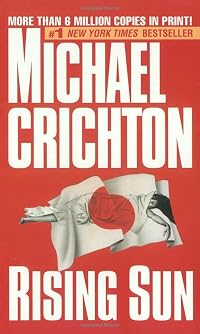
Rising Sun
by Michael Crichton
On This Page
Description
During the grand opening celebration of the new American headquarters of an immense Japanese conglomerate, the dead body of a beautiful woman is found. The investigation begins, and immediately becomes a headlong chase through a twisting maze of industrial intrigue and a violent business battle that takes no prisoners.Tags
Recommendations





Member Reviews
"Americans are eager to sell. It amazes the Japanese. They think we're committing economic suicide." (pg. 45)
I should have known better than to doubt Michael Crichton. Rising Sun looked, on the face of it, like an outdated and middle-ranked thriller. Despite the author's reputation, it certainly wasn't one of his most praised works and, what was more, it has been regularly accused of being a racist, or at least a reactionary, polemic. Even leaving aside my scepticism about that last point, as we're in a 'boy who cried wolf' situation regarding accusations of racism nowadays and it usually just means someone's said something interesting or mildly controversial, I had read that the book sacrificed its plot and characters for clumsy show more digressions into economics and anti-Japanese slurs.
All of which is complete bollocks. I ended up doing a complete 180 degrees on my impressions of Rising Sun, going from complete scepticism (picking up the book in a why-the-hell-not moment, more than a year after buying it in a charity shop) to being completely engrossed in its plotting and its purpose. It is a fine piece of thriller-writing – as you would imagine from someone who had just finished writing Jurassic Park – and it has a substantial message besides.
I won't go into that message too much, because, by God, Michael Crichton will, but suffice to say it's about the Japanese economic influence on America. "Business is war" to the Japanese, as Crichton repeatedly says (pg. 152), and his novel goes into shady and ruthless Japanese corporate practices, predatory investment strategies, the collusion and weakness of American regulators and businesses, and ultimately the almost wholly negative effect this has on the working man, the American taxpayer. "We don't make things anymore," one character laments (pg. 217), and though we've long been conditioned by our bought media and our political betters to scoff at this train of thought, it's a legitimate viewpoint. In the Fifties, a single paycheck could support an entire family and a house (pg. 109), and that just isn't the case anymore. And it's not an 'aw, shucks, what can ya do?' dilemma; Crichton shows how this is because of very definite economic and corporate practices.
Trade deficits, purchasing power, corporate takeovers and the like might not sound like the most compelling ingredients for a thriller, but Crichton leans heavily on the ruthlessness and the high stakes of the game and it's often arresting to read. Even if it's sometimes an over-simplification, there's a sort of thrill you get from thinking you're getting the skinny, the inside scoop. And as for this 1992 book being outdated, well, consider that accusations of racism are thrown at some of the characters to silence and intimidate them (which is about as contemporary as it gets in 2020), or that you could replace every mention of 'Japan' with 'China' and get something completely up to date, and even more concerning.
Aside from the stimulation these ideas provide in Crichton's pages (and the polemical asides and info-dumps are much more naturalistic and entertaining than most reviewers allow), Rising Sun is just a cracking good thriller. Crichton's writing style, even when discussing a difficult concept, is clean and simple, and the pages fly by. The murder of the young woman in the offices of a Japanese corporation is, commendably, kept front and centre throughout: the reader cares about the mystery and it's not just an excuse, a starting gun, for Crichton's story. There are some stellar plot twists, and the importance of Japanese cultural mores allows for some original dynamics between characters (as well as being something of a crash-course in Japanese etiquette). The characterisation is better than your average thriller, though I felt the protagonist, Peter Smith, was not very credible as a detective – he always seemed to be slow on the uptake. This, however, is in large part because of his role as an audience surrogate. He asks simple questions and has things explained to him because someone has to perform that role, if the reader isn't to lose their way.
Ultimately, however, it's the message that decides whether Rising Sun succeeds or fails, and whether it endures into our own times. Though its sun seems to have been eclipsed by Crichton's more well-known works, the labels of 'controversial', 'problematic' and particularly 'racist' are deeply unfair. The book is a provocative and well-written thriller that delivers an earnest and important message about American decline. Far from being racist, Crichton even raises the important point that most of this decline is self-inflicted (see my opening quote) and America needs to step it up, both in hard work and in countering its naivety and ignorance. "In no other country in the world… would you hear people calmly discussing the fact that their cities and states were sold to foreigners" (pg. 44). To which I can only say: Hello, America, greetings from England. It's just about the only point Crichton gets wrong. show less
I should have known better than to doubt Michael Crichton. Rising Sun looked, on the face of it, like an outdated and middle-ranked thriller. Despite the author's reputation, it certainly wasn't one of his most praised works and, what was more, it has been regularly accused of being a racist, or at least a reactionary, polemic. Even leaving aside my scepticism about that last point, as we're in a 'boy who cried wolf' situation regarding accusations of racism nowadays and it usually just means someone's said something interesting or mildly controversial, I had read that the book sacrificed its plot and characters for clumsy show more digressions into economics and anti-Japanese slurs.
All of which is complete bollocks. I ended up doing a complete 180 degrees on my impressions of Rising Sun, going from complete scepticism (picking up the book in a why-the-hell-not moment, more than a year after buying it in a charity shop) to being completely engrossed in its plotting and its purpose. It is a fine piece of thriller-writing – as you would imagine from someone who had just finished writing Jurassic Park – and it has a substantial message besides.
I won't go into that message too much, because, by God, Michael Crichton will, but suffice to say it's about the Japanese economic influence on America. "Business is war" to the Japanese, as Crichton repeatedly says (pg. 152), and his novel goes into shady and ruthless Japanese corporate practices, predatory investment strategies, the collusion and weakness of American regulators and businesses, and ultimately the almost wholly negative effect this has on the working man, the American taxpayer. "We don't make things anymore," one character laments (pg. 217), and though we've long been conditioned by our bought media and our political betters to scoff at this train of thought, it's a legitimate viewpoint. In the Fifties, a single paycheck could support an entire family and a house (pg. 109), and that just isn't the case anymore. And it's not an 'aw, shucks, what can ya do?' dilemma; Crichton shows how this is because of very definite economic and corporate practices.
Trade deficits, purchasing power, corporate takeovers and the like might not sound like the most compelling ingredients for a thriller, but Crichton leans heavily on the ruthlessness and the high stakes of the game and it's often arresting to read. Even if it's sometimes an over-simplification, there's a sort of thrill you get from thinking you're getting the skinny, the inside scoop. And as for this 1992 book being outdated, well, consider that accusations of racism are thrown at some of the characters to silence and intimidate them (which is about as contemporary as it gets in 2020), or that you could replace every mention of 'Japan' with 'China' and get something completely up to date, and even more concerning.
Aside from the stimulation these ideas provide in Crichton's pages (and the polemical asides and info-dumps are much more naturalistic and entertaining than most reviewers allow), Rising Sun is just a cracking good thriller. Crichton's writing style, even when discussing a difficult concept, is clean and simple, and the pages fly by. The murder of the young woman in the offices of a Japanese corporation is, commendably, kept front and centre throughout: the reader cares about the mystery and it's not just an excuse, a starting gun, for Crichton's story. There are some stellar plot twists, and the importance of Japanese cultural mores allows for some original dynamics between characters (as well as being something of a crash-course in Japanese etiquette). The characterisation is better than your average thriller, though I felt the protagonist, Peter Smith, was not very credible as a detective – he always seemed to be slow on the uptake. This, however, is in large part because of his role as an audience surrogate. He asks simple questions and has things explained to him because someone has to perform that role, if the reader isn't to lose their way.
Ultimately, however, it's the message that decides whether Rising Sun succeeds or fails, and whether it endures into our own times. Though its sun seems to have been eclipsed by Crichton's more well-known works, the labels of 'controversial', 'problematic' and particularly 'racist' are deeply unfair. The book is a provocative and well-written thriller that delivers an earnest and important message about American decline. Far from being racist, Crichton even raises the important point that most of this decline is self-inflicted (see my opening quote) and America needs to step it up, both in hard work and in countering its naivety and ignorance. "In no other country in the world… would you hear people calmly discussing the fact that their cities and states were sold to foreigners" (pg. 44). To which I can only say: Hello, America, greetings from England. It's just about the only point Crichton gets wrong. show less
There's an old saying in Japan. Or at least I assume there is; people have been living there for over 30 000 years, I'd say they've been slacking if they haven't come up with a saying in that time. I don't know any old Japanese sayings because most of what I know about Japan is based on watching anime and Japanese horror films and reading manga, so all I know for sure is that all the men have huge crazy hair, all the women have huge crazy breasts, and every problem is solved by playing children's card games. Quite how much you know about Japan and more to the point where you are on the Japanophilia scale will probably have a not inconsiderable impact on your enjoyment of Rising Sun.
Like several of Michael Crichton's books, Rising Sun show more is a vehicle for him to talk about an issue facing America or science within the trappings of a well-paced thriller. In [b:State of Fear|15860|State of Fear|Michael Crichton|http://photo.goodreads.com/books/1166695731s/15860.jpg|1749610] the issue was global warming and the inability of either side of the (non-)debate to discuss the matter calmly or rationally; in [b:Jurassic Park|12596223|Jurassic Park (Jurassic Park #1)|Michael Crichton|http://photo.goodreads.com/books/1315827012s/12596223.jpg|3376836] he discussed the dangers of wandering around a central American island full of bitey velociraptors without carrying a honking great gun; and in this murder mystery it's America's inability to cope with Japan's way of doing business. And like several of Michael Crichton's books, many people seem to take umbrage with the content without apparently having read the book. With State of Fear people bemoaned Crichton's global warming denialism, apparently ignoring the part where he says global warming is happening but deigned to question the current methods being used to tackle it; with Jurassic Park people complained that you can't really clone dinosaurs from the contents of mosquitoes stomachs, and that dinosaurs actually had feathers, apparently ignoring the part where he says it's a bad idea to wander around a central American island full of bitey velociraptors without carrying a honking great gun; and here in Rising Sun a common cry is that Crichton is racist, ignoring the fact that the book's message is that America and Japan have two very different ways of doing business, indeed America and Japan are two very different countries – but some people can't read “different” without assuming that means “better” or “worse” and so decide the message here must be a priori racist, ignoring the fact that, if anything, Crichton suggests the Japanese way is better and America needs to shape up or ship out, to use the vernacular.
Ignoring all these concerns which have nothing to do with elephants and thus are irrelephant, the novel is up to Crichton's typical high standard if full of the usual long speeches and modestly disguised diatribes on the issue in question. Since the issues in question are economic rather than scientific these soliloquies didn't hold my interest especially well, but the trappings that surround these artifices are a satisfying thriller in their own right. show less
Like several of Michael Crichton's books, Rising Sun show more is a vehicle for him to talk about an issue facing America or science within the trappings of a well-paced thriller. In [b:State of Fear|15860|State of Fear|Michael Crichton|http://photo.goodreads.com/books/1166695731s/15860.jpg|1749610] the issue was global warming and the inability of either side of the (non-)debate to discuss the matter calmly or rationally; in [b:Jurassic Park|12596223|Jurassic Park (Jurassic Park #1)|Michael Crichton|http://photo.goodreads.com/books/1315827012s/12596223.jpg|3376836] he discussed the dangers of wandering around a central American island full of bitey velociraptors without carrying a honking great gun; and in this murder mystery it's America's inability to cope with Japan's way of doing business. And like several of Michael Crichton's books, many people seem to take umbrage with the content without apparently having read the book. With State of Fear people bemoaned Crichton's global warming denialism, apparently ignoring the part where he says global warming is happening but deigned to question the current methods being used to tackle it; with Jurassic Park people complained that you can't really clone dinosaurs from the contents of mosquitoes stomachs, and that dinosaurs actually had feathers, apparently ignoring the part where he says it's a bad idea to wander around a central American island full of bitey velociraptors without carrying a honking great gun; and here in Rising Sun a common cry is that Crichton is racist, ignoring the fact that the book's message is that America and Japan have two very different ways of doing business, indeed America and Japan are two very different countries – but some people can't read “different” without assuming that means “better” or “worse” and so decide the message here must be a priori racist, ignoring the fact that, if anything, Crichton suggests the Japanese way is better and America needs to shape up or ship out, to use the vernacular.
Ignoring all these concerns which have nothing to do with elephants and thus are irrelephant, the novel is up to Crichton's typical high standard if full of the usual long speeches and modestly disguised diatribes on the issue in question. Since the issues in question are economic rather than scientific these soliloquies didn't hold my interest especially well, but the trappings that surround these artifices are a satisfying thriller in their own right. show less
This is very interesting book because of two things in general. First it is very fine crime story set in high tech world of 1990's. Characters are very well done especially Connor and Japanese businessmen involved in the incident.
Second is the whole talk about racism in this book. I think people need to learn the difference between the meaning of words "nationalism" and "racism". In my opinion Crichton is a staunch nationalist. It is interesting how people got concentrated around his portrayal of Japanese company doing business in America that they completely skipped the very unfavorable depiction of money grabbing American society that is willing to sell everything for a short term gain without thinking about the future. It is very show more clear how he feels about American industry losing its captains and primacy in the world because it is much easier to be a lawyer or banker and shuffle paper and play with stocks with someone else's money. Gains are high, risk is rather low (basically people who hired you are at risk) - whats not to like, right? Except that industry slowly decays until majority of goods is produced in some remote sweatshop. Which is all fine I guess for big-money-makers but in general when proverbial object hits the fan then it becomes very obvious that multiple countries are so interconnected that one wrong move and everybody goes to the bottom. Picture of America is anything but flattering in here but interestingly everybody went over this (which is even more disturbing to me).
Was Crichton wrong at the end? I guess he was but only in location of far eastern country (China anybody?) but again him being staunch nationalist that is expected and don't forget he wrote the book at specific time period when Japan was dominant. And keep in mind this is work of fiction.
Now lets look at Japanese - I don't get what is so wrong with depiction of them in this novel. They are big company ready to do whatever is necessary to achieve their goal. If this was American or any other company (Baldacci's Total Control comes to mind) nobody would say anything. They have different approach to business but this is due to cultural differences - and believe me there are definitely differences between the way West and East approach business. I wonder if book "Doing Business with Germans: Their Perception, Our Perception" in which American businessmen are instructed what to avoid when dealing with Germans (stick to business and skip all the familiarity, patting and talking about personal matters, be precise and specific etc) would also be marked as racist? Crichton's nationalism is reflected in his admiration for the way Japan society works and plans. Especially in regard to education and securing the foothold in the foreign markets from the start, knowing that it will pay out in the long run. Basically Crichton is wishing American economy had a same view of the future and its own work-force.
Japanese company in story is presented as an economic empire willing to obtain additional (and very crucial) piece of the world market. And if they have to work in individualistic America that cherishes money over everything else of course they will utilize every means possible to achieve their goals. When caught they will obey the word of the law but the aim is not to get caught. Therefore all the machinations are nothing so groundbreaking, nothing that was not seen in any other novel that has big business and multinational companies as its subject.
Story is good with sufficient number of twists to keep reader wandering what is going to happen. If you like a good thriller give it a try. show less
Second is the whole talk about racism in this book. I think people need to learn the difference between the meaning of words "nationalism" and "racism". In my opinion Crichton is a staunch nationalist. It is interesting how people got concentrated around his portrayal of Japanese company doing business in America that they completely skipped the very unfavorable depiction of money grabbing American society that is willing to sell everything for a short term gain without thinking about the future. It is very show more clear how he feels about American industry losing its captains and primacy in the world because it is much easier to be a lawyer or banker and shuffle paper and play with stocks with someone else's money. Gains are high, risk is rather low (basically people who hired you are at risk) - whats not to like, right? Except that industry slowly decays until majority of goods is produced in some remote sweatshop. Which is all fine I guess for big-money-makers but in general when proverbial object hits the fan then it becomes very obvious that multiple countries are so interconnected that one wrong move and everybody goes to the bottom. Picture of America is anything but flattering in here but interestingly everybody went over this (which is even more disturbing to me).
Was Crichton wrong at the end? I guess he was but only in location of far eastern country (China anybody?) but again him being staunch nationalist that is expected and don't forget he wrote the book at specific time period when Japan was dominant. And keep in mind this is work of fiction.
Now lets look at Japanese - I don't get what is so wrong with depiction of them in this novel. They are big company ready to do whatever is necessary to achieve their goal. If this was American or any other company (Baldacci's Total Control comes to mind) nobody would say anything. They have different approach to business but this is due to cultural differences - and believe me there are definitely differences between the way West and East approach business. I wonder if book "Doing Business with Germans: Their Perception, Our Perception" in which American businessmen are instructed what to avoid when dealing with Germans (stick to business and skip all the familiarity, patting and talking about personal matters, be precise and specific etc) would also be marked as racist? Crichton's nationalism is reflected in his admiration for the way Japan society works and plans. Especially in regard to education and securing the foothold in the foreign markets from the start, knowing that it will pay out in the long run. Basically Crichton is wishing American economy had a same view of the future and its own work-force.
Japanese company in story is presented as an economic empire willing to obtain additional (and very crucial) piece of the world market. And if they have to work in individualistic America that cherishes money over everything else of course they will utilize every means possible to achieve their goals. When caught they will obey the word of the law but the aim is not to get caught. Therefore all the machinations are nothing so groundbreaking, nothing that was not seen in any other novel that has big business and multinational companies as its subject.
Story is good with sufficient number of twists to keep reader wandering what is going to happen. If you like a good thriller give it a try. show less
A slow story, hopelessly dated and full of racist propaganda and dire ridiculous warnings. As a person raised during the era when "we had all best learn Japanese" (according to some), I can at least remember this time.
If you're too young to remember the cola wars, this book is best skipped. A sort of nationalist alarmist fabric with a rather dull and lackluster plot laboriously tacked onto it, it has none of the things I like about Crichton.
If you're too young to remember the cola wars, this book is best skipped. A sort of nationalist alarmist fabric with a rather dull and lackluster plot laboriously tacked onto it, it has none of the things I like about Crichton.
The late, great Michael Creighton has written a murder mystery here but he has also taken the opportunity to use this theme to express his own personal commentary about Japanese competition with America in the world of business competition. This is not the only novel in which he voices editorial commentary within he scope of the book’s plot, and I almost suspect that he wrote this book for the specific purpose of advocating his views within the scope of a novel.
I’m not really a fan of the murder mystery genre - that’s my wife’s domain, so I really don’t feel very comfortable rating this book from that aspect. But I am very comfortable within the field of politics and this book is loaded with it. And I love books that make me show more think deeply about ideas and beliefs I have held - and this book certainly did that as well. And for that, I gave it a fourth star. And that is what my review will focus on.
I have been an advocate of free trade for some time now. I still am, but this book has really caused me to realize there is more to this than I have previously considered. There are certain business practices that are illegal for American companies to pursue, but high foreign countries do not seem to be restrained by, putting American companies at an unfair advantage. “Japanese companies and the Japanese government target specific industries, which they take over. Industry after industry, year after year. While we sit around and spout off about free trade. And the Japanese don’t believe in fair trade at all. You know, there’s a reason the Japanese love Reagan. They cleaned up during his presidency.” (P. 229). What’s not fair about it? They’re closed to us. We’re open to them. This was dramatically illustrated a little later when described Oklahoma State University alumnus oil tycoon T. Boone Pickens’ attempt at a hostile takeover of a Japanese company called Koito which is an auto parts maker. “A few years ago, T. Boone Pickens bought one-fourth [20.2%] of the stock of a Japanese company, but he couldn’t get on the board of directors. Japan is closed.” (P. 281). This is confirmed by an article from the Los Angeles Times of June 30, 1989, in which Pickens declares “You invest freely in my country, the United States, … yet I invest in Japan and am excluded. Trade and investment opportunities between our two countries are simply not a two-way street.”
A couple of years later T. Boone Pickens was so frustrated with Japan he decided to get out entirely. “… I’m not interested in being a 26 percent owner in a company in which I have no influence.” (Seattle Times, June 9, 1991).
If a multibillionaire like the late T. Boone Pickens can be totally frustrated by Japan, what chance has anyone else? Then Creighton states, “… if you sell the country to Japan, then they will own it, whether you like it or not. And people who own things do what they want with them.” (P. 388).
Well, that’s certainly food for thought. I’m not sure I agree with the sentiment. After all, I own my house yet I can’t do just anything I want with it. Also, it’s been about 30 years now since the book was copyrighted and, as of February 3, 2022, according investopedia.com, the USA is ranked #1 with a 24.67 percent share of the global market, China is #2 at 17.39 percent, and Japan is #3 at 5.97 percent. To this individual who admits to being uneducated in the world of international economics, this seems to indicate that Japan has yet to overtake us. However, as of January 21, 2020, according to the U.S. State Department, Japan has invested some $480 billion in our economy and employs some 860,000 Americans in various jobs. Is this good or bad? I’ll let you decide that. show less
I’m not really a fan of the murder mystery genre - that’s my wife’s domain, so I really don’t feel very comfortable rating this book from that aspect. But I am very comfortable within the field of politics and this book is loaded with it. And I love books that make me show more think deeply about ideas and beliefs I have held - and this book certainly did that as well. And for that, I gave it a fourth star. And that is what my review will focus on.
I have been an advocate of free trade for some time now. I still am, but this book has really caused me to realize there is more to this than I have previously considered. There are certain business practices that are illegal for American companies to pursue, but high foreign countries do not seem to be restrained by, putting American companies at an unfair advantage. “Japanese companies and the Japanese government target specific industries, which they take over. Industry after industry, year after year. While we sit around and spout off about free trade. And the Japanese don’t believe in fair trade at all. You know, there’s a reason the Japanese love Reagan. They cleaned up during his presidency.” (P. 229). What’s not fair about it? They’re closed to us. We’re open to them. This was dramatically illustrated a little later when described Oklahoma State University alumnus oil tycoon T. Boone Pickens’ attempt at a hostile takeover of a Japanese company called Koito which is an auto parts maker. “A few years ago, T. Boone Pickens bought one-fourth [20.2%] of the stock of a Japanese company, but he couldn’t get on the board of directors. Japan is closed.” (P. 281). This is confirmed by an article from the Los Angeles Times of June 30, 1989, in which Pickens declares “You invest freely in my country, the United States, … yet I invest in Japan and am excluded. Trade and investment opportunities between our two countries are simply not a two-way street.”
A couple of years later T. Boone Pickens was so frustrated with Japan he decided to get out entirely. “… I’m not interested in being a 26 percent owner in a company in which I have no influence.” (Seattle Times, June 9, 1991).
If a multibillionaire like the late T. Boone Pickens can be totally frustrated by Japan, what chance has anyone else? Then Creighton states, “… if you sell the country to Japan, then they will own it, whether you like it or not. And people who own things do what they want with them.” (P. 388).
Well, that’s certainly food for thought. I’m not sure I agree with the sentiment. After all, I own my house yet I can’t do just anything I want with it. Also, it’s been about 30 years now since the book was copyrighted and, as of February 3, 2022, according investopedia.com, the USA is ranked #1 with a 24.67 percent share of the global market, China is #2 at 17.39 percent, and Japan is #3 at 5.97 percent. To this individual who admits to being uneducated in the world of international economics, this seems to indicate that Japan has yet to overtake us. However, as of January 21, 2020, according to the U.S. State Department, Japan has invested some $480 billion in our economy and employs some 860,000 Americans in various jobs. Is this good or bad? I’ll let you decide that. show less
This is a fast-paced, competent novel of suspense, murder and international politics between the USA and Japan, in which a Special Services operative, Peter Smith, is called upon to solve the murder of a young Caucasian woman at the opening celebration party of the Nakamoto Tower in Los Angeles. With the help of John Connor, a legendary retired Special Services operative who has spent time in Japan and knows their customs and language, he attempts to penetrate the wall of differing cultures and attitudes that block him from obtaining the truth. This is fairly faithful to the later movie with Wesley Snipes and Sean Connery. It is somewhat marred by Crichton's wariness of the Japanese, which shows in the storyline, John Connor's attitude, show more and the afterword that follows the conclusion. Crichton is warning us that the Japanese see business as war, and are set on financially conquering this country and becoming our masters. I don't know enough about Japan to know if there's any truth to this, but Crichton wrote of this as an imminent threat 24 years ago, and I don't see any evidence of it yet. show less
Michael Crichton's books are hit or miss. Rising Sun is a miss. I think it's supposed to be taking place during the mid to late 1980s when there was an influx of Japanese business ventures in the United States -- especially in California. I remember the xenophobic response from some people of my parents age and especially of people my grandparents age (not everyone, of course). As a teenager, I was surprised, confused and later embarrassed by the reactions of my relatives.
Rising Sun is clearly playing into those sentiments and frankly I don't like it. Both cultures, American and Japanese in this book are reduced to stereotypal representations making for a boring, predicatable and insulting read.
Rising Sun is clearly playing into those sentiments and frankly I don't like it. Both cultures, American and Japanese in this book are reduced to stereotypal representations making for a boring, predicatable and insulting read.
Members
- Recently Added By
Lists

Novels that you shouldn't waste your time on
94 works; 52 members

Books About Murder
313 works; 7 members

Biggest Disappointments
606 works; 163 members

Best Workplace Fiction
47 works; 18 members

Very Very Bad
22 works; 7 members
Author Information

John Michael Crichton, known as Michael Crichton, was born on October 28, 1942 in Chicago, Illinois. He wrote novels while attending Harvard University and Harvard Medical School to help pay the tuition. One of these, The Andromeda Strain, which was published in 1969, became a bestseller. After graduating summa cum laude, he was a postdoctoral show more fellow at the Salk Institute in California before becoming a full-time writer and film director. His carefully researched novels included Eaters of the Dead, The Terminal Man, The Great Train Robbery, Congo, Sphere, Jurassic Park, Rising Sun, Disclosure, The Lost World, Airframe, and Micro. He also wrote non-fiction works including Five Patients: The Hospital Explained, Jasper Johns, and Travels. In the late 1960s, he also wrote under the pen names Jeffrey Hudson and John Lange. He has received several awards including Writer of the Year in 1970 from the Association of American Medical Writers and two Edgar Awards in 1968 and in 1979. Many of his novels have been made into highly successful films, six of which he directed. He was also the creator and executive producer of the Emmy Award-winning television series ER. In addition to his writing and directorial success, his expertise in information science enabled him to run a software company and develop a computer game. He died of cancer on November 4, 2008 at the age of 66. (Bowker Author Biography) show less
Awards and Honors
Distinctions
Series
Belongs to Publisher Series
Work Relationships
Is contained in
Has the adaptation
Common Knowledge
- Canonical title
- Rising Sun
- Original title
- Rising Sun
- Original publication date
- 1992-03; 1993-01 (1st Ballantine Books edt.) (1st Ballantine Books edt.)
- People/Characters
- Peter Smith; John Connor
- Important places
- Los Angeles, California, USA
- Related movies
- Rising Sun (1993 | IMDb)
- Epigraph
- We are entering a world where the old rules no longer apply. --Phillip Sanders
Business is war. --Japanese motto - Dedication
- To my mother, Zula Mille Crichton
- First words
- Actually, I was sitting on my bed in my apartment in Culver City, watching the Lakers game with the sound turned off, while I tried to study vocabulary for my introductory Japanese class.
- Quotations
- Er wacht ons een wereld waarin de oude regels niet meer van toepassing zijn. (Phillip Sanders)
Zakendoen is oorlog. (Japans motto) - Last words
- (Click to show. Warning: May contain spoilers.)I'm still waiting.
(Click to show. Warning: May contain spoilers.)Afterword: The Japanese are not our saviors. They are our competitors. We should not forget it. - Original language
- English
Classifications
Statistics
- Members
- 5,992
- Popularity
- 2,151
- Reviews
- 56
- Rating
- (3.37)
- Languages
- 18 — Chinese, Czech, Danish, Dutch, English, Finnish, French, German, Greek, Hungarian, Italian, Japanese, Lithuanian, Norwegian (Bokmål), Polish, Spanish, Swedish, Portuguese (Portugal)
- Media
- Paper, Audiobook, Ebook
- ISBNs
- 92
- UPCs
- 1
- ASINs
- 44