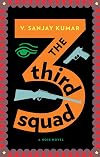
The Third Squad
by V. Sanjay Kumar
On This Page
Description
"Belonging to an elite hit squad whose members all fall somewhere along the autism spectrum, Karan is notorious for his ruthless efficiency carrying out the exdtrajudicial assassinations the Indian Police Service is notorious for. Yet Karan's impenetrable fac ?ade begins to crack: Should he continue to follow morally suspect orders, or is it time to take matters into his own hands?"--Cover, p. [4] "A melancholy cop's obsessions are just the tip of the iceberg as he leads a two-fisted team show more determined to clean up Mumbai's mean streets...Kumar's style, blunt but often by turns poetic and droll, is arresting...As unusual as it is compelling, this entry lays the groundwork for an entertaining series." -- Kirkus Reviews show lessTags
Recommendations












































Member Reviews
Simply stunning read about a police hit squad composed of officers with autism spectrum syndrome. As the parent of an autistic, I was truly shaken. Aspects of the syndrome make the central character Karan uniquely qualified in his tasks, but it takes its toll. The peek into the poverty and corruption of Mumbai is simply fascinating, as is Karan's marriage. The view remains unflinching right to the end. I was both relieved to escape and sad to leave this exquisitely drawn world. Offered as a "noir novel," I'd recommend this amazing story to more than just fans of crime fiction. Kudos to the author, who got everything right.
 This review was written for LibraryThing Early Reviewers.
Kumar's noir novel is a beautiful study of character and corruption in a police force and culture completely foreign to me. This story was compelling, thoughtful, and amazingly thrilling in the most nonchalant and droll way (and I mean that as a wonderful compliment).
By treating such a gruesome topic as assignation by police in such a casual and character driven way, rather than high action and straight violence, the situations and characters become humanize Dina terrifying way.
This story was amazingly written and extremely complex. I look forward to reading it again.
By treating such a gruesome topic as assignation by police in such a casual and character driven way, rather than high action and straight violence, the situations and characters become humanize Dina terrifying way.
This story was amazingly written and extremely complex. I look forward to reading it again.
This review was written for LibraryThing Early Reviewers.The Third Squad is a novel that centers around the "encounter killings" carried out by the Indian Police Service, extrajudicial killings the police use to take out criminals they can't prosecute legally. The novel is divided into three books.
The first book focuses on Karan, an encounter specialist with Asperger's syndrome. His wife strongly opposes his work and this causes problems in his marriage as well as at work because his bosses believe his wife's disapproval will affect his ability to do his job. He is, however, exceptionally good at these encounter killings and takes pride in the work that he does.
The second book follows the side characters related to Karan who were introduced in the first book. Here we get a clearer picture of show more the circumstances that shaped Karan and a view of things Karan has no knowledge of. The encounter killings are controversial and Karan's squad is particularly concerning to the other police squads. There is a power struggle between two of the departments and a lot of political chess moves happening that Karan remains oblivious to.
Book 3 splits its time between Karan and the others that were the focus of book 2 as Karan becomes unwittingly wrapped up in the power struggle between the two departments.
All the characters live in shades of gray with some being more villainous and some being more heroic than others. The reader is thrust into a world of extreme choices where all the characters are in situations that force them to rationalize their own immoral behavior.
The discussion of Asperger's syndrome in the book is actually handled surprisingly well. Something like that has the potential to be very gimmicky but it was rather interesting. All of the characters have their own unique "morality" and Karan's Asperger's syndrome is treated as another element that has the potential to shape a person's world view.
The book changes perspective frequently and jumps back and forth in time almost as often. The story is told in a roundabout way with even minor characters getting backstory and most settings intensely described. We get a very vivid portrait of the world this story takes place in. The first two books are fascinating because the 'end game' of the book is obscured. You don't really get a clear picture of the overarching plot until the third book starts. I was fascinated by the method of storytelling and the story itself. I look forward to retreading it as it is one of those books with enough layers to require a reread. show less
The first book focuses on Karan, an encounter specialist with Asperger's syndrome. His wife strongly opposes his work and this causes problems in his marriage as well as at work because his bosses believe his wife's disapproval will affect his ability to do his job. He is, however, exceptionally good at these encounter killings and takes pride in the work that he does.
The second book follows the side characters related to Karan who were introduced in the first book. Here we get a clearer picture of show more the circumstances that shaped Karan and a view of things Karan has no knowledge of. The encounter killings are controversial and Karan's squad is particularly concerning to the other police squads. There is a power struggle between two of the departments and a lot of political chess moves happening that Karan remains oblivious to.
Book 3 splits its time between Karan and the others that were the focus of book 2 as Karan becomes unwittingly wrapped up in the power struggle between the two departments.
All the characters live in shades of gray with some being more villainous and some being more heroic than others. The reader is thrust into a world of extreme choices where all the characters are in situations that force them to rationalize their own immoral behavior.
The discussion of Asperger's syndrome in the book is actually handled surprisingly well. Something like that has the potential to be very gimmicky but it was rather interesting. All of the characters have their own unique "morality" and Karan's Asperger's syndrome is treated as another element that has the potential to shape a person's world view.
The book changes perspective frequently and jumps back and forth in time almost as often. The story is told in a roundabout way with even minor characters getting backstory and most settings intensely described. We get a very vivid portrait of the world this story takes place in. The first two books are fascinating because the 'end game' of the book is obscured. You don't really get a clear picture of the overarching plot until the third book starts. I was fascinated by the method of storytelling and the story itself. I look forward to retreading it as it is one of those books with enough layers to require a reread. show less
This review was written for LibraryThing Early Reviewers.I received a free copy of this book in exchange for an honest review.
I completely enjoyed reading this thriller in the noir tradition, set in modern-day India. The plot is unusual: a police unit of assassins, in which all the assassins have Asperger's syndrome. It seems an unlikely premise that the police could have their own assassination squad with seemingly little oversight, but I was willing to suspend disbelief in order to follow the story to its perhaps inevitable conclusion. In the classic noir tradition, many of the characters have both good and (sometimes very) evil qualities; some who should be good are in fact not good at all, and nearly all the characters have a complicated relationship with good, evil, and even truth. I may show more be a bit biased, because I love reading stories set in India, and thought that the liberal use of (untranslated) slang was a lot of fun, as well as the tours through Mumbai neighborhoods. The right person could make this into a really interesting movie.... show less
I completely enjoyed reading this thriller in the noir tradition, set in modern-day India. The plot is unusual: a police unit of assassins, in which all the assassins have Asperger's syndrome. It seems an unlikely premise that the police could have their own assassination squad with seemingly little oversight, but I was willing to suspend disbelief in order to follow the story to its perhaps inevitable conclusion. In the classic noir tradition, many of the characters have both good and (sometimes very) evil qualities; some who should be good are in fact not good at all, and nearly all the characters have a complicated relationship with good, evil, and even truth. I may show more be a bit biased, because I love reading stories set in India, and thought that the liberal use of (untranslated) slang was a lot of fun, as well as the tours through Mumbai neighborhoods. The right person could make this into a really interesting movie.... show less
This review was written for LibraryThing Early Reviewers.I very much enjoy reading crime fiction, particularly the type that is so dark and surreal that it has been tagged with the words “noir fiction” as the best way to describe it. That means that most of my favorite fictional detectives tend to live rather bleak lives on their own, usually estranged from an ex-wife or two and, often enough, even from their children. They drink too much, don’t sleep nearly enough, chain-smoke as the rest of the world scowls at them, and wouldn’t recognize a proper meal if someone accidentally brought it to their table. They are good detectives, but losers at the game of life – a characteristic shared by most of the characters in this kind of fiction. Seldom are there clean winners in these books; show more when the smoke finally clears life just goes on much as it always has for most everyone concerned.
All of this is what drew me to V. Sanjay Kumar’s The Third Squad, a new novel whose publisher has labeled it a “ripped-from-the-headlines noir novel” about the Indian Police Service’s decision to assassinate hundreds of suspected criminals without ever bringing formal charges against them. Apparently the Mumbai police see this as the best chance police have of stemming the growth of criminal activity in that city. So much so, in fact, that numerous hit squads have been assembled to carry out the deadly work required of them. All of this (even though it is based upon fact) has that surreal feel to it that I expect from noir fiction and would be “dark” simply by definition. But throw in the book’s setting, a city teeming with people, potential crime, and a rogue police force, and what could be more perfect for fans of noir writing. Right? Well, not so fast.
The best thing about The Third Squad is the nature of the particular hit squad of which its chief character is a member. It seems that one of the Mumbai police higher-ups has come up with the theory that the best assassins all fall somewhere along the scale that measures autism – and he begins to recruit those types for further training. None of these men, despite being aware that they are a little different when it comes to social skills and the like, has any idea that autism is what makes them feel so different. All of this works very well for the man who put the squad together until Karan (who has a relatively mild case of Asperger’s syndrome) begins to grow a conscious – and refuses to kill anyone he does not “know.”
Kumar’s portrayal of the various degrees of autism and those who have it is interesting and gives the impression that the illness has been well researched by the author. This aspect of the novel, alone, guarantees that The Third Squad will be one to stick in the minds of its readers. Too, Kumar does a masterful job building the story’s tension level as Karan draws closer and closer to his final confrontation with his superiors in the Indian Police Service.
So why did it not work for me as well as I hoped it would? Simply put, I found it difficult to distinguish between some of the characters and to keep the long Indian surnames clear in my mind. The plot is a very complicated one involving much in-fighting and backstabbing, flash backs, stream-of-consciousness thinking, dreams, and subplots, and I found it all a bit confusing. I blame some of my confusion on myself – perhaps my mind drifted at the wrong moments, etc. – but I have to believe that a more straightforward telling of this one would have delivered a more striking tale than the one ultimately delivered by the author.
Bottom Line: There is a lot to like about The Third Squad, a whole lot, in fact - and a little to dislike about it. It’s not a perfect novel, but it’s one I’m going to remember for a while because of its unique plot. show less
All of this is what drew me to V. Sanjay Kumar’s The Third Squad, a new novel whose publisher has labeled it a “ripped-from-the-headlines noir novel” about the Indian Police Service’s decision to assassinate hundreds of suspected criminals without ever bringing formal charges against them. Apparently the Mumbai police see this as the best chance police have of stemming the growth of criminal activity in that city. So much so, in fact, that numerous hit squads have been assembled to carry out the deadly work required of them. All of this (even though it is based upon fact) has that surreal feel to it that I expect from noir fiction and would be “dark” simply by definition. But throw in the book’s setting, a city teeming with people, potential crime, and a rogue police force, and what could be more perfect for fans of noir writing. Right? Well, not so fast.
The best thing about The Third Squad is the nature of the particular hit squad of which its chief character is a member. It seems that one of the Mumbai police higher-ups has come up with the theory that the best assassins all fall somewhere along the scale that measures autism – and he begins to recruit those types for further training. None of these men, despite being aware that they are a little different when it comes to social skills and the like, has any idea that autism is what makes them feel so different. All of this works very well for the man who put the squad together until Karan (who has a relatively mild case of Asperger’s syndrome) begins to grow a conscious – and refuses to kill anyone he does not “know.”
Kumar’s portrayal of the various degrees of autism and those who have it is interesting and gives the impression that the illness has been well researched by the author. This aspect of the novel, alone, guarantees that The Third Squad will be one to stick in the minds of its readers. Too, Kumar does a masterful job building the story’s tension level as Karan draws closer and closer to his final confrontation with his superiors in the Indian Police Service.
So why did it not work for me as well as I hoped it would? Simply put, I found it difficult to distinguish between some of the characters and to keep the long Indian surnames clear in my mind. The plot is a very complicated one involving much in-fighting and backstabbing, flash backs, stream-of-consciousness thinking, dreams, and subplots, and I found it all a bit confusing. I blame some of my confusion on myself – perhaps my mind drifted at the wrong moments, etc. – but I have to believe that a more straightforward telling of this one would have delivered a more striking tale than the one ultimately delivered by the author.
Bottom Line: There is a lot to like about The Third Squad, a whole lot, in fact - and a little to dislike about it. It’s not a perfect novel, but it’s one I’m going to remember for a while because of its unique plot. show less
This review was written for LibraryThing Early Reviewers.THE THIRD SQUAD by V. Sanjay Kumar is a very interesting, very distinct title in Akashic Books noir series.
Akashic Books has quite a few noir titles which range around the globe from Chile to Belfast (Northern Ireland) to Oakland (California) to Mumbai - well, you get my drift.
I thank Akashic Books for making titles available to me in exchange for an unbiased, honest review.
Please go online at Akashic Books to view their catalog. It is quite eclectic and quite extensive.
THE THIRD SQUAD takes place in Mumbai and refers to an elite hit squad (very loosely connected with the official police force) that targets and kills suspected criminals. This is outside of a normal justice protocol and the court system - a (controlled) vigilante show more justice.
Our main character, Karan, is an ‘encounter specialist’ (a.k.a. assassin) in the Third Squad. His controller is Ranvir Pratap. Pratap’s controller is Parthasarathy, and the person in the middle is Tiwari, who operates a spy unit or information unit known as the Khabiri Squad. Tiwari’s nickname is ‘King Rat’.
On the periphery is Evam Bashkar who helps Ranvir Pratap with the recruitment of ‘Aspies’ or autistics for the elite Third Squad. Evam runs a home for autistic children and their parents. A doctor of child psychology, “Evam Bhaskar was a social misfit. In his dreams he was a miscast hero, but in life he was just another abject Mumbaikar. He peddled sex for a living and ran a home for idiot savants on the side.” (p.158) I found Evam to be a very interesting character.
Then there is Nandini, Karan’s wife, who tries desperately to understand and save her husband.
The sense of place in this title is incredible. Mumbai is center-stage. A great description of Mumbai occurs on p. 23 as “shape-shifting”. Mumbai seems to have a metamorphosis characteristic of completely transforming its physical shape to the onlooker.
The title is very raw and gritty, with close-up assassinations; extremely complex characters with seemingly psychological ailments or at best mood-swing disorders; and many layered plot lines. It is culturally puzzling at times; a true noir, highlighting cynicism, fatalism and moral ambiguity.
This is one of the most different, fascinating books I have read in a long time and I would highly recommend it. show less
Akashic Books has quite a few noir titles which range around the globe from Chile to Belfast (Northern Ireland) to Oakland (California) to Mumbai - well, you get my drift.
I thank Akashic Books for making titles available to me in exchange for an unbiased, honest review.
Please go online at Akashic Books to view their catalog. It is quite eclectic and quite extensive.
THE THIRD SQUAD takes place in Mumbai and refers to an elite hit squad (very loosely connected with the official police force) that targets and kills suspected criminals. This is outside of a normal justice protocol and the court system - a (controlled) vigilante show more justice.
Our main character, Karan, is an ‘encounter specialist’ (a.k.a. assassin) in the Third Squad. His controller is Ranvir Pratap. Pratap’s controller is Parthasarathy, and the person in the middle is Tiwari, who operates a spy unit or information unit known as the Khabiri Squad. Tiwari’s nickname is ‘King Rat’.
On the periphery is Evam Bashkar who helps Ranvir Pratap with the recruitment of ‘Aspies’ or autistics for the elite Third Squad. Evam runs a home for autistic children and their parents. A doctor of child psychology, “Evam Bhaskar was a social misfit. In his dreams he was a miscast hero, but in life he was just another abject Mumbaikar. He peddled sex for a living and ran a home for idiot savants on the side.” (p.158) I found Evam to be a very interesting character.
Then there is Nandini, Karan’s wife, who tries desperately to understand and save her husband.
The sense of place in this title is incredible. Mumbai is center-stage. A great description of Mumbai occurs on p. 23 as “shape-shifting”. Mumbai seems to have a metamorphosis characteristic of completely transforming its physical shape to the onlooker.
The title is very raw and gritty, with close-up assassinations; extremely complex characters with seemingly psychological ailments or at best mood-swing disorders; and many layered plot lines. It is culturally puzzling at times; a true noir, highlighting cynicism, fatalism and moral ambiguity.
This is one of the most different, fascinating books I have read in a long time and I would highly recommend it. show less
A very well-written and thought-out noir crime novel set in Bombay about a hit-squad created by the police to take out criminals who can't easily be brought to justice. The hit-men all "Aspies", guys with Asperger Syndrome, who in theory can follow orders and feel no remorse. Highly recommended for those into noir fiction, and maybe for those interested in Indian fiction, although it's very dark. My only incredibly minor suggestion is that the book could have included a glossary of a few dozen Hindi terms used in the book that were a little difficult to figure out from the context.
This review was written for LibraryThing Early Reviewers.Members
- Recently Added By
Lists

Noirvember: The Best Noir
113 works; 56 members
Author Information

6 Works 44 Members
Classifications
Statistics
- Members
- 30
- Popularity
- 928,110
- Reviews
- 10
- Rating
- (3.92)
- Languages
- English
- Media
- Paper, Ebook
- ISBNs
- 2
- ASINs
- 1