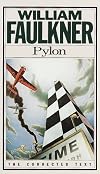
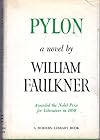
Pylon
by William Faulkner
On This Page
Description
One of the few of William Faulkner?s works to be set outside his fictional Yoknapatawpha County, Pylon, first published in 1935, takes place at an air show in a thinly disguised New Orleans named New Valois. An unnamed reporter for a local newspaper tries to understand a very modern m?nage a trois of flyers on the brainstorming circuit. These characters, Faulkner said, were a fantastic and bizarre phenomenon on the face of the contemporary scene. . . . That is, there was really no place for show more them in the culture, in the economy, yet they were there, at that time, and everyone knew that they wouldn?t last very long, which they didn?t. . . . That they were outside the range of God, not only of respectability, of love, but of God too. In Pylon Faulkner set out to test their rootless modernity to see if there is any place in it for the old values of the human heart that are the central concerns of his best fiction. -- show lessTags
Recommendations




















Member Reviews
66. Pylon by William Faulkner
OPD: 1935
format: 285-page paperback, 2011 edition
acquired: March from The Faulkner House in New Orleans read: Sep 22 – Oct 2 time reading: 10:53, 2.3 mpp
rating: 4
genre/style: classic fiction theme: Faulkner
locations: then-contemporary New Orleans
about the author: 1897-1962. American Noble Laureate who was born in New Albany, MS, and lived most of his life in Oxford, MS.
Yair. That word, which must occur a hundred times here, always in dialogue, is apparently a Faulkner neologism disguised as a local word in his heavily fictionalized not-New Orleans. It means roughly "yeah", but with its own sonic undertones, I guess. This is Faulkner's flying book. He was pilot himself, but he wrote this to get it published show more ASAP. He must have needed the money. He wrote it a furious pace while taking a break from [Absalom Absalom!] It was apparently written from scratch, edited and published all within a several months. It's a one-off, disconnected with Yoknapatawpha County. What comes out is a mostly, but not entirely, coherent drunk fest. It has distinct prose. Not careless, but weighted, and that is both slowed by its weight and energetic - its energy propelled by sentences and dialogues and points never concluding, but going on and on, ever expanding, the reader desperate to know where this thought will end. Sometimes the text just gets lost. A quote:
That's only the 1st 1/3 of that sentence. In his defense, it is Mardi Gras, and we must decorate Catholically.
The story itself is about a New Orlean reporter who falls for the mechanic-wife of a competitive pilot. This fictionalized New Orleans is here called New Valois, but there is plenty real New Orleans in the location and in the story of its then new airport, which also opened with a competitive air show to celebrate. The opening day death of a famous pilot is factual. Our reporter is covering the show and gets obsessed with Laverne, who he first sees in mechanic's overalls working on her husband's plane. The reporter ingratiates himself with the whole crew - the pilot, his wife, a parachute jumper, a mechanic, a six-year-old child, son of the pilot's wife, but with an unknown father. There is a quiet but widely known controversy around this boy. The reporter is probably more interested in what this means about Laverne's sex life than anything about flying. But he never says. When the crew lack a place to stay one night, he offers them his place, and then inappropriately gets everyone except Laverne, but including himself, sick-drunk. They have to dodge the parades to reach his bachelor pad in the French Quarter.
The book carries on to Tomorrow, And Tomorrow, these two Macbeth-like chapter titles taking us through a hungover Ash Wednesday and into Lent. The story is really about Laverne. But the telling is through the reporter. It makes for an interesting structure. Much of the book wanders without a clear direction, and with long dialogue paragraphs of backhanded storytelling. It's flush with the reporter's energy, and his confidence in whatever he's doing. But this is all a false confidence in that nothing the reporter says means anything. He knows a lot, and talks a lot, but the two don't overlap much. He's also careless, irresponsible, unreliable, bold, but full of energy and friendship, giving anything he has away without considerations, and causing a lot of problems. He is both cause and observer of this story, but a cause in ways he couldn't himself possibly understand.
The book is a mess. But it's a Faulknerian mess. And for all its flaws and pointlessness, it accumulates a meaning, it becomes fun and curiously strange and lingering at the same time. Recommended for Faulkner completists. But, if you're not that, and interested and wondering whether to take a look, I would of course say, "Yair".
2024
https://www.librarything.com/topic/362165#8640313 show less
OPD: 1935
format: 285-page paperback, 2011 edition
acquired: March from The Faulkner House in New Orleans read: Sep 22 – Oct 2 time reading: 10:53, 2.3 mpp
rating: 4
genre/style: classic fiction theme: Faulkner
locations: then-contemporary New Orleans
about the author: 1897-1962. American Noble Laureate who was born in New Albany, MS, and lived most of his life in Oxford, MS.
Yair. That word, which must occur a hundred times here, always in dialogue, is apparently a Faulkner neologism disguised as a local word in his heavily fictionalized not-New Orleans. It means roughly "yeah", but with its own sonic undertones, I guess. This is Faulkner's flying book. He was pilot himself, but he wrote this to get it published show more ASAP. He must have needed the money. He wrote it a furious pace while taking a break from [Absalom Absalom!] It was apparently written from scratch, edited and published all within a several months. It's a one-off, disconnected with Yoknapatawpha County. What comes out is a mostly, but not entirely, coherent drunk fest. It has distinct prose. Not careless, but weighted, and that is both slowed by its weight and energetic - its energy propelled by sentences and dialogues and points never concluding, but going on and on, ever expanding, the reader desperate to know where this thought will end. Sometimes the text just gets lost. A quote:
"And here also the cryptic shieldcaught (i n r i) loops of bunting giving an appearance temporary and tentlike to the interminable long corridor of machine plush and gilded synthetic plaster running between anonymous and rentable space or alcoves from sunrise to sunset across America...."
That's only the 1st 1/3 of that sentence. In his defense, it is Mardi Gras, and we must decorate Catholically.
The story itself is about a New Orlean reporter who falls for the mechanic-wife of a competitive pilot. This fictionalized New Orleans is here called New Valois, but there is plenty real New Orleans in the location and in the story of its then new airport, which also opened with a competitive air show to celebrate. The opening day death of a famous pilot is factual. Our reporter is covering the show and gets obsessed with Laverne, who he first sees in mechanic's overalls working on her husband's plane. The reporter ingratiates himself with the whole crew - the pilot, his wife, a parachute jumper, a mechanic, a six-year-old child, son of the pilot's wife, but with an unknown father. There is a quiet but widely known controversy around this boy. The reporter is probably more interested in what this means about Laverne's sex life than anything about flying. But he never says. When the crew lack a place to stay one night, he offers them his place, and then inappropriately gets everyone except Laverne, but including himself, sick-drunk. They have to dodge the parades to reach his bachelor pad in the French Quarter.
The book carries on to Tomorrow, And Tomorrow, these two Macbeth-like chapter titles taking us through a hungover Ash Wednesday and into Lent. The story is really about Laverne. But the telling is through the reporter. It makes for an interesting structure. Much of the book wanders without a clear direction, and with long dialogue paragraphs of backhanded storytelling. It's flush with the reporter's energy, and his confidence in whatever he's doing. But this is all a false confidence in that nothing the reporter says means anything. He knows a lot, and talks a lot, but the two don't overlap much. He's also careless, irresponsible, unreliable, bold, but full of energy and friendship, giving anything he has away without considerations, and causing a lot of problems. He is both cause and observer of this story, but a cause in ways he couldn't himself possibly understand.
The book is a mess. But it's a Faulknerian mess. And for all its flaws and pointlessness, it accumulates a meaning, it becomes fun and curiously strange and lingering at the same time. Recommended for Faulkner completists. But, if you're not that, and interested and wondering whether to take a look, I would of course say, "Yair".
2024
https://www.librarything.com/topic/362165#8640313 show less
As much as I love Faulkner, I cannot summon any enthusiasm for this one. I don't think I've ever managed to read it all the way through before, and I did so this time just because I felt I ought to. It's a mess...the kind of thing people write when they're trying to mock Faulkner, full of rambling incoherent thoughtsentences and words like "thoughtsentences". The action takes place during "Moddy Graw" in a city that is obviously New Orleans, but which Faulkner inexplicably calls "New Valois". He even changes the name of the state to "Franciana". It just screams at the reader every time it's mentioned. Giving Oxford, Mississippi, a fictitious name and creating a county called Yoknapatawpha in his large body of work makes show more sense...Jefferson and its environs could be in any number of places in the deep south. There's only one New Orleans, and there is nothing else remotely like it in the country. The main character in [Pylon] is a man without a name, "the reporter", who becomes obsessed with a threesome of air show performers and their young child. (One woman, two men, nobody really knows which one is the child's father, although the woman is married to one of them. Speculation is that there was a coin toss involved.) Most of the men are drunk most of the time, and plain stupid the rest of it. The woman is flat, unaffected and a significant slug of ammunition in the war over whether Faulkner was a misogynist. Only the child has any redeeming qualities, and he is probably doomed, even after he's sent to live with his supposed paternal grandparents, one of whom has no more sense than to burn money in the kitchen stove because of where he thinks it came from. For a handful of authentically funny moments, I give this novel a reluctant single star. I cannot recommend it to anyone. show less
As much as I love Faulkner, I cannot summon any enthusiasm for this one. I don't think I've ever managed to read it all the way through before, and I did so this time just because I felt I ought to. It's a mess...the kind of thing people write when they're trying to mock Faulkner, full of rambling incoherent thoughtsentences and words like "thoughtsentences". The action takes place during "Moddy Graw" in a city that is obviously New Orleans, but which Faulkner inexplicably calls "New Valois". He even changes the name of the state to "Franciana". It just screams at the reader every time it's mentioned. Giving Oxford, Mississippi, a fictitious name and creating a county called Yoknapatawpha in his large body of work makes show more sense...Jefferson and its environs could be in any number of places in the deep south. There's only one New Orleans, and there is nothing else remotely like it in the country. The main character in [Pylon] is a man without a name, "the reporter", who becomes obsessed with a threesome of air show performers and their young child. (One woman, two men, nobody really knows which one is the child's father, although the woman is married to one of them. Speculation is that there was a coin toss involved.) Most of the men are drunk most of the time, and plain stupid the rest of it. The woman is flat, unaffected and a significant slug of ammunition in the war over whether Faulkner was a misogynist. Only the child has any redeeming qualities, and he is probably doomed, even after he's sent to live with his supposed paternal grandparents, one of whom has no more sense than to burn money in the kitchen stove because of where he thinks it came from. For a handful of authentically funny moments, I give this novel a reluctant single star. I cannot recommend it to anyone. show less
Un meeting aérien est organisé pour fêter l'inauguration de l'Aéroport Femman. Le reporter chargé de « couvrir » la réunion, remarque dans la troupe des aviateurs participants, un quatuor qui le fascine. Il s'agit du pilote Shumann, de sa femme Laverne, du parachutiste Jackson et du mécanicien Jiggs; ils ont avec eux un enfant, le petit jack. Malheureusement ces personnages n'intéressent pas son rédacteur en chef. Qu'importe alors au lecteur que Jiggs ait dépensé l'argent gagné par Jackson pour s'acheter des bottes qui ne sont même pas de sa pointure; que Shumann ne puisse pas toucher le prix de sa victoire et n'ait pas de quoi payer leur chambre d'hôtel ni les réparations de son vieux zinc, ce qui l'élimine des autres show more courses? C'est pourtant cela qui conduit le reporter à jouer dans leur existence un rôle que symbolise son aspect décharné d'évadé de cimetière, selon la pittoresque description de Jiggs, fantôme d'homme attiré par l'aura charnelle de Laverne et réduit à n'être que l'instrument d'un destin impitoyable. show less
Impenetrable, moreso than any other Faulkner for me.
group of barn stormers whose lives are thoroughly unconventional
“I wish I could write well enough to write about air-craft. Faulkner did it very well in Pylon but you cannot do something some one else has done though you might have done it if they hadn’t.”
Letter to Harvey Breit, 1956
Selected Letters, pg. 863.
Letter to Harvey Breit, 1956
Selected Letters, pg. 863.
Members
- Recently Added By
Lists

20th Century Literature
1,161 works; 55 members
Author Information

460+ Works 98,827 Members
Born in an old Mississippi family, William Faulkner made his home in Oxford, seat of the University of Mississippi. After the fifth grade he went to school only off and on-lived, read, and wrote much as he pleased. In 1918, refusing to enlist with the "Yankees," he joined the Canadian Air Force, and was transferred to the British Royal Air Force. show more After the war he studied a little at the University, did house painting, worked as a night superintendent at a power plant, went to New Orleans and became a friend of Sherwood Anderson, then to Europe and back home to Oxford. By this time he had written two novels. The Sound and the Fury followed in 1929. Financial success came with Sanctuary in 1931, which he assisted in filming. Faulkner 's novels are intense in their character portrayals of disintegrating Southern aristocrats, poor whites, and African Americans. A complex stream-of-consciousness rhetoric often involves Faulkner in lengthy sentences of anguished power. Most of his tales are set in the mythical Yoknapatawpha County, Mississippi, and are characterized by the use of many recurring characters from families of different social levels spanning more than a century. His best subjects are the old, dying South and the newer materialistic South. As I Lay Dying (1930), is a grotesquely tragicomic story about a family of poor southern whites. With Absalom, Absalom! (1936); the difficult parts of his famous short novel "The Bear" (published in Go Down, Moses, 1942); and the allegorical A Fable (1954), a non-Yoknapatawpha novel set in France during World War I; Faulkner returned to an innovative and difficult style that most readers have trouble with. Yet, interspersed among such works are collections of easily read stories originally published in popular magazines. There seems to be a growing sentiment among critics that the Snopes trilogy-The Hamlet (1940), The Town (1957), and The Mansion (1959)-for the most part an example of Faulkner's "moderate" style, could well be among his most important works. Faulkner was awarded the 1949 Nobel Prize for literature "for his powerful and artistically independent contribution to the new American novel," but it would appear now that he also deserved to win that honor for his contribution to world literature. When reporting his death, the Boston Globe quoted Faulkner's having once told an interviewer: "Since man is mortal, the only immortality for him is to leave something behind him that is immortal since it will always move. That is the artist's way of scribbling "Kilroy was here" on the wall of the final and irrevocable oblivion through which he must some day pass." In addition to the Nobel Prize, Faulkner received the Howells Medal of the American Academy of Arts and Letters in 1950, and in 1951 he was given the National Book Award for his Collected Stories Collected Stories. For his novel A Fable he received the National Book Award for the second time, as well as the Pulitzer Prize in 1955. The Reivers (1962) was awarded the Pulitzer Prize in 1963. In 1957 and 1958, he was the University of Virginia's first writer-in-residence, and in January 1959 he accepted an appointment as consultant on contemporary literature to the Alderman Library of that university. Although Faulkner was not without honors in his lifetime and has received world recognition since then, it is surprising to learn that, when Malcolm Cowley edited The Portable Faulkner in 1946, he found that almost all of Faulkner's books were out of print. By arranging selections from the works to form a continuous chronicle, Cowley deserves much of the credit for making readers aware of the way in which Faulkner was creating a fictive world on a scale grander than that of any novelist since Balzac. William Faulkner died in Oxford, Mississippi, in 1962. (Bowker Author Biography) show less
Some Editions
Series
Belongs to Publisher Series
Work Relationships
Common Knowledge
- Canonical title*
- Wendemarke
- Original title
- Pylon
- Original publication date
- 1935-03-25
- Related movies
- The Tarnished Angels (1957 | IMDb)
- First words
- For a full minute Jiggs stood before the window in a light spatter of last night's confetti lying against the windowbase like spent dirty foam, lightpoised on the balls of his greasestained tennis shoes, looking at the boots.
- Last words
- (Click to show. Warning: May contain spoilers.)I guess this is what you want you bastard and now I am going down to Amboise st. and get drunk a while and if you dont know where Amboise st. is ask your son to tell you and if you dont know what drunk is come down there and look at me and when you come bring some jack because I am on a credit
- Original language
- English
*Some information comes from Common Knowledge in other languages. Click "Edit" for more information.
Classifications
Statistics
- Members
- 583
- Popularity
- 50,136
- Reviews
- 8
- Rating
- (3.41)
- Languages
- 8 — English, French, German, Italian, Polish, Russian, Spanish, Swedish
- Media
- Paper, Ebook
- ISBNs
- 20
- UPCs
- 1
- ASINs
- 39