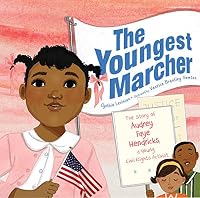
The Youngest Marcher: The Story of Audrey Faye Hendricks, a Young Civil Rights Activist
by Cynthia Levinson
On This Page
Description
Presents the life of nine-year-old Audrey Faye Hendricks who became the youngest known child to be arrested for picketing against Birmingham segregation practices in 1963.Tags
Recommendations














Member Reviews
4.5 stars rounded up. If I'd been introduced to history this way, I may actually have enjoyed it and wanted to learn more.
I very much enjoyed it. I agree it's not a complete biography, but it does include some of Audrey's life beyond this one experience. And the bright illustrations make it palatable--it doesn't look like heavy old history but more like a fun story that happens to be True and also Relevant. I think it's perfect for schoolchildren who still get too much dry & didactic stuff that they find it easy to dismiss as 'the old days, when everything was in black and white.'
I'm tempted to give this five stars, because I think everyone should read it. How many of us have even heard of Audrey? Not me! We should all know that show more thousands, tens of thousands, of people are involved in most events/ changes... not just the big few names but all the others marching with them, helping them with their lab work, building their rocketships, etc. And Audrey was more than just one of thousands, so she matters even more. show less
I very much enjoyed it. I agree it's not a complete biography, but it does include some of Audrey's life beyond this one experience. And the bright illustrations make it palatable--it doesn't look like heavy old history but more like a fun story that happens to be True and also Relevant. I think it's perfect for schoolchildren who still get too much dry & didactic stuff that they find it easy to dismiss as 'the old days, when everything was in black and white.'
I'm tempted to give this five stars, because I think everyone should read it. How many of us have even heard of Audrey? Not me! We should all know that show more thousands, tens of thousands, of people are involved in most events/ changes... not just the big few names but all the others marching with them, helping them with their lab work, building their rocketships, etc. And Audrey was more than just one of thousands, so she matters even more. show less
This book for readers 5 and up is based on the real story of Audrey Faye Hendricks, who at age nine was one of 3,000 children arrested and sent to jail in Birmingham, Alabama for marching for civil rights in 1963. Audrey, part of the Children’s March planned by three preachers, including Dr. Martin Luther King, Jr., ended up spending seven days in jail.
The march was conceived for several reasons, according to the Zinn Education Project. The civil rights movement was looking for ways to energize the campaign, but many adults were reluctant to participate in the protests because they would lose their jobs. Children marching had less to lose. In addition, a march by children (and the inevitable punitive reaction by law enforcement), show more would “subpoena the conscience of the nation to the judgment seat of morality” per Dr. King. As Civil Rights Leader Reverend Virgil Wood later averred:
“Dr. King was severely criticized for allowing the children to be involved, but the children insisted themselves. The children were their own self-initiators of their own freedom. They said, ‘This is our future and we want to help shape it.’”
The Smithsonian’s National Museum of African American History & Culture offers a synopsis of how the march got underway:
“On May 2, 1963, more than one thousand students skipped classes and gathered at Sixth Street Baptist Church to march to downtown Birmingham, Alabama. As they approached police lines, hundreds were arrested and carried off to jail in paddy wagons and school buses. When hundreds more young people gathered the following day for another march, white commissioner, Bull Connor, directed the local police and fire departments to use force to halt the demonstration. Images of children being blasted by high-pressure fire hoses, being clubbed by police officers, and being attacked by police dogs appeared on television and in newspapers, and triggered outrage throughout the world.”
Both of Audrey’s parents were very active in the civil rights movement in Alabama. She was often exposed to conversations in her home between her parents and leaders of the movement, including Dr. King and other ministers who orchestrated efforts to rescind segregation laws.
The author points out that Audrey knew all about segregation from her own experiences as well. She had to ride in the back of buses, drink out of separate water fountains, and use the freight elevators in stores. She knew that nicer things “were for white folks.”
So when the children’s march was proposed, Audrey begged her momma to let her go, and her momma finally relented. Her daddy gave her a game to take with her to pass the time in jail. She was not only the youngest protester, but the only one from her school, and she didn’t know anybody else; most of the protestors were teenagers.
She may have been scared and lonely, but when Jim Bevel, one of the organizers, lined her up to march, she stood up straight:
“She was going to break a law and go to jail to help make things right. Clutching a protest sign in one hand and her game in the other, Audrey marched out the door. She stomped and sang, ‘Ain’t gonna le-e-t nobody turn me ‘round, turn me ;round, turn me ‘round.”
Sure enough, Audrey was sentenced to one week in juvenile detention, but it was harder than she thought. She was afraid, hungry, and tired.
She was even interrogated by a group of four older white men. By Audrey’s fifth day, the police announced the jails were too full, and they couldn’t arrest anyone else. After seven days, she was released. Her momma and daddy came and got her, and that night, she had her favorite “hot rolls, baptized in butter” for dinner.
The author tells us that two months later, the City of Birmingham wiped segregation laws off the books. Audrey was finally able to sit in the ice cream shop, inter alia, like everyone else. The author concludes:
“Black and white together, like we belong.”
An Author’s Note, time line, and list of sources end the book, along with the recipe for Audrey’s favorite “Hot Rolls Baptized in Butter.”
The art work by illustrator Vanessa Brantley Newton captures the emotions of everyone caught up in the civil rights struggle. She depicts fearful situations, but emphasizes the joy of family and friends, the feeling of righteousness from fighting against injustice, and the happiness of reunion after separation.
The author was able to interview Audrey before she died in 2009:
“Audrey told me that she remained an activist afterward. She volunteered to integrate a high school, enrolling as one of the its first black students. ‘It took a while for whites and blacks to work together,’ she said. “But it was what we fought for.’”
Evaluation: Talk about an inspiring story! Audrey's courage and initiative shows us how people of all ages can help make a difference in the struggle against injustice. It also reminds us how much can be accomplished by a community working together and demonstrating in large numbers to achieve a goal. I especially appreciated that the author and illustrator did not sugar-coat negative aspects of what happened, even though it was couched in an overall positive light. show less
The march was conceived for several reasons, according to the Zinn Education Project. The civil rights movement was looking for ways to energize the campaign, but many adults were reluctant to participate in the protests because they would lose their jobs. Children marching had less to lose. In addition, a march by children (and the inevitable punitive reaction by law enforcement), show more would “subpoena the conscience of the nation to the judgment seat of morality” per Dr. King. As Civil Rights Leader Reverend Virgil Wood later averred:
“Dr. King was severely criticized for allowing the children to be involved, but the children insisted themselves. The children were their own self-initiators of their own freedom. They said, ‘This is our future and we want to help shape it.’”
The Smithsonian’s National Museum of African American History & Culture offers a synopsis of how the march got underway:
“On May 2, 1963, more than one thousand students skipped classes and gathered at Sixth Street Baptist Church to march to downtown Birmingham, Alabama. As they approached police lines, hundreds were arrested and carried off to jail in paddy wagons and school buses. When hundreds more young people gathered the following day for another march, white commissioner, Bull Connor, directed the local police and fire departments to use force to halt the demonstration. Images of children being blasted by high-pressure fire hoses, being clubbed by police officers, and being attacked by police dogs appeared on television and in newspapers, and triggered outrage throughout the world.”
Both of Audrey’s parents were very active in the civil rights movement in Alabama. She was often exposed to conversations in her home between her parents and leaders of the movement, including Dr. King and other ministers who orchestrated efforts to rescind segregation laws.
The author points out that Audrey knew all about segregation from her own experiences as well. She had to ride in the back of buses, drink out of separate water fountains, and use the freight elevators in stores. She knew that nicer things “were for white folks.”
So when the children’s march was proposed, Audrey begged her momma to let her go, and her momma finally relented. Her daddy gave her a game to take with her to pass the time in jail. She was not only the youngest protester, but the only one from her school, and she didn’t know anybody else; most of the protestors were teenagers.
She may have been scared and lonely, but when Jim Bevel, one of the organizers, lined her up to march, she stood up straight:
“She was going to break a law and go to jail to help make things right. Clutching a protest sign in one hand and her game in the other, Audrey marched out the door. She stomped and sang, ‘Ain’t gonna le-e-t nobody turn me ‘round, turn me ;round, turn me ‘round.”
Sure enough, Audrey was sentenced to one week in juvenile detention, but it was harder than she thought. She was afraid, hungry, and tired.
She was even interrogated by a group of four older white men. By Audrey’s fifth day, the police announced the jails were too full, and they couldn’t arrest anyone else. After seven days, she was released. Her momma and daddy came and got her, and that night, she had her favorite “hot rolls, baptized in butter” for dinner.
The author tells us that two months later, the City of Birmingham wiped segregation laws off the books. Audrey was finally able to sit in the ice cream shop, inter alia, like everyone else. The author concludes:
“Black and white together, like we belong.”
An Author’s Note, time line, and list of sources end the book, along with the recipe for Audrey’s favorite “Hot Rolls Baptized in Butter.”
The art work by illustrator Vanessa Brantley Newton captures the emotions of everyone caught up in the civil rights struggle. She depicts fearful situations, but emphasizes the joy of family and friends, the feeling of righteousness from fighting against injustice, and the happiness of reunion after separation.
The author was able to interview Audrey before she died in 2009:
“Audrey told me that she remained an activist afterward. She volunteered to integrate a high school, enrolling as one of the its first black students. ‘It took a while for whites and blacks to work together,’ she said. “But it was what we fought for.’”
Evaluation: Talk about an inspiring story! Audrey's courage and initiative shows us how people of all ages can help make a difference in the struggle against injustice. It also reminds us how much can be accomplished by a community working together and demonstrating in large numbers to achieve a goal. I especially appreciated that the author and illustrator did not sugar-coat negative aspects of what happened, even though it was couched in an overall positive light. show less
eaders can decide whether, were they in Audrey’s shoes, they would make the same dangerous decision.
Nine-year-old Audrey and her mother are happily preparing a meal for their special guest, whom they call Mike—otherwise known as Martin Luther King Jr. It is this environment that helps her decide to march in Birmingham in May 1963 and get arrested—all to fight segregation peacefully. The adults are too fearful to march, so Audrey proudly volunteers to join other children and go to “j-a-a-il!” Her parents and her grandparents support her decision, and so, to the sounds of civil rights–era music, she is arrested. The time behind bars is unpleasant, but the cells soon fill up. Audrey comes home after seven days to her favorite show more food: “hot rolls, baptized in butter.” Eating at an integrated lunch counter follows. Levinson, who wrote for older readers in We’ve Got a Job: The 1963 Birmingham Children’s March (2012), here carefully tailors her text to a level suitable for a younger audience. Newton’s digital illustrations burst with color against a white background. Audrey smiles and looks fearful, as appropriate. A double-page spread of her in a jail cell, all in gray, is especially effective.
A vivid reminder that it took a community to fight segregation and the community responded. (author’s note, timeline, recipe, sources) (Informational picture book. 7-10)
-Kirkus Review show less
Nine-year-old Audrey and her mother are happily preparing a meal for their special guest, whom they call Mike—otherwise known as Martin Luther King Jr. It is this environment that helps her decide to march in Birmingham in May 1963 and get arrested—all to fight segregation peacefully. The adults are too fearful to march, so Audrey proudly volunteers to join other children and go to “j-a-a-il!” Her parents and her grandparents support her decision, and so, to the sounds of civil rights–era music, she is arrested. The time behind bars is unpleasant, but the cells soon fill up. Audrey comes home after seven days to her favorite show more food: “hot rolls, baptized in butter.” Eating at an integrated lunch counter follows. Levinson, who wrote for older readers in We’ve Got a Job: The 1963 Birmingham Children’s March (2012), here carefully tailors her text to a level suitable for a younger audience. Newton’s digital illustrations burst with color against a white background. Audrey smiles and looks fearful, as appropriate. A double-page spread of her in a jail cell, all in gray, is especially effective.
A vivid reminder that it took a community to fight segregation and the community responded. (author’s note, timeline, recipe, sources) (Informational picture book. 7-10)
-Kirkus Review show less
The Youngest Marcher is a beautifully written biography of Audrey Faye Hendricks' admirable bravery in the 1963 Children's March in Birmingham, Alabama. Audrey was only 9 years old but she knew what is right and what she deserves and was prepared to stand up for her rights.The language is clear and expressive in depicting Audrey's struggles during the civil rights movement. For example, Audrey must sit in the back of the bus, drink from a dirty water fountain, and use the freight elevator in stores. Audrey heard of awful injustices around her community and knew she had to do something. Despite the dangerous scene that is illustrated, she marched against injustice and was subsequently arrested. This book successfully demonstrates the show more perspective of a brave young girl who will spark inspiration and courage in all who read this book.
Reading Level: 3-4 show less
Reading Level: 3-4 show less
Until this book I never knew there was a children’s march in Alabama for the Civil Rights Movement. When adults were too scared or set in their ways, the children did what was needed. They marched and they went to jail. Audrey Faye Hendricks was one of these marchers. She was the youngest one, and she spent a week in jail for even daring to ask to be treated like others. This wonderful story is amazing, and it should be taught in schools. This is something that should be in school history books, not left out as if civil rights was only an adult problem.
This book is a huge inspiration when it comes to accepting yourself and having the courage to fight what is wrong. The most compelling aspect of the book is the pictures. I think this is valuable because the pictures allow you to have a deeper understanding and appreciation of what the characters went through. You can see the fear and determination on their faces and feel inspired yourself. I think this is essential when teaching history because history feels abstract and bland unless students have something to draw from. The first thing my eye traveled to were the pictures so I think for that reason alone this book should be used in a history lesson. I also like this book because it wasn't afraid to bring up the topic of not only civil show more rights but the strength of children. Many people dismiss the value of children but this book does an amazing job of expressing the strength of children. The part of the book that stood out the most in that sense was when Audrey looked around and saw that none of the adults were stepping up so she stood up in their place. show less
This was a story I had not yet heard, of a 9 year old who went to jail as part of the Civil Rights Movement in Birmingham. Powerful story, in a nice, concise format. Well done.
Members
- Recently Added By
Lists

Fiction Books with Recipes
224 works; 3 members

Youth: BLM
265 works; 1 member
Author Information

10+ Works 1,513 Members
All Editions
Awards and Honors
Awards
Distinctions
Notable Lists
Common Knowledge
- People/Characters
- Audrey Faye Hendricks; Martin Luther King, Jr.; Jim Bevel
- Important places
- Birmingham, Alabama, USA
Classifications
Statistics
- Members
- 606
- Popularity
- 47,949
- Reviews
- 28
- Rating
- (4.38)
- Languages
- English
- Media
- Paper, Audiobook, Ebook
- ISBNs
- 7
- ASINs
- 2