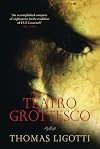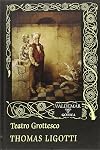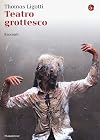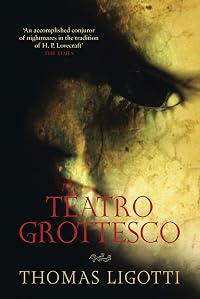
Teatro Grottesco
by Thomas Ligotti
On This Page
Description
Often cited as the most curious and remarkable figure in horror literature. His work is noted by critics for its display of an exceptionally grotesque imagination and accomplished prose style. The cycle of narratives introduces readers to a freakish community of artists who encounter demonic perils that will engulf their lives!Tags
Recommendations














Member Reviews
Thomas Ligotti's work has been hard to find in the UK. When I picked up this edition (published by Virgin in 2008 from the 2006 US hardback), I feared that it would be another general anthology largely duplicating the only other available text - The Shadow At The Bottom Of The World.
Of course, there are very many overlaps (most notably Purity, The Red Tower, The Bungalow House, Severini and Teatro Grottesco itself) but the two books are complementary and not competitive. Why? The 'Shadow' (to be reviewed separately) presents a series of small masterpieces that give a taste of this heir to Poe in the round but 'Teatro' presents Ligotti as a coherent philosophy of life - or is it non-life since the mood is decidely nihilistic.
Three show more sections presents different viewpoints on an essentially single dark vision of existence - a form of anti-existentialist nihilism in which the life force at the heart of the universe is presented as something very dark indeed, a deadening puppetry in which blind forces make us act or become as they wish and not as we, illusorily, believe we will ourselves to do or to be.
All this is encapsulated in the final story - 'The Shadow, The Darkness' - which requires what has gone before in the book and leaves one with a taste of a nihilism that must surely cause us to worry about Mr. Ligotti's mental state. I have never read a more credible account of that blackest state of existence, existential depression - one without Satanic or demonic dark forces, a pure expression of (perhaps) Lovecraft's Nyarlothep's malign and meaningless rule over all being.
This alone is not a story to be read lightly - certainly not by someone mentally vulnerable. Personally, I found it powerful, a necessary read and one that triggered a sense of commitment to life in me precisely because, in literary form, it exhibited the darkest mental state imaginable, Styron's and Milton's 'darkness visible'. To see this darkness, feel it inside oneself as a possibility and then turn away from it is a liberation - but some may not be able to do that. Approach with care if you are unsure of your own hold on life.
But we run ahead of ourselves ... The book is divided into three sections - Derangements, Deformations, and The Damaged and the Diseased.
The first [Derangements] comprises five stories of alienation and, since I am not into spoilers, let us just say that he presents a world of individuals and communities where the protagonists are victims or observers of various mysterious, unfathomable, apparently random, external forces whose general tendency is towards madness, dissolution, degradation and death.
This is Lovecraft shorn of even the hope that there might be a heroic conclusion or an ultimate triumph of the ordinary against dark forces. The Old Ones are no longer 'personalities' out there to be feared and fought but have become diffuse mindless malignities inside us and our communities. Dark forces are embedded very deep indeed within the ordinary and seem to be loki-like in their conduct, engaged in a snide and sardonic sideshow at our expense. Malicious almost out of boredom, accident and blind nature. Indeed, the hint is that nature, our nature, is 'nihil' or, at best, a blind willing of itself at our expense.
The second [Deformations] set of three stories are centred on a very particular environment - a mysterious and foggy border town where a faceless corporation is in league with manipulative forces, the medical profession it would seem, to pull in unsuspecting and mentally vulnerable people and force them into lives of inescapable drudgery 'lightened' only by random acts of cruelty which seem to be without personal malice. An air of cosmic malice depersonalises the horror.
Existence is seen as almost accidental, a situation where all we can see are the workings of systems that cannot be understood, operating according to unknown rules and rivalries, that entrap us as readers to the degree that we identify with the neurasthenic, paranoid personalities who act as narrators. Hidden within the text are hints of the sort of practices that Lovecraft and Howard would have assigned to 'unspeakable cults'.
If the first section is about the horror of being at the mercy of specific events and processes and the second is seemingly an allegory of the meaningless of modern life, working as drudges towards death, the real darkness, centred on art and philosophy, comes in the third section, 'The Damaged and the Diseased'. This culminates in the vile, dark tale with which this review began.
Again no spoilers but the five stories seem to centre on the presumption of art and of the intellect in their claims to come close to meaning in a meaningless existence. The characters are possibly all mad, certainly disturbed and often sick in body as much as mind, introvert and stuck in their dreams or in environments that are claustrophobic. The best known work is Teatro Grottesco, a descriptor of the world of Ligotti, as much as the story 'The Clown Puppet' is a descriptor of the individual in that world. There are clowns, carnivals, costumes, cabarets, theatres, puppetry, art, all supposed to be providers of fun and entertainment but all, following the tradition of Stephen King and Ray Bradbury, twisted into paranoia, deception, madness and tragedy.
Why go on? The world of Ligotti is disturbing. I have mentioned the obvious influence of Poe mediated by Lovecraft. There are small nods to King (an underestimated writer) although Ligotti writes in small amounts to concentrated effect whereas King tells long rollicking tales that somehow always seem to affirm humanity somewhere in the text, even if the general tone is pessimistic.
In my view, Ligotti is a must-read and a re-read and the fact that the book can contain perhaps half the material of another anthology and yet the two anthologies bear complete separate (possibly repeated) readings (like Poe and Lovecraft) suggests that the artistry lies in the positioning of the stories against one another as much as in the stories themselves. But for a taste, I give you with two extended quotations:-
"Even in a northern border town of such intensely chaotic oddity and corruption there was still some greater chaos, some deeper insanity, than one had counted on, or could ever be taken into account - wherever there was anything, there would be chaos and insanity to such a degree that one could never come to terms with it, and it was only a matter of time before your world, whatever you thought it to be, was undermined, if not completely overrun, by another world."
['In A Foreign Town, In A Foreign Land']
"Words are a total obfuscation of the most basic fact of existence, the very conspiracy against the human race ... Words are simply a cover-up for this conspiracy. They are the ultimate means for the cover-up, the ultimate artwork of the shadow, the darkness - its ultimate artistic cover-up. Because of the existence of words, we think that there exists a mind, that some kind of self or soul exists. This is just another of the infinite layers of the cover-up'
['The Shadow, The Darkness']
There is one last thing to note - the style. Ligotti uses repetitions a lot, much like Lovecraft might use a word like 'eldritch' to make the reader feel some intensity of engagement with the story. The style is hard to pin down but it is detached and world-weary, observing, emotionless, sometimes allusive so that some horror or disturbance is seen (as it were) slightly offstage, like a twitch of a curtain or rat running across the aisle of the show. The mood is of being stuck in a grey, misty or sepia stage set or geographical location where, if you walked too far in any direction, you might fall off the ends of the known world and into nothingness. Those borders seem to shrink as the stories progress so that claustrophobia is inevitable.
There is something European about the sensibility. Ligotti is not in the least optimistic like your average American. This is the world of Dr. Caligari and black and white art movies of long ago, of Kafka (one is reminded of 'In the Penal Colony') ... there are a lot of hospitals and medication, a lot of attempts to avoid reality through art, work, society and drugs that are ultimately useless.
So, if you have a strong stomach for existential horror, try it. show less
Of course, there are very many overlaps (most notably Purity, The Red Tower, The Bungalow House, Severini and Teatro Grottesco itself) but the two books are complementary and not competitive. Why? The 'Shadow' (to be reviewed separately) presents a series of small masterpieces that give a taste of this heir to Poe in the round but 'Teatro' presents Ligotti as a coherent philosophy of life - or is it non-life since the mood is decidely nihilistic.
Three show more sections presents different viewpoints on an essentially single dark vision of existence - a form of anti-existentialist nihilism in which the life force at the heart of the universe is presented as something very dark indeed, a deadening puppetry in which blind forces make us act or become as they wish and not as we, illusorily, believe we will ourselves to do or to be.
All this is encapsulated in the final story - 'The Shadow, The Darkness' - which requires what has gone before in the book and leaves one with a taste of a nihilism that must surely cause us to worry about Mr. Ligotti's mental state. I have never read a more credible account of that blackest state of existence, existential depression - one without Satanic or demonic dark forces, a pure expression of (perhaps) Lovecraft's Nyarlothep's malign and meaningless rule over all being.
This alone is not a story to be read lightly - certainly not by someone mentally vulnerable. Personally, I found it powerful, a necessary read and one that triggered a sense of commitment to life in me precisely because, in literary form, it exhibited the darkest mental state imaginable, Styron's and Milton's 'darkness visible'. To see this darkness, feel it inside oneself as a possibility and then turn away from it is a liberation - but some may not be able to do that. Approach with care if you are unsure of your own hold on life.
But we run ahead of ourselves ... The book is divided into three sections - Derangements, Deformations, and The Damaged and the Diseased.
The first [Derangements] comprises five stories of alienation and, since I am not into spoilers, let us just say that he presents a world of individuals and communities where the protagonists are victims or observers of various mysterious, unfathomable, apparently random, external forces whose general tendency is towards madness, dissolution, degradation and death.
This is Lovecraft shorn of even the hope that there might be a heroic conclusion or an ultimate triumph of the ordinary against dark forces. The Old Ones are no longer 'personalities' out there to be feared and fought but have become diffuse mindless malignities inside us and our communities. Dark forces are embedded very deep indeed within the ordinary and seem to be loki-like in their conduct, engaged in a snide and sardonic sideshow at our expense. Malicious almost out of boredom, accident and blind nature. Indeed, the hint is that nature, our nature, is 'nihil' or, at best, a blind willing of itself at our expense.
The second [Deformations] set of three stories are centred on a very particular environment - a mysterious and foggy border town where a faceless corporation is in league with manipulative forces, the medical profession it would seem, to pull in unsuspecting and mentally vulnerable people and force them into lives of inescapable drudgery 'lightened' only by random acts of cruelty which seem to be without personal malice. An air of cosmic malice depersonalises the horror.
Existence is seen as almost accidental, a situation where all we can see are the workings of systems that cannot be understood, operating according to unknown rules and rivalries, that entrap us as readers to the degree that we identify with the neurasthenic, paranoid personalities who act as narrators. Hidden within the text are hints of the sort of practices that Lovecraft and Howard would have assigned to 'unspeakable cults'.
If the first section is about the horror of being at the mercy of specific events and processes and the second is seemingly an allegory of the meaningless of modern life, working as drudges towards death, the real darkness, centred on art and philosophy, comes in the third section, 'The Damaged and the Diseased'. This culminates in the vile, dark tale with which this review began.
Again no spoilers but the five stories seem to centre on the presumption of art and of the intellect in their claims to come close to meaning in a meaningless existence. The characters are possibly all mad, certainly disturbed and often sick in body as much as mind, introvert and stuck in their dreams or in environments that are claustrophobic. The best known work is Teatro Grottesco, a descriptor of the world of Ligotti, as much as the story 'The Clown Puppet' is a descriptor of the individual in that world. There are clowns, carnivals, costumes, cabarets, theatres, puppetry, art, all supposed to be providers of fun and entertainment but all, following the tradition of Stephen King and Ray Bradbury, twisted into paranoia, deception, madness and tragedy.
Why go on? The world of Ligotti is disturbing. I have mentioned the obvious influence of Poe mediated by Lovecraft. There are small nods to King (an underestimated writer) although Ligotti writes in small amounts to concentrated effect whereas King tells long rollicking tales that somehow always seem to affirm humanity somewhere in the text, even if the general tone is pessimistic.
In my view, Ligotti is a must-read and a re-read and the fact that the book can contain perhaps half the material of another anthology and yet the two anthologies bear complete separate (possibly repeated) readings (like Poe and Lovecraft) suggests that the artistry lies in the positioning of the stories against one another as much as in the stories themselves. But for a taste, I give you with two extended quotations:-
"Even in a northern border town of such intensely chaotic oddity and corruption there was still some greater chaos, some deeper insanity, than one had counted on, or could ever be taken into account - wherever there was anything, there would be chaos and insanity to such a degree that one could never come to terms with it, and it was only a matter of time before your world, whatever you thought it to be, was undermined, if not completely overrun, by another world."
['In A Foreign Town, In A Foreign Land']
"Words are a total obfuscation of the most basic fact of existence, the very conspiracy against the human race ... Words are simply a cover-up for this conspiracy. They are the ultimate means for the cover-up, the ultimate artwork of the shadow, the darkness - its ultimate artistic cover-up. Because of the existence of words, we think that there exists a mind, that some kind of self or soul exists. This is just another of the infinite layers of the cover-up'
['The Shadow, The Darkness']
There is one last thing to note - the style. Ligotti uses repetitions a lot, much like Lovecraft might use a word like 'eldritch' to make the reader feel some intensity of engagement with the story. The style is hard to pin down but it is detached and world-weary, observing, emotionless, sometimes allusive so that some horror or disturbance is seen (as it were) slightly offstage, like a twitch of a curtain or rat running across the aisle of the show. The mood is of being stuck in a grey, misty or sepia stage set or geographical location where, if you walked too far in any direction, you might fall off the ends of the known world and into nothingness. Those borders seem to shrink as the stories progress so that claustrophobia is inevitable.
There is something European about the sensibility. Ligotti is not in the least optimistic like your average American. This is the world of Dr. Caligari and black and white art movies of long ago, of Kafka (one is reminded of 'In the Penal Colony') ... there are a lot of hospitals and medication, a lot of attempts to avoid reality through art, work, society and drugs that are ultimately useless.
So, if you have a strong stomach for existential horror, try it. show less
Having read Ligotti's bigger works before this, this one strikes as, in true Ligottian fashion, both too much Ligotti, while also not quite Ligotti enough.
He's still plumbing those very weird depths that no one else is using, and he's still doing so to good effect. The stories are weird, hypnotic, dreamlike, claustrophobic, dark, and confusing in a frustratingly entertaining way. The first half of this collection is filled with stories of workers in bizarre industries, all seemingly interrelated in some horrid way. The second half tends to focus more on artistic types and the nefarious art they do (or don't) produce. So, we're still treading the strange pathways of the mind of Thomas Ligotti, all right.
At the same time, however, these show more stories don't seem quite as fantastical as his previous collections, at times relying on the same plot devices more than one (that man! it was me! and intestinal issues galore).
Too me, I feel like Ligotti is definitely branching into different areas, but they seem to be somewhat more dull and repetitive, more drab than usual. Perhaps that was his goal all along. show less
He's still plumbing those very weird depths that no one else is using, and he's still doing so to good effect. The stories are weird, hypnotic, dreamlike, claustrophobic, dark, and confusing in a frustratingly entertaining way. The first half of this collection is filled with stories of workers in bizarre industries, all seemingly interrelated in some horrid way. The second half tends to focus more on artistic types and the nefarious art they do (or don't) produce. So, we're still treading the strange pathways of the mind of Thomas Ligotti, all right.
At the same time, however, these show more stories don't seem quite as fantastical as his previous collections, at times relying on the same plot devices more than one (that man! it was me! and intestinal issues galore).
Too me, I feel like Ligotti is definitely branching into different areas, but they seem to be somewhat more dull and repetitive, more drab than usual. Perhaps that was his goal all along. show less
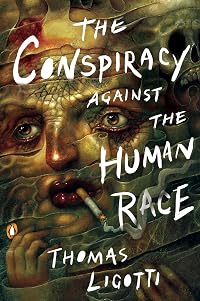
Ligotti hooked me through his philosophical treatise The Conspiracy Against the Human Race. HIs pure pessimistic-nihilism intrigued me: it is better not to exist at all, consciousness is not a gift but pain.
The stories in this collection are an embodiment of this philosophy, often extending it to its highest conclusion.
Of all the stories, the one that captivated me most was the one with the bungalow. Ligotti captures the feeling of loneliness and isolation terrifyingly well, focusing not just on the concept of being truly alone but also at the pure annihilating aspect of it on the psyche.
The final story with Grossvogel is another standout. His thesis: there’s an underlying shadow in the world that must be experienced through the show more body. This shadow not just permeates through everything, it also destroys any and all meaning that dares to come near it. Ultimately, there’s no light, no hope, no dreams, just pure, black nonexistence. And isn’t that sweet? The joy of not existing at all.
I hope Ligotti produces even more stories, but the next time around, please skip the Lovecraftian language. It feels derivative rather than nostalgic at this point. It’s also a chore to read. show less
The stories in this collection are an embodiment of this philosophy, often extending it to its highest conclusion.
Of all the stories, the one that captivated me most was the one with the bungalow. Ligotti captures the feeling of loneliness and isolation terrifyingly well, focusing not just on the concept of being truly alone but also at the pure annihilating aspect of it on the psyche.
The final story with Grossvogel is another standout. His thesis: there’s an underlying shadow in the world that must be experienced through the show more body. This shadow not just permeates through everything, it also destroys any and all meaning that dares to come near it. Ultimately, there’s no light, no hope, no dreams, just pure, black nonexistence. And isn’t that sweet? The joy of not existing at all.
I hope Ligotti produces even more stories, but the next time around, please skip the Lovecraftian language. It feels derivative rather than nostalgic at this point. It’s also a chore to read. show less
I've read Ligotti before, but this is the first time I've read several of his stories together, and I have to say that I don't think there is anyone else like him. Lovecraft comes close, but not quite. Lovecraft's stories usually at least begin in our world, while Ligotti's exist in one that is somewhat like ours, but is slightly off, though accepted as normal by his characters. His language is dense and precise, and his narrators (the stories are written in first-person) seem to have an obsessive nature that causes them to repeat phrases, not in an annoying or condescending way, but in a way that lends a kind of weird rhythm to the pieces. The stories are full of ambiguity and mystery, and by the end you may not know much more than you show more did when you began, but you will have had a unique and deeply unsettling experience. show less
Ligotti's fiction is a dark dream, his characters wandering through strange towns and being made to face not ghosts or monsters but the horrors of their own existence in nightmarish and surreal realms that are just enough like our own to make us realize we share the dread. The dread that Ligotti evokes is akin to that brought out by the writings of Poe. Ligotti makes the world around us appear suspect, life appear absurd, and makes us wonder if ideas of a rational and "right" world are what is actually suspect. These stories make the sensations of agonizing woe and surreal melancholy that we often experience into whole worlds in which men are but puppets and playthings. "The soft black stars have already begun to fill the sky ..."
sometimes ligotti is nothing but language. a black velvet painting drawn in dread, visible only in UV and your last lightbulb just broke. good luck.
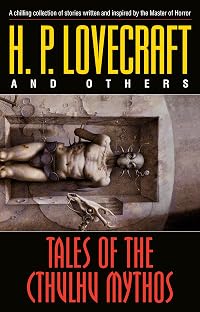
Impressed enough by the Ligotti work I've seen in anthologies devoted to following up on H. P. Lovecraft's Cthulhu Mythos, I bought this anthology.
Is Ligotti a Lovecraftian writer? Well, based on this collection - and I have no idea how representative it is - yes and no. There are no explicit Lovecraftian allusions in this collection - no references to the forbidden books, nightmare locations, and mysterious entities created by Lovecraft and those adding to the Mythos. Yet, the pre-eminent, most important aspect of Lovecraft's work, "cosmic horror", the "infinite terror and dreariness" of existence, as one story here puts it, is shared by Ligotti.
Yet, that horror is expressed in vaguer and more general terms than in Lovecraft. In one show more of his stories, the horrific revelation is one of man's hidden evolutionary past, miscegenation in a family's past, the existence of alien races. The revelation at the end of a Ligotti story is rarely so specific.
And their prose differs. The scientific references in a Lovecraft story are not here. The technological trappings of a Lovecraft story frequently link it to its time of composition. Ligotti's stories are noticeably lacking in any specific technological reference. An "audiotape" is the most time specific reference there is. Otherwise, they could be set almost anytime during the 20th century. Ligotti's prose reminded me more of Lovecraft's idol, Poe, than Lovecraft. Always told in the first person, they frequently deal with odd psychological states and fixations. The notion of the alternate self, the doppelganger as pioneered by Poe in his "William Wilson", also shows up a lot.
In fact, if one wanted to be snarky, you could say Ligotti was a writer of bloated prose, stories almost always told in the same way, ending usually with some horrible revelation of malevolent, vague cosmic forces, a recycler of the images of dilapidated buildings and towns, abandoned factories, clowns and puppets, and intestinal viruses. In short, Ligotti's not a storyteller telling many tales in many ways, but a writer obsessively telling the same story the same way.
Yet, when that story is worth telling and told well, that sort of writer is also called an artist. And, by that definition, Ligotti is an artist.
What might seem, on a quick reading, bloated prose with frequent repetition of the same phrases and the same details of event and character, is not exactly poetry but it is incantory, akin to the repetition often found in writing for children. But here, rather than a child, it is adults introduced to a world of horrible wonder, the world of "the icy bleakness of things". The use of those recurring images is varied enough not to bore - though I can see some readers perhaps wanting to ration themselves an occasional Ligotti story rather than gulping them down all at once. And Ligotti is consistently, even more than Lovecraft, a writer of weird, not horror, fiction. The rewards of each are different.
Ligotti groups his 13 stories into three sections - Derangements, Deformations, and the Damaged and Diseased. These classifications are a bit too general to provide a sense of the collection.
Two of Ligotti's best stories deal with the world of work. In "The Town Manager", we are told of the mysterious disappearances of a town's unelected, unrequested town managers, each of which institute reforms which hasten the town's decay. "Our Temporary Supervisor" has the narrator in a meaningless job detailing how a new employee, in collusion with a new, horribly undefined and unseen supervisor, transforms a factory job into virtually round the clock enslavement via social pressure. While it is tempting to see these stories as commentaries on politics and capitalism, I think Ligotti has just set his existential horror in a more recognizable, specific setting.
The Quine Corporation is the force behind the latter story and is also mentioned in "My Case for Retributive Action". The title brings to mind the opening of Poe's "The Casque of Amontillado" and the plot Kafka's "Metamorphoses". The story seems to share the same vague setting, near the border of an unnamed country, with "In a Foreign Town, In a Foreign Land". In this collection of four first person accounts obliquely gazing the horror encroaching on a town, Lovecraft fans may strain to see echoes of the master's "The Festival" and "The Shadow Over Innsmouth".
The technique of multiple accounts in one story also shows up, as an artist's vignettes rather than recollections of characters, in "Sideshow, and Other Stories". It is an interesting story of trying to compare our world to an unknown order which may or may not exist, but compounded ambiguities make it a failure. Also, in the failed category, is "The Clown Puppet". The titular figure and his attached strings are a metaphor for unseen forces. But the image is too common, and the plot not very compelling.
"Purity" is another strong story. Rather than demolishing a vague and general notion of existence and replacing it with some general, nihilistic notion of cosmic reality, this story attacks the universal human anchors and consolations of country, faith, and family. The child narrator's father is up to something creepy in the basement - but Ligotti neatly surprises us with what that horror is and then throws in another hint about what the rest of the family has been up to. "The Red Tower" is the most Poe like story in its prose which recounts the odd appearance, history, and function of an abandoned factory. "Teatro Grottesco" has a writer seeking out a mysterious cabal that strips artists of their creative impulses and powers. Like so many stories in this collection, its narrator ultimately embraces the maleovelent forces that are revealed. This is also the first of four stories in the collection's last section that feature physical distress, specifically gastrointestinal distress, as a revelatory ordeal. "Gas Station Carnivals" is all right as a story but is mostly interesting for the delusional details of the title attraction. "The Bungalow Horror" combines a Poe-like doppelganger with "Teatro Grottesco"'s notion of destroyed artist. It is also something of a rumination of what people get out of writers like Lovecraft and Ligotti - and how the art serves its creators. "Severini" is the most physical story and the story whose images most evoke Lovecraft. Actually, its glimpses of a priesthood of Tantric Medicine on an island near the Philippines using dysentery as a tool of enlightenment reminded me of one of Lovecraft's favorite stories - A. Merritt's "The Moon Pool". "The Shadow, the Darkness" is a powerful story that, in its horrific insistence on humans as only bodies, tools for the Tsalal (evidently, recurring entitites in Ligotti's works) raises questions of free will and cosmic parasitism. show less
Is Ligotti a Lovecraftian writer? Well, based on this collection - and I have no idea how representative it is - yes and no. There are no explicit Lovecraftian allusions in this collection - no references to the forbidden books, nightmare locations, and mysterious entities created by Lovecraft and those adding to the Mythos. Yet, the pre-eminent, most important aspect of Lovecraft's work, "cosmic horror", the "infinite terror and dreariness" of existence, as one story here puts it, is shared by Ligotti.
Yet, that horror is expressed in vaguer and more general terms than in Lovecraft. In one show more of his stories, the horrific revelation is one of man's hidden evolutionary past, miscegenation in a family's past, the existence of alien races. The revelation at the end of a Ligotti story is rarely so specific.
And their prose differs. The scientific references in a Lovecraft story are not here. The technological trappings of a Lovecraft story frequently link it to its time of composition. Ligotti's stories are noticeably lacking in any specific technological reference. An "audiotape" is the most time specific reference there is. Otherwise, they could be set almost anytime during the 20th century. Ligotti's prose reminded me more of Lovecraft's idol, Poe, than Lovecraft. Always told in the first person, they frequently deal with odd psychological states and fixations. The notion of the alternate self, the doppelganger as pioneered by Poe in his "William Wilson", also shows up a lot.
In fact, if one wanted to be snarky, you could say Ligotti was a writer of bloated prose, stories almost always told in the same way, ending usually with some horrible revelation of malevolent, vague cosmic forces, a recycler of the images of dilapidated buildings and towns, abandoned factories, clowns and puppets, and intestinal viruses. In short, Ligotti's not a storyteller telling many tales in many ways, but a writer obsessively telling the same story the same way.
Yet, when that story is worth telling and told well, that sort of writer is also called an artist. And, by that definition, Ligotti is an artist.
What might seem, on a quick reading, bloated prose with frequent repetition of the same phrases and the same details of event and character, is not exactly poetry but it is incantory, akin to the repetition often found in writing for children. But here, rather than a child, it is adults introduced to a world of horrible wonder, the world of "the icy bleakness of things". The use of those recurring images is varied enough not to bore - though I can see some readers perhaps wanting to ration themselves an occasional Ligotti story rather than gulping them down all at once. And Ligotti is consistently, even more than Lovecraft, a writer of weird, not horror, fiction. The rewards of each are different.
Ligotti groups his 13 stories into three sections - Derangements, Deformations, and the Damaged and Diseased. These classifications are a bit too general to provide a sense of the collection.
Two of Ligotti's best stories deal with the world of work. In "The Town Manager", we are told of the mysterious disappearances of a town's unelected, unrequested town managers, each of which institute reforms which hasten the town's decay. "Our Temporary Supervisor" has the narrator in a meaningless job detailing how a new employee, in collusion with a new, horribly undefined and unseen supervisor, transforms a factory job into virtually round the clock enslavement via social pressure. While it is tempting to see these stories as commentaries on politics and capitalism, I think Ligotti has just set his existential horror in a more recognizable, specific setting.
The Quine Corporation is the force behind the latter story and is also mentioned in "My Case for Retributive Action". The title brings to mind the opening of Poe's "The Casque of Amontillado" and the plot Kafka's "Metamorphoses". The story seems to share the same vague setting, near the border of an unnamed country, with "In a Foreign Town, In a Foreign Land". In this collection of four first person accounts obliquely gazing the horror encroaching on a town, Lovecraft fans may strain to see echoes of the master's "The Festival" and "The Shadow Over Innsmouth".
The technique of multiple accounts in one story also shows up, as an artist's vignettes rather than recollections of characters, in "Sideshow, and Other Stories". It is an interesting story of trying to compare our world to an unknown order which may or may not exist, but compounded ambiguities make it a failure. Also, in the failed category, is "The Clown Puppet". The titular figure and his attached strings are a metaphor for unseen forces. But the image is too common, and the plot not very compelling.
"Purity" is another strong story. Rather than demolishing a vague and general notion of existence and replacing it with some general, nihilistic notion of cosmic reality, this story attacks the universal human anchors and consolations of country, faith, and family. The child narrator's father is up to something creepy in the basement - but Ligotti neatly surprises us with what that horror is and then throws in another hint about what the rest of the family has been up to. "The Red Tower" is the most Poe like story in its prose which recounts the odd appearance, history, and function of an abandoned factory. "Teatro Grottesco" has a writer seeking out a mysterious cabal that strips artists of their creative impulses and powers. Like so many stories in this collection, its narrator ultimately embraces the maleovelent forces that are revealed. This is also the first of four stories in the collection's last section that feature physical distress, specifically gastrointestinal distress, as a revelatory ordeal. "Gas Station Carnivals" is all right as a story but is mostly interesting for the delusional details of the title attraction. "The Bungalow Horror" combines a Poe-like doppelganger with "Teatro Grottesco"'s notion of destroyed artist. It is also something of a rumination of what people get out of writers like Lovecraft and Ligotti - and how the art serves its creators. "Severini" is the most physical story and the story whose images most evoke Lovecraft. Actually, its glimpses of a priesthood of Tantric Medicine on an island near the Philippines using dysentery as a tool of enlightenment reminded me of one of Lovecraft's favorite stories - A. Merritt's "The Moon Pool". "The Shadow, the Darkness" is a powerful story that, in its horrific insistence on humans as only bodies, tools for the Tsalal (evidently, recurring entitites in Ligotti's works) raises questions of free will and cosmic parasitism. show less
Members
- Recently Added By
Lists

Weird and Weirder Fiction
270 works; 35 members

Top Five Books of 2015
811 works; 241 members
Author Information

82+ Works 6,238 Members
Work Relationships
Contains
Common Knowledge
- Original publication date
- 2006
- People/Characters
- Severini; Dr. Theodore Groddeck; Reiner Grossvogel; Ivan Vizniak; Mrs Pyk; Mrs Glimm (show all 14); Dr Zirk; Mr Pell; Rev. Cork; Ribello; Pilsen; Blecher; Nohls; Ascrobius
- Important places
- St. Alban's Marsh
- First words
- We were living in a rented house, neither the first nor the last of a long succession of such places that the family inhabited throughout my childhood years.
- Last words
- (Click to show. Warning: May contain spoilers.)There is only this body, this shadow, this darkness.
Classifications
Statistics
- Members
- 867
- Popularity
- 31,436
- Reviews
- 23
- Rating
- (3.99)
- Languages
- 6 — Danish, English, German, Italian, Polish, Spanish
- Media
- Paper, Ebook
- ISBNs
- 11
- ASINs
- 5