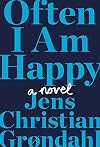
Often I Am Happy
by Jens Christian Grøndahl
On This Page
Description
This elegant and nuanced literary gem explores the intricacies of friendship, secrets, and two marriages, for fans of The Dinner and Dept. of Speculation."Often I am happy and yet I want to cry; / For no heart fully shares my joy." — B.S. Ingemann
Ellinor is seventy. Her husband Georg has just passed away, and she is struck with the need to confide in someone. She addresses Anna, her long-dead best friend, who was also Georg's first wife. Fully aware of the absurdity of speaking to show more someone who cannot hear her, Ellinor nevertheless finds it meaningful to divulge long-held secrets and burdens of her past: her mother's heartbreaking pride; Ellinor's courtship with her first husband; their seemingly charmed friendship with Anna and Georg; the disastrous ski trip that shattered the two couples' lives. Wry and mellow yet infused with subdued emotion, this philosophical, lyrical novel moves in parallel narrative threads while questioning the assumptions we cherish concerning identity and love. show less
Tags
Recommendations




























Member Reviews
Other reviewers did not find aspects of this novel credible. I did.
The main character, Ellinor had a friend Anna, a friend of her young adulthood, who died young and unexpectedly. After Anna's death, Ellinor discovered a betrayal by her friend.
There is something special about those friendships that begin when we are young adults, just beginning to make our life's path and becoming ourselves. Those friendships, even if not extraordinarily long, are uniquely important. So, even decades later, Ellinor, at 70, still longed for the solace of that friendship with Anna. It was not surprising she would turn once again to talking to Anna, or rather talking to her memory of Anna.
It was after Anna's death and after the simultaneous death of show more Ellinor's first husband that she as a widow became close to Anna's widowed husband Georg. In time she married him and raised Anna's children. It was after Georg's death when Ellinor began wishing she could share with her friend the ways she loved Georg and the problematic relationships with Anna's boys as grown men. She directed her thoughts to Anna, thoughts about her detoured life, the one created specifically because Anna's ended.
Ellinor had forgiven Anna. She could even acknowledge that Anna might have cared deeply for those she hurt and been torn herself by those acts of betrayal. That's not surprising. My experience is that when a person dies and after sufficient time has passed, many grudges and hurt feelings die too, leaving the best parts, the love in that relationship, alive. We forgive the dead.
I liked Ellinor. She seemed real to me: decent, likeable, not perfect. She was a person who had long postponed thinking too deeply.
The novel's interwoven drama concerning the remaining living family members was petty and unpleasant. It illustrated the significant aspect of Ellinor's lifelong story of feeling a fraud, ashamed for being who she was by no fault of her own. Once she found she could disconnect with one of the sons, a man negatively astonished by, in his opinion, her radical relocation and insulted by her new expression of frank but accurate opinions, she was free to let go -- like her spare new apartment, she was becoming free of all that which was not-Ellinor.
I enjoyed Grøndahl's style. It is also praise-worthy that he wrote convincingly from a woman's point of view. I have mixed feelings making that observation. But let's acknowledge that happens more rarely than it probably should or could, and I want to give kudos when done well.
Ellinor's journey at 70 is to become herself, to find fresh fulfilments among her heartbreaks. I am reminded of another novel I read this year, Memento Mori featuring also a septuagenarian who said this about a long life's journey, "We all appear to ourselves frustrated in our old age, Alec, because we cling to everything so much. But in reality we are still fulfilling our lives." show less
The main character, Ellinor had a friend Anna, a friend of her young adulthood, who died young and unexpectedly. After Anna's death, Ellinor discovered a betrayal by her friend.
There is something special about those friendships that begin when we are young adults, just beginning to make our life's path and becoming ourselves. Those friendships, even if not extraordinarily long, are uniquely important. So, even decades later, Ellinor, at 70, still longed for the solace of that friendship with Anna. It was not surprising she would turn once again to talking to Anna, or rather talking to her memory of Anna.
It was after Anna's death and after the simultaneous death of show more Ellinor's first husband that she as a widow became close to Anna's widowed husband Georg. In time she married him and raised Anna's children. It was after Georg's death when Ellinor began wishing she could share with her friend the ways she loved Georg and the problematic relationships with Anna's boys as grown men. She directed her thoughts to Anna, thoughts about her detoured life, the one created specifically because Anna's ended.
Ellinor had forgiven Anna. She could even acknowledge that Anna might have cared deeply for those she hurt and been torn herself by those acts of betrayal. That's not surprising. My experience is that when a person dies and after sufficient time has passed, many grudges and hurt feelings die too, leaving the best parts, the love in that relationship, alive. We forgive the dead.
I liked Ellinor. She seemed real to me: decent, likeable, not perfect. She was a person who had long postponed thinking too deeply.
The novel's interwoven drama concerning the remaining living family members was petty and unpleasant. It illustrated the significant aspect of Ellinor's lifelong story of feeling a fraud, ashamed for being who she was by no fault of her own. Once she found she could disconnect with one of the sons, a man negatively astonished by, in his opinion, her radical relocation and insulted by her new expression of frank but accurate opinions, she was free to let go -- like her spare new apartment, she was becoming free of all that which was not-Ellinor.
I enjoyed Grøndahl's style. It is also praise-worthy that he wrote convincingly from a woman's point of view. I have mixed feelings making that observation. But let's acknowledge that happens more rarely than it probably should or could, and I want to give kudos when done well.
Ellinor's journey at 70 is to become herself, to find fresh fulfilments among her heartbreaks. I am reminded of another novel I read this year, Memento Mori featuring also a septuagenarian who said this about a long life's journey, "We all appear to ourselves frustrated in our old age, Alec, because we cling to everything so much. But in reality we are still fulfilling our lives." show less
Seventy year-old Ellinor, whose husband has just died, feels the need to confide in someone and decides upon her dead best friend Anna. In the very first line of the novel, Ellinor refers to the recent death of her husband, of “their” husband. Right then, any curious reader is firmly caught in the net of this novel.
There is something terribly compelling, strangely refreshing in Eleanor’s open, honest and direct narration; she knows she’s talking to a dead woman but continues to unburden herself of her joys, regrets, long-held secrets—certainly with some surprises for the reader.
“I walked about at random from one neighborhood to the next. If it started raining, I would simply button up my coat and allow my hair to become show more wet. It always dried again, Anna. There isn't a thing that doesn’t pass off. It strikes me that my account must seem sad to you but I am not a sad person, you know that. Often I am happy, as the song goes, happy inside, even if I can’t always show it. It is all just something that passes you by, You’re being pushed and pressed, sometimes even crushed, and you can be knocked off your course, but you remain the same on the inside….”
So much is contained in these 165 small pages. And one cannot read this novel without looking at the people around us, the people we think we know, and not wonder what they carry within. show less
There is something terribly compelling, strangely refreshing in Eleanor’s open, honest and direct narration; she knows she’s talking to a dead woman but continues to unburden herself of her joys, regrets, long-held secrets—certainly with some surprises for the reader.
“I walked about at random from one neighborhood to the next. If it started raining, I would simply button up my coat and allow my hair to become show more wet. It always dried again, Anna. There isn't a thing that doesn’t pass off. It strikes me that my account must seem sad to you but I am not a sad person, you know that. Often I am happy, as the song goes, happy inside, even if I can’t always show it. It is all just something that passes you by, You’re being pushed and pressed, sometimes even crushed, and you can be knocked off your course, but you remain the same on the inside….”
So much is contained in these 165 small pages. And one cannot read this novel without looking at the people around us, the people we think we know, and not wonder what they carry within. show less
In the ironically titled Often I Am Happy, the rarely happy Danish housewife Ellinor has recently lost her husband Georg. She begins writing to her long-dead best friend Anna, who also happened to be Georg’s first wife. What emerges are reminisces of a woman who is just now realizing — at age 70-something — how self-effacing and self-sacrificing her life has been. To say more would be to ruin this novel, which resembles The Golden Notebook more than The Dinner. Not a lot of action, but Often I Am Happy proves so revealing of female nature that I was stunned to discover that its author, the prize-winning Jens Christian Grøndahl, is a man. Recommended.
In the interest of full disclosure, I received this book from NetGalley and show more Twelve Books in exchange for an honest review. show less
In the interest of full disclosure, I received this book from NetGalley and show more Twelve Books in exchange for an honest review. show less
While reading this novel, I never got the sense that I was really understanding, really in touch with the main character, Ellinor. At times I wondered if it might be the translation holding me at bay, but in the end, I simply decided that this was just an essence of her character. Something in this woman, mourning the loss of her husband, addressing her best friend Anna (the first wife of Ellinor’s husband), that keeps her at arm’s length from the reader. It felt as if, even when she is attempting to be the most honest about herself and her feelings, there was something missing in her – something that had always been missing.
“I walked about at random from one neighborhood to the next. If it started raining, I would simply button show more up my coat and allow my hair to become wet. It always dries again, Anna. There isn’t a thing that doesn’t pass off. It strikes me that my account must seem sad to you but I am not a sad person, you know that. Often I am happy, as the song goes, happy inside, even if I can’t always show it.”
It’s not as if Ellinor cannot show she is happy, it seems as if she does not know what happy actually feels like. Instead of happy, it seems more accurate to say that she knows what the absence of sorrow/pain/unhappiness feels like, but not what experiencing actual joy or delight is like.
The book details the words Ellinor says/thinks to her dead friend Anna shortly after their mutual husband Georg dies. Ellinor truly seems to miss Georg, but again, in a more removed way. A way in which it is clear that she does not like him being gone, but not in a way that it seems as if she truly appreciated him when he was alive.
“I miss him all the time, but it is something different that I miss about him, at different times. His body next to me in bed, the sound of his steps, the familiar timbre of his voice in the familiar rooms. Without him, they’re just somewhere. His way of sighing, which wasn’t an expression of fatigue or despair but only, how to put it, a pneumatic effect of his composure. The sound of one man’s being in the world. A man I loved.”
In the end, I felt the book was more about her connection to Anna that Georg. Ellinor was married to Georg because Anna was married to him first. What Anna had, said, did had value to Ellinor. Georg was good as a husband because he had been Anna’s husband, because he was the father of Anna’s children, then Ellinor’s step-children. It seems as if Anna was the true center of Ellinor’s life, and her true grief goes back to losing her, and her attempt to recapture that feeling by taking on her role as wife and mother to Anna’s husband and children. Not in a scheming way, but in a way that is forlorn more than anything else.
“I miss him, my husband, our husband, I miss him so. There are times when I don’t know what to do with myself. That’s when I think that I’ve made a big mistake moving to Amerikajef. He would never find me here if he were to come back. I am not insane. It has dawned on me that human beings were never meant to reconcile their longing with reason, not at the expense of longing. As if I could love him in a lesser way just because he’s dead. That was never the meaning of words. That is why I am speaking to you.” show less
“I walked about at random from one neighborhood to the next. If it started raining, I would simply button show more up my coat and allow my hair to become wet. It always dries again, Anna. There isn’t a thing that doesn’t pass off. It strikes me that my account must seem sad to you but I am not a sad person, you know that. Often I am happy, as the song goes, happy inside, even if I can’t always show it.”
It’s not as if Ellinor cannot show she is happy, it seems as if she does not know what happy actually feels like. Instead of happy, it seems more accurate to say that she knows what the absence of sorrow/pain/unhappiness feels like, but not what experiencing actual joy or delight is like.
The book details the words Ellinor says/thinks to her dead friend Anna shortly after their mutual husband Georg dies. Ellinor truly seems to miss Georg, but again, in a more removed way. A way in which it is clear that she does not like him being gone, but not in a way that it seems as if she truly appreciated him when he was alive.
“I miss him all the time, but it is something different that I miss about him, at different times. His body next to me in bed, the sound of his steps, the familiar timbre of his voice in the familiar rooms. Without him, they’re just somewhere. His way of sighing, which wasn’t an expression of fatigue or despair but only, how to put it, a pneumatic effect of his composure. The sound of one man’s being in the world. A man I loved.”
In the end, I felt the book was more about her connection to Anna that Georg. Ellinor was married to Georg because Anna was married to him first. What Anna had, said, did had value to Ellinor. Georg was good as a husband because he had been Anna’s husband, because he was the father of Anna’s children, then Ellinor’s step-children. It seems as if Anna was the true center of Ellinor’s life, and her true grief goes back to losing her, and her attempt to recapture that feeling by taking on her role as wife and mother to Anna’s husband and children. Not in a scheming way, but in a way that is forlorn more than anything else.
“I miss him, my husband, our husband, I miss him so. There are times when I don’t know what to do with myself. That’s when I think that I’ve made a big mistake moving to Amerikajef. He would never find me here if he were to come back. I am not insane. It has dawned on me that human beings were never meant to reconcile their longing with reason, not at the expense of longing. As if I could love him in a lesser way just because he’s dead. That was never the meaning of words. That is why I am speaking to you.” show less
An endless monologue, which, the connoisseur sees it passing by, goes through half of Denmark, of a woman who apparently notes everything without emotions, is sometimes blunt, and slowly makes us sharers in the relationships that lie behind her.
I once saw a play in the Arto theatre in Schoonhoven, where Bella Lens gave a performance. That monologue still sticks in my mind, so special.
What is special or beautiful about this book? If anyone knows, let them tell me. All the lyrical reviews from the book world can charm me just as little as the book itself.
Perhaps, if this book is ever performed as a monologue or play, I will give a standing ovation. I imagine that the story will only come to life then.
I once saw a play in the Arto theatre in Schoonhoven, where Bella Lens gave a performance. That monologue still sticks in my mind, so special.
What is special or beautiful about this book? If anyone knows, let them tell me. All the lyrical reviews from the book world can charm me just as little as the book itself.
Perhaps, if this book is ever performed as a monologue or play, I will give a standing ovation. I imagine that the story will only come to life then.
In this very short book, Ellinor is 70 and is talking to her best friend, Anna, about her life. Her husband, Georg has just passed away, and she feels the need to divulge life long secrets and the weight of her past. The thing is, Anna has been dead for a few decades and was married to Georg before before the women met and became friends.
Ellinor's story unfolds and we learn how she stepped in and helped Georg raise the 6-year old twins and eventually married him. Bit by bit we learn about Ellinor's family, or lack of it and she reflects on how that shaped her life.
A quick read, it was very poignant and thought provoking. 3.5 stars
I received this ARC from Hatchett Book Group.
Ellinor's story unfolds and we learn how she stepped in and helped Georg raise the 6-year old twins and eventually married him. Bit by bit we learn about Ellinor's family, or lack of it and she reflects on how that shaped her life.
A quick read, it was very poignant and thought provoking. 3.5 stars
I received this ARC from Hatchett Book Group.
Premier lu de Grondahl, beaucoup aimé.
Members
- Recently Added By
Lists

Blind Date With The Alphabet
8 works; 1 member
Author Information

Some Editions
Awards and Honors
Awards
Series
Belongs to Publisher Series
Common Knowledge
- Canonical title
- Often I Am Happy
- Original title
- Tit er jeg glad
- Alternate titles*
- Vaak ben ik gelukkig : roman
- Original publication date
- 2016 (1e édition originale danoise, Gyldendag, Copenhague) (1e édition originale danoise, Gyldendag, Copenhague); 2018-02-08 (1e traduction et édition française, Du monde entier, Gallimard) (1e traduction et édition française, Du monde entier, Gallimard)
- People/Characters*
- Ellinor (Protagoniste); Anna (Meilleure amie d'Ellinor); Georg (Epouc d'Ellinor, Ex-époux d'Anna); Henning (Ex-époux d'Ellinor); Stefan (Fils d'Anna et Geor, Beau-fils d'Ellinrg); Morten (Fils d'Anna et Georg, Beau-Fils d'Ellinor) (show all 8); Sigrid (Mère d'Ellinor); Mia (Epouse de Stefan)
- Important places*
- Copenhague, Danemark)
- Epigraph*
- Quelle n’est pas ma joie, et je m’en vais pleurer
Que nul cœur ne partage toute mon allégresse.
Quelle n’est pas ma tristesse, et j’en suis à rire
Que personne ne voie la larme de détresse.
B... (show all). S. Ingemann - Dedication*
- /
- First words
- Nu is jouw man ook dood, Anna.
- Last words
- (Click to show. Warning: May contain spoilers.)Daar denk ik aan elke keer als ik Thomas Hoffman voor me probeer te zien, die nazomer samen met mijn moeder, onder de herfstmaan bij de baai.
- Original language
- Danish
- Disambiguation notice*
- Problem CK :
- 2016 (1e édition originale danoise, Gyldendag, Copenhague)
- 2018-02-08 (1e traduction et édition française, Du monde entier, Gallimard)
*Some information comes from Common Knowledge in other languages. Click "Edit" for more information.
Classifications
- Genres
- Fiction and Literature, General Fiction
- DDC/MDS
- 839.8 — Literature & rhetoric German & related literatures Other Germanic literatures Danish and Norwegian literatures
- LCC
- PT8175 .G753 .T5813 — Language and Literature German, Dutch and Scandinavian literatures Danish literature Individual authors or works 1900-1960
- BISAC
Statistics
- Members
- 150
- Popularity
- 217,359
- Reviews
- 12
- Rating
- (3.66)
- Languages
- 6 — Danish, Dutch, English, French, Italian, Spanish
- Media
- Paper, Audiobook, Ebook
- ISBNs
- 22
- ASINs
- 5