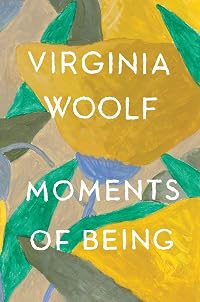
Moments of Being
by Virginia Woolf
On This Page
Description
This collection of autobiographical writings brings together unpublished material selected from the Woolf archives at the British Library and the University of Sussex Library.Tags
Recommendations
















Member Recommendations

Member Reviews
This collection pulls together a number of Virginia Woolf's autobiographical writings, written across a thirty-year period and covering many more than that. The centerpiece of the book is definitely "A Sketch of the Past," a 100-page fragment Woolf never completed. Woolf's very self-conscious narrative is highly suited to autobiography; she often leads off a new section explaining what the date is and how long it's been since she last worked on the narrative. In one of my favorite bits, she reflects on how we remember things:
I often wonder-- that thing we have felt with great intensity have an existence independent of our minds; are in fact still in existence? And if so, will it not be possible, in time, that some device will be show more invented by which we can tap them? I see it-- the past-- as an avenue lying behind; a long ribbon of scenes, emotions.... Instead of remembering here a scene and there a sound, I shall fit a plug into the wall; and listen in to the past. I shall turn up August 1890. I feel that strong emotion must leave its trace; and it is only a question of discovering how we can get ourselves again attached to it, so that we shall be able to live our lives through from the start. (67)
In addition to being a great metaphor and a captivating meditation on the problems of memory, I also suspect it was Helen Raynor's inspiration for "Ghost Machine," an episode of Torchwood. Woolf's literary techniques, used self-consciously to untangle her own past, really work for me here in a way they often don't in her fiction.
The other standout piece (there are five in all), is "22 Hyde Park Gate," which tells Woolf's memories of the home she grew up in. Like the best memoirs, it's funny fairly often (so is "Am I a Snob?", for that matter), but it mixes in some sharp moments of pain. Especially the last page. It's probably my favorite bit of writing by Woolf, such a great reversal. show less
I often wonder-- that thing we have felt with great intensity have an existence independent of our minds; are in fact still in existence? And if so, will it not be possible, in time, that some device will be show more invented by which we can tap them? I see it-- the past-- as an avenue lying behind; a long ribbon of scenes, emotions.... Instead of remembering here a scene and there a sound, I shall fit a plug into the wall; and listen in to the past. I shall turn up August 1890. I feel that strong emotion must leave its trace; and it is only a question of discovering how we can get ourselves again attached to it, so that we shall be able to live our lives through from the start. (67)
In addition to being a great metaphor and a captivating meditation on the problems of memory, I also suspect it was Helen Raynor's inspiration for "Ghost Machine," an episode of Torchwood. Woolf's literary techniques, used self-consciously to untangle her own past, really work for me here in a way they often don't in her fiction.
The other standout piece (there are five in all), is "22 Hyde Park Gate," which tells Woolf's memories of the home she grew up in. Like the best memoirs, it's funny fairly often (so is "Am I a Snob?", for that matter), but it mixes in some sharp moments of pain. Especially the last page. It's probably my favorite bit of writing by Woolf, such a great reversal. show less
I feel that I have had a blow; but it is not, as I thought as a child, simply a blow from an enemy hidden behind the cotton wool of daily life; it is or will become a revelation of some order; it is a token of some real thing behind appearances; and I make it real by putting it into words. It is only by putting it into words that I make it whole; this wholeness means that it has lost its power to hurt me; it gives me, perhaps because by doing so I take away the pain, a great delight to put the severed parts together.
I found this book on the shelf at the library while retrieving On Being Ill. I was drawn to the title, distracted from my search, a search that has very much acquired tunnel vision. Lately I think I have been too calculating show more with the order in which I read books. I used to not be this way; I used to read books strictly as they came my way, through serendipity, and that has always worked for me. So I saw this book and I took it, even though it wasn't on my list, my carefully selected and ordered list.
Recently I have also been feeling disconnected from my reviews, like they are something to get past after reading a book. I take notes as I read, I synthesize in my head, and I write it all out and post it here. Then I start reading another book and the process starts again. But I don't think I am spending enough time with these books. I want to know them better, know the characters more deeply, connect with the writers as if they are conversing with me.
In “A Sketch of the Past,” one of the memoir pieces in this collection, Virgina Woolf talks about moments of being and non-being, and how most days contain many more moments of non-being, this “cotton wool” of daily life, than moments of being, the “sudden violent shocks” or “sledgehammer blows” that become more valuable to us as we grow older. These hints at what is lurking behind the cotton wool can easily become more important than the cotton wool itself. But what of the cotton wool? What can we do with this gauzy material wrapping itself around us from morning to night? What if we work harder to incorporate what is behind the wool into the wool itself, weaving the two together so that they are entwined, then maybe the cotton wool will shine brighter. I am interested in doing this.
I am always a bit hesitant to read collections of a writer's work that was not intended for publication. I try to imagine how I would feel if someone looted my hard drive and published writing I was still toying with or had abandoned. But I would likely be dead at that point so it wouldn't matter. And I guess maybe that is why I give myself leniency in this indulgence. Virginia Woolf wrote a lot of words during her lifetime, and what she did publish was some of the most original writing still being read today. And so of course I was curious about what she might have written about herself.
This short volume collects Woolf's only autobiographical writing. It consists of five discrete pieces arranged in chronological order of the time periods Woolf was writing about, not necessarily in the order in which they were written. The first, “Reminiscences,” is an early piece written as a memoir of her sister Vanessa to be given to Vanessa and her husband Clive. In terms of style, I found it to be the least interesting of the batch, but it provides a lot of important family history, in particular describing the far-reaching effects that the death of Virginia's mother had on all of them.
It is the second piece in here, “A Sketch of the Past,” that affected me the most deeply. This was written late in Virginia's career and is the longest piece in the book. She wrote it while taking breaks from working on other books, chiefly her biography of Roger Fry. What she is attempting is a new (for the time) way of writing memoir, swirling the present into the past, contextualizing her moments of being into a more cohesive whole by writing them out, by putting the severed parts together, as she describes it. When I look at my reading notes, almost all of the passages I pulled out come from this section of the book. It is here where we gain the greatest insight into her creative process, where she lays out how she fit her life into her novels. There are other hints in other places in the book, descriptions of various people in her life who remind one of characters in her novels, but nowhere is this so explicitly evident as in this piece. She writes the most about To the Lighthouse and how important writing that book was in grieving for her mother, how it allowed her to finally let go, because of how the writing, the making whole, frees one from the pain, destroys the power of the real thing to hurt you. This meant so much to me because that is how I feel about writing.
I found the prose in “A Sketch of the Past” to be hypnotic. I didn't want it to end, but it finally did. The remaining three pieces in the book were written for the Memoir Club, a literary society that included the Woolfs and which was a post-war reunion of their previous society, Bloomsbury. Members wrote honest, personal accounts from their lives and read them to the group. One of these describes the original Bloomsbury group, catching the reader up in the heady excitement of first connections with others who read and talked about literature and the arts. This made me pine for the days of clandestine literary gatherings with names like the “Midnight Society,” days that I didn't live in but maybe wished I did. It made me think of Goodreads as our newfangled version of a literary society, but while I think GR excels at how it brings together such far-flung readers into one virtual place, I still romanticize the idea of a smoke-filled room full of rowdy wine-drinking ne'er-do-wells arguing over Keats and Shelley. Virginia and her siblings were finally breaking free of the stodgy Victorian constriction and this type of gathering became their life's blood. There is so much youthful energy and passion evident here. At one point, Virginia's brother Thoby remarks, “Nobody was much good after twenty-five,” which I thought was funny.
The thing about the Memoir Club pieces is that they were written for a specific audience and were meant to be read aloud. Jeanne Schulkind notes in one of her introductions that Virginia probably wouldn't have stuck to the typescript, either. There would have been asides, inside jokes, laughing in the room. Some of the details in these pieces went over my head because I didn't know the people Virginia was writing about, did not know her siblings and other family members. “Hyde Park Gate” picks up chronologically more or less where “A Sketch of the Past” leaves off, and yet it offers a more light-hearted, less pensive treatment of the material, and was obviously tailored to its audience. Virginia is not going as deep inside herself as she does in “A Sketch.” She does not stop to poke her head down all the rabbit holes that appear along the path when one is reviewing the formative moments of one's life. To me, that made it less personal, although I still enjoyed it for what it was.
The final piece from the Memoir Club selections is “Am I a Snob?” and for me was the funniest one in the book. Here, Virginia wonder if she is a snob and sets out to determine the answer by comparing herself to other people in her life, some of whom were also club members, which likely led to much laughter in the room as she read the piece aloud. In some ways, I thought this piece gave me the most insight into how Virginia was as an adult, after having achieved literary success, and being now quite comfortable in her own skin, having shed the Victorian exoskeleton forced upon her as a child, and fashioned her own way of living in place of it. It was a fitting close to the book.
I came to Virginia Woolf somewhat late in my reading life, but I think maybe that is a good thing. So much of her writing has to do with asking questions, about life, reality, love. There are few, if any, actual answers to these questions, but we keep asking them, we always will, and I think that's why her writing will always feel relevant. Like Virginia, I now welcome the sledgehammer blows in my life and seek to explore them, to describe them in a critical way. I want to write through everything, not trying to answer the questions, but trying to get at why we ask them, what roles the questions play in our own lives, how important they are to us and how we can help each other to better understand their significance. Whether the questions are all bunching up behind the cotton wool or hammering down upon us, I think ignoring them does nothing to help us live our lives.
4/5: The reason for the 4 is mostly a technicality. Since Virginia didn't intend these pieces for publication they are somewhat incomplete and unpolished. In some ways this is a good thing, for it offers a more personal view into Virginia's thinking than the view one gets from reading her published work. But I'm trying not to be so cavalier with my 5-star ratings, hence the 4. show less
A collection of Virginia Woolf's autobiographical writings, most of them never published in her lifetime. There are three short and very funny sketches on her family, Bloomsbury and her aristocratic connections(where she confesses her embarrassment at trying on suspenders in shops), but the main bulk are two attempts at narrating her childhood and the death of her mother and her elder half-sister Stella. The earlier one is rather stilted but the later one, 'A Sketch of the Past' is an outstanding and very original autobiography. It shifts between the present and the past with ease, and is full of delicately observed detail and restrained, unmelodramatic analysis of a series of rather traumatic events.
"We are the words; we are the music; we are the thing itself." Published years after her death, Moments of Being is "the single most moving and beautiful thing that Virginia Woolf ever wrote about her own life" (The New York Times) and her only autobiographical writing.
This collection of five pieces written for different audiences spanning almost four decades reveals the remarkable unity of Virginia Woolf's art, thought, and sensibility. "Reminiscences," written during her apprenticeship period, exposes the childhood shared by Woolf and her sister, Vanessa, while "A sketch of the Past" illuminates the relationship with her father, Leslie Stephens, who played a crucial role in her development as an individual a writer. Of the final show more three pieces, composed for the Memoir Club, which required absolute candor of its members, two show Woolf at the threshold of artistic maturity and one shows a confident writer poking fun at her own foibles. show less
This collection of five pieces written for different audiences spanning almost four decades reveals the remarkable unity of Virginia Woolf's art, thought, and sensibility. "Reminiscences," written during her apprenticeship period, exposes the childhood shared by Woolf and her sister, Vanessa, while "A sketch of the Past" illuminates the relationship with her father, Leslie Stephens, who played a crucial role in her development as an individual a writer. Of the final show more three pieces, composed for the Memoir Club, which required absolute candor of its members, two show Woolf at the threshold of artistic maturity and one shows a confident writer poking fun at her own foibles. show less
Virginia Woolf is probably my favorite writer of all time, so it was amazing to read these intimate and literary (but still relatively unpolished) memoirs. The writings split their time between Woolf's childhood and family and her adult friendships with the Bloomsbury group. One of the writings on her childhood was written very early in her career (before she had published any novels) and the other late in her life, finished the same year she killed herself. The remaining three pieces were written as part of the Memoir Club, a writing group of Woolf and some of the other Bloomsbury regulars where autobiographical sketches were written and read aloud to the other group members. Rather than arrange the writings by the time period in which show more they were written, Schulkind arranges them so that the events discussed move forward in chronological order, and includes brief prefaces to each piece that tie the works into the timeline of Woolf's life and make this collection something of a mini-biography.
[full review here: http://spacebeer.blogspot.com/2009/09/moments-of-being-1985.html ]
Added on second reading (August 2023): The first piece is admittedly a bit rough -- Woolf wrote it as she was assigning herself exercises to teach herself how to write -- pushing through it highlights even more strongly the masterful wit and phrasing of Woolf at her prime.
Virginia Woolf is one of my favorite writers of all time and I picked this as the final book in my Virginia Woolf book club, where me and some of my most dedicated friends have read everything she published in her lifetime. It took us SIX YEARS and was extremely rewarding on every possible level. Love you, my WOOLFateers show less
[full review here: http://spacebeer.blogspot.com/2009/09/moments-of-being-1985.html ]
Added on second reading (August 2023): The first piece is admittedly a bit rough -- Woolf wrote it as she was assigning herself exercises to teach herself how to write -- pushing through it highlights even more strongly the masterful wit and phrasing of Woolf at her prime.
Virginia Woolf is one of my favorite writers of all time and I picked this as the final book in my Virginia Woolf book club, where me and some of my most dedicated friends have read everything she published in her lifetime. It took us SIX YEARS and was extremely rewarding on every possible level. Love you, my WOOLFateers show less
Virginia Woolf is a writer who is still very much with us. This is quite surprising, as Woolf had her roots in the Victorian Age, and died in the early 1940s. Many other writers of that era are now obscure. That this was not her fate, can be understood from the quality of her fiction. Apart from some pothumous publications into the 1950s, most of Virginia Woolf's works were published during the 1920s and 30s, and as the main representative of stream-of-consciousness her works have become canonized and included in highschool and university curricula guaranteeing many new generations of readers. Besides, Virginia Woolf appeals to readers imaginations through her participation in the Bloomsbury Group, as a publisher, running the Hogarth show more Press and her role in female emancipation and gender issues. Because although she grew up in a Victorian milieu most of her literary work was created and helped shape the landscape of modernity.
Sustained academic interest throughout the 1960s through 80s led to the publication of Virginia Woolfs autobiographical writings, foremostly the Letters and Diaries, most of which were published during the 1970 through 1990s. This is really still very recent, and therefore many of these materials appear very fresh to modern readers, who are unlikely to be familiar with much of that material. Who has read, for instance, her Greek travel diary, edited by Jan Morris and published as Travels With Virginia Woolf (1993). A selection of the Diaries has recently appeared in the Red Series of Vintage Books.
Moments of Being brings together a collection of previously unpublished autobiographical essays of Virginia Woolf. In these essays, readers will find the source for many pieces of common knowledge about Virginia Woolf such as the famous scene of horror in which, as a young woman, she imagined seeing something move behind her in the mirror. There are many autobiographical details about herself, her family members, Lytton Strachy and other members of the Bloomsbury Circle, as well as essential descriptions of the author's environs, particularly the houses she lived. Moments of being was first published in 1976, but interested readers are advised to read the updated and expanded second edition, first published in 1985, which includes many new manuscript materials and versions which were discovered later.
Including 27 pages of introduction, Moments of Being is a modest volume of 230 pages, including two larger and four smaller contributions. The earliest youth work "Reminiscences" is somewhat stilted, and could be skipped, or simply included for completeness, as it only consists of 30 pages. Far more interesting is "A Sketch of the Past" which displays all the characteristics of the mature style of Virginia Woolf. In the final pages of this work, Woolf describes how she experienced the transition from the Victorian Age to the Edwardian Period, showing how changes in architecture, and symbolized by the move from 22 Hyde Park Gate to 46 Gordon Square in Bloomsbury, and manners created a very different world, particularly favourable to the earliest beginnings of women's emancipation. The shorter essays, such as "22 Hyde Park Gate", "Old Bloomsbury" and "Am I a Snob?" were written for the Memoir Club and were read aloud to its members. These pieces are very humourous, and one can almost hear the peals of laughter that they must have earned Woolf as she midly satirized her companions and herself. In some of these essays, Woolf writes very openly about homosexuality, as she would later playfully show her ambivalence in her novel Orlando.
The essays and autobiographical writings in Moments of Being are arranged in the order of the historical events they describe, not the order of conception. It is an absolutely delightful book, which I regret not to have read during my students days, and am very happy to have discovered now, and read with relish. show less
Sustained academic interest throughout the 1960s through 80s led to the publication of Virginia Woolfs autobiographical writings, foremostly the Letters and Diaries, most of which were published during the 1970 through 1990s. This is really still very recent, and therefore many of these materials appear very fresh to modern readers, who are unlikely to be familiar with much of that material. Who has read, for instance, her Greek travel diary, edited by Jan Morris and published as Travels With Virginia Woolf (1993). A selection of the Diaries has recently appeared in the Red Series of Vintage Books.
Moments of Being brings together a collection of previously unpublished autobiographical essays of Virginia Woolf. In these essays, readers will find the source for many pieces of common knowledge about Virginia Woolf such as the famous scene of horror in which, as a young woman, she imagined seeing something move behind her in the mirror. There are many autobiographical details about herself, her family members, Lytton Strachy and other members of the Bloomsbury Circle, as well as essential descriptions of the author's environs, particularly the houses she lived. Moments of being was first published in 1976, but interested readers are advised to read the updated and expanded second edition, first published in 1985, which includes many new manuscript materials and versions which were discovered later.
Including 27 pages of introduction, Moments of Being is a modest volume of 230 pages, including two larger and four smaller contributions. The earliest youth work "Reminiscences" is somewhat stilted, and could be skipped, or simply included for completeness, as it only consists of 30 pages. Far more interesting is "A Sketch of the Past" which displays all the characteristics of the mature style of Virginia Woolf. In the final pages of this work, Woolf describes how she experienced the transition from the Victorian Age to the Edwardian Period, showing how changes in architecture, and symbolized by the move from 22 Hyde Park Gate to 46 Gordon Square in Bloomsbury, and manners created a very different world, particularly favourable to the earliest beginnings of women's emancipation. The shorter essays, such as "22 Hyde Park Gate", "Old Bloomsbury" and "Am I a Snob?" were written for the Memoir Club and were read aloud to its members. These pieces are very humourous, and one can almost hear the peals of laughter that they must have earned Woolf as she midly satirized her companions and herself. In some of these essays, Woolf writes very openly about homosexuality, as she would later playfully show her ambivalence in her novel Orlando.
The essays and autobiographical writings in Moments of Being are arranged in the order of the historical events they describe, not the order of conception. It is an absolutely delightful book, which I regret not to have read during my students days, and am very happy to have discovered now, and read with relish. show less
This is a fascinating collection of private notes, typed reminiscences, and other writings not intended to be published. There are scenes from Virginia Woolf's childhood in London and at her family's summer house in St. Ives on the Cornwall coast, as well as from her Bloomsbury days.
I learned much about the background for To the Lighthouse, The Waves, and her other books by reading this collection.
I learned much about the background for To the Lighthouse, The Waves, and her other books by reading this collection.
Members
- Recently Added By
Lists

20th Century Literature
1,161 works; 55 members

Deathreads
78 works; 2 members

1920s
141 works; 6 members

In Our Time books
4,934 works; 2 members
Author Information

653+ Works 119,149 Members
Virginia Woolf was born in London, England on January 25, 1882. She was the daughter of the prominent literary critic Leslie Stephen. Her early education was obtained at home through her parents and governesses. After death of her father in 1904, her family moved to Bloomsbury, where they formed the nucleus of the Bloomsbury Group, a circle of show more philosophers, writers, and artists. During her lifetime, she wrote both fiction and non-fiction works. Her novels included Jacob's Room, Mrs. Dalloway, To the Lighthouse, Orlando, and Between the Acts. Her non-fiction books included The Common Reader, A Room of One's Own, Three Guineas, The Captain's Death Bed and Other Essays, and The Death of the Moth and Other Essays. Having had periods of depression throughout her life and fearing a final mental breakdown from which she might not recover, Woolf drowned herself on March 28, 1941 at the age of 59. Her husband published part of her farewell letter to deny that she had taken her life because she could not face the terrible times of war. (Bowker Author Biography) show less
Some Editions
Series
Belongs to Publisher Series
Work Relationships
Is contained in
Common Knowledge
- Canonical title
- Moments of Being
- Original title
- Moments of being
- Alternate titles*
- Augenblicke des Daseins: Autobiographische Skizzen
- Original publication date
- 1976; 1985 (expanded 2nd edition) (expanded 2nd edition)
- People/Characters
- Virginia Woolf
- First words
- This collection of autobiographical writings, although diverse, nevertheless reveals the remarkable unity of Virginia Woolf's art, thought and sensibility. - Introduction by Jeanne Schulkind
Your mother was born in 1879, and as some six years at least must have passed before I knew that she was my sister, I can say nothing of that time. - Last words
- (Click to show. Warning: May contain spoilers.)And the car drove off, and she sat by my side, trying to impress me with the fact that she had known Henry James.
*Some information comes from Common Knowledge in other languages. Click "Edit" for more information.
Classifications
Statistics
- Members
- 1,249
- Popularity
- 19,661
- Reviews
- 13
- Rating
- (4.23)
- Languages
- 14 — Dutch, English, Estonian, Finnish, French, German, Hungarian, Italian, Polish, Slovenian, Spanish, Swedish, Turkish, Portuguese (Portugal)
- Media
- Paper, Ebook
- ISBNs
- 35
- UPCs
- 1
- ASINs
- 16