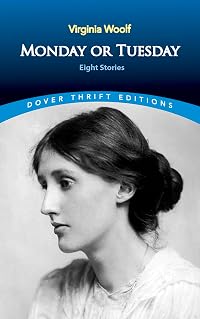
Monday or Tuesday: Eight Stories
by Virginia Woolf
On This Page
Description
Interested in diving into the works of brilliant modernist author Virginia Woolf, but don't know where to start? Try Monday or Tuesday, a collection of eight short stories originally published in 1921. Although the collected stories contain the same keen insight and bold experimentation that made Woolf's reputation, their easy-to-digest size make them a bit easier to tackle than one of Woolf's novels, especially for newcomers to this feminist icon's body of work..
Tags
Recommendations

















Member Reviews
A lot of mysteriously evasive stuff. Playful too. This collection of eight stories from 1921 was important to me because of the window we get from an author who had only yet published two somewhat conventional novels. Nothing here is conventional. Lines require different mindsets, hard to find mindsets. Sometimes it’s oddly very beautiful. Often, it’s super-insecure.
lines like this: "Yet, the moment after, if the door was opened, spread about the floor, hung upon the walls, pendant from the ceiling--what?" It takes a moment to realize "the moment after" is the subject of the sentence, rather than simply a time descriptor. Which is elegant, but where does one store the meaning of the sentence in your mind?
There are many aspects of show more the stories like this. Although usually the point of the story becomes clear, it can leave an almost mystical feeling, trying to understand the full texture of the story, the way, for example, the ghostly couple exist in the opening story, holding hands, making noises. Are they real? Is this Woolf's deceased parents? Am I thinking the right mindset? Am I close? That whole mindset has a religious or spiritual tone to it. ... I mean, I think it does.
I don't know that these stories will stick, that they or can as they can be so elusive. Well, other than that ghostly couple who come to mind as soon as I think about the title. But the nature of the mindset here will be something I carry over, as venture on to the next Woolf novel, [Jacob's Room], one that is apparently very difficult.
2026
https://www.librarything.com/topic/384249#9194944 show less
lines like this: "Yet, the moment after, if the door was opened, spread about the floor, hung upon the walls, pendant from the ceiling--what?" It takes a moment to realize "the moment after" is the subject of the sentence, rather than simply a time descriptor. Which is elegant, but where does one store the meaning of the sentence in your mind?
There are many aspects of show more the stories like this. Although usually the point of the story becomes clear, it can leave an almost mystical feeling, trying to understand the full texture of the story, the way, for example, the ghostly couple exist in the opening story, holding hands, making noises. Are they real? Is this Woolf's deceased parents? Am I thinking the right mindset? Am I close? That whole mindset has a religious or spiritual tone to it. ... I mean, I think it does.
I don't know that these stories will stick, that they or can as they can be so elusive. Well, other than that ghostly couple who come to mind as soon as I think about the title. But the nature of the mindset here will be something I carry over, as venture on to the next Woolf novel, [Jacob's Room], one that is apparently very difficult.
2026
https://www.librarything.com/topic/384249#9194944 show less
Stream of consciousness monologues from an author with a rich internal life. The slightest stimulus can trigger an hours-long mental journey, a smudge on a wall that may or may not be a nail can paralyze you with its suggestiveness, you can have a long imaginary conversation with an old woman across from you on the train without saying a word. I frequently get distracted and lost in my head so this hit close to home.
Actually it hit a little too close to home. My own mental anchors are relatively recently established. I don't know if I'm ready to dive into someone else's choppy brain-ocean. Maybe I should have started with another Virginia Woolf.
Actually it hit a little too close to home. My own mental anchors are relatively recently established. I don't know if I'm ready to dive into someone else's choppy brain-ocean. Maybe I should have started with another Virginia Woolf.
Rating: 3.5* of five
The Publisher Says: A collection of eight deliberately fragmentary and experimental sketches, Monday or Tuesday remains unique in being the only volume of short stories that Virginia Woolf published herself. A woman gazes at a mark on a wall and ponders the vagaries of thought and opinion; a succession of couples are caught up with nostalgia for their past as they stroll among the vibrant flowers of Kew Gardens; a heron soars high above cities and towns, lakes and mountains, while below, life continues in all its mundanity; and blue and green are given their expression in words. Monday or Tuesday is a brilliant and striking series of impressions, written in Woolf’s characteristic lyrical and startling prose.
My show more Review: This short book, only 54pp in my Dover Thrift Edition, is the best and the worst of La Woolf. Some pieces are incomprehensible to the merely mortal, others are simply brilliant evocations of mood, of consciousness...it's in reading this book that I came to the realization that what many people dislike about Woolf's writing can be traced back to the sense one has of Woolf staring, staring, staring, with eyes darting hither and thither, while speaking aloud what most of us simply allow to slide from one eye to the other.
I don't think stories were Miss Virginnie's métier, the way they were Miss Eudora's for example, but there is something in each experience of a story in these pages to make one glad to have met with it.
"A Haunted House," a few brief words, a simple story of a ghostly apparition and her husband re-experiencing their home after death; not much to it, not much of it, but so haunting (!) 3.5 stars
"A Society," of women you see, a society that undertakes A Study, frankly uninteresting to me as a 21st century reader, and pretty much a clunker 2.5 stars
"Monday or Tuesday" explores simultaneity with simple imagery and makes flight seem magically mundane. 3.5 stars
"An Unwritten Novel," now, this is the Woolf of Orlando and how I adore her, what a gorgeous thing it is to be there in her head as her eyes move ceaselessly and her brain which can not shut itself off like mere mortals' can, and see the details that tell more than the words alone can describe, creating a huge and varied landscape from a twitch. 4.5 stars
"The String Quartet," again, brings the Orlando touch to a musical evening, but came too soon after "An Unwritten Novel" for me to drool on it so hard 4 stars
"Blue & Green," on the other hand, makes not one whit of sense and is a mere catalog of responses to the colors. 2.5 stars
"Kew Gardens," color and light and the air, with people moving through them and leaving vapor trails of self that commingle not at all, but swirl intricately around and past each other. 3.5 stars
"The Mark on the Wall," the ultimate Woolfy story, staring staring staring while brainwaves toss up Landseer paintings, housemaids, Heaven and Hell... 4 stars
This work is licensed under a Creative Commons Attribution-NonCommercial-ShareAlike 3.0 Unported License. show less
The Publisher Says: A collection of eight deliberately fragmentary and experimental sketches, Monday or Tuesday remains unique in being the only volume of short stories that Virginia Woolf published herself. A woman gazes at a mark on a wall and ponders the vagaries of thought and opinion; a succession of couples are caught up with nostalgia for their past as they stroll among the vibrant flowers of Kew Gardens; a heron soars high above cities and towns, lakes and mountains, while below, life continues in all its mundanity; and blue and green are given their expression in words. Monday or Tuesday is a brilliant and striking series of impressions, written in Woolf’s characteristic lyrical and startling prose.
My show more Review: This short book, only 54pp in my Dover Thrift Edition, is the best and the worst of La Woolf. Some pieces are incomprehensible to the merely mortal, others are simply brilliant evocations of mood, of consciousness...it's in reading this book that I came to the realization that what many people dislike about Woolf's writing can be traced back to the sense one has of Woolf staring, staring, staring, with eyes darting hither and thither, while speaking aloud what most of us simply allow to slide from one eye to the other.
I don't think stories were Miss Virginnie's métier, the way they were Miss Eudora's for example, but there is something in each experience of a story in these pages to make one glad to have met with it.
"A Haunted House," a few brief words, a simple story of a ghostly apparition and her husband re-experiencing their home after death; not much to it, not much of it, but so haunting (!) 3.5 stars
"A Society," of women you see, a society that undertakes A Study, frankly uninteresting to me as a 21st century reader, and pretty much a clunker 2.5 stars
"Monday or Tuesday" explores simultaneity with simple imagery and makes flight seem magically mundane. 3.5 stars
"An Unwritten Novel," now, this is the Woolf of Orlando and how I adore her, what a gorgeous thing it is to be there in her head as her eyes move ceaselessly and her brain which can not shut itself off like mere mortals' can, and see the details that tell more than the words alone can describe, creating a huge and varied landscape from a twitch. 4.5 stars
"The String Quartet," again, brings the Orlando touch to a musical evening, but came too soon after "An Unwritten Novel" for me to drool on it so hard 4 stars
"Blue & Green," on the other hand, makes not one whit of sense and is a mere catalog of responses to the colors. 2.5 stars
"Kew Gardens," color and light and the air, with people moving through them and leaving vapor trails of self that commingle not at all, but swirl intricately around and past each other. 3.5 stars
"The Mark on the Wall," the ultimate Woolfy story, staring staring staring while brainwaves toss up Landseer paintings, housemaids, Heaven and Hell... 4 stars
This work is licensed under a Creative Commons Attribution-NonCommercial-ShareAlike 3.0 Unported License. show less
More like a 3 1/2. You can tell that she is really experimenting in an attempt to get towards what she would achieve with To the Lighthouse and Mrs. Dalloway. The "stories" here are more like prose poems than narratives, which she would put to great use in later works. But that's not to say that these are not fascinating vignettes--lovely, dreamy, and abstract, unlike Gertrude Stein's harsh experiments.
More like a 3 1/2. You can tell that she is really experimenting in an attempt to get towards what she would achieve with To the Lighthouse and Mrs. Dalloway. The "stories" here are more like prose poems than narratives, which she would put to great use in later works. But that's not to say that these are not fascinating vignettes--lovely, dreamy, and abstract, unlike Gertrude Stein's harsh experiments.
This slim collection of early short stories by Virginia Woolf has a little bit of all her strengths crammed into one tiny volume. "Kew Gardens" is probably my favorite, but the poetry of "Blue & Green" and "Monday or Tuesday," the feminist commentary of "A Society," and the sly commentary of "An Unwritten Novel" are all pretty wonderful. Oh, and "A Haunted House" and "Mark on the Wall"! Who am I fooling, I loved all of them. Worth a dip for fans of literature, Virginia Woolf, or kick ass short (and super short) stories.
My latest #Woolfalong read for phase three, was Monday or Tuesday, a collection of short stories which was published during Woolf’s lifetime. So many other collections – like Mrs Dalloway’s Party which I read last month were put together after her death. I enjoyed this collection, although not quite as much as the aforementioned Mrs Dalloway’s Party – but I already know that writing about this slim little collection will be a challenge, which I won’t even attempt to do in any great detail or depth.
These stories are all generally pretty short, some just a couple of pages, they are impressionistic, and at times feel rather experimental. A few of the stories I read twice, captivated by the imagery, appreciative of the delicious show more prose, I found myself bemused occasionally asking myself ‘well what did she mean by that then?’ Searching for meaning particularly in the two very short pieces, which are over almost as soon as they have begun; Monday or Tuesday and Blue and Green. Woolf’s powers of observation and description are certainly what stand out from these eight stories, as ever her prose is simply wonderful.
The collection opens with A Haunted House, in which the ghostly presence of the past rub shoulders with the living inhabitants. The ghostly couple roam the house, reminiscing their past, while the residents of the house sleep. I adored the descriptions of the silent house, the feeling of the past presence which still exists there.
A Society is a brilliant satire. A group of women form a society in which they gather to think and discuss the contribution made by men in the arts and sciences in which they have always dominated. The women swear to not marry or have children until they have discovered for themselves what it is the men have been doing all these years. Had the sacrifice made by generations of women caring for men, bearing their children been worth it? The women; each taking a different element for investigation go their separate ways. We see the women come together again after a period of five years, in the intervening years a few have got married and had children after all. They make their reports – though don’t seem to come to any conclusions, except that their girl children must be made to believe in themselves, and so in time the mantle is passed to the next generation.
“’Oh Cassandra why do you torment me? Don’t you know that our belief in man’s intellect is the greatest fallacy of them all?”
“What?” I exclaimed. “Ask any journalist, schoolmaster, politician or public house keeper in the land and they will all tell you that men are much cleverer than women.”
“As if I doubted it,” she said scornfully. “How could they help it? Haven’t we bred them and fed and kept them in comfort since the beginning of time so that they may be clever even if they’re nothing else? It’s all our doing!” she cried.”
(from A Society)
heronMonday or Tuesday – the title story, is a beautifully rendered piece of modernist experimental writing. It is slightly less than two pages long – and describes the flight of a heron above the teeming life of towns and cities below. There are some lovely contrasts between the freedom of the heron in flight and the restrictions of life below, the striking of a clock a reminder of the tyranny which time has upon our lives. The writing is simply beautiful, there is an exquisite sense of all aspects of life coming together over the course of a day.
“Lazy and indifferent, shaking space easily from his wings, knowing his way, the heron passes over the church beneath the sky. White and distant, absorbed in itself, endlessly the sky covers and uncovers, moves and remains. A lake? Blot the shores of it out! A mountain? Oh, perfect – the sun gold on its slopes. Down that falls. Ferns then, or white feathers, for ever and ever…”
(From Monday or Tuesday)
In An unwritten novel a woman on a train, glances up at the face of the woman sat opposite her. It is a small, insignificant moment, but one Virginia Woolf expands on brilliantly. She sees something in that face, and imagines a whole life, a whole world for her travelling companion. The women do exchange a few words, and our narrator learns a little more about the woman, and from that builds a whole story in her imagination. The unwritten novel of the title – the possible story of this woman’s life.
“Such an expression of unhappiness was enough by itself to make one’s eyes slide above the paper’s edge to the poor woman’s face—insignificant without that look, almost a symbol of human destiny with it. Life’s what you see in people’s eyes; life’s what they learn, and, having learnt it, never, though they seek to hide it, cease to be aware of—what? That life’s like that.”
(From An Unwritten Novel)
In The String Quartet Virginia Woolf represents in prose the music of Mozart’s string quartet. Our narrator attends a performance of the string quartet, and we see and hear her thoughts and observations, and with her overhear snatches of conversation at the concert.
Blue and Green is just two paragraphs long. One paragraph dedicated to blue and one to green. There is no narrative, but again Virginia Woolf flexes her descriptive muscles.
Kew Gardens takes us to the flower boarders of that famous botanical garden. The story alternates between descriptions of a flower bed – including an examination of a snail, to the conversations between several couples walking in the gardens.
Aspects of the final story The Mark on the Wall reminded me of The Unwritten novel, like that story, our narrator’s flits about over various possibilities. Her attention is drawn to a mark on the wall, a mark she hadn’t notice before. In her mind she contemplates how the mark could have got there, inventing, imagining, allowing her thoughts to roam from one explanation to another as each idea sparks off another. Of course Virginia Woolf is particularly good at this kind of perspective.
In these stories, which Virginia Woolf wrote as a distraction at the same period that she was writing Night and Day her second novel, she examines the ordinary everyday moment, the ordinary mind and the impressions it receives.
(for those of you counting – book 2 of #20booksofsummer) show less
These stories are all generally pretty short, some just a couple of pages, they are impressionistic, and at times feel rather experimental. A few of the stories I read twice, captivated by the imagery, appreciative of the delicious show more prose, I found myself bemused occasionally asking myself ‘well what did she mean by that then?’ Searching for meaning particularly in the two very short pieces, which are over almost as soon as they have begun; Monday or Tuesday and Blue and Green. Woolf’s powers of observation and description are certainly what stand out from these eight stories, as ever her prose is simply wonderful.
The collection opens with A Haunted House, in which the ghostly presence of the past rub shoulders with the living inhabitants. The ghostly couple roam the house, reminiscing their past, while the residents of the house sleep. I adored the descriptions of the silent house, the feeling of the past presence which still exists there.
A Society is a brilliant satire. A group of women form a society in which they gather to think and discuss the contribution made by men in the arts and sciences in which they have always dominated. The women swear to not marry or have children until they have discovered for themselves what it is the men have been doing all these years. Had the sacrifice made by generations of women caring for men, bearing their children been worth it? The women; each taking a different element for investigation go their separate ways. We see the women come together again after a period of five years, in the intervening years a few have got married and had children after all. They make their reports – though don’t seem to come to any conclusions, except that their girl children must be made to believe in themselves, and so in time the mantle is passed to the next generation.
“’Oh Cassandra why do you torment me? Don’t you know that our belief in man’s intellect is the greatest fallacy of them all?”
“What?” I exclaimed. “Ask any journalist, schoolmaster, politician or public house keeper in the land and they will all tell you that men are much cleverer than women.”
“As if I doubted it,” she said scornfully. “How could they help it? Haven’t we bred them and fed and kept them in comfort since the beginning of time so that they may be clever even if they’re nothing else? It’s all our doing!” she cried.”
(from A Society)
heronMonday or Tuesday – the title story, is a beautifully rendered piece of modernist experimental writing. It is slightly less than two pages long – and describes the flight of a heron above the teeming life of towns and cities below. There are some lovely contrasts between the freedom of the heron in flight and the restrictions of life below, the striking of a clock a reminder of the tyranny which time has upon our lives. The writing is simply beautiful, there is an exquisite sense of all aspects of life coming together over the course of a day.
“Lazy and indifferent, shaking space easily from his wings, knowing his way, the heron passes over the church beneath the sky. White and distant, absorbed in itself, endlessly the sky covers and uncovers, moves and remains. A lake? Blot the shores of it out! A mountain? Oh, perfect – the sun gold on its slopes. Down that falls. Ferns then, or white feathers, for ever and ever…”
(From Monday or Tuesday)
In An unwritten novel a woman on a train, glances up at the face of the woman sat opposite her. It is a small, insignificant moment, but one Virginia Woolf expands on brilliantly. She sees something in that face, and imagines a whole life, a whole world for her travelling companion. The women do exchange a few words, and our narrator learns a little more about the woman, and from that builds a whole story in her imagination. The unwritten novel of the title – the possible story of this woman’s life.
“Such an expression of unhappiness was enough by itself to make one’s eyes slide above the paper’s edge to the poor woman’s face—insignificant without that look, almost a symbol of human destiny with it. Life’s what you see in people’s eyes; life’s what they learn, and, having learnt it, never, though they seek to hide it, cease to be aware of—what? That life’s like that.”
(From An Unwritten Novel)
In The String Quartet Virginia Woolf represents in prose the music of Mozart’s string quartet. Our narrator attends a performance of the string quartet, and we see and hear her thoughts and observations, and with her overhear snatches of conversation at the concert.
Blue and Green is just two paragraphs long. One paragraph dedicated to blue and one to green. There is no narrative, but again Virginia Woolf flexes her descriptive muscles.
Kew Gardens takes us to the flower boarders of that famous botanical garden. The story alternates between descriptions of a flower bed – including an examination of a snail, to the conversations between several couples walking in the gardens.
Aspects of the final story The Mark on the Wall reminded me of The Unwritten novel, like that story, our narrator’s flits about over various possibilities. Her attention is drawn to a mark on the wall, a mark she hadn’t notice before. In her mind she contemplates how the mark could have got there, inventing, imagining, allowing her thoughts to roam from one explanation to another as each idea sparks off another. Of course Virginia Woolf is particularly good at this kind of perspective.
In these stories, which Virginia Woolf wrote as a distraction at the same period that she was writing Night and Day her second novel, she examines the ordinary everyday moment, the ordinary mind and the impressions it receives.
(for those of you counting – book 2 of #20booksofsummer) show less
Members
- Recently Added By
Author Information

607+ Works 119,583 Members
Virginia Woolf was born in London, England on January 25, 1882. She was the daughter of the prominent literary critic Leslie Stephen. Her early education was obtained at home through her parents and governesses. After death of her father in 1904, her family moved to Bloomsbury, where they formed the nucleus of the Bloomsbury Group, a circle of show more philosophers, writers, and artists. During her lifetime, she wrote both fiction and non-fiction works. Her novels included Jacob's Room, Mrs. Dalloway, To the Lighthouse, Orlando, and Between the Acts. Her non-fiction books included The Common Reader, A Room of One's Own, Three Guineas, The Captain's Death Bed and Other Essays, and The Death of the Moth and Other Essays. Having had periods of depression throughout her life and fearing a final mental breakdown from which she might not recover, Woolf drowned herself on March 28, 1941 at the age of 59. Her husband published part of her farewell letter to deny that she had taken her life because she could not face the terrible times of war. (Bowker Author Biography) show less
Some Editions
Series
Belongs to Publisher Series
Work Relationships
Is contained in
Contains
Common Knowledge
- Canonical title
- Monday or Tuesday: Eight Stories
- Alternate titles
- Monday or Tuesday
- Original publication date
- 1921
Classifications
Statistics
- Members
- 592
- Popularity
- 49,746
- Reviews
- 16
- Rating
- (3.65)
- Languages
- 7 — Dutch, English, French, German, Italian, Spanish, Turkish
- Media
- Paper, Audiobook, Ebook
- ISBNs
- 81
- UPCs
- 2
- ASINs
- 17