On This Page
Description
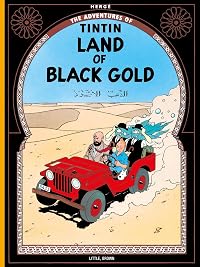
The classic graphic novel. Car engines have started spontaneously exploding all over the country . . . someone's been tampering with the oil! Tintin, with Thompson and Thompson at his side, sails on an oil tanker to the Middle East to track down the source of the faulty oil.Tags
Recommendations








Member Reviews
https://fromtheheartofeurope.eu/tintin-au-pays-de-lor-noir-land-of-black-gold-by...
Tintin au Pays de l’Or Noir, known in English as Land of Black Gold, has an extraordinary publication history. The first half of it came out in 1939-40, but since the villain of the story is a sinister German, the story abruptly stopped when the Nazis invaded Belgium, leaving Tintin stranded in a sandstorm in the Palestinian desert.
Eight years later with the war safely over, Hergé started publishing it again from the beginning in Tintin magazine. He then took three months off in the middle of the process, without telling anyone in advance; he found the forced pace of creativity stressful, but his unplanned absences infuriated colleagues. The full show more 62-page album was published in 1949.
But it doesn’t end there. More than two decades later, in 1971, the English-language rights had been acquired by Methuen, who gently suggested to Hergé that it might be a good idea to change the setting from British-mandate Palestine and maybe take out the bit where Irgun mistake Tintin for one of their own agents and kidnap him (and also perhaps remove the British army officers). So Hergé shifted the Arabian settings to the fictional county of Khemed, working in some Belgian humour (more on that below), and the Khemed version rather than the Palestine version is now the standard text in all languages.
Despite its pervasive very dubious Orientalism, the story has some great parts. The opening pages in Belgium see an epidemic of explosions in cars and cigarette lighters due to contaminated petrol. But war clouds are gathering and Captain Haddock gets mobilised into the navy. Tintin learns that the problem with the petrol is happening at its source in Khemed, and undertakes a perilous journey to investigate. Having arrived, he gets entangled in a power struggle between the emir and a rebel leader, with the evil Dr Müller behind the sabotage. Despite the antics of detectives Thomson and Thompson, and with the aid of Captain Haddock, Tintin defeats Müller, rescues the emir’s obnoxious son Abdallah, and returns in triumph.
There’s some very good visual stuff here, especially the scenes on the boat across the Mediterranean, in the desert, and in the underground dungeon where Abdallah is imprisoned. Thomson and Thompson mistakenly consume Dr Müller’s chemicals and start sprouting blue hair and frothing at the mouth. The obnoxious Abdallah is well depicted with few words. But the end is a bit rushed and infodumpy, with text occupying almost 50% of the final page. And the plot does not cohere as well as in some of the other albums, no doubt due to the peculiar process of composition. This is oddly reflected in a recurrent Captain Haddock gag – several times he starts to explain how he has happened to arrive on the scene in the nick of time, but keeps getting interrupted and we never find out.
It is well worth reading in French, if you are so inclined. There’s an amusing and untranslatable riff on Charles Trenet’s classic song “Boum!” on the first page. Some of the Khemed names are taken from the Brussels dialect of Flemish – most obviously the capital Wadesdah is a riff on “wat is dat”, “what’s that”, and the oil wells are located in Bir El Ambik, referring to the Brussels lambiek beer. In a nod to French, the emir’s military adviser is Moulfrid, ie “moules-frites”, “mussels with chips”. And you can’t beat the original version of Captain Haddock swearing. “Anacoluthe! Ectoplasme! Oryctérope!” (That last is the standard French word for “aardvark”.) show less
Tintin au Pays de l’Or Noir, known in English as Land of Black Gold, has an extraordinary publication history. The first half of it came out in 1939-40, but since the villain of the story is a sinister German, the story abruptly stopped when the Nazis invaded Belgium, leaving Tintin stranded in a sandstorm in the Palestinian desert.
Eight years later with the war safely over, Hergé started publishing it again from the beginning in Tintin magazine. He then took three months off in the middle of the process, without telling anyone in advance; he found the forced pace of creativity stressful, but his unplanned absences infuriated colleagues. The full show more 62-page album was published in 1949.
But it doesn’t end there. More than two decades later, in 1971, the English-language rights had been acquired by Methuen, who gently suggested to Hergé that it might be a good idea to change the setting from British-mandate Palestine and maybe take out the bit where Irgun mistake Tintin for one of their own agents and kidnap him (and also perhaps remove the British army officers). So Hergé shifted the Arabian settings to the fictional county of Khemed, working in some Belgian humour (more on that below), and the Khemed version rather than the Palestine version is now the standard text in all languages.
Despite its pervasive very dubious Orientalism, the story has some great parts. The opening pages in Belgium see an epidemic of explosions in cars and cigarette lighters due to contaminated petrol. But war clouds are gathering and Captain Haddock gets mobilised into the navy. Tintin learns that the problem with the petrol is happening at its source in Khemed, and undertakes a perilous journey to investigate. Having arrived, he gets entangled in a power struggle between the emir and a rebel leader, with the evil Dr Müller behind the sabotage. Despite the antics of detectives Thomson and Thompson, and with the aid of Captain Haddock, Tintin defeats Müller, rescues the emir’s obnoxious son Abdallah, and returns in triumph.
There’s some very good visual stuff here, especially the scenes on the boat across the Mediterranean, in the desert, and in the underground dungeon where Abdallah is imprisoned. Thomson and Thompson mistakenly consume Dr Müller’s chemicals and start sprouting blue hair and frothing at the mouth. The obnoxious Abdallah is well depicted with few words. But the end is a bit rushed and infodumpy, with text occupying almost 50% of the final page. And the plot does not cohere as well as in some of the other albums, no doubt due to the peculiar process of composition. This is oddly reflected in a recurrent Captain Haddock gag – several times he starts to explain how he has happened to arrive on the scene in the nick of time, but keeps getting interrupted and we never find out.
It is well worth reading in French, if you are so inclined. There’s an amusing and untranslatable riff on Charles Trenet’s classic song “Boum!” on the first page. Some of the Khemed names are taken from the Brussels dialect of Flemish – most obviously the capital Wadesdah is a riff on “wat is dat”, “what’s that”, and the oil wells are located in Bir El Ambik, referring to the Brussels lambiek beer. In a nod to French, the emir’s military adviser is Moulfrid, ie “moules-frites”, “mussels with chips”. And you can’t beat the original version of Captain Haddock swearing. “Anacoluthe! Ectoplasme! Oryctérope!” (That last is the standard French word for “aardvark”.) show less
My review, as published in Tintin Books:
After working on six straight apolitical albums, Hergé decided to return, in 1948, to "Land of Black Gold": a work he had been forced to abandon in 1940 with the onset of war. Much more varied in tone than its lacklustre predecessor, Prisoners of the Sun, "Land of Black Gold" is not perfect 'Tintin', but moves along at a nice pace with a complicated enough plot to keep interest, and a nice array of characters on both sides of the line. The first half, which after all was planned ten years before it was finally published, is much more reminiscent of Tintin's earlier adventures. It is very amusing and filled with great moments, particularly for the Thom[p]sons, but still a bit of a triumph of style show more over substance. There's a few too many mirage jokes, though, with several pages given over to the Thom[p]sons, Tintin and Snowy mistaking mirages for real life and vice versa.
Despite this, the central plot - of the world's oil supply being tampered with - feels just as relevant and worrying today. Things pick up considerably on arrival in Khemed, where Dr J.W. Muller (from The Black Island) proves a worthy foe to Tintin. The Emir and Oliveira de Figuera are great allies for the reporter, who goes through an array of disguises and does some genuine investigation. (As is par for the course in the middle books, Tintin's status as a reporter opens doors for him but is never the reason he gets involved in an adventure).
While the texture and colour of the album is noteworthy, the story really comes together due to the complex politics of the plot. The middle third of the album - including the revelations of the conspiracy - are some of the wordiest parts of the "Tintin" series to date. This doesn't feel like a bad thing, though, since it allows us to believe Tintin is caught up in serious world events. The absence of Haddock and Calculus - who didn't exist when the book was first planned but were prominent by the time of its publication - is barely felt given the richness of Tintin's surroundings.
(One interesting point: the returns of both Muller and de Figuera are accompanied by a footnote, directing the reader to their previous appearance. It's not a bad element, but it's a bit of a surprise since this isn't consistently done throughout the series.)
This is probably right on four stars for me. Nothing about this work challenges Herge's formula, but like the next few albums in the series, Herge is working at full throttle. show less
After working on six straight apolitical albums, Hergé decided to return, in 1948, to "Land of Black Gold": a work he had been forced to abandon in 1940 with the onset of war. Much more varied in tone than its lacklustre predecessor, Prisoners of the Sun, "Land of Black Gold" is not perfect 'Tintin', but moves along at a nice pace with a complicated enough plot to keep interest, and a nice array of characters on both sides of the line. The first half, which after all was planned ten years before it was finally published, is much more reminiscent of Tintin's earlier adventures. It is very amusing and filled with great moments, particularly for the Thom[p]sons, but still a bit of a triumph of style show more over substance. There's a few too many mirage jokes, though, with several pages given over to the Thom[p]sons, Tintin and Snowy mistaking mirages for real life and vice versa.
Despite this, the central plot - of the world's oil supply being tampered with - feels just as relevant and worrying today. Things pick up considerably on arrival in Khemed, where Dr J.W. Muller (from The Black Island) proves a worthy foe to Tintin. The Emir and Oliveira de Figuera are great allies for the reporter, who goes through an array of disguises and does some genuine investigation. (As is par for the course in the middle books, Tintin's status as a reporter opens doors for him but is never the reason he gets involved in an adventure).
While the texture and colour of the album is noteworthy, the story really comes together due to the complex politics of the plot. The middle third of the album - including the revelations of the conspiracy - are some of the wordiest parts of the "Tintin" series to date. This doesn't feel like a bad thing, though, since it allows us to believe Tintin is caught up in serious world events. The absence of Haddock and Calculus - who didn't exist when the book was first planned but were prominent by the time of its publication - is barely felt given the richness of Tintin's surroundings.
(One interesting point: the returns of both Muller and de Figuera are accompanied by a footnote, directing the reader to their previous appearance. It's not a bad element, but it's a bit of a surprise since this isn't consistently done throughout the series.)
This is probably right on four stars for me. Nothing about this work challenges Herge's formula, but like the next few albums in the series, Herge is working at full throttle. show less
The Land of Black Gold is an oddly disjointed book. Begun before World War II and shelved for the duration of Belgium's occupation the story pulled out of mothballs and completed after the Axis defeat. The result is a schizophrenic book that is basically two disparate halves mashed together to form one strange story involving exploding cars, Middle-Eastern unrest, scheming returning villains, and a weird recurring gag resulting from a mixed up aspirin bottle. In a sense, this is the last of the pre-War Tintin stories, even though it was half-written and published after the conflict was over, and after the switch to more pulpy adventure of the previous four books, it feels odd to return to the more political tone that was set up in King show more Ottokar's Sceptre. Despite this, the fairly linear first half of the story melds reasonably well with the more character driven second half, resulting in a strange but readable adventure.
The most noticeable thing about the book is the paucity of supporting characters in the first half. Because Captain Haddock and Professor Calculus were War-era creations, they don't appear in the opening portion of the book other than a single panel inserted into the story in which Haddock telephones Tintin to tell him that he has been activated by the Admiralty and has to report to his ship. Two supporting characters who do show up early are the detectives Thompson and Thomson, who make their appearance in the first panel getting fuel from a petrol station. In this sequence the pair behave like jerks, which makes me wonder if Hergé had intended to move them from being merely bumbling sticklers for the law to being somewhat insufferable elitists as a way of using his then existing roster of regulars in a more expansive way. This apparent elitism never rears its head again, possibly because when Hergé got back to working on the book, he had established the cadre of now-familiar characters surrounding his hero and no longer felt the need to take his comic relief in this direction - indeed in the second half of the story Thompson and Thomson reach truly absurd heights due to an innocent mishap.
Having gotten their tiny dose of gasoline, Thompson and Thomson stumble into the plot of the book when their car blows up. It turns out that cars start blowing up with regularity, as does Thompson's cigarette lighter. While consulting Tintin, the detectives have a fit of competence and identify the petrol as the source of the problem. But they then follow up this insight by asserting that it is obvious to them that the roadside assistance company "Autocart" must be behind the epidemic of exploding cars and so they charge off into a tangent where they get employed by the company and incompetently investigate while wrecking tow trucks and getting themselves into trouble (and once again the amazingly fragile nature of tires in the Tintin universe comes in to play). In the mean time, Tintin sets out to discuss the matter with the managing director of the oil company Spedol, soon securing a position as radio operator on the tanker the Speedol Star in an effort to get to the bottom of the mystery. I suppose Tintin could plausibly get an interview with a high ranking oil executive based on his alleged job as a journalist, but one wonders why the Speedol executive arranges for Tintin to investigate the problem rather than, say hiring a professional investigator. Throughout this section of the book, there is a constant background drumbeat of impending war, an element of the story that was probably at least partially responsible for Hergé shelving it when actual war broke out.
Before too long, Tintin is on the trail of the conspirators and on his way to the city of Khemikhal, but not before they frame him as a gun runner and frame Thompson and Thomson as opium smugglers. But before Tintin can be taken to jail, he is saved by a case of mistaken identity by the rebel sheikh Bab El Ehr. (Yes, that name, like most of the names in the series, is a bad pun, and a fairly insulting one to boot). The sheikh is expecting an arms shipment and rescues Tintin, but is somewhat understandably annoyed when it turns out that Tintin is not, in fact, an arms dealer. Once Thompson and Thomson clear their names, they learn that there is a substantial reward for catching Bab El Ehr and they set out into the desert in a jeep to find him, setting up a series of gags involving two incompetent nitwits wandering the desert. Tintin is dragged into the desert by Bab El Ehr and is then abandoned. This allows Tintin to wander the desert to just the right location to find the saboteurs who have been tainting the petrol supply hard at work.
This little bit of serendipity leads Tintin to the ringleader of the villains who turns out to be an old enemy last seen in The Black Island who has apparently switched from counterfeiting to fomenting war. The fact that the villain turns out to be German may be another reason that Hergé shelved the story during Belgium's occupation, and perhaps following the Nazi withdrawal continuing the story with Müller as the bad guy was a bit of minor revenge. After some twists and turns with Thompson and Thomson and a sand storm, Tintin finds himself talking to Emir Mohammed Ben Kalish Ezab and at this point Müller's plan becomes clear: to get the Emirate to switch from Arabex to a contract with his employer Skoil Petroleum, and since it seems that Bab El Ehr isn't going to be able to topple Ben Kalish, he kidnaps the Emir's son Abdullah.
At this point, the story turns into the now familiar "Tintin against the mobsters" format as Tintin convinces Ben Kalish to let him try to track down where Müller has taken the child. Showing his penchant for bringing back characters from earlier books, Hergé pulls Oliveira de Figueira out of the mothballs he had been sitting in since Cigars of the Pharaoh and sets him up as Tintin's avenue into the gangsters hideout. Because bringing recurring characters back into the series has become de rigeur, Hergé also works Bianca Castafiore into the book with a radio performance. In short order Tintin has infiltrated Müller's compound and finds that rescuing the prince is not quite as easy as he might have thought. It is difficult to determine exactly what part of the story was written before the War, and what part came after: is it when Müller is introduced as the villain? When de Figueira shows up? Madame Castafiore? Perhaps, but then again all of them appeared in pre-War Tintin books. But what is certain is that when Captain Haddock shows up out of the blue to rescue Tintin from a locked basement without explanation, that the rest of the story is material that was produced after the conflict was over.
And this part of the book is more or less a fairly linear extended chase scene as Tintin and Haddock team up to try to apprehend Müller after he has run off with Abdullah. Once Haddock shows up the remainder of the book is divided between straightforward action and comic silliness. Tintin repeatedly asks Haddock what he has been doing and how he happened to find Tintin at just the right time, and Haddock repeatedly starts to answer only to be interrupted right before he can deliver his explanation. In the end, no explanation is forthcoming: Hergé just kicked the can down the road until the book ended and left it as an unexplained mystery, playing off Haddock's extended absences as a source of humor. Thompson and Thomson also give chase after Müller, in their own endearingly incompetent way, their elitist jerk tendencies of the opening pages now forgotten, and stumble into a joke that launches the humor surrounding them from a poke at bumbling incompetence to absurd heights of silliness - a joke which becomes part of the front cover of the book (and which is, incidentally, the only cover of the Tintin series on which Thompson and Thomson appear). Even the denouement of the chase after Müller takes on a humorous tone as he falls for one of Abdullah's pranks. Land of Black Gold, which started as an investigation-heavy mystery, ends up as a Keystone Kops style farce.
Stuck in the middle of the Tintin series, and sandwiched between two much better two-book adventures, Land of Black Gold is something of an odd duck out. Disjointed as a result of political circumstances that forced it onto the back burner for several years and six intervening books, this story has a very uneven quality. Even more so than most Tintin books Land of Black Gold cannot decide if it wants to be an adventure, a mystery, or a comedy, and as a result, it does a mediocre job at all of them. Having made Captain Haddock an integral part of the series during the war, Hergé had to figure out a way to wedge him into a story that was started before he even existed, and did so in a fairly clumsy manner that is used for nothing but cheap laughs. Despite all of these problems, the book is still a good read, and is actually made even more interesting because of all the flaws which were driven by outside world events and therefore give a reader a view into just how much impact the experiences of World War Two had upon the series. Although the story is messy at times, it is vintage pre-war Tintin mixed with War-era Tintin in a strange but fascinating soup that is both entertaining and revealing.
This review has also been posted to my blog Dreaming About Other Worlds. show less
The most noticeable thing about the book is the paucity of supporting characters in the first half. Because Captain Haddock and Professor Calculus were War-era creations, they don't appear in the opening portion of the book other than a single panel inserted into the story in which Haddock telephones Tintin to tell him that he has been activated by the Admiralty and has to report to his ship. Two supporting characters who do show up early are the detectives Thompson and Thomson, who make their appearance in the first panel getting fuel from a petrol station. In this sequence the pair behave like jerks, which makes me wonder if Hergé had intended to move them from being merely bumbling sticklers for the law to being somewhat insufferable elitists as a way of using his then existing roster of regulars in a more expansive way. This apparent elitism never rears its head again, possibly because when Hergé got back to working on the book, he had established the cadre of now-familiar characters surrounding his hero and no longer felt the need to take his comic relief in this direction - indeed in the second half of the story Thompson and Thomson reach truly absurd heights due to an innocent mishap.
Having gotten their tiny dose of gasoline, Thompson and Thomson stumble into the plot of the book when their car blows up. It turns out that cars start blowing up with regularity, as does Thompson's cigarette lighter. While consulting Tintin, the detectives have a fit of competence and identify the petrol as the source of the problem. But they then follow up this insight by asserting that it is obvious to them that the roadside assistance company "Autocart" must be behind the epidemic of exploding cars and so they charge off into a tangent where they get employed by the company and incompetently investigate while wrecking tow trucks and getting themselves into trouble (and once again the amazingly fragile nature of tires in the Tintin universe comes in to play). In the mean time, Tintin sets out to discuss the matter with the managing director of the oil company Spedol, soon securing a position as radio operator on the tanker the Speedol Star in an effort to get to the bottom of the mystery. I suppose Tintin could plausibly get an interview with a high ranking oil executive based on his alleged job as a journalist, but one wonders why the Speedol executive arranges for Tintin to investigate the problem rather than, say hiring a professional investigator. Throughout this section of the book, there is a constant background drumbeat of impending war, an element of the story that was probably at least partially responsible for Hergé shelving it when actual war broke out.
Before too long, Tintin is on the trail of the conspirators and on his way to the city of Khemikhal, but not before they frame him as a gun runner and frame Thompson and Thomson as opium smugglers. But before Tintin can be taken to jail, he is saved by a case of mistaken identity by the rebel sheikh Bab El Ehr. (Yes, that name, like most of the names in the series, is a bad pun, and a fairly insulting one to boot). The sheikh is expecting an arms shipment and rescues Tintin, but is somewhat understandably annoyed when it turns out that Tintin is not, in fact, an arms dealer. Once Thompson and Thomson clear their names, they learn that there is a substantial reward for catching Bab El Ehr and they set out into the desert in a jeep to find him, setting up a series of gags involving two incompetent nitwits wandering the desert. Tintin is dragged into the desert by Bab El Ehr and is then abandoned. This allows Tintin to wander the desert to just the right location to find the saboteurs who have been tainting the petrol supply hard at work.
This little bit of serendipity leads Tintin to the ringleader of the villains who turns out to be an old enemy last seen in The Black Island who has apparently switched from counterfeiting to fomenting war. The fact that the villain turns out to be German may be another reason that Hergé shelved the story during Belgium's occupation, and perhaps following the Nazi withdrawal continuing the story with Müller as the bad guy was a bit of minor revenge. After some twists and turns with Thompson and Thomson and a sand storm, Tintin finds himself talking to Emir Mohammed Ben Kalish Ezab and at this point Müller's plan becomes clear: to get the Emirate to switch from Arabex to a contract with his employer Skoil Petroleum, and since it seems that Bab El Ehr isn't going to be able to topple Ben Kalish, he kidnaps the Emir's son Abdullah.
At this point, the story turns into the now familiar "Tintin against the mobsters" format as Tintin convinces Ben Kalish to let him try to track down where Müller has taken the child. Showing his penchant for bringing back characters from earlier books, Hergé pulls Oliveira de Figueira out of the mothballs he had been sitting in since Cigars of the Pharaoh and sets him up as Tintin's avenue into the gangsters hideout. Because bringing recurring characters back into the series has become de rigeur, Hergé also works Bianca Castafiore into the book with a radio performance. In short order Tintin has infiltrated Müller's compound and finds that rescuing the prince is not quite as easy as he might have thought. It is difficult to determine exactly what part of the story was written before the War, and what part came after: is it when Müller is introduced as the villain? When de Figueira shows up? Madame Castafiore? Perhaps, but then again all of them appeared in pre-War Tintin books. But what is certain is that when Captain Haddock shows up out of the blue to rescue Tintin from a locked basement without explanation, that the rest of the story is material that was produced after the conflict was over.
And this part of the book is more or less a fairly linear extended chase scene as Tintin and Haddock team up to try to apprehend Müller after he has run off with Abdullah. Once Haddock shows up the remainder of the book is divided between straightforward action and comic silliness. Tintin repeatedly asks Haddock what he has been doing and how he happened to find Tintin at just the right time, and Haddock repeatedly starts to answer only to be interrupted right before he can deliver his explanation. In the end, no explanation is forthcoming: Hergé just kicked the can down the road until the book ended and left it as an unexplained mystery, playing off Haddock's extended absences as a source of humor. Thompson and Thomson also give chase after Müller, in their own endearingly incompetent way, their elitist jerk tendencies of the opening pages now forgotten, and stumble into a joke that launches the humor surrounding them from a poke at bumbling incompetence to absurd heights of silliness - a joke which becomes part of the front cover of the book (and which is, incidentally, the only cover of the Tintin series on which Thompson and Thomson appear). Even the denouement of the chase after Müller takes on a humorous tone as he falls for one of Abdullah's pranks. Land of Black Gold, which started as an investigation-heavy mystery, ends up as a Keystone Kops style farce.
Stuck in the middle of the Tintin series, and sandwiched between two much better two-book adventures, Land of Black Gold is something of an odd duck out. Disjointed as a result of political circumstances that forced it onto the back burner for several years and six intervening books, this story has a very uneven quality. Even more so than most Tintin books Land of Black Gold cannot decide if it wants to be an adventure, a mystery, or a comedy, and as a result, it does a mediocre job at all of them. Having made Captain Haddock an integral part of the series during the war, Hergé had to figure out a way to wedge him into a story that was started before he even existed, and did so in a fairly clumsy manner that is used for nothing but cheap laughs. Despite all of these problems, the book is still a good read, and is actually made even more interesting because of all the flaws which were driven by outside world events and therefore give a reader a view into just how much impact the experiences of World War Two had upon the series. Although the story is messy at times, it is vintage pre-war Tintin mixed with War-era Tintin in a strange but fascinating soup that is both entertaining and revealing.
This review has also been posted to my blog Dreaming About Other Worlds. show less
23) [Tintin Land of Black Gold] by Hergé
Just to bump my reading numbers I 'happened' to read this as I was entering it on my kids' LT account.
The usual romp with the famous boy reporter and his brave dog, Snowy, along with Captain Haddock and the Thomson (Thompson?) twins. This time the adventure sees them on a tanker to the port of Khemikhal in the Middle East where Tintin investigates a case of sabotage to the world's oil supply which is causing cars to explode, oil prices to fall and threatening to result in a world war. Needless to say, there are lots of inflammatory double entendres.
There's a bit of slapstick, as usual, which even Tintin and poor old Snowy don't escape, bumping into things for instance. And there's a six year old show more spoiled son of the emir who inadvertently saves the day, despite his best intentions.
While you do have to bear in mind that it was first published in 1950 and is to some extent a product of its time (cars, radio operators, phone boxes, aeroplanes) it still has relevance in this day and age.
Fun. A pleasant way to spend an afternoon.
4**** stars show less
Just to bump my reading numbers I 'happened' to read this as I was entering it on my kids' LT account.
The usual romp with the famous boy reporter and his brave dog, Snowy, along with Captain Haddock and the Thomson (Thompson?) twins. This time the adventure sees them on a tanker to the port of Khemikhal in the Middle East where Tintin investigates a case of sabotage to the world's oil supply which is causing cars to explode, oil prices to fall and threatening to result in a world war. Needless to say, there are lots of inflammatory double entendres.
There's a bit of slapstick, as usual, which even Tintin and poor old Snowy don't escape, bumping into things for instance. And there's a six year old show more spoiled son of the emir who inadvertently saves the day, despite his best intentions.
While you do have to bear in mind that it was first published in 1950 and is to some extent a product of its time (cars, radio operators, phone boxes, aeroplanes) it still has relevance in this day and age.
Fun. A pleasant way to spend an afternoon.
4**** stars show less
Just finished this book, which I read in short segments over the past week or so. Feel a little pathetic, posting it on goodreads, but these Tintin books! They mean something different each time, largely because you start reading them as a kid and later grow to understand them better, or at least differently.
Anyway, this one is interesting because it's about... oil! And war over oil! Sound familiar? Anyway, always fun, as Tintin is.
Anyway, this one is interesting because it's about... oil! And war over oil! Sound familiar? Anyway, always fun, as Tintin is.
I do not particularly enjoy graphic novels but it was interesting to read this one. My brother always read the tin tin books so I was curious to see what they were like. The premise of the story is a company "autocart" is using bad gasoline to gain business. Tin tin is trying to get to the bottom of the problem which inevitably take him on an adventure.
Tintin and his adventures are highly amusing! As a second-language learner, I found this book easy to understand, even with words I did not know.
Members
- Recently Added By
Lists

Books Read in 2014
2,343 works; 89 members
Author Information

'Hergé' was born Georges Remi on 22 May, 1907 in Etterbeek, a suburb of Brussels, in Belgium. After leaving school, he worked for the daily newspaper, Le XXe Siècle (The 20th Century). He was responsibe the for the section of the newspaper designed for children. Tintin, the main character in his works, was introduced on January 10, 1929 in a show more story entitled 'Tintin in the Land of the Soviets.' Each story ran as a comic strip in the newspaper and then was published as a book. Some of these books were adapted for the small screen including The Crab With The Golden Claws, Star of Mystery, Red Rakham's Treasure, Black Island, Objective Moon and The Calculus Affair. French TV produced longer versions of twenty of the books in 1992, which have been broadcast in over fifty countries. On 3 March, 1983, he died in Brussels. At the time of his death, he was working on Tintin and the Alpha-Art, which was published in an unfinished form. (Bowker Author Biography) show less
Some Editions
Awards and Honors
Notable Lists
Series

Work Relationships
Is contained in
Common Knowledge
- Canonical title
- Land of Black Gold
- Original title
- Tintin au pays de l'or noir
- Alternate titles*
- Tintin : Tintin au pays de l'or noir
- Original publication date
- 1950
- People/Characters
- Tintin; Snowy; Captain Haddock; Mohammed ben Kalish Ezab; Bab El Ehr; Abdullah (show all 11); Thomson and Thompson; Jock McPhee; Doctor Müller; Ali Ben Mahmud; Oliveira da Figueira
- Important places
- Wadesdah, Khemed; Khemikhal, Khemed; Hasch Abaibabi, Khemed
- First words
- Ça va!...Ça va!...
O.K! ... O.K! ... I'm coming! - Last words
- (Click to show. Warning: May contain spoilers.)Cette fois, mille sabords! c'est fini, bien fini! ...
- Original language
- French
*Some information comes from Common Knowledge in other languages. Click "Edit" for more information.
Classifications
- Genre
- Graphic Novels & Comics
- DDC/MDS
- 741.59493 — Arts & recreation Drawing & decorative arts Drawing Comic books, graphic novels, fotonovelas, cartoons, caricatures, comic strips History, geographic treatment, biography European Other European Belgium & Luxembourg
- LCC
- PN6790 .B44 — Language and Literature Literature (General) Literature (General) Collections of general literature Comic books, strips, etc.
- BISAC
Statistics
- Members
- 1,944
- Popularity
- 10,934
- Reviews
- 17
- Rating
- (3.95)
- Languages
- 24 — Bengali, Catalan, Chinese, Czech, Danish, Dutch, English, Finnish, French, German, Greek, Hindi, Italian, Japanese, Korean, Norwegian (Bokmål), Norwegian, Portuguese, Serbian, Croatian, Spanish, Swedish, Turkish, Welsh
- Media
- Paper, Ebook
- ISBNs
- 82
- ASINs
- 16