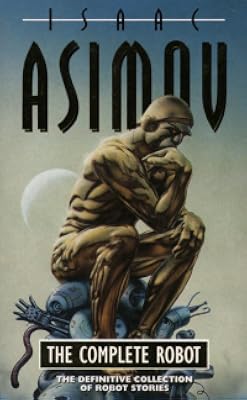
The Complete Robot
by Isaac Asimov
Asimov's Universe (Collections and Selections — ), Isaac Asimov's Robot Series (Collections and Selections — 3.0)
On This Page
Description
A collection of all of Isaac Asimov's robot stories, including some which have never before appeared in book form.Tags
Recommendations








Member Recommendations

Member Reviews
Pulled from the shelf almost at whim, in a moment I craved an indulgence read. It fit the bill. Many of the stories were familiar if only half-remembered, meeting my need for a sentimental re-acquaintance, but a good many I'd never read before.
I've somehow been left with an idea of Asimov being quaint and juvenile, even for a genre writer: wooden characters, uncomplicated plots. There is something to that, but I was pleased that mostly it is a caricature of his work. His ideas and plots are quite good, often go somewhere unexpected, and there is an emotional depth to his situations and the interactions between characters, if not in his prose. A story involving autism is a conspicuous (and not saccharine) example.
Not all these stories show more fit the same universe, though many do and this accounts for their later inclusion in his Foundation canon. His Three Laws of Robotics are frequently cited, unsurprisingly, though often to be teased out or twisted or put into some extreme situation to see if they'll crack. There are other commonalities between the tales: most posit a general suspicion of robots, centred on danger posed by them, and the stories often explore the ignorance and superstition behind this fear. (One explores the uncanny valley and design principles employed to avoid it.) In most stories, Asimov posits that robots cannot be used on Earth, but only off world, until that place (satellite, planet, space station) becomes sufficiently populated so as to be another Earth.
Also prevalent are dated perspectives, not only with the obvious technologies not anticipated (interface with AI via tickertape, analog not digital photographs) but more significantly with social mores. Susan Calvin addresses an adult robot as "boy", two hooligans essentially set out to lynch a robot. Which is to say, plus ça change ....
Children are often featured, highlighting relationships between human and robot which are based in something other than fear.
In affinithy with many Golden Age writers, Asimov writes about robots as a way of reflecting humanity, of writing about humans. It's not that he hasn't done the work to understand his robots, in fact there's quite a bit there (witness, that Calvin is a robopsychologist rather than AI logician or even forensic engineer). But Asimov doesn't focus on the robot so much as how people interact with (react to) the robot.
It seems Asimov added some connecting elements, or revised certain details of stories for better continuity. It is most suggestive in the Powell and Donovan stories. Unlike some omnibus editions, Asimov's robot stories make for a satisfying read overall, collected in this way. show less
I've somehow been left with an idea of Asimov being quaint and juvenile, even for a genre writer: wooden characters, uncomplicated plots. There is something to that, but I was pleased that mostly it is a caricature of his work. His ideas and plots are quite good, often go somewhere unexpected, and there is an emotional depth to his situations and the interactions between characters, if not in his prose. A story involving autism is a conspicuous (and not saccharine) example.
Not all these stories show more fit the same universe, though many do and this accounts for their later inclusion in his Foundation canon. His Three Laws of Robotics are frequently cited, unsurprisingly, though often to be teased out or twisted or put into some extreme situation to see if they'll crack. There are other commonalities between the tales: most posit a general suspicion of robots, centred on danger posed by them, and the stories often explore the ignorance and superstition behind this fear. (One explores the uncanny valley and design principles employed to avoid it.) In most stories, Asimov posits that robots cannot be used on Earth, but only off world, until that place (satellite, planet, space station) becomes sufficiently populated so as to be another Earth.
Also prevalent are dated perspectives, not only with the obvious technologies not anticipated (interface with AI via tickertape, analog not digital photographs) but more significantly with social mores. Susan Calvin addresses an adult robot as "boy", two hooligans essentially set out to lynch a robot. Which is to say, plus ça change ....
Children are often featured, highlighting relationships between human and robot which are based in something other than fear.
In affinithy with many Golden Age writers, Asimov writes about robots as a way of reflecting humanity, of writing about humans. It's not that he hasn't done the work to understand his robots, in fact there's quite a bit there (witness, that Calvin is a robopsychologist rather than AI logician or even forensic engineer). But Asimov doesn't focus on the robot so much as how people interact with (react to) the robot.
It seems Asimov added some connecting elements, or revised certain details of stories for better continuity. It is most suggestive in the Powell and Donovan stories. Unlike some omnibus editions, Asimov's robot stories make for a satisfying read overall, collected in this way. show less
[ai:Isaac Asimov|16667|Isaac Asimov|https://images.gr-assets.com/authors/1341965730p2/16667.jpg]A really enjoyable work of Sci-Fi full of short stories author Isaac Asimov wrote over several decades dealing with all kinds of robots in various situations. Many of the stories delightfully puzzle-through various aspects, twists-and-turns and challenges, of the Three Laws of Robotics. The historical time-span Asimov employs reveals how he could imaginatively peer into the future and project technological and social developments, which is true as an over-arching theme in many of his authored works, as if he had this centuries-long frame into which he painted his stories across the canvas of time, space, and the galaxy. The interplay of the show more social life of humans and that of robots, as the Life they share intertwines, reveals the forces of logic and emotional passion and whimsical social trends, and how they can conflict, distort, challenge, and not always get along very well -- at all. The book is enjoyable reading for anyone interested in, to turn a phrase, 'Human Life, The Universe, and Everything Robotic'. show less
I genuinely think the critical opposition to SF is increasingly overstated; I'm not entirely sure what "being taken seriously" even means any more except in the nerd media sense of "nothing but glowing praise from serious critics". The greats of SF - the real greats, that is, the authors who have properly endured and those new authors who have something really interesting to say - do do well. But perhaps the reason there's little serious critical comment on SF is that there's not a lot to say about it? It's well supported in the popular media, and the amateur/blog scenes, so does it need to be included in the broadsheets or LRB too?
I think the major complaint is that the very best of SF books never make the longlists/shortlists of show more mainstream literary awards. If these mainstream awards were marketed as best in the nebulous maybe-genre of literary fiction this wouldn't be a problem, but they're marketed as best in all fiction. If you have an award that markets itself as best in all fiction, yet continually overlooks talented writers in a certain field, then SF has a fair complaint of being stuck with an implied second-class citizenship status tag. Except that the ones who "endure" tend to be the ones with something to them often described in terms of having something "beyond" the SF exterior, and so on. You even use the term "serious critics" to apparently describe non-specifically-SF critics.
These books have "crossover appeal" or "something to say about people as well as technology". Not direct quotes but attitudes prevalent in those "serious critics"' positive reviews of SF. The problem isn't that there's exactly opposition - fantasy and SF series on TV and in the written word do still get critical praise - but there is differentiation. The SF aspects of the fiction are deemed the coating, and it's only when the SF work has some serious part to it as well that it becomes "good" or "taken seriously". There's something in the attitude there that says that SF is inherently juvenile or lesser to those great novels with something to say about the human spirit or society or whatever.
A SF novel that's a good novel shouldn't have to be a crossover novel - it should just be a good SF novel. There's still a stigma to the term science fiction that has more to do with stereotypes of the fans (and therefore writers) of those works, which are still pretty prevalent. It might not be restricted to the white male shut-in, but it's still often associated with a certain type of social ineptitude. Yeah, "mainstream" culture is happily incorporating "nerd" culture into its allusions and characters these days, but they're still a curiosity, a kind of benign freakshow. It might not be all that negative or persecuting, but it still refuses to see SF as something that can be thrilling and profound in its own right.
I don't think 'true' SF will ever win literary awards. In it's purest form it's a philosophical or intellectual genre that undertakes a fundamentally different job from 'literary' fiction. Literary fiction is descended from the novel, which stood in contrast to older forms of romance or satirical/philosophical prose in that it tried to capture the nature of human experience (albeit often with a moral or political purpose). SF's roots lie in an older satirical and philosophical approach, (and that's without considering romances, which are closer to genre fiction as a whole).
SF ideas are often used as metaphors in more novellistic approaches - that's a huge part of P K Dick's appeal as his use of androids and replicants and illusion expresses something complex about the human experience. These are mixed up with dystopic elements drawn from SF's satirical roots, but the reason for his strong critical reputation is that his works are essentially novelistic - they try and show us what it is to be alive and human (rather than tell us how we should be alive or human).
Contrast this with “The Complete Robot” (which I re-read recently after about thirty years away) which is very clearly a philosophical and Utopian work with little interest in cracking open the nature of human experience. It's not a matter of one being better than the other (although I personally think that the novelistic approach has a more enduring appeal) but that the goals of the two types of writing make them impossible to compare. To be honest, I don't think that SF fans and critics have a strong idea of what SF is really for. Even awards lists within the genre can be made of books with very different goals and approaches which makes choosing between them very difficult - it's the old business of do you prefer a book that does a simple thing well or one that doesn't quite pull off something very ambitious?
How to judge fiction? If we take literature seriously then we surely need to look at the best examples, and there are several mentioned in the article and the comments above (but nothing of Christopher Priest's "The Adjacent" - another outstanding author woefully ignored by the mainstream). However, SF fans can, in my opinion, often be their own (and even their beloved authors) worst enemies. Lots of indifferent or poor writers in SF and 'fantasy' are buttressed by undiscriminating fans prepared to buy any old crap that they churn out. Even worse, there often seems to be little or no interest in reading anything much outside the genre, with the result that fans frequently have naive and inflated opinions of the qualities of the stuff they read. I'm totally weary of excitable 'fan recommendations' taking me to books that are just shoddily written crap, and fed up of standards of evaluation that are so limited. This is partially true of any 'genre' fiction, but you rarely hear of other genre readers absolutely demanding that their chosen literature must be taken seriously by the mainstream.
Call me a snob if you wish, but just to repeat, we need to look at the best examples to judge literature, and apart from a handful of authors, much SF and 'fantasy' is really just awful.
I'm adding an additional note, because after some reflection, I think an example might clarify my criticism: take “The Complete Robot” as a prime example. I won’t even bother calling it a SF collection. Why the need to classify it at all as a SF? Why not just accord it the status of a favourite/excellent/great collection of short-stories? Place it in the company of some of the other fine collections of the last 200 years. See how it fares: does it get its ba...sorry, shins kicked? Does it stand proud? It’s a great collection even after 30 years. Period. There are reviewers who do this sort of thing with verve, intelligence, and fearlessness. The Australian writer and critic James Bradley is a wonderful example, who also, by the way, includes M. John Harrison’s “Empty Space” on his Best Books of 2012 list - note 'Best Books', not 'Best SF Books' or something of that ilk - and who also, interestingly, compares George R.R. Martin and Hilary Mantel. “The Complete Robot” will still be read when I’m not around any more. I wonder how many contemporary works (be it SF or not) will still be read 50 years from now.
SF = Speculative Fiction.
Book Review SF = Speculative Fiction show less
I think the major complaint is that the very best of SF books never make the longlists/shortlists of show more mainstream literary awards. If these mainstream awards were marketed as best in the nebulous maybe-genre of literary fiction this wouldn't be a problem, but they're marketed as best in all fiction. If you have an award that markets itself as best in all fiction, yet continually overlooks talented writers in a certain field, then SF has a fair complaint of being stuck with an implied second-class citizenship status tag. Except that the ones who "endure" tend to be the ones with something to them often described in terms of having something "beyond" the SF exterior, and so on. You even use the term "serious critics" to apparently describe non-specifically-SF critics.
These books have "crossover appeal" or "something to say about people as well as technology". Not direct quotes but attitudes prevalent in those "serious critics"' positive reviews of SF. The problem isn't that there's exactly opposition - fantasy and SF series on TV and in the written word do still get critical praise - but there is differentiation. The SF aspects of the fiction are deemed the coating, and it's only when the SF work has some serious part to it as well that it becomes "good" or "taken seriously". There's something in the attitude there that says that SF is inherently juvenile or lesser to those great novels with something to say about the human spirit or society or whatever.
A SF novel that's a good novel shouldn't have to be a crossover novel - it should just be a good SF novel. There's still a stigma to the term science fiction that has more to do with stereotypes of the fans (and therefore writers) of those works, which are still pretty prevalent. It might not be restricted to the white male shut-in, but it's still often associated with a certain type of social ineptitude. Yeah, "mainstream" culture is happily incorporating "nerd" culture into its allusions and characters these days, but they're still a curiosity, a kind of benign freakshow. It might not be all that negative or persecuting, but it still refuses to see SF as something that can be thrilling and profound in its own right.
I don't think 'true' SF will ever win literary awards. In it's purest form it's a philosophical or intellectual genre that undertakes a fundamentally different job from 'literary' fiction. Literary fiction is descended from the novel, which stood in contrast to older forms of romance or satirical/philosophical prose in that it tried to capture the nature of human experience (albeit often with a moral or political purpose). SF's roots lie in an older satirical and philosophical approach, (and that's without considering romances, which are closer to genre fiction as a whole).
SF ideas are often used as metaphors in more novellistic approaches - that's a huge part of P K Dick's appeal as his use of androids and replicants and illusion expresses something complex about the human experience. These are mixed up with dystopic elements drawn from SF's satirical roots, but the reason for his strong critical reputation is that his works are essentially novelistic - they try and show us what it is to be alive and human (rather than tell us how we should be alive or human).
Contrast this with “The Complete Robot” (which I re-read recently after about thirty years away) which is very clearly a philosophical and Utopian work with little interest in cracking open the nature of human experience. It's not a matter of one being better than the other (although I personally think that the novelistic approach has a more enduring appeal) but that the goals of the two types of writing make them impossible to compare. To be honest, I don't think that SF fans and critics have a strong idea of what SF is really for. Even awards lists within the genre can be made of books with very different goals and approaches which makes choosing between them very difficult - it's the old business of do you prefer a book that does a simple thing well or one that doesn't quite pull off something very ambitious?
How to judge fiction? If we take literature seriously then we surely need to look at the best examples, and there are several mentioned in the article and the comments above (but nothing of Christopher Priest's "The Adjacent" - another outstanding author woefully ignored by the mainstream). However, SF fans can, in my opinion, often be their own (and even their beloved authors) worst enemies. Lots of indifferent or poor writers in SF and 'fantasy' are buttressed by undiscriminating fans prepared to buy any old crap that they churn out. Even worse, there often seems to be little or no interest in reading anything much outside the genre, with the result that fans frequently have naive and inflated opinions of the qualities of the stuff they read. I'm totally weary of excitable 'fan recommendations' taking me to books that are just shoddily written crap, and fed up of standards of evaluation that are so limited. This is partially true of any 'genre' fiction, but you rarely hear of other genre readers absolutely demanding that their chosen literature must be taken seriously by the mainstream.
Call me a snob if you wish, but just to repeat, we need to look at the best examples to judge literature, and apart from a handful of authors, much SF and 'fantasy' is really just awful.
I'm adding an additional note, because after some reflection, I think an example might clarify my criticism: take “The Complete Robot” as a prime example. I won’t even bother calling it a SF collection. Why the need to classify it at all as a SF? Why not just accord it the status of a favourite/excellent/great collection of short-stories? Place it in the company of some of the other fine collections of the last 200 years. See how it fares: does it get its ba...sorry, shins kicked? Does it stand proud? It’s a great collection even after 30 years. Period. There are reviewers who do this sort of thing with verve, intelligence, and fearlessness. The Australian writer and critic James Bradley is a wonderful example, who also, by the way, includes M. John Harrison’s “Empty Space” on his Best Books of 2012 list - note 'Best Books', not 'Best SF Books' or something of that ilk - and who also, interestingly, compares George R.R. Martin and Hilary Mantel. “The Complete Robot” will still be read when I’m not around any more. I wonder how many contemporary works (be it SF or not) will still be read 50 years from now.
SF = Speculative Fiction.
Book Review SF = Speculative Fiction show less
First published in 1982 and Asimov having written other robots stories after that, 'The Complete Robot' is, well, not so complete after all! A few short stories are indeed missing (e.g. 'Robot Dream'), a disappointing fact I for one wish the publisher would have addressed by now!
Well, misleading title aside, here's nevertheless a remarkable anthology which is definitely a must-read. Indeed it will please both those curious enough to have a glimpse at Asimov's work (SF master who came up with the fictional Three Laws of Robotics -a term he also coined) and, all those who are already fans as I am (yesssss! Nearly all the stories with Susan Calvin are here!).
Playing with the Three Laws of Robotics and their intricate dilemma, addressing show more the differences and their consequences between a human brain and robotic ('positronics') ones or, again, dealing with how humans might behave in an age of robots and machines, these stories are clever, funny, touching, charming and, if some can really be twisted, all intellectually and philosophically/ethically engaging. The fact they are ordered by categories depending mostly on the nature of the robots depicted ('immobile', 'metallic', 'humanoid' etc.) even add to make the whole a smooth read.
Entertaining and intelligent, what more to ask? show less
Well, misleading title aside, here's nevertheless a remarkable anthology which is definitely a must-read. Indeed it will please both those curious enough to have a glimpse at Asimov's work (SF master who came up with the fictional Three Laws of Robotics -a term he also coined) and, all those who are already fans as I am (yesssss! Nearly all the stories with Susan Calvin are here!).
Playing with the Three Laws of Robotics and their intricate dilemma, addressing show more the differences and their consequences between a human brain and robotic ('positronics') ones or, again, dealing with how humans might behave in an age of robots and machines, these stories are clever, funny, touching, charming and, if some can really be twisted, all intellectually and philosophically/ethically engaging. The fact they are ordered by categories depending mostly on the nature of the robots depicted ('immobile', 'metallic', 'humanoid' etc.) even add to make the whole a smooth read.
Entertaining and intelligent, what more to ask? show less
My first Asimov book and I loved it, from the first till the last story included. His [b:Foundation Trilogy|8683655|Foundation Trilogy|Isaac Asimov|https://d.gr-assets.com/books/1347954762s/8683655.jpg|41350] is still waiting to be read, but as I saw this collection of short stories, I decided to tackle these first.
'The Complete Robot' is said to contain all of his robot stories that were published previously in other compilations or magazines, and a few other ones that didn't make it into those earlier compilations. Everything is neatly explained in the foreword (and the different introductions to each segment in this compilation) by Mr Asimov himself, topped with a pinch of humour, which I didn't know he had.
The various stories were show more put together according by theme: Non-human Robots (3), Metallic Robots (3), Immobile Robots (6), Humanoid Robots (3), Powell and Donovan (4), Susan Calvin (10) (a robot-psychologist - or someone who likes robots more than humans), Two Climaxes (2).
Of course, the Three Laws of Robotics return throughout the book and are crucial in how robots work and interact with mankind:
1: A robot may not injure a human being or, through inaction, allow a human being to come to harm;
2: A robot must obey the orders given it by human beings except where such orders would conflict with the First Law;
3: A robot must protect its own existence as long as such protection does not conflict with the First or Second Law;
About law no. 2: Which human being? A robot must therefore be able to distinguish a child from an adult, a police agent from a bank clerk, etc.
Asimov tried to show that robots can be used for various kinds of work and tasks, some more specialized than the others. And that's how they are used today: assembly plants, computers, construction, in hospitals, self-driving cars (not fully trustworthy yet, of course), and elsewhere. We just don't always think about it or simply take it for granted. And then there's the eternal discussion about jobs: Will and do robots take away workers'/employees' jobs?
With all those stories, Asimov offered a broad view on how robots are implemented in our lives, how they can be implemented and how they can become even human-like. And there are human-like robots today, as demonstrated by a.o. Honda, or in hospitals or geriatric places, to help the elderly. Who doesn't remember the cartoon series 'The Jetsons' and specifically Rosie, the household robot? She's also in this book, albeit in a different version. So is an alternative version of KITT, the car in 'Knight Rider', in this case Sally.
A few stories, one of them being 'The Tercentenary Incident', reminded me of current happenings: A president who has a robot double (why?), for example. But the robot gets destroyed during the public event, after which the real president shows up quickly to reassure the public that he's fine. Reminded me, in a way, of the coup in Turkey, the army wanting to overthrow president Erdogan.
In another story, 'The Bicentennial Man', Andrew the robot wants to be free, but is still subjected to the Three Laws, which allows for humans to abuse this and get him to do things which are harmful to himself, despite Andrew wanting to become a human being and going at great lengths to obtain his goal, even it means a quick death. But it also shows how humanity will always have a sly way to abuse others, robots or otherwise. And how people aren't ready yet to fully accept robots as equals, unless perhaps in a certain animal shape.
Or, if you want to go extreme: What if - but that's a what if many of us won't experience anymore, I think - robots become so free in thinking and communicating that they stand up against their makers?
Although there's a bit of hard SF, Asimov's writing style is quite accessible here. If you haven't read any Asimov yet (or none of his robot stories), this is a fine book to start with, since it contains all of the robot stories, more than in the previous compilations. This is also a fine work for those interested in the possible happenings in the future of robotics or how every day life could look many years from now. show less
'The Complete Robot' is said to contain all of his robot stories that were published previously in other compilations or magazines, and a few other ones that didn't make it into those earlier compilations. Everything is neatly explained in the foreword (and the different introductions to each segment in this compilation) by Mr Asimov himself, topped with a pinch of humour, which I didn't know he had.
The various stories were show more put together according by theme: Non-human Robots (3), Metallic Robots (3), Immobile Robots (6), Humanoid Robots (3), Powell and Donovan (4), Susan Calvin (10) (a robot-psychologist - or someone who likes robots more than humans), Two Climaxes (2).
Of course, the Three Laws of Robotics return throughout the book and are crucial in how robots work and interact with mankind:
1: A robot may not injure a human being or, through inaction, allow a human being to come to harm;
2: A robot must obey the orders given it by human beings except where such orders would conflict with the First Law;
3: A robot must protect its own existence as long as such protection does not conflict with the First or Second Law;
About law no. 2: Which human being? A robot must therefore be able to distinguish a child from an adult, a police agent from a bank clerk, etc.
Asimov tried to show that robots can be used for various kinds of work and tasks, some more specialized than the others. And that's how they are used today: assembly plants, computers, construction, in hospitals, self-driving cars (not fully trustworthy yet, of course), and elsewhere. We just don't always think about it or simply take it for granted. And then there's the eternal discussion about jobs: Will and do robots take away workers'/employees' jobs?
With all those stories, Asimov offered a broad view on how robots are implemented in our lives, how they can be implemented and how they can become even human-like. And there are human-like robots today, as demonstrated by a.o. Honda, or in hospitals or geriatric places, to help the elderly. Who doesn't remember the cartoon series 'The Jetsons' and specifically Rosie, the household robot? She's also in this book, albeit in a different version. So is an alternative version of KITT, the car in 'Knight Rider', in this case Sally.
A few stories, one of them being 'The Tercentenary Incident', reminded me of current happenings: A president who has a robot double (why?), for example. But the robot gets destroyed during the public event, after which the real president shows up quickly to reassure the public that he's fine. Reminded me, in a way, of the coup in Turkey, the army wanting to overthrow president Erdogan.
In another story, 'The Bicentennial Man', Andrew the robot wants to be free, but is still subjected to the Three Laws, which allows for humans to abuse this and get him to do things which are harmful to himself, despite Andrew wanting to become a human being and going at great lengths to obtain his goal, even it means a quick death. But it also shows how humanity will always have a sly way to abuse others, robots or otherwise. And how people aren't ready yet to fully accept robots as equals, unless perhaps in a certain animal shape.
Or, if you want to go extreme: What if - but that's a what if many of us won't experience anymore, I think - robots become so free in thinking and communicating that they stand up against their makers?
Although there's a bit of hard SF, Asimov's writing style is quite accessible here. If you haven't read any Asimov yet (or none of his robot stories), this is a fine book to start with, since it contains all of the robot stories, more than in the previous compilations. This is also a fine work for those interested in the possible happenings in the future of robotics or how every day life could look many years from now. show less
All the Robot you could ever need! This doorstop of a book collects the majority of Asimov's Robot Short stories, which chart the development of man's relationship with his creation.
The stories are sharp, well written and have a huge scope to them. This is considered 'hard' science fiction (as opposed to the fantasy space opera kind), but is immensely readable none the less.
Considered by Asimov himself to be the starting point for his 14 book 'Future History', this is a must for any self-respecting Science Fiction fan. If you haven't read any Asimov, this is as good a place as any to start.
The stories are sharp, well written and have a huge scope to them. This is considered 'hard' science fiction (as opposed to the fantasy space opera kind), but is immensely readable none the less.
Considered by Asimov himself to be the starting point for his 14 book 'Future History', this is a must for any self-respecting Science Fiction fan. If you haven't read any Asimov, this is as good a place as any to start.
Asimov's tales of robots of the future are both disarming and disturbing. There are moments that appear quaint to us; information being fed into computers via punched tapes and huge machines that have less power and fewer functions than a mobile phone. It's these instances that disarm a reader into to feeling a little smug about Asimov's limited view of technilogical potential. You're not allowed to remain secure in that smugness for all that long. The real power of these tales of subserviant robots is the sharp focus on human behavior and all too human flaws.
This total understanding of humanity ensures that Asimov's fiction will be readable for decades to come. These stories highlight the conflict that lies between our desire for show more advancement and our resistance to anything new. As humans we want to push the boundaries of technoloy, but we are reluctant to engage with anything that is different to what we are used to. In these short stories this reluctance finds expression in distrust of robots.
My favourite story in this collection is Robbie. Robbie is a companion robot to a little girl named Gloria. The bond between child and android is of that complete type that only realy exisits in childhood. The sort of bond that parents can't understand and worry might not be healthy. After much nagging Gloria's mother talks her husband into getting rid of Robbie. Gloria goes into a serious cycle of depression, which frustrated her mother who feels that her little girl should be glad the nasty robot is gone and should be making friends with normal children. On a trip to New York Gloria's father organises events so Gloria finds Robbie again. It's not quite the meeting he had planed as Gloria runs into danger and is saved by Robbie. After this there is no way that they can seperate their daughter from her robot pal, but the worry is still there. Is it safe, healthy or right for Gloria to be so emotional close to a robot?
Don't expect any answers from Asimov. His stories leave you wondering about the state of humanity. The Complete Robot is a great combination of science fiction and human fact and well worth reading. show less
This total understanding of humanity ensures that Asimov's fiction will be readable for decades to come. These stories highlight the conflict that lies between our desire for show more advancement and our resistance to anything new. As humans we want to push the boundaries of technoloy, but we are reluctant to engage with anything that is different to what we are used to. In these short stories this reluctance finds expression in distrust of robots.
My favourite story in this collection is Robbie. Robbie is a companion robot to a little girl named Gloria. The bond between child and android is of that complete type that only realy exisits in childhood. The sort of bond that parents can't understand and worry might not be healthy. After much nagging Gloria's mother talks her husband into getting rid of Robbie. Gloria goes into a serious cycle of depression, which frustrated her mother who feels that her little girl should be glad the nasty robot is gone and should be making friends with normal children. On a trip to New York Gloria's father organises events so Gloria finds Robbie again. It's not quite the meeting he had planed as Gloria runs into danger and is saved by Robbie. After this there is no way that they can seperate their daughter from her robot pal, but the worry is still there. Is it safe, healthy or right for Gloria to be so emotional close to a robot?
Don't expect any answers from Asimov. His stories leave you wondering about the state of humanity. The Complete Robot is a great combination of science fiction and human fact and well worth reading. show less
Members
- Recently Added By
Lists

Elevenses
316 works; 87 members

Books Read in 2016
4,666 works; 197 members

to get
244 works; 2 members

Books Read in 2021
5,361 works; 113 members
The Five Books That Represent Us
391 works; 150 members

Favorite Science Fiction
458 works; 224 members
Author Information

2,440+ Works 294,666 Members
Isaac Asimov was born in Petrovichi, Russia, on January 2, 1920. His family emigrated to the United States in 1923 and settled in Brooklyn, New York, where they owned and operated a candy store. Asimov became a naturalized U.S. citizen at the age of eight. As a youngster he discovered his talent for writing, producing his first original fiction at show more the age of eleven. He went on to become one of the world's most prolific writers, publishing nearly 500 books in his lifetime. Asimov was not only a writer; he also was a biochemist and an educator. He studied chemistry at Columbia University, earning a B.S., M.A. and Ph.D. In 1951, Asimov accepted a position as an instructor of biochemistry at Boston University's School of Medicine even though he had no practical experience in the field. His exceptional intelligence enabled him to master new systems rapidly, and he soon became a successful and distinguished professor at Columbia and even co-authored a biochemistry textbook within a few years. Asimov won numerous awards and honors for his books and stories, and he is considered to be a leading writer of the Golden Age of science fiction. While he did not invent science fiction, he helped to legitimize it by adding the narrative structure that had been missing from the traditional science fiction books of the period. He also introduced several innovative concepts, including the thematic concern for technological progress and its impact on humanity. Asimov is probably best known for his Foundation series, which includes Foundation, Foundation and Empire, and Second Foundation. In 1966, this trilogy won the Hugo award for best all-time science fiction series. In 1983, Asimov wrote an additional Foundation novel, Foundation's Edge, which won the Hugo for best novel of that year. Asimov also wrote a series of robot books that included I, Robot, and eventually he tied the two series together. He won three additional Hugos, including one awarded posthumously for the best non-fiction book of 1995, I. Asimov. "Nightfall" was chosen the best science fiction story of all time by the Science Fiction Writers of America. In 1979, Asimov wrote his autobiography, In Memory Yet Green. He continued writing until just a few years before his death from heart and kidney failure on April 6, 1992. (Bowker Author Biography) show less
Some Editions
Series

Asimov's Universe
14 works (Collections and Selections — )

Isaac Asimov's Robot Series
4 works (Collections and Selections — 3.0)
Belongs to Publisher Series
Work Relationships
Is contained in
Contains
Common Knowledge
- Canonical title
- The Complete Robot
- Original title
- The complete robot
- Original publication date
- 1982
- People/Characters
- Susan Calvin; Mike Donovan; Gregory Powell; R. Daneel Olivaw; Lije Baley; Peter Bogert (show all 7); Alfred Lanning
- Related movies
- Bicentennial Man (1999 | IMDb)
- Dedication
- Dedicated to:
Marjorie Goldstein
David Bearinger
Hugh O'Neill
for whom books are in progress - First words
- By the time I was in my late teens and already a hardened science fiction reader, I had read many robot stories and found that they fell into two classes.
Mr Anderson said, ‘Where's Jimmy, dear?’ - Last words
- (Click to show. Warning: May contain spoilers.)‘Little Miss,’ he whispered, too low to be heard.
- Original language
- English
- Canonical DDC/MDS
- 813.08762
Classifications
- Genres
- Science Fiction, Fiction and Literature
- DDC/MDS
- 813.08762 — Literature & rhetoric American literature in English American fiction in English By type Genre fiction Adventure fiction Speculative fiction Science fiction
- LCC
- PS3551 .S5 .C6 — Language and Literature American literature American literature Individual authors 1961-
- BISAC
Statistics
- Members
- 2,768
- Popularity
- 6,677
- Reviews
- 43
- Rating
- (4.17)
- Languages
- 11 — Catalan, Chinese, Dutch, English, Finnish, French, German, Hungarian, Italian, Portuguese, Spanish
- Media
- Paper, Audiobook, Ebook
- ISBNs
- 33
- ASINs
- 17