
On This Page
Description
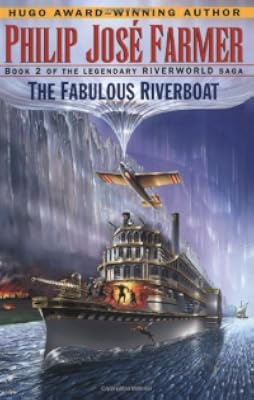
This story tells of a world where all of humanity has been mysteriously resurrected on the banks of one mighty river. Samuel Clemens (a.k.a. Mark Twain) is tasked with finding a fallen meteorite and using its ore to build a massive riverboat. But in order to succeed, he'll have to outwit some of history's most nefarious villains.Tags
Recommendations




















Member Reviews
As in the first book, Farmer bites off more than he can chew. By using real individuals and cultures from history as his fodder, Farmer invites close inspection by readers familiar with (and fond of) those characters and cultures.
His protagonist is an unfunny Mark Twain, whose occasional spoutings of without the ichor for which Twain is renowned. Likewise, the many conflicting cultures are oversimplified and whitewashed. Peace and war both come too easily, and intrigue tends to be replaced by bare conflict. Farmer includes the grandest political players to ever take the stage, and then makes them nothing more than petty warlords.
The whole plot is moved along by a mysterious and literal deus ex machina, and despite the buildup of the show more first book, brings us no closer to the mystery itself. Though I was curious how Farmer meant to resolve the grand questions raised by his grandiose world, he revealed too little to titillate.
This, combined with the massive influx of minor characters to a busy and muddled plot did little to keep me reading. Perhaps I will get to the other books at some point, but with my current to-read pile, it doesn't seem likely.
There is also an entertaining throwaway character in this book, a huge pre-human giant. Farmer strains credibility by presenting this creature as being capable of learning human speech (impossible for adult humans who were not exposed as children, let alone a pre-human larynx). Beyond this, he also comes to quickly grasp abstract thought, humor, planning, rationality, and sarcasm. Perhaps Farmer is a hard-line Chomskyan.
Farmer's idea for this series was audacious, but his plotting and characterization are rather bland, and seem even moreso against the unbelievably grand backdrop of Riverworld. Like Feynman said of religion: "The stage is too big for the drama". show less
His protagonist is an unfunny Mark Twain, whose occasional spoutings of without the ichor for which Twain is renowned. Likewise, the many conflicting cultures are oversimplified and whitewashed. Peace and war both come too easily, and intrigue tends to be replaced by bare conflict. Farmer includes the grandest political players to ever take the stage, and then makes them nothing more than petty warlords.
The whole plot is moved along by a mysterious and literal deus ex machina, and despite the buildup of the show more first book, brings us no closer to the mystery itself. Though I was curious how Farmer meant to resolve the grand questions raised by his grandiose world, he revealed too little to titillate.
This, combined with the massive influx of minor characters to a busy and muddled plot did little to keep me reading. Perhaps I will get to the other books at some point, but with my current to-read pile, it doesn't seem likely.
There is also an entertaining throwaway character in this book, a huge pre-human giant. Farmer strains credibility by presenting this creature as being capable of learning human speech (impossible for adult humans who were not exposed as children, let alone a pre-human larynx). Beyond this, he also comes to quickly grasp abstract thought, humor, planning, rationality, and sarcasm. Perhaps Farmer is a hard-line Chomskyan.
Farmer's idea for this series was audacious, but his plotting and characterization are rather bland, and seem even moreso against the unbelievably grand backdrop of Riverworld. Like Feynman said of religion: "The stage is too big for the drama". show less
Oh FFS.
Really?
The only part of this that survived the decades well is the subplot about SamMark and his beloved, obsessed-over Livy. Be careful what you wish for in this life! (I actually mean "Riverworld life," though that hoary old saying is hoary and old because it never stops being true.) The "race relations" aren't new or trenchant, just tediously familiar. The modern then, well-trodden-trail now use of insomnia, depression, and drug use to self-medicate them is gloom-inducing. Heteronormative dreariness is de rigueur, tobacco use is unstigmatized, and the whole damned enterprise has at its core a frustrating reality: THIS IS A HUGE MISSED OPPORTUNITY. There's no essential difference between the various factions scrapping over bits show more and pieces. There's nothing, in short, new under this brand-new sun.
But DAYUM is the Fabulous Riverboat a spiffy Maguffin. I don't think it's too much to say the ride is worth the journey if only just. show less
Really?
The only part of this that survived the decades well is the subplot about SamMark and his beloved, obsessed-over Livy. Be careful what you wish for in this life! (I actually mean "Riverworld life," though that hoary old saying is hoary and old because it never stops being true.) The "race relations" aren't new or trenchant, just tediously familiar. The modern then, well-trodden-trail now use of insomnia, depression, and drug use to self-medicate them is gloom-inducing. Heteronormative dreariness is de rigueur, tobacco use is unstigmatized, and the whole damned enterprise has at its core a frustrating reality: THIS IS A HUGE MISSED OPPORTUNITY. There's no essential difference between the various factions scrapping over bits show more and pieces. There's nothing, in short, new under this brand-new sun.
But DAYUM is the Fabulous Riverboat a spiffy Maguffin. I don't think it's too much to say the ride is worth the journey if only just. show less
This was an extremely difficult book to rate and review. Farmer created a brilliant concept in the first novel of his Riverworld series entitled To Your Scattered Bodies Go. The premise of Riverworld is that every single human who has ever lived has been reincarnated on a strange planet. Not only are they suddenly back alive, they are young again, and each time they die in this new world they are reincarnated somewhere else 24 hours later. Needless to say, this and all the other odd rules I did not mention are an excuse for Farmer to play in a sandbox of disparate cultures and historical figures.
But it is a concept I love. However arbitrary it seems, there's no denying this is one of the best ideas to come out of science fiction. There show more are innumerable directions to take such a premise.
Does Farmer's execution hold up? I had a few reservations about To Your Scattered Bodies Go, but for the most part, my answer was a resounding yes. In the Fabulous Riverboat, it is a much weaker yes.
The Fabulous Riverboat is almost a reboot. The main character from the first novel, Richard Burton, is nowhere to be seen. He is referenced a few times, but the focus of The Fabulous Riverboat is Samuel Clemens aka Mark Twain. The problem with this is obvious. Richard Burton is a historical figure, but not widely known. Samuel Clemens however, is still famous and beloved by a great many people. As evidenced in other reviews, readers may be less than satisfied with Farmer's portrayal of Clemens.
Personally, I had no issue with Farmer's Clemens. This is a reincarnation of Clemens at the very end of his life. This is a reincarnation of a man, not one of his characters. Clemens acted the part of a tortured humorist to my satisfaction. All of the misery Clemens suffered was still apparent in this resurrected Clemens, and hints of his famous wit bleed through at several points. Farmer is not Clemens and he is not the same kind of writer as Clemens, so I felt he did an admirable job of representing him.
Where Farmer failed in my view, is with other characters like his pre-human Joe Miller, the Viking Bloodaxe and Cyrano de Bergerac. All felt like caricatures rather than characters. King John of Lackland is portrayed well as his Herman Goering, but Elwood and the other black nationalists were not. It was hit and miss, but the focus is on Samuel Clemens, and I felt Farmer presented a believable Mark Twain.
By the end of the novel, the characters are no closer than they were in the first novel to reaching the headwaters of the planet circling river and finding the identity of those who have reincarnated them. I have a bad feeling that will remain the case until the very last novel.
That said, this is still a quality series. Farmer has created such a brilliant concept, I can ignore the issues I listed here. Other readers less taken with the idea may not be able to. show less
But it is a concept I love. However arbitrary it seems, there's no denying this is one of the best ideas to come out of science fiction. There show more are innumerable directions to take such a premise.
Does Farmer's execution hold up? I had a few reservations about To Your Scattered Bodies Go, but for the most part, my answer was a resounding yes. In the Fabulous Riverboat, it is a much weaker yes.
The Fabulous Riverboat is almost a reboot. The main character from the first novel, Richard Burton, is nowhere to be seen. He is referenced a few times, but the focus of The Fabulous Riverboat is Samuel Clemens aka Mark Twain. The problem with this is obvious. Richard Burton is a historical figure, but not widely known. Samuel Clemens however, is still famous and beloved by a great many people. As evidenced in other reviews, readers may be less than satisfied with Farmer's portrayal of Clemens.
Personally, I had no issue with Farmer's Clemens. This is a reincarnation of Clemens at the very end of his life. This is a reincarnation of a man, not one of his characters. Clemens acted the part of a tortured humorist to my satisfaction. All of the misery Clemens suffered was still apparent in this resurrected Clemens, and hints of his famous wit bleed through at several points. Farmer is not Clemens and he is not the same kind of writer as Clemens, so I felt he did an admirable job of representing him.
Where Farmer failed in my view, is with other characters like his pre-human Joe Miller, the Viking Bloodaxe and Cyrano de Bergerac. All felt like caricatures rather than characters. King John of Lackland is portrayed well as his Herman Goering, but Elwood and the other black nationalists were not. It was hit and miss, but the focus is on Samuel Clemens, and I felt Farmer presented a believable Mark Twain.
By the end of the novel, the characters are no closer than they were in the first novel to reaching the headwaters of the planet circling river and finding the identity of those who have reincarnated them. I have a bad feeling that will remain the case until the very last novel.
That said, this is still a quality series. Farmer has created such a brilliant concept, I can ignore the issues I listed here. Other readers less taken with the idea may not be able to. show less
It's a pretty okay novel, but it suffers from being a product of its times. That being said, it's pretty fun to ride with Samuel L. Clemens on his constantly-being-built steamboat, made of "Space Age" plastics! Wooooo that stuff is a pretty neat idea! Ahem. Sorry. I got carried away there.
A lot of the action is mostly finding new ways to build tech on the extremely huge world of reincarnated humans from all time periods showing up at the same time here, but we've moved along far enough that nations are being built and fortresses and boundaries are in full effect. Resource gathering is also a must, especially for a certain Mark Twain if he'll ever live out his dream of captaining his own steamboat. Of course, this is riverworld.
In 1971, show more the time when the novel came out, we're forced to face our worst nightmares (*laugh*) of an entirely black nation wanting to go completely isolationist from the honky. The arabs are too white, too, so even though they make up 1/6th of this separate riverworld nation, they're still getting evicted. "We're not perfect, whitey, but at least it'll be Our Problem. We blame you for everything." Storyline. Ahem. Let me be clear here. Practically EVERY treatment of the issue that I've ever read is better than this one. It's nearly a stereotype of a stereotype of black power, taken so far that it has come out the other side into near satire.
So, yeah, action happens, and tragedies, too, and all the while the mysterious counter-plan alien is trying to help ease our sufferings on this admittedly great-idea world. :)
Not the best novel I've ever read, by a long shot, but not incapable of telling a story, either. :) The first one was a lot more enjoyable. Sam was a bit too whiny for my tastes. *shrug*
I'm going to continue the series. This was hardly a deal-breaker. It's just a cultural-awareness crapfest issue. :) show less
A lot of the action is mostly finding new ways to build tech on the extremely huge world of reincarnated humans from all time periods showing up at the same time here, but we've moved along far enough that nations are being built and fortresses and boundaries are in full effect. Resource gathering is also a must, especially for a certain Mark Twain if he'll ever live out his dream of captaining his own steamboat. Of course, this is riverworld.
In 1971, show more the time when the novel came out, we're forced to face our worst nightmares (*laugh*) of an entirely black nation wanting to go completely isolationist from the honky. The arabs are too white, too, so even though they make up 1/6th of this separate riverworld nation, they're still getting evicted. "We're not perfect, whitey, but at least it'll be Our Problem. We blame you for everything." Storyline. Ahem. Let me be clear here. Practically EVERY treatment of the issue that I've ever read is better than this one. It's nearly a stereotype of a stereotype of black power, taken so far that it has come out the other side into near satire.
So, yeah, action happens, and tragedies, too, and all the while the mysterious counter-plan alien is trying to help ease our sufferings on this admittedly great-idea world. :)
Not the best novel I've ever read, by a long shot, but not incapable of telling a story, either. :) The first one was a lot more enjoyable. Sam was a bit too whiny for my tastes. *shrug*
I'm going to continue the series. This was hardly a deal-breaker. It's just a cultural-awareness crapfest issue. :) show less
ORIGINALLY POSTED AT Fantasy Literature.
To Your Scattered Bodies Go, the first of Philip Jose Farmer’s Riverworld novels, was a fast-paced, highly creative, and extremely exciting story, so I was eager to continue the tale in the second novel, The Fabulous Riverboat. This part of the story of mankind’s resurrection onto a million-miles-long stretch of river valley focuses on Samuel Clemens (Mark Twain) — one of the people who’ve been contacted by a traitor who hopes to use twelve special humans to disrupt the plans of the creatures (gods? aliens?) who are responsible for the Resurrection.
At the beginning of The Fabulous Riverboat, we meet Sam Clemens and his 800 lb Neanderthal bodyguard named Joe Miller. (Note: I highly show more recommend Recorded Books’ audiobook version narrated by Paul Hecht. Joe Miller’s lisping speech is difficult to read in print, but Mr. Hecht is brilliant with him.) Sam Clemens and Joe Miller are on a Viking ship that is searching for iron-rich meteors (the Riverworld has very few mineral deposits). The Vikings want the iron for weapons, but Sam wants to build a huge steamboat so he can sail up the river to its source and confront the beings who run the planet.
Sam gets some help from the mysterious traitor who tells him where to find required materials, but then he must work with tyrannical humans who want to hoard their countries’ natural resources or promote their political or religious agendas. Thus, there’s a lot more threatening, squabbling, political maneuvering, dealing, double-dealing, and war going on than actual ship-building.
It’s fun to meet real historical tyrants in Riverworld — they tend to rise to the top and become the leaders of aggressive city-states. It’s also amusing to watch the interactions of humans from such a wide range of time periods. For example, we see Joe Miller gradually becoming more cynical and humorous as he spends time with Mark Twain and we watch a 20th century engineer teach Twain how to store electricity to power the riverboat.
What’s not fun is that Philip Jose Farmer takes every opportunity to provide information about each of the characters who’s a real historical figure, and this is inelegantly done:
"I read about him in school!” von Richthofen said. “Let’s see. He was born in 1797, died about 1853, I believe. He was an artillery expert and a good friend of Frederick Wilhelm IV of Prussia. He was called ‘The Warlike Monk’ because he was a general who also had strict religious views. He died when he was about fifty years old, a disappointed man because he had been dropped from favor...
And sometimes the facts are repeated. For example, we’re told at least twice that John Lackland was such a bad king that the English swore they’d never have another king named John.
Also annoying is that Farmer frequently takes the opportunity to address topics such as racism and determinism by either having characters hold long philosophical discourses, or by obvious and clumsy manipulation of the plot. The end result is that there is lots of teaching and moralizing and little action in The Fabulous Riverboat. If you look at the book cover, you’d expect to be exploring Riverworld from the deck of Mark Twain’s steamboat, but the boat finally gets finished at the end of the novel.
It’s the wonderful world-building and intriguing questions that make this series so compelling: Why has humankind been resurrected? Who created this world? Who is the traitor? Is there a way out? What’s the purpose of dream gum? But we don’t get to explore much of Riverworld and we learn very little about it in The Fabulous Riverboat. I’m still so curious, though, so I’m hoping we’ll progress more quickly in the next installment: The Dark Design.
Later addendum: When I began downloading the audio version of The Dark Design, I realized it was 18 hours long — twice the length of the previous novels. I decided to investigate before committing and was disappointed to learn from other reviewers that the series degenerates after The Fabulous Riverboat. Readers cite the same issues I’ve mentioned here and other issues that killed their enjoyment of Riverworld. There was such a consensus that I feel I should believe them and not waste my time on a series that will ultimately disappoint me. I’m sad to say that I’m going to quit here — I just don’t have time to read bad books. This is especially upsetting because I really loved To Your Scattered Bodies Go. I also want to find out the answers I posed in the previous paragraph. If you know the answers, please tell me in a comment below. If nobody knows, I’ll just skim through the last half of book 4, The Magic Labyrinth, to find out. According to readers, that’s where the uninspiring answers are to be found). show less
To Your Scattered Bodies Go, the first of Philip Jose Farmer’s Riverworld novels, was a fast-paced, highly creative, and extremely exciting story, so I was eager to continue the tale in the second novel, The Fabulous Riverboat. This part of the story of mankind’s resurrection onto a million-miles-long stretch of river valley focuses on Samuel Clemens (Mark Twain) — one of the people who’ve been contacted by a traitor who hopes to use twelve special humans to disrupt the plans of the creatures (gods? aliens?) who are responsible for the Resurrection.
At the beginning of The Fabulous Riverboat, we meet Sam Clemens and his 800 lb Neanderthal bodyguard named Joe Miller. (Note: I highly show more recommend Recorded Books’ audiobook version narrated by Paul Hecht. Joe Miller’s lisping speech is difficult to read in print, but Mr. Hecht is brilliant with him.) Sam Clemens and Joe Miller are on a Viking ship that is searching for iron-rich meteors (the Riverworld has very few mineral deposits). The Vikings want the iron for weapons, but Sam wants to build a huge steamboat so he can sail up the river to its source and confront the beings who run the planet.
Sam gets some help from the mysterious traitor who tells him where to find required materials, but then he must work with tyrannical humans who want to hoard their countries’ natural resources or promote their political or religious agendas. Thus, there’s a lot more threatening, squabbling, political maneuvering, dealing, double-dealing, and war going on than actual ship-building.
It’s fun to meet real historical tyrants in Riverworld — they tend to rise to the top and become the leaders of aggressive city-states. It’s also amusing to watch the interactions of humans from such a wide range of time periods. For example, we see Joe Miller gradually becoming more cynical and humorous as he spends time with Mark Twain and we watch a 20th century engineer teach Twain how to store electricity to power the riverboat.
What’s not fun is that Philip Jose Farmer takes every opportunity to provide information about each of the characters who’s a real historical figure, and this is inelegantly done:
"I read about him in school!” von Richthofen said. “Let’s see. He was born in 1797, died about 1853, I believe. He was an artillery expert and a good friend of Frederick Wilhelm IV of Prussia. He was called ‘The Warlike Monk’ because he was a general who also had strict religious views. He died when he was about fifty years old, a disappointed man because he had been dropped from favor...
And sometimes the facts are repeated. For example, we’re told at least twice that John Lackland was such a bad king that the English swore they’d never have another king named John.
Also annoying is that Farmer frequently takes the opportunity to address topics such as racism and determinism by either having characters hold long philosophical discourses, or by obvious and clumsy manipulation of the plot. The end result is that there is lots of teaching and moralizing and little action in The Fabulous Riverboat. If you look at the book cover, you’d expect to be exploring Riverworld from the deck of Mark Twain’s steamboat, but the boat finally gets finished at the end of the novel.
It’s the wonderful world-building and intriguing questions that make this series so compelling: Why has humankind been resurrected? Who created this world? Who is the traitor? Is there a way out? What’s the purpose of dream gum? But we don’t get to explore much of Riverworld and we learn very little about it in The Fabulous Riverboat. I’m still so curious, though, so I’m hoping we’ll progress more quickly in the next installment: The Dark Design.
Later addendum: When I began downloading the audio version of The Dark Design, I realized it was 18 hours long — twice the length of the previous novels. I decided to investigate before committing and was disappointed to learn from other reviewers that the series degenerates after The Fabulous Riverboat. Readers cite the same issues I’ve mentioned here and other issues that killed their enjoyment of Riverworld. There was such a consensus that I feel I should believe them and not waste my time on a series that will ultimately disappoint me. I’m sad to say that I’m going to quit here — I just don’t have time to read bad books. This is especially upsetting because I really loved To Your Scattered Bodies Go. I also want to find out the answers I posed in the previous paragraph. If you know the answers, please tell me in a comment below. If nobody knows, I’ll just skim through the last half of book 4, The Magic Labyrinth, to find out. According to readers, that’s where the uninspiring answers are to be found). show less
I had purchased the first two books of the Riverworld series together at a used book store several years back, but then found myself quite disappointed with To Your Scattered Bodies Go. So this had been languishing in my "to be read" stack for a long, long time when I decided to pick it up for a quick read before digging into heavier duty anticipated Chrismas gift reading materials.
I am happy to report that I liked it more than the first book of the series (doesn't it usually seem to work the other way?). Samuel Clemens is not particularly believable, but I found him more sympathetic as a protagonist than Richard Francis Burton. Indeed, while the characters here are often annoying, they are at least drawn in more realistic shades of show more gray than I remember from the first volume. And at least some of the billiions of women from the history of humanity seem to have some purpose higher than having carnal knowledge of the protagonist. The ending offers no sense of closure whatsoever.
By the end of this volume I can almost begrudingly admit that I have at least a moderate level of interest in finding out who created this world and why and which of them is out to thwart their grand plans and why. But the moderately interesting meta story seems to me the limit of what the series has to offer. show less
I am happy to report that I liked it more than the first book of the series (doesn't it usually seem to work the other way?). Samuel Clemens is not particularly believable, but I found him more sympathetic as a protagonist than Richard Francis Burton. Indeed, while the characters here are often annoying, they are at least drawn in more realistic shades of show more gray than I remember from the first volume. And at least some of the billiions of women from the history of humanity seem to have some purpose higher than having carnal knowledge of the protagonist. The ending offers no sense of closure whatsoever.
By the end of this volume I can almost begrudingly admit that I have at least a moderate level of interest in finding out who created this world and why and which of them is out to thwart their grand plans and why. But the moderately interesting meta story seems to me the limit of what the series has to offer. show less
The Fabulous Riverboat is a good follow up to To Your Scattered Bodies Go, the first book in the Riverworld series. I shouldn't have read some reviews about this one while I was reading it because it did colour my feelings about the book a little. Sam Clemens (Mark Twain) isn't his witty best in this story. There's no one funnier than Twain in full flight. One of my favourite books by him is The Innocents Abroad and it is hilarious, the satire is scathing. Farmer's Twain is more humourless. Possibly the circumstances of his re-birth and life on Riverworld has made him more earnest and mopy. That said I still liked the book for the ideas expressed and the plot moves along at a nice clip. There's more than enough intrigue to continue. show more Richard Burton, the explorer and main protagonist in the first book - not the actor , returns in book 3 of the Riverworld series so I'm looking forward to that.
A quick edit to note that SF&F books prior to the 1980s are notable for being short compared to now. This probably a good thing. The Fabulous Riverboat is no exception. It only runs to about 230 pages. If it had been written now Farmer would be expected to punch out 4 or 500 pages. A couple of hundred pages is easily more digestible and less intimidating that 500 page door stopper. show less
A quick edit to note that SF&F books prior to the 1980s are notable for being short compared to now. This probably a good thing. The Fabulous Riverboat is no exception. It only runs to about 230 pages. If it had been written now Farmer would be expected to punch out 4 or 500 pages. A couple of hundred pages is easily more digestible and less intimidating that 500 page door stopper. show less
Members
- Recently Added By
Lists

Best Science Fiction Novels
816 works; 430 members

Speculative Fiction to Read
706 works; 32 members

Swinging Seventies
255 works; 18 members

Books Read in 2011
684 works; 20 members

Les 100 principaux titres de la science-fiction (1981)
126 works; 3 members
Favorite Science Fiction
454 works; 217 members

Slipstream or Interstitial Fiction
160 works; 19 members
Author Information

366+ Works 36,026 Members
Philip José Farmer was born in North Terre Haute, Indiana on January 26, 1918. He worked in a steel mill while attending Bradley University at night and writing in his spare time. In 1952, his story The Lovers, in which a human has sex with an alien, was published in a pulp magazine called Startling Stories and won him the Hugo Award in 1953 for show more most promising new author. He quit his job to become a full-time writer, but a string of misfortunes eventually forced him to take jobs as a manual laborer. He worked as a technical writer from 1956 to 1970, but continued writing science fiction. He finally found success in the 1960's with the Riverworld series. He wrote more than 75 books throughout his lifetime including the Dayworld series and the World of Tiers series. He also wrote short stories. He won the Hugo award for best novella in 1968 for Riders of the Purple Wage and for best novel in 1972 for To Your Scattered Bodies Go. In 1988, he was the recipient of the Writers of the Past Award and the Nova for best book for Riverworld. In 2001 he was awarded the Grand Master Award and the World Fantasy Life Achievement Award. He died on February 25, 2009 at the age of 91. (Bowker Author Biography) show less
Some Editions
Awards and Honors
Distinctions
Series


Belongs to Publisher Series
Work Relationships
Common Knowledge
- Canonical title
- The Fabulous Riverboat
- Original title
- The Fabulous Riverboat
- Original publication date
- 1971
- People/Characters
- Sir Richard Francis Burton; Samuel Langhorne Clemens
- Dedication
- For the unholy trinity of Bobs: Bloch, Heinlein, and Traurig - may I meet them on the banks of the River, where we'll board the fabulous Riverboat.
- First words
- 'Resurrection, like politics, makes strange bedfellows,' Sam Clemens said.
- Last words
- (Click to show. Warning: May contain spoilers.)"Some day, John! Some day!"
- Blurbers
- Rey, Lester del; Fielder, Leslie, A.
- Original language
- English
Classifications
Statistics
- Members
- 2,431
- Popularity
- 7,995
- Reviews
- 36
- Rating
- (3.58)
- Languages
- 12 — Czech, Danish, Dutch, English, French, German, Italian, Polish, Romanian, Russian, Spanish, Swedish
- Media
- Paper, Audiobook, Ebook
- ISBNs
- 45
- ASINs
- 22