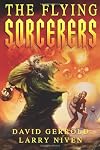
The Flying Sorcerers
by David Gerrold (Author), Larry Niven (Author)
On This Page
Description
This funny and insightful science fiction classic introduces Shoogar, the greatest wizard ever known in his village. His spells can strike terror in the hearts of even his most powerful enemies. But the enemy he faces now is like none he has ever seen before. The stranger has come from nowhere and is ignorant of even the most basic principles of magic. But the stranger has an incredibly powerful magic of his own. There is no room in Shoogar's world for an intruder whose powers match his own, show more let alone one whose powers might exceed his. So before the blue sun can cross the face of the red sun once more, Shoogar will show this stranger just who is boss. show lessTags
Recommendations

















Member Reviews
In 1970, when The Flying Sorcerers was serialized as "The Misspelled Magician" in The Worlds of If, Larry Niven was months away from hitting it big with Ringworld. His co-author, David Gerrold, had already written the short stories he would combine into When H.A.R.L.I.E. Was One, the novel that would earn his first Hugo and Nebula nominations. As far as I know, The Flying Sorcerers is their only collaboration, which is a shame because their talents mesh well. Niven is a genius at building new worlds with plausible physics and engineering. Gerrold combines acerbic social satire with believable characters. Sorcerers provides an early example of the sort of tongue-in-cheek sci-fi fantasy that would define the careers of Robert Asprin, show more Douglas Adams, and Terry Pratchett.
A scientist-explorer lands on a planet inhabited by furry humanoids, close enough to human that the women can do what they call “the family-making thing” with the scientist. Each village has a resident magician, and much of the humor comes from the three-way debate between the practical head man, the stubborn scientist, and the hard-headed magician.
The satire has the subtlety of a slap-in-the face. The village women are hobbled, have no names, have sister wives, and are treated like beasts of burden. The industrial revolution the scientist inspires will give them names and make their labor valuable. They are amazed that they can sit down to spin thread.
And there are puns, shameless anachronistic puns. We have two brothers building a flying machine. Their names, of course, are Wilville and Orbur. The best (or worst) of the puns involves the scientist's name. The villagers call him Purple because, he says, “the translator makes two-language puns! As a color, shade of purple-gray! As a mauve. Oh, how delightful.”
I know, but science fiction fans will get it. show less
A scientist-explorer lands on a planet inhabited by furry humanoids, close enough to human that the women can do what they call “the family-making thing” with the scientist. Each village has a resident magician, and much of the humor comes from the three-way debate between the practical head man, the stubborn scientist, and the hard-headed magician.
The satire has the subtlety of a slap-in-the face. The village women are hobbled, have no names, have sister wives, and are treated like beasts of burden. The industrial revolution the scientist inspires will give them names and make their labor valuable. They are amazed that they can sit down to spin thread.
And there are puns, shameless anachronistic puns. We have two brothers building a flying machine. Their names, of course, are Wilville and Orbur. The best (or worst) of the puns involves the scientist's name. The villagers call him Purple because, he says, “the translator makes two-language puns! As a color, shade of purple-gray! As a mauve. Oh, how delightful.”
I know, but science fiction fans will get it. show less
This is the worst book I’ve read in a very long time (the memory of woman runneth not to the contrary), so bad I’m almost tempted to try to make rachelmanija review it because she could be funny. I thought initially the book might be a parody of the “white man space explorer comes to uplift savage natives” trope, especially when I got to the Wizard of Oz homage, but the book was really just trying to be funny while using the White Man’s Burden as the humorous vehicle. See, they really are savages! His condescension is fully justified! They don’t name their women, they just beat them, until the noble space explorer shows them that women can be allowed to work (and sit while they work) and have names! There’s a Wright show more Brothers thing with Wilville and Orbur (I’m not lying) building an airship, except not really because the noble space explorer has to teach them what to do, in the process introducing money, betting, and theft, among other innovations, to the savages. The worst part is: I just ordered another David Gerrold book, before I read this. show less
The Flying Sorcerers is a difficult book for me to get a good handle on. Through much of the book it seems as though the two authors had different ideas about the tone of the books, as it is goofily humorous at times (mostly as a result of the rampant Tuckerization of names such as the bicycle making Orbur and Wilville), and a serious work of science fiction concerning the effects an outside visitor might have on an isolated culture at others.
The story takes place on an isolated planet, surrounded by a dust cloud with two suns and five moons. Consequently, the planet's weather, tides, and seasons are so complicated that true science (which relies upon a certain level of predictability) is unable to take root. The inhabitants, unable to show more see the stars, are completely unaware of anything outside their corner of the universe. A sort of pseudo-science has evolved, that the inhabitants refer to as magic, and one of the primary characters in the book is the village wizard Shoogar.
Into this world comes an off world visitor whose name translates as "As a color, shade of purple-grey" ("as-a-Mauve" or Asimov, another Tuckerization), and they promptly dub him "Purple". Purple's technological devices are seen as magic by the inhabitants, and the villagers are scandalized by his disregard for their gods and customs. The main character of the book, a native named Lant, tries to figure out the visitor and mediate between him and Shoogar, leading to much frustration and cross-cultural misunderstanding. Eventually, Shoogar (with Lant's help) decides he must get rid of the visitor, by destroying his means of transportation (described in the book as a flying egg). He succeeds, but the ensuing explosion drives all the inhabitants of his village out of the area, turning them into refugees.
They eventually find a new home on a peninsula later turned into an island by the erratic tides of the planet, but Purple is there already, thrown miles away by the explosion that destroyed his egg. Purple eventually decides he must build a flying machine (a ship won't work, the waters are too treacherous) and return to his original landing spot to call down his mother ship and leave. Much of the book details the somewhat unintended effects of this effort, as Purple converts the natives to an industrial society, introducing concepts like money, assembly line production, division of labor, and sexual equality along the way. Eventually, Purple succeeds and leaves, but it is clear that the natives will never be the same.
The story is interesting. Purple's unintended changes to Lant's culture have far reaching ramifications, most of which are followed up upon in the course of the story. The story is told from Lant's perspective, and while the reader can figure out what devices Purple has, and what concepts he is introducing, by having a native narrator, the viewpoint of the natives is made quite clear – including their misconceptions concerning the nature of Purple's devices and outrage at some of Purple's actions. Overall, a very solid and well-done science fiction story provided one can get past the groan inducing names. show less
The story takes place on an isolated planet, surrounded by a dust cloud with two suns and five moons. Consequently, the planet's weather, tides, and seasons are so complicated that true science (which relies upon a certain level of predictability) is unable to take root. The inhabitants, unable to show more see the stars, are completely unaware of anything outside their corner of the universe. A sort of pseudo-science has evolved, that the inhabitants refer to as magic, and one of the primary characters in the book is the village wizard Shoogar.
Into this world comes an off world visitor whose name translates as "As a color, shade of purple-grey" ("as-a-Mauve" or Asimov, another Tuckerization), and they promptly dub him "Purple". Purple's technological devices are seen as magic by the inhabitants, and the villagers are scandalized by his disregard for their gods and customs. The main character of the book, a native named Lant, tries to figure out the visitor and mediate between him and Shoogar, leading to much frustration and cross-cultural misunderstanding. Eventually, Shoogar (with Lant's help) decides he must get rid of the visitor, by destroying his means of transportation (described in the book as a flying egg). He succeeds, but the ensuing explosion drives all the inhabitants of his village out of the area, turning them into refugees.
They eventually find a new home on a peninsula later turned into an island by the erratic tides of the planet, but Purple is there already, thrown miles away by the explosion that destroyed his egg. Purple eventually decides he must build a flying machine (a ship won't work, the waters are too treacherous) and return to his original landing spot to call down his mother ship and leave. Much of the book details the somewhat unintended effects of this effort, as Purple converts the natives to an industrial society, introducing concepts like money, assembly line production, division of labor, and sexual equality along the way. Eventually, Purple succeeds and leaves, but it is clear that the natives will never be the same.
The story is interesting. Purple's unintended changes to Lant's culture have far reaching ramifications, most of which are followed up upon in the course of the story. The story is told from Lant's perspective, and while the reader can figure out what devices Purple has, and what concepts he is introducing, by having a native narrator, the viewpoint of the natives is made quite clear – including their misconceptions concerning the nature of Purple's devices and outrage at some of Purple's actions. Overall, a very solid and well-done science fiction story provided one can get past the groan inducing names. show less
Sometimes one is able to retreive a piece of one's past and experience it anew. Such is the case with this book. Years ago when I first was getting into science fiction, I picked up a coverless copy of The Flying Sorcerers from a sidewalk sale at Page One bookstore. (I didn't know then how blatantly illegal that was.) I read it and enjoyed it and later discarded it when I started running out of book space. Now, years later, I've picked this book up again (cover intact) in an effort to spend a gift certificate. The Flying Sorcerers tells the tale of a space traveler who encounters a group of "primitive" natives and incurs the wrath of the native wizard, who sees him as a rival. The traveler, called Purple by the natives, loses most of show more his equipment and then has to work with the natives and their primitive technology to get himself back to his mother ship. The story is a comedy of errors, told from the native point of view, and filled with all sorts of in jokes for science fiction fans. (I don't recall if I caught any of them the first time around, and this time I probably still missed a lot.) I enjoyed it more, however, for a humorous look at cross cultural mis-communication. I recommend that you check it out, even though for me it's good enough to keep... again.
--J. show less
--J. show less
Not one of Niven's best, but cute...using Isaac Asimov as a protagonist in the story.
SF, fantasy, library, first shelf
This is a light and amusing book, easy to read; but the authors didn’t just toss it off casually, they gave it the work and attention that might go into a more serious book. So, as well as being pleasant light amusement, it’s also a real sf novel with some meat to it.
Bearing the title in mind and the presence of so-called magicians, it’s worth noting that this is a work of science fiction and not fantasy. Even the science in it seems fairly solid and not very speculative.
Real imaginative work has been done to construct the bizarre scenario and to work out the low-technology solutions required for the plot. Characterization is amiable and sufficiently varied, though male-dominated: apparently the authors decided that strong female show more characters would be an unwanted complication in this case. The plot is well constructed and has a beginning and an end.
I haven’t read much by David Gerrold; but I’ve read quite a lot by co-author Larry Niven, and I reckon this is one of his better books. He’s written plenty of books that are more ambitious, but with varying degrees of success. show less
Bearing the title in mind and the presence of so-called magicians, it’s worth noting that this is a work of science fiction and not fantasy. Even the science in it seems fairly solid and not very speculative.
Real imaginative work has been done to construct the bizarre scenario and to work out the low-technology solutions required for the plot. Characterization is amiable and sufficiently varied, though male-dominated: apparently the authors decided that strong female show more characters would be an unwanted complication in this case. The plot is well constructed and has a beginning and an end.
I haven’t read much by David Gerrold; but I’ve read quite a lot by co-author Larry Niven, and I reckon this is one of his better books. He’s written plenty of books that are more ambitious, but with varying degrees of success. show less
Dec 17, 2024 (Edited)English (UK)
Members
- Recently Added By
Lists

Books Read in 2008
336 works; 8 members

Read in 2008
32 works; 1 member
Author Information

David Gerrold is one of the most popular science fiction writers working today. His first professional sale, the Star Trek episode "Trouble With Tribbles," won a Hugo Award. He has written for television, published more than forty books, and had columns in six different magazines. In 1995, his novelette "The Martian Child" won both the Hugo and show more Nebula Awards. Gerrold lives in San Fernando, California, and teaches writing at Pepperdine University show less

Larry Niven received his B.A. in mathematics in 1962. His first novel, World of Ptavvs (1966), was a success and launched his career. Niven has won five Hugos and one Nebula award, testimony that his colleagues in the science fiction world respect his work. Perhaps Niven's most well-known creation is Ringworld, a distant planet that may be taken show more as a metaphor for Earth, as it was once great but has since fallen into decay. (Bowker Author Biography) show less
Some Editions
Series
Belongs to Publisher Series
Work Relationships
Is abridged in
Common Knowledge
- Canonical title*
- Die fliegenden Zauberer
- Original title
- The flying sorcerers
- Original publication date
- 1971-08
- People/Characters
- Lant; Pilg; Shoogar; Orbur; Wilville; Purpur (show all 14); Hinc; Gortik; Trone; Bellis; Lesta; Ang; Grimm; Damd
- Dedication
- Dedicated to the men of NASA;
We understand their problems - First words
- I was awakened by Pilg the Crier pounding excitedly on the wall of my nest and crying, "Lant! Lant! It's happened! Come quickly!"
- Last words
- (Click to show. Warning: May contain spoilers.)The people become less willing to part with them every day. But I will have to see what I can do for him.
- Publisher's editor*
- Jeschke, Wolfgang
- Original language
- English
*Some information comes from Common Knowledge in other languages. Click "Edit" for more information.
Classifications
Statistics
- Members
- 766
- Popularity
- 36,805
- Reviews
- 7
- Rating
- (3.56)
- Languages
- Czech, English, German, Italian
- Media
- Paper, Audiobook, Ebook
- ISBNs
- 16
- ASINs
- 14