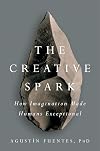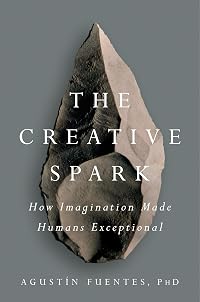
The Creative Spark: How Imagination Made Humans Exceptional
by Agustin Fuentes
On This Page
Description
Overturns widely held misconceptions about race, war and peace, and human nature itself and asserts that creativity is what has made humans so exceptional among all the species on Earth. --Publisher.Tags
Recommendations







Member Reviews
Excellent presentation of the key to the uniqueness of the human species: creative collaboration. Written clearly and intelligently for the lay reader interested in the science but not interested in being overwhelmed by the scientific jargon and minutiae, but brings the receipts in the notes for those looking for the detailed scientific arguments. Succinctly and clearly summarizes the ESS (extended evolutionary synthesis) before focusing on the application to the evolution of genus Homo, in particular highlighting the importance of niche construction. Highly recommended for a highly readable summary of current science regarding human evolution with a laser focus on the creativity and cooperation that forms the human niche.
You will not learn much about human origins but a lot about politics and social mores of early 21st century.
I admit I have a soft spot for people who venture into large syntheses, based on a broad point of view and solid (secondary) research. Apparently Agustin Fuentes is such a person. He's an American biological anthropologist associated with Princeton. What particularly charmed me is that he is averse to reductionist approaches: for each domain of human activity he discusses (dexterity, art, sex, religion, …) he has an eye for complexity and context, and he indicates nuances and also gaps in our knowledge.
Of course I am not well versed enough to be able to make a general assessment of this book, but a number of aspects that I do know something about (the evolution from hominids to humans, for example) allow me to say that this is a very show more solid, up-to-date to date book that offers a truly global look at both the uniqueness of humans and their embeddedness in the natural environment. I know, anthropocentrism has long since ceased to be woke, but I think we should certainly dare to face the ways in which our species distinguishes itselve – for better and for worse – from our environment. Fuentes rightly follows the nuanced middle ground.
In itself, the focus on creativity is not so earth-shattering and unique. As the book shows, behind that notion lies a complex interaction of consciousness, imagination, cognitive abilities, communication skills, cooperation, and so on. As a result, this book offers much more than an investigation into where and how human creativity originated (the question in itself - in that formulation - is of course nonsensical).
More in my History account on Goodreads: https://www.goodreads.com/review/show/2386756790 . show less
Of course I am not well versed enough to be able to make a general assessment of this book, but a number of aspects that I do know something about (the evolution from hominids to humans, for example) allow me to say that this is a very show more solid, up-to-date to date book that offers a truly global look at both the uniqueness of humans and their embeddedness in the natural environment. I know, anthropocentrism has long since ceased to be woke, but I think we should certainly dare to face the ways in which our species distinguishes itselve – for better and for worse – from our environment. Fuentes rightly follows the nuanced middle ground.
In itself, the focus on creativity is not so earth-shattering and unique. As the book shows, behind that notion lies a complex interaction of consciousness, imagination, cognitive abilities, communication skills, cooperation, and so on. As a result, this book offers much more than an investigation into where and how human creativity originated (the question in itself - in that formulation - is of course nonsensical).
More in my History account on Goodreads: https://www.goodreads.com/review/show/2386756790 . show less
Jul 27, 2023Dutch
Ratings
Members
- Recently Added By
Lists

Psychology: Abuse, Grief, Self-Help
189 works; 1 member
Author Information

17 Works 354 Members
Agustin Fuentes is Professor of Anthropology at the University of Notre Dame. He is the author of Core Concepts in Biological Anthropology (2006) and coauthor/editor of Health, Risk and Adversity (2008), Primates in Perspective (OUP, 2006), Primates Face to Face: The Conservation Implications of Human-Nonhuman Primate Interconnections (2002), and show more The Nonhuman Primates (1999). show less
Common Knowledge
- Original title
- The Creative Spark: How Imagination Made Humans Exceptional
- Original publication date
- 2017
- Dedication
- To everyone past, present, and future who dares to imagine, create, and learn
- First words
- When we consider creativity, we might think of Shakespeare or Mozart, Albert Einstein or Marie Curie, Charles Dickens or Mary Shelley, Andy Warhol or Annie Leibovitz, Jamie Oliver or Julia Child, Beyoncé or Prince. We ofte... (show all)n see the capacity for creativity residing in a single person or a select group of people. But creativity is not limited to the United States and Europe or to rich people or to people born in the last 500 years. It is not, after all, a solitary endeavor limited to the work of a genius or some particularly original thinker.
- Last words
- (Click to show. Warning: May contain spoilers.)That spark has grown and burns brightly across the planet. We’ve developed better tools, clothes, longer and healthier lives, airplanes, ideas of transcendent beauty, spacecraft to interstellar space, and a lot more children. But the challenges have grown in scale as well, and they show no sign of slowing down.
Let’s meet those challenges head-on and shoot for another 2 million years of creativity. - Original language
- English
Classifications
- Genres
- Anthropology, Nonfiction, Science & Nature, History, General Nonfiction, Philosophy
- DDC/MDS
- 153.3 — Philosophy & psychology Psychology Conscious mental processes and intelligence Creativity And Visualization
- LCC
- BD450 .F79456 — Philosophy, Psychology and Religion Speculative philosophy Speculative philosophy Ontology
- BISAC
Statistics
- Members
- 119
- Popularity
- 269,564
- Reviews
- 3
- Rating
- (3.50)
- Languages
- English, Spanish
- Media
- Paper, Audiobook, Ebook
- ISBNs
- 7
- ASINs
- 3