On This Page
Description
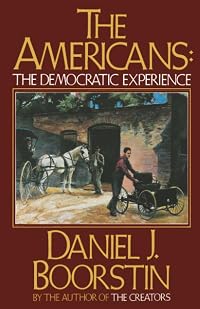
Final volume in a trilogy; the first of which is the author's The Americans, the colonial experience; and the second of which is his The Americans, the national experience. Daniel J. Boorstin's long-awaited full-scale portrait of modern America chronicles the Great Transformation that has come about in our daily lives since the Civil War. [This book] recaptures the drama and the meaning of the countless and sometimes little-noticed revolutions which occurred, not in legislatures or on show more battlefields but in our homes and farms and factories and schools and stores--making something surprising and unprecedented of our everyday experience. The revolutions in our daily life have been the work of a peculiarly American galaxy of talent--from cow-town builder Joseph McCoy; Edwin L. Drake, the retired railroad conductor who was crazy enough to "drill" for oil; R. G. Dun, the self-made Ohio merchant who made a career of reporting the credit rating of other merchants (to build Dun & Bradstreet); the railway agent Richard Warren Sears, who started the greatest general merchandising operation in the world; Raymond Smith, who democratized gambling and helped build Reno; Robert Bonner, flamboyant publisher of sensational novels who forced newspapers to use display type for advertising--from these inventors and businessmen to the educators who sponsored a New Higher Learning and the linguists who brought the colloquial into the classroom, the psychologist who reinterpreted our sexual mores, and the scientists who escalated us into a New Momentum. While Dr. Boorstin takes a new look at everything from Christmas to air conditioning, from the rise of the candy bar to the decline of grammar, he does not relate facts simply because they are themselves interesting, amusing, and enlightening--though they are that, too. For he uses them all to help ask: What has life come to mean--and ceased to mean--to us late-twentieth-century Americans? He shows us how we became a nation held together by what we buy and the ads we read, defined by how we count ourselves and how others count us, characterized by the way we describe our wealth or our poverty. The new American technology of food and drink and construction, of education and communication and travel--including the "mass-produced moment" via photography and the phonograph--dilutes our daily life with "repeatable experience" in the very act of enriching it. The endless streams of property created by the American corporation, the new ambiguity of ownership in a nation of franchised outlets (for everything from car mufflers to hamburgers), and the new democracy of packaging, in which the wrapping of items often costs more than their contents, add up to the "thinner life of things." The quest for novelty--from the multibillion-dollar efforts of Research and Development producing solutions which then must go in search of problems to the annual (and semiannual) automobile models and the idealization of newness in art--has brought, along with its rewards, a new bewilderment over what we really mean by something new. The very idea of Progress is displaced by the Rate of Growth. All this adds up--in Dr. Boorstin's phrase--to the Democratic Experience. Few books about the U.S.A. since De Tocqueville have had the sweep, the scope, the originality, and the intimacy of [this one]. Reaching back to the roots of all this in the era of the Civil War, Dr. Boorstin makes his history into a kind of national autobiography, reminding us of how we have made ourselves what we are. While this book will long be a subject of controversy, it aims at a balanced assessment of the price and the promise of what American civilization has done with and for and to Americans.--Dust jacket. show lessTags
Recommendations















Member Recommendations
John_Vaughan Daniel Boorstin is an eminently readable author and historian; his trilogy The Americans offers a full outline of Colonial America.
21
Member Reviews
After the Civil War, the United States transformed from a country looking for a national identity to one whose democratic experience spread to everyone. The Americans: The Democratic Experience is the third and final volume of Daniel Boorstin’s trilogy which features the American experience after it found a national identity and creating a democratic culture.
Throughout the 600 pages of text of Boorstin’s work, his working thesis that after finding a national identity Americans looked to create a democratic culture in which everyone had access to the same quality of products and experiences no matter their income or pedigree. Covering such diverse things like how all Americans were able to get access to fresh beef, how education from show more primary school up through college—including the creation of high school—for all became a national obsession, how clothing went from being a mark of status to mass produced equality, and so much more Boorstin made the case that Americans looked to make things for everyone either for profit or for the betterment of society but through this democratic pursuit to create for everyone it resulted massive efforts to do things collectively on a large scale leading to the atomic bomb and the landing on the moon roughly a century after the country had nearly torn itself apart while also spreading it’s democratic outlook to the world. Of the six books I’ve read of Boorstin’s this is the one in which his consensus view of history really stands out with his focus on inventors and entrepreneurs in this book even while expressing his loathing of the vulgarities that crept into American culture and advertising through this democratization process. As the concluding installment of his trilogy of looking at American history through how the physical environment of the continent shaped—from the beginning of colonization to the late 20th Century—American society and how it reflected on how individuals interacted with their society, it’s been informative especially one little discussed individuals and trends that would influence those more well known to us.
The Americans: The Democratic Experience completes Daniel Boorstin’s trilogy on the cultural history of the United States by showing how in the shadow of a war that nearly destroyed a country a culture aiming to spread to everyone was formed. show less
Throughout the 600 pages of text of Boorstin’s work, his working thesis that after finding a national identity Americans looked to create a democratic culture in which everyone had access to the same quality of products and experiences no matter their income or pedigree. Covering such diverse things like how all Americans were able to get access to fresh beef, how education from show more primary school up through college—including the creation of high school—for all became a national obsession, how clothing went from being a mark of status to mass produced equality, and so much more Boorstin made the case that Americans looked to make things for everyone either for profit or for the betterment of society but through this democratic pursuit to create for everyone it resulted massive efforts to do things collectively on a large scale leading to the atomic bomb and the landing on the moon roughly a century after the country had nearly torn itself apart while also spreading it’s democratic outlook to the world. Of the six books I’ve read of Boorstin’s this is the one in which his consensus view of history really stands out with his focus on inventors and entrepreneurs in this book even while expressing his loathing of the vulgarities that crept into American culture and advertising through this democratization process. As the concluding installment of his trilogy of looking at American history through how the physical environment of the continent shaped—from the beginning of colonization to the late 20th Century—American society and how it reflected on how individuals interacted with their society, it’s been informative especially one little discussed individuals and trends that would influence those more well known to us.
The Americans: The Democratic Experience completes Daniel Boorstin’s trilogy on the cultural history of the United States by showing how in the shadow of a war that nearly destroyed a country a culture aiming to spread to everyone was formed. show less
Daniel Boorstin is the most oft cited consensus historian of the post-war period. As critics observe, he is persistently oblivious to conflict and contest in American history. Worse than being reviled, he is ignored by the profession as irrelevant.
Main current of Boorstin's thought is that Americans are a "practical" people. Free from abstract doctrine or theological speculation, the Puritans built a "city on a hill." Celia Kenyon pointed to "the themes of practicality, of realistic adaptation to the circumstances of colonial life, of intelligent and effective amateurism" in his work. As others have pointed out, he was one of the first people to point out the importance of technological innovation throughout American history. In the show more woods of New England, people did need to be jacks of all trades to survive. This is, as Brooke Hindle and Steven Lubar were to point out later, a source of innovation in America's wooden age. Another problem with Boorstin's approach is the insistence on the irrelevance of ideology to the American experience. The Quakers were the only ideologues in his history. They, like the Civil Rights workers, went to prisons singing. The Quakers are as wrong-headed in Boorstin's views as those who protested for civil rights.
In a review entitled "American Social History: The Boorstin Experience," Kenneth L. Kusmer covers all three volumes and concludes that Boorstin is best when talking about times when conflict was less important than consensus. Unfortunately, there is no time in American History when conflict was less important than consensus. Kusmer points out that the American Revolution flows from his pen as a decidedly un-revolutionary event. On the Puritans he stresses the lack of rancorous contention. The Puritans had the right to get rid of dissenters (Williams and Hutchinson). Religion was the site of social stability not the realm of contested values. When turning his eye to the military history of America, Kusmer tells us that Boorstin is more valuable. He stresses the unschooled and "pragmatic" approach which American commanders took during the Revolution. Unrestrained by the weight of the "old world," they adopted guerilla tactics that enabled them to fight more effectively. (Yet what do we make of the Prussian drill master who trained Washington's troops?) Also points usefully to the American way of war as a defense of the home land, partially explaining the difficulty with LBJ faced in fighting the Vietnam war.
On the Civil War, he contrasts Northern practicality with Southern ideology. As Eric Foner has shown, Free Soil ideology was as much a motivating force in the North as white supremacy was in the South. He ignores blacks, indians and women as makers of history at all turns. His work is solidly "middle class," what one would call Whiggish, in the first two volumes and turns a bit pessimistic in the third. The rise of the New Left and anti-Vietnam protest disillusioned him it seems. In the third volume he was less celebratory. The imperative of technology seemed to be pushing us forward, making life more second hand ... the immediacy of experience was fading, and so too was the practical amateurism that forswears the ideological. show less
Main current of Boorstin's thought is that Americans are a "practical" people. Free from abstract doctrine or theological speculation, the Puritans built a "city on a hill." Celia Kenyon pointed to "the themes of practicality, of realistic adaptation to the circumstances of colonial life, of intelligent and effective amateurism" in his work. As others have pointed out, he was one of the first people to point out the importance of technological innovation throughout American history. In the show more woods of New England, people did need to be jacks of all trades to survive. This is, as Brooke Hindle and Steven Lubar were to point out later, a source of innovation in America's wooden age. Another problem with Boorstin's approach is the insistence on the irrelevance of ideology to the American experience. The Quakers were the only ideologues in his history. They, like the Civil Rights workers, went to prisons singing. The Quakers are as wrong-headed in Boorstin's views as those who protested for civil rights.
In a review entitled "American Social History: The Boorstin Experience," Kenneth L. Kusmer covers all three volumes and concludes that Boorstin is best when talking about times when conflict was less important than consensus. Unfortunately, there is no time in American History when conflict was less important than consensus. Kusmer points out that the American Revolution flows from his pen as a decidedly un-revolutionary event. On the Puritans he stresses the lack of rancorous contention. The Puritans had the right to get rid of dissenters (Williams and Hutchinson). Religion was the site of social stability not the realm of contested values. When turning his eye to the military history of America, Kusmer tells us that Boorstin is more valuable. He stresses the unschooled and "pragmatic" approach which American commanders took during the Revolution. Unrestrained by the weight of the "old world," they adopted guerilla tactics that enabled them to fight more effectively. (Yet what do we make of the Prussian drill master who trained Washington's troops?) Also points usefully to the American way of war as a defense of the home land, partially explaining the difficulty with LBJ faced in fighting the Vietnam war.
On the Civil War, he contrasts Northern practicality with Southern ideology. As Eric Foner has shown, Free Soil ideology was as much a motivating force in the North as white supremacy was in the South. He ignores blacks, indians and women as makers of history at all turns. His work is solidly "middle class," what one would call Whiggish, in the first two volumes and turns a bit pessimistic in the third. The rise of the New Left and anti-Vietnam protest disillusioned him it seems. In the third volume he was less celebratory. The imperative of technology seemed to be pushing us forward, making life more second hand ... the immediacy of experience was fading, and so too was the practical amateurism that forswears the ideological. show less
Covers a wide range of History from the end of the American Civil War to about the seventies. From the mundane of invention of packaging to the Atomic bomb and a lot in-between, an informative read.
LT The Americans: the Democratic Experience, Daniel Boorstin, Vintage Books, 1974, 4/1/24-6/14/25 read in Lima mostly I suppose; recommended by [if anybody], Where is hard copy? BCSA in history section
Theme: the century after the Civil War; “the most tremendous and far-reaching engine of social change which has ever blessed or cursed mankind”; The century after the Civil War was to be an Age of Revolution—of countless, little-noticed revolutions, which occurred not in the halls of legislatures or on battlefields or on the barricades but in homes and farms and factories and schools and stores, across the landscape and in the air—so little noticed because they came so swiftly, because they touched Americans everywhere and every show more day. “prelude,” p ix
Type: history with commentary
Value: 1-
Age: college
Interest: 1-
Objectionable:
Synopsis/Noteworthy: like Warmth of Other Suns in showing where today’s country came from
GENERAL
1 (first sentence) AMERICANS reached out to one another. A new civilization found new ways of holding men together—less and less by creed or belief, by tradition or by place, more and more by common effort and common experience, by the apparatus of daily life, by their ways of thinking about themselves.
3 The years after the Civil War when the continent was only partly explored were the halcyon days of the Go-Getters. They went in search of what others had never imagined was there to get. The Go-Getters made something out of nothing, they brought meat out of the desert, found oil in the rocks, and brought light to millions.
63 A great nationwide change in American legal education appeared after 1870. The common law way of thinking, perfected and applied by Chief Justice Lemuel Shaw in Massachusetts and by others elsewhere, was primarily a judge-declared law, which deftly bent ancient traditions and esoteric vocabularies to the new needs f the coming age of railroads. … Now the law seemed less a treasury of principles to be discovered than a set of instruments to be used.
64 The law, once a metaphysic, had become a social science.
78 The Americans’ desire to gamble had been equaled only by their desire to see that gambling was legally forbidden.
86 As late as 1959 two states, Oklahoma and Mississippi, still outlawed alcoholic beverages. … It was 1966 before Mississippi adopted the local option liquor law and so became the last state to abandon the luxury of prohibiting what its citizens desired.
87 While in the days of prohibition the bootleggers had aimed to satisfy a demand that was already there, when organized crime turned to narcotics it also undertook to stimulate the demand.
89 Invisible new communities were created and preserved by how and what men consumed.
106 Just as the rise of the suburbs in the late 19th century was inseparable from the story of the streetcar, so the rise of the department store was one with the rise of newspaper advertising. The department store pioneers were pioneers in the art and science of advertising.
108 In other, subtler ways, the market was homogenized and democratized. One of the most interesting, and least noticed was the fixed-price, one-price policy of the great new department stores. The old practice, still a spice of life in the world’s bazaars, was for the seller to be bargaining individually with each buyer, asking a price determined by that particular buyer’s social position, his need, and his desire for that particular item. … The refusal to bargain was considered churlish or unsociable, and it surely made life less interesting.
109 The expression “chain store,” an Americanism firmly settled into the language by the beginning of the 20th century, described one of a group of similar stores under common ownership. … “Cash-and-Carry,” an Americanism added to the language by the early 20th century, would become the motto of the chain stores.
120 Some have called the big mail order catalogs the first characteristically American kind of book. It was not merely facetious to say that many farmers came to live more intimately with the good Big Book of Wards or Sears, Roebuck then with the Good Book.
135 In the century after the civil war, mail order enterprises using the power of their Big Book became another of the unplanned forces of attenuation, thinning out the differences between all places and times and seasons, assimilating the ways of the country and of the city. Americans were coming to think of the improvement of life as whatever made life where they were more like life everywhere else. And by the turn of the century that everywhere else was the city.
138 The very notion of “classified advertisements,” and the Americanism “classified,” did not exist until after the Civil War.
144 “The commonplace is the proper level of for writing in business,” explained John E Powers, the dean of early American advertising writers, “where the first virtue is plainness, ‘fine writing’ is not only intellectual, it is offensive.” The pioneering advertising agent George P Rowell advised, “You must write your advertisements to catch damned fools—not college professors, and you’ll catch just as many college professors as you will of any other sort.”
145 And an advertisement was, in fact, a form of insurance to the consumer that by buying this commodity, by smoking this brand of cigarette, or by driving this make of car he would not find himself alone. The larger the advertising campaign, the more widespread and the more effective, the more the campaign itself offered a kind of communitarian seal of approval.
148 Old fashioned political and religious communities now became only two among many new, once unimagined fellowships. Americans were increasingly held to others not by a few iron bonds, but by countless gossamer webs knitting together the trivia of their lives.
158 By the era of the Civil War the old festival, characterized by folksy conviviality, was beginning to be transformed. There were signs that the holiday was on its way to becoming a spectacular nationwide festival of consumption. On December 24, 1867, the first Christmas Eve when RH Macy’s remained open until midnight, the store set a record with one-day receipts of $6,000. In 1874 Macy’s offered its first promotional window displays to have an exclusively Christmas motif, featuring the Macy collection of dolls, and from then on the Christmas windows became an annual institution.
175 And insurance became a kind of substitute for family, for neighborhood, and for community.
195 While the 19th century system aimed to manufacture products that were just good enough for their purpose, the 20th century actually aimed to manufacture products that were no better than they needed to be.
197 True manufacturing involves making a quantity of the same article, uniform within limits. In this respect it is the diametrical opposite of artwork. The manufacturer seeks to make things alike, but the artist drives for the creation of things that are different and individualistic.
217 Harrington defined the “poor” as “those who suffer levels of life well below those that are possible, even though they live better than medieval knights or Asian peasants. … those who are denied the minimal levels of health, housing, food, and education that our present stage of scientific acknowledge specifies as necessary for life as it is now lived in the United States.”
230 Christianity had relied on a ministry of the gospel, on sacred authoritative text, and had enlisted faith in the authority and benevolence of a Fatherly God. But psychology, in Hall’s vision, referred man to no higher authority (except perhaps the psychologist). Its sacred text was experience and it made man a rule unto himself. Would you know what man ought to be? Discover, for the first time, what man is. In place of the “Thou shalt not’s” of the Decalogue, psychology would substitute open questions: “What is man?” “How does he behave?” Psychology, the science of uniting the “is” and the “ought,” was the supremely democratic science. For it referred all questions of human behavior not to any higher authority, nor to some traditional scripture, but to the normal behavior of men.
230 In American education within a few decades (as the historian Lawrence Cremen has shown) Hall and his followers would accomplish a new Copernican Revolution. The center of the educational universe would shift from the “subject matter” and the teacher to the child. Until this time, Hall explained, education had been scholiocentric (centering around the school and its demands), but now it must become pedocentric (centering around the child, his needs and desires). Before this revolution could take place, psychologists had to discover what the child himself thought and felt and wanted. … The word “questionnaire” would come into the American language within the next 15 years from child study and educational psychology, and largely as a result of Hall's work. In place of introspecting, like the great philosophers from Plato to Kant, or debating like the professors and schoolmen, Americans, following Hall, characteristically would advance their knowledge of man by finding new ways of entering into the minds of living men and women, allowing them to speak for themselves.
232 In his “Children’s Lies” (1890), for example, Hall objected to the traditional schoolmaster attitude toward truth telling. Lying, according to Hall, was not simply a vice but a complicated form of behavior, and its significance varied with the stage of a child’s development. Most “lying” in children required not punishment but understanding. It commonly expressed the child's undervalued “mythopoetic” faculty, his quest for “easement from a rather tedious sense of the obligation of undiscriminating, universal and rigorously literal veracity.” In children, lying was closely related to play, and the child's attitudes embodied the delightful naivete of earlier stages of man's evolution. As Hall studied the child's fears and his ways of venting anger, he then concluded that they called for respect and understanding. Anger “has its place in normal development.”
236 Gesell was full of good common sense, reminding the parent, as all parents needed reminding, that his baby was not the first infant on earth. … Instead of looking to rules of thumb, the old saws and moral exhortations, the parent was now urged to look to scientifically established statistical norms. … In 1946 Dr Benjamin Spock, a New Haven-born pediatrician-psychiatrist with a wide practical experience, produced the Common Sense Book of Baby and Childcare. … A democratic society was committed to take account of what every person, from Gesell’s “quasi-dormant neonate” on up, naturally and spontaneously wanted.
237 Gesell’s book [Gesell was a disciple of Hall] was not meant for every parent. But it had a remarkable popular success, going through 12 printings in a single year. And these new ways of thinking about child rearing were soon brilliantly translated into everyday language reaching millions. In 1946 Dr. Benjamin Spock, a New Haven-born pediatrician-psychiatrist with a wide practical experience, produced the Common Sense Book of Baby and Child Care. In its inexpensive paperback edition it went through some 30 reprintings in 10 years, and became Everybody's Guide to Raising a Family. Spock warned against old wives’ remedies and urged parents to be guided by their own child’s development. Generally following Gesell’s notion of a “self-demand” feeding schedule, Spock urged mothers to “be flexible and adjust to the baby's needs and happiness.” While the book was by no means revolutionary, reviewers agreed that it “interprets the best in modern thinking.” Now every parent had an easy path into the new world of norms. ... A democratic society was committed to take account of what every person, from Gesell’s “quasi-dormant neonate” on up, naturally and spontaneously wanted.
238 By 1900 Sigmund Freud had published his basic work in psychoanalysis. In 1909, when G Stanley Hall brought Freud, who was then still slightly disreputable in European scientific circles, to a conference at Clark University, he caused a stir, but he helped make Freud more respectable in America than he was in his home country.
239 Like Hall, Kinsey was raised in the strict, moralistic family. Kinsey’s Methodist father was so observant of the Sabbath that he would not permit the family to ride to church on Sunday, even with the minister; Sunday milk deliveries were not permitted at the house, and the full whole family was required to attend Sunday School, morning services, and evening prayer meeting.
244 As the new truths took the form of quantitative, scientifically authenticated norms, morality was replaced by normality. Prescriptions were displaced by descriptions. Statistical morality carried its own kind of latent prescription. The new knowledge of norms was as “guilty” and as unforgettable as Adam’s first bite of the apple in Eden. A man who knew the norms had lost his innocence. Never again could he look on the violations of parental authority, on youthful vices, on extramarital peccadilloes, or on unnatural sexual satisfactions with the simple disgust of his grandfathers.
254 Arriving in eastern seaboard cities, the Irish commonly lacked the means to disperse themselves into the continent. NYC, where the greatest number arrived, by 1850 there had accumulated some 130,000 Irish-born who comprised a quarter of the city’s population; five years later more than a third of the city’s voters were Irish. This story was repeated elsewhere in the northern seaport towns, notably in Boston.
269 But by 1970, when the Los Angeles metropolitan area had spread over more than 450 square miles, included seven million people, and had become the core of the second most populous SMSA in the US, there was no longer a dominant downtown. Pundits competed in efforts to describe the city’s vagueness. “Suburbs in search of a city,” “prototype of the super city,” “autopia”—even the fertile American language was strained to suggest the nebulousness of this bizarre metropolitan entity. … The predominant visual image of the city was no longer of an urban center but of highways.
271 In 1925 the Secretary of Agriculture approved a uniform system of numbering and marking highways: east-west roads were assigned even numbers, north-south roads were assigned odd numbers, and transcontinental highways were designated in multiples of 10. Under this scheme, the old north-south post [for mail] road along the Atlantic seaboard became US 1, and the Pacific Coast road was US 101. A uniform design was adopted for the marker, the familiar shield with the state’s name along the top and featuring the US highway number. For their own highways the states then develop their own numbering systems. … As air traffic increase, and as the construction of airports became more expensive, more and more airports appeared between cities—Norfolk-Hampton Roads, Fort Worth-Dallas and others—and they became newly ambiguous points of arrival.
292 As late as 1900 only half as many as whites (in proportion to their numbers) were living in cities, but by 1960, when 68% of the nation’s white population was classified as urban, the proportion of the nation’s Negroes living in cities already came to 73%.
293 The proportion of the nation’s population found in the south decline from 90% in 1870 to 60% in 1960. Negroes living in the rural South generally did not move to a southern city on their way northward and westward. The dispersion out into the nation showed a striking uniformity. While the proportion of Negroes in the population as a whole decrease from 1870 to 1920 (from 13% to 10%), and then remained relatively stable after 1920, every section outside the South showed an increase in its Negro population.
294 New York’s Harlem, which soon which was soon called “the largest Negro community in the world,” was the symbol and the prototype of the Metropolitan life that the Negro in his new urban congregation and segregation was building for himself. … New opportunities for the Negro in the city were symbolized in the career of the talented and versatile James Walden Johnson, a founder of the NAACP, a lawyer, composer and lyricist (he wrote some 200 songs), fighter free opportunity, and chronicler of the New York Negro community.
296 Harlem had its Renaissance. By 1920 the population of New York City, overwhelmingly concentrated in Harlem, numbered more than 150,000, making it the largest Negro community of any city in the nation.
297 “The Jazz Age,” the decade after World War I, when the nation became predominantly urban, took its name from the rich and variety new popular music which was essentially a creation of the Negro in the city. … But there is no denying that this American form of music originated with Negroes in the first age of their migration to the city…
302 The second Ku Klux Klan, founded in Georgia 1915, spread through the North and Middle West until it claimed a membership four million in the 1920’s. By the 1960s the slogans of “White Supremacy,” which had long plagued American life, were being matched by slogans of “Black Power,” and a new Negro racism became almost respectable.
327 Another essential step toward homogenizing the regions and seasons, toward democratizing the national diet and increasing the varieties of foods of the ordinary citizen was the coming of refrigeration to every household.
342 Libbey organized the Toledo Museum of art in 1901, used his fortune to erect its first building in 1912, and helped make it a model for the dynamic role of museums in American education.
346 The skyscraper was the climactic symbol of man’s ability to rise above particular places and times to satisfy his needs, to keep himself comfortable and at work, making experience for all Americans, wherever they lived, more alike.
350 The luxurious American hotels, the palaces of the public, were among the first and most influential American buildings to bring running water indoors.
351 But it was the early 20th century before the private bathroom became normal for every room in better American hotels.
354 The new communal sources of water, and the communal outlets for sewage, became the unexpected causes for isolating individuals, incidentally changing the social attitudes toward bodily functions.
359 The “fleeting moment” was the poet’s cliche because nothing was more obvious than that the instant now was never to be recaptured.
379 In this there was a poetic appropriateness, for movies were the American invention which, more than any other before, focuses the vision of the world. And motion pictures became the great democratic art, which, naturally enough, was the characteristically American art.
384 Music was being democratized, not only because the nation’s millions could now enjoy music once reserved for few, but also because the millions now commanded the most profitable musical market, had a new power to shape musical taste, a way of making it worth it composers or performers while to give the millions what they wanted.
393 Just as the printing press five centuries before had begun to democratize learning, now the television set would democratize experience, incidentally changing the very nature of what was newly shared. Before, the desire to share experience had brought people out of their homes gathering them together (physically as well as spiritually), but television would somehow separate them in the very act of sharing.
396 Before, the spectator attending a national political convention would, simply by turning his head, decide for himself where he would look, but the TV watcher in the living room lacked the power to decide. Cameramen, directors, and commentators decided for him, focusing on this view of a brutal policeman or that view of a pretty delegate.
422 [Ford] thought people should be thrifty and prudent, buying what they could pay for period from the beginning for to post all sorts of time payment plans...
434 …packaging was a new way of democratizing products…
446 The supermarket offered new opportunities for impulse buying; and impulse buying was essentially the buying of packages. With the rise in the American Standard of Living, the increase of disposable income, and the multiplication of novel objects, more and more people went to the supermarket hoping to be seduced into buying something they really wanted. In England and elsewhere in the Old World, it was still true in the late twentieth century that middle class shoppers went to markets to buy what they wanted, while Americans went increasingly to see what they wanted.
452 One virtue of democracy, according to Webster, was that it offered people a “standard”—in “the rules of the language itself”—more uniform than the language of aristocracies...
456-462 [Charles Carpenter Fries’] Two influential books aimed to discover the structure of the American language, not from the grammarians’ rules, but from how ordinary Americans actually wrote and spoke. ... He urged English teachers to change their methods in order to teach students the everyday practices of their community, aiming finally “to stimulate among our pupils observation of actual usage and to go as far as possible in giving them a practical equipment for this purpose.”
461 Here was a compromise, the editor explained, “a linguistically sound middle course” between the antiquated “authoritarian” point of view and the futuristic “descriptive” approach. But this dictionary, too, was permissive, plainly dominated by the living, spoken language. When “usage” was prescribed, it was only in order to make the book “fully descriptive.” The Random House Dictionary, partly because of its differences from the new Webster’s, was an enormous commercial success.
462 “Oratory is the parent of liberty,” explained a popular American handbook in 1896...
463 It is sometimes forgotten that these books, out of which generations of American school children learned to read, aimed to teach boys and girls how to read aloud. McGuffey’s Fifth Eclectic Reader (1879 ed.) began by describing the purpose of reading as a rhetorical exercise, and went on with Twelve Rules and examples of “correct” and “incorrect” Articulation, Inflection, Accent, Emphasis, Modulation, and Poetic Pauses….
478 If there was to be a new American religion of education, the universities were its cathedrals, just as the high schools later would become its parish churches. It was no accident that American universities adopted the architecture of the great age of European cathedral building.
X? 479 At the same time, elementary schools and high schools, which supplied the lifeblood of the colleges and universities, were weak in resources, and had begun to be corrupted (as the universities had been a half-century earlier) by the very institutions of local control which had once been their strength.
480f The characteristic American college was less a place of instruction than a place of worship—worship of the growing individual. ... By the mid-twentieth century, increasing numbers of Americans agreed that any citizen who had not been sent to some institution of higher education had been cheated of his opportunity for maximum growth. Agreement on any other definition of higher education seemed both impossible and unnecessary.
481 John Dewey’s new Democracy of Facts meant also a new Democracy of Subjects. The old collegiate choice between a Bachelor of Science and a Bachelor of Arts was not enough. There must be courses to suit every taste, and a degree for anybody... Democracy in higher education meant a new blurring of the boundaries between lower and higher, practice and theory, liberal and vocational.
488 The age of the land-grant college saw other acts of faith in the new religion of education. The years between the end of the civil war and the beginning of World War I were an era of great private philanthropies.
490 It was not hard to see that to prepare student minds (as well as student bodies) for a truly higher education, it would have to be preparatory institutions above the elementary grade open to all citizens. The obvious answer to this need was the “high school.” The expression itself was an Americanism which had appeared earlier in the 19th century to describe any school beyond the elementary level where students were taught “all those branches which fit a young man for college.” To complete a democratic apparatus of education, these high schools would have to become universal, free, and public. Never before in any modern nation had there been such a need simply because the opportunity to enter institutions of higher learning had never been so widespread... The free public high school, which would prove under the nation’s most significant, most distinctive, and least celebrated institutions, was an American invention. For all practical purposes, it was to be a creature of the 20th century...
491-2 From the beginning, two different views with quite different emphases battle for control of the new American high school. In the tradition of Thomas Jefferson, Elliott held that the duty of democratic education, in addition to preparing a whole literate populace, was to cultivate the natural aristocracy, so that the whole community could benefit from the fulfillment of its ablest citizens. And so that educational resources would not be wasted on those unable to employ them profitably. This view required rigorous standards, the same for all.
Opponents of this view, who also were enthusiasts for the free public high school, were led by G. Stanley Hall, whom we have already met as a founder of child study in the discoverer of adolescence, and by John Dewey, disciple of Hall, who was destined to be the most influential exponent of the New Education....
For while Elliot, reformer though he was, still thought and talked about subjects of study, Hall, Dewey, and their followers thought and talked about the pupil. While Eliot aimed to emancipate the student from narrow, antiquated subject matters, giving him a freedom to “elect” the subject of greatest interest, the others aimed to liberate the student from subject matter, to emancipate him to be himself. While Eliot’s changes meant a radical reform, the Hall and Dewey proposals implied a revolution. And this revolutionary new view of education would transform the secondary school in America from an institution providing specialized learning for a few (as it was and still remains in most of the world) into something else much harder to define, an expression of a new American religion.
493 If democracy, the freedom to move up and to be oneself, distinguished America, then, Elliott argued, it must also distinguish American education. He therefore championed new ways to bring democracy into education: by giving every American the opportunity to choose what he wanted to learn, by opening the paths for growth, by liberating all from the artificial barriers of wealth and of class.
By 1894 a Harvard undergraduate could earn a Bachelor of Arts degree by taking (in addition to English and a modern foreign language) the required number of courses in any subjects of his choice.
494-5 It was this rigid, academic emphasis that had led Benjamin Franklin back in 1743 to propose another kind of post primary school, to be called an “academy,” which would offer mathematics (not then taught in “Latin Schools”), modern languages, science, modern history, and geography. Franklin, too, had aimed to widen the knowledge of all young Americans, including those who did not intend to be teachers, clergymen, doctors, or lawyers. Between the Revolution and the Civil War some 1,300 “academies” had been founded all over the country; they were generally private institutions, aiming to provide a better post-primary education for children who are not going on to college.
A Massachusetts law of 1827 required, under heavy penalty, that every community of 500 families provide some such school offering classes for ten months a year.
The legislature of Pennsylvania received more than 30,000 petitions against its education law of 1834, from citizens who objected because they believed the public high school to be an unconstitutional burden on the taxpayers and an undemocratic interference with the rights of parents to control the education of their own children. But the state supreme courts one by one upheld the laws establishing public high schools, on the grounds that the state constitution did justify the provision of an educational minimum at public cost. Not until 1874 did the classic statement by Chief Justice Thomas M. Cooley of the Michigan Supreme Court finally dissolve doubts of the legality of the tax-support public high school.
496ff While [Dewey] was the nation’s leading apostle of education, some respected educators called him the leading American enemy of education. … Dewey spent his life breaking down barriers, trying to let experience flow.
498 Dewey's grant encompassing aim was “growth”— growth for every citizen, and growth for the society. And this became the elusive aim of the New Education. Growth, a mysterium tremendum, a promise of salvation, was the heart of the new religion. Everybody knew what growth meant, yet nobody knew its limits. Knowledge could be acquired, learning could be possessed, but growth was a process.
500-1 The new American religion of education was becoming universal, and the high school was every citizen's place of worship.
But the New Education transformed the very meaning of the school and of school-taught “knowledge.” Its creature was the American high school; and even more plainly than the elementary schools, the high school bore the American mark. ... “… The high school is the people’s college. Its principal should be an educational Bishop for the community. The building should be in the best location, and the handsomest in town.” When the NEA reported and adopted its Seven Cardinal Principles of Secondary Education in 1918, it declared the credo of the new American high school. The “Main Objectives” which they listed, without regard to priority, were “1. Health. 2. Command of fundamental processes. 3. Worthy home membership. 4. Vocation. 5. Citizenship. 6. Worthy uses of leisure. 7. Ethical character.” High school principals made these their commandments. The National Congress of Parents and Teachers... adopted the Seven Cardinal Principles as their national platform, and made the theme of their 1928 convention how to apply these “to ‘The Whole Child’ from babyhood through his high school years.
After the Russians launched their Sputnik into orbit in 1957, some Americans, suspecting that the Russian success was a product of a more solid school curriculum, began to wonder whether American education had dissolved into a vague and purposeless national mystique.
502 When the American Republic was founded, and for nearly a century thereafter, an “artist” was commonly someone pursuing and embodying the community’s traditional notions of beauty.
503 On the whole, the fine Arts in the United States had been the least American of the expressions of this transatlantic civilization. Both the American collectors and the patrons of American painting knew the European academies and museums; their notions of art, and of beauty in the fine arts, were shaped by the Old Masters...
504-5 The apostle of anticolonialism and art was the eloquent Robert Henri. Born in Cincinnati, in the year of Appomattox, Henri had his fill of academy art by studying first at the Pennsylvania Academy of the Fine Arts... “In this country we have no need of art as a culture, no need of art as a refined and elegant performance; no need of art for poetry’s sake, or any of these things for their own sake. What we do need is art that expresses the spirit of the people of today. What we want is to meet young people who are expressing the spirit and listen to what they have to tell us.”
508-9 But as early as 1887 a pioneer American photographer, the young Alfred Stieglitz, foresaw that photography, more than any earlier art, somehow might be able to capture the moment. ... While Stieglitz made photography his point of departure, he insisted that all art was emphatically an individual vision. ... In other ways, too, Stieglitz set free the artistic imagination of the American audience. He exhibited the works of untaught children; and he offered the first American show (1914-15) of African sculpture exhibited not as anthropology but as art. ... He was also beginning to say—what would become an American cliche in the late 20th century—that art might be anything that anybody anywhere produced in his quest for self-expression.
527 “Discovery is not invention,” said Edison, “and I dislike to see the two words confounded. A discovery is more or less in the nature of an accident.” Did Americans want new products? Then they could not wait for discoveries. ... And Edison believed that the right men, properly organized, could turn out inventions just as regularly and as intentionally as a factory turn out any other product.
529 The businesslike Edison actually put little store by inspiration or the idea of inventive genius. He was, as his biographer observed, “a genius who held that there was no such thing as a genius.”
530 For Edison himself, inventing would be a passion. He sometimes complained that every young applicant for a job at Menlo Park wanted to know only how much was the pay and how long were the hours. And he would tell them, “Well, we don’t pay anything, and we work all the time!” But many young men shared his passion and joined him on the job.
534 Edison thus was not simply “inventing” a new incandescent bulb, he was organizing a new electrical lighting system for whole communities.
537 By the 1960s R&D had entered dictionaries is another Americanism.
547 The understandable temptation of the manufacturer, therefore, and the one to which Henry Ford fatally succumbed, was remarkably similar to the temptations of Old World guilds—to go on forever producing the same old thing. And it did not take long, with production going full speed, before this inherent conservatism of assembly-line technology had resulted in a monotony production which would incite far-reaching reactions, and in turn create a new institution.
550 Technology required a new architecture to fit, confined, channel, and hasten the flow—and so brought into being a new science of factory design.
550 Ironically, Henry Ford’s faith in the Model T was an Old World faith: a belief in the perfectible product rather than the novel product.
552 Sloan and his able collaborators at General Motors set up a styling department (which by 1963 would employ more than 1400 workers).
The annual model was an answer not only to the growing American demand for newness. While it institutionalized novelty, it responded to other distinctively American needs. In the democracy of cash, how were people to prove that they really were climbing the social ladder? The annual model, as Sloan elaborated it, provided a visible and easily understood symbol of personal progress, and so produced what we could call a “ladder of consumption.” When the Model T became cheap and reliable and almost universal, cheapness and reliability were no longer enough. Universality and uniformity actually became drawbacks.
554 The American economy, then, would have to grow by displacing objects that were still usable. This need was rooted in the matrix of American life, and the expanding wealth, the personal uncertainties, and the vague social classes. Americans would climb the ladder of consumption by abandoning the new for the newer.
Sloan’s annual model, and the accompanying ladder of consumption, came closer than any earlier American institution to creating a visible and universal scheme of class distinction in the democratic US of America.
558 Now the American assignment seemed to come no longer from the conscious choices of individual citizens, but from the scale and velocity of the national projects themselves. Growth, ever more and faster, seemed to have become the nation’s whole purpose.
560 Samuel John Mills, founding father of American foreign missions, was born in Connecticut in 1783, the very year of peace with England. Like some other great evangelists and expansionist., he was not a man of deep thought or sharp intellect.
561 And out of Mill’s secret society of Brethren grew the student volunteer movement for Foreign Missions later in the century, which recruited thousands of young missionaries and became a prototype for the Peace Corps and other youth movements.
562 The American foreign missions, which would reach all continents and win the support of millions at home, enlisted other impressive talents. Among these was the brilliant and attractive Adoniram Judson, who had joined Mill’s Brethren at Andover. One of the members of that first group sent to Calcutta by the American Board in 1812, Judson spent time on shipboard reading theology on the question of baptism in preparation for meeting the English Baptist missionary William Carey. Judson and his wife were converted to the Baptist doctrine; he resigned his assignment from the American Board (which was Congregational) and urged the founding of a Baptist Foreign Mission Society, of which he became the first missionary. … Almost everywhere the work of conversion was slow.
562 But religious conversion pure and simple was no adequate measure of the meaning of American missionary effort abroad. Missions became a way of hallowing in American democracy and the American Standard of Living; and in the course of the 19th century, the foreign-missionary effort actually helped give religious authenticity to the ways of Americans at home. Education, which was becoming a secular religion within the United States, became an agency of missions abroad...
566 The largest single benefactor of American foreign missions at the opening of the century was John D Rockefeller. A devout Baptist, he had given large sums to Baptist missions, but by 1905 he had not yet aided other denominations. Earlier that year, when the secretary of the Congregational Board wrote Rockefeller asking for $160,000 to support their missions, Rockefeller responded by giving $100,000. He followed his usual practice of never himself announcing his gifts publicly...
570 And a new era was opened when the Geneva Convention in 1864 gave international immunity in time of war to Henri Dunant’s Red Cross league.
574 The Neutrality Act of November 4, 1937, allowed only the cash-and-carry export of arms and munitions. As late as the Lend-Lease Act of March 11, 1941, Americans were trying to preserve the traditional distinction between the voluntary gifts of citizens for charitable or ideological motives and the acts of government which were matters of international finance and foreign policy.
575 On March 12, 1947, President Truman, before a joint session of Congress, made his momentous statement of American intentions toward the world. The Truman Doctrine, as a departure in American foreign policy, would rank with President Monroe’s statement more than a century earlier and with President Wilson’s utterances before World War I, and in some ways it combined their purposes…
597 Precisely because the United States had been so democratized, the Old World barriers between “science” and “technology,” the institutions which Traditionally separated the men who thought from the men who did, were broken down. In fact, the very distinction between the “theoretical” and the “practical” acquired a shocking new irrelevance.
598 Fewer decisions of social policy seemed to be Whether-or-Not as more became decisions of How-Fast-and-When. Was it possible even to slow the pace, to hold back the momentum—of packaging, of automobile production, of communications, of image making, of university expansion, of highway construction, of population growth?
Not legislation or the wisdom of statesman but something else determined the future. And of all things on earth, the growth of knowledge remains still the most spontaneous and unpredictable
CBC
5 Practical Yet what really distinguished them [the Puritans] in their day was that they were less
K 139 Roots It is hard to bring ourselves to believe that the great Virginia fathers of the Republic were nourished in the soil of aristocracy, slavery, and an established church.
L 113 Buying
LCA 232Lauren 565
Ethan 195 manufacturing, 196 imperfectability, 210 CPAs
Packaging
Language-grammar 458-
Education 478-501
Art is everywhere 502, 505
X 214? show less
Theme: the century after the Civil War; “the most tremendous and far-reaching engine of social change which has ever blessed or cursed mankind”; The century after the Civil War was to be an Age of Revolution—of countless, little-noticed revolutions, which occurred not in the halls of legislatures or on battlefields or on the barricades but in homes and farms and factories and schools and stores, across the landscape and in the air—so little noticed because they came so swiftly, because they touched Americans everywhere and every show more day. “prelude,” p ix
Type: history with commentary
Value: 1-
Age: college
Interest: 1-
Objectionable:
Synopsis/Noteworthy: like Warmth of Other Suns in showing where today’s country came from
GENERAL
1 (first sentence) AMERICANS reached out to one another. A new civilization found new ways of holding men together—less and less by creed or belief, by tradition or by place, more and more by common effort and common experience, by the apparatus of daily life, by their ways of thinking about themselves.
3 The years after the Civil War when the continent was only partly explored were the halcyon days of the Go-Getters. They went in search of what others had never imagined was there to get. The Go-Getters made something out of nothing, they brought meat out of the desert, found oil in the rocks, and brought light to millions.
63 A great nationwide change in American legal education appeared after 1870. The common law way of thinking, perfected and applied by Chief Justice Lemuel Shaw in Massachusetts and by others elsewhere, was primarily a judge-declared law, which deftly bent ancient traditions and esoteric vocabularies to the new needs f the coming age of railroads. … Now the law seemed less a treasury of principles to be discovered than a set of instruments to be used.
64 The law, once a metaphysic, had become a social science.
78 The Americans’ desire to gamble had been equaled only by their desire to see that gambling was legally forbidden.
86 As late as 1959 two states, Oklahoma and Mississippi, still outlawed alcoholic beverages. … It was 1966 before Mississippi adopted the local option liquor law and so became the last state to abandon the luxury of prohibiting what its citizens desired.
87 While in the days of prohibition the bootleggers had aimed to satisfy a demand that was already there, when organized crime turned to narcotics it also undertook to stimulate the demand.
89 Invisible new communities were created and preserved by how and what men consumed.
106 Just as the rise of the suburbs in the late 19th century was inseparable from the story of the streetcar, so the rise of the department store was one with the rise of newspaper advertising. The department store pioneers were pioneers in the art and science of advertising.
108 In other, subtler ways, the market was homogenized and democratized. One of the most interesting, and least noticed was the fixed-price, one-price policy of the great new department stores. The old practice, still a spice of life in the world’s bazaars, was for the seller to be bargaining individually with each buyer, asking a price determined by that particular buyer’s social position, his need, and his desire for that particular item. … The refusal to bargain was considered churlish or unsociable, and it surely made life less interesting.
109 The expression “chain store,” an Americanism firmly settled into the language by the beginning of the 20th century, described one of a group of similar stores under common ownership. … “Cash-and-Carry,” an Americanism added to the language by the early 20th century, would become the motto of the chain stores.
120 Some have called the big mail order catalogs the first characteristically American kind of book. It was not merely facetious to say that many farmers came to live more intimately with the good Big Book of Wards or Sears, Roebuck then with the Good Book.
135 In the century after the civil war, mail order enterprises using the power of their Big Book became another of the unplanned forces of attenuation, thinning out the differences between all places and times and seasons, assimilating the ways of the country and of the city. Americans were coming to think of the improvement of life as whatever made life where they were more like life everywhere else. And by the turn of the century that everywhere else was the city.
138 The very notion of “classified advertisements,” and the Americanism “classified,” did not exist until after the Civil War.
144 “The commonplace is the proper level of for writing in business,” explained John E Powers, the dean of early American advertising writers, “where the first virtue is plainness, ‘fine writing’ is not only intellectual, it is offensive.” The pioneering advertising agent George P Rowell advised, “You must write your advertisements to catch damned fools—not college professors, and you’ll catch just as many college professors as you will of any other sort.”
145 And an advertisement was, in fact, a form of insurance to the consumer that by buying this commodity, by smoking this brand of cigarette, or by driving this make of car he would not find himself alone. The larger the advertising campaign, the more widespread and the more effective, the more the campaign itself offered a kind of communitarian seal of approval.
148 Old fashioned political and religious communities now became only two among many new, once unimagined fellowships. Americans were increasingly held to others not by a few iron bonds, but by countless gossamer webs knitting together the trivia of their lives.
158 By the era of the Civil War the old festival, characterized by folksy conviviality, was beginning to be transformed. There were signs that the holiday was on its way to becoming a spectacular nationwide festival of consumption. On December 24, 1867, the first Christmas Eve when RH Macy’s remained open until midnight, the store set a record with one-day receipts of $6,000. In 1874 Macy’s offered its first promotional window displays to have an exclusively Christmas motif, featuring the Macy collection of dolls, and from then on the Christmas windows became an annual institution.
175 And insurance became a kind of substitute for family, for neighborhood, and for community.
195 While the 19th century system aimed to manufacture products that were just good enough for their purpose, the 20th century actually aimed to manufacture products that were no better than they needed to be.
197 True manufacturing involves making a quantity of the same article, uniform within limits. In this respect it is the diametrical opposite of artwork. The manufacturer seeks to make things alike, but the artist drives for the creation of things that are different and individualistic.
217 Harrington defined the “poor” as “those who suffer levels of life well below those that are possible, even though they live better than medieval knights or Asian peasants. … those who are denied the minimal levels of health, housing, food, and education that our present stage of scientific acknowledge specifies as necessary for life as it is now lived in the United States.”
230 Christianity had relied on a ministry of the gospel, on sacred authoritative text, and had enlisted faith in the authority and benevolence of a Fatherly God. But psychology, in Hall’s vision, referred man to no higher authority (except perhaps the psychologist). Its sacred text was experience and it made man a rule unto himself. Would you know what man ought to be? Discover, for the first time, what man is. In place of the “Thou shalt not’s” of the Decalogue, psychology would substitute open questions: “What is man?” “How does he behave?” Psychology, the science of uniting the “is” and the “ought,” was the supremely democratic science. For it referred all questions of human behavior not to any higher authority, nor to some traditional scripture, but to the normal behavior of men.
230 In American education within a few decades (as the historian Lawrence Cremen has shown) Hall and his followers would accomplish a new Copernican Revolution. The center of the educational universe would shift from the “subject matter” and the teacher to the child. Until this time, Hall explained, education had been scholiocentric (centering around the school and its demands), but now it must become pedocentric (centering around the child, his needs and desires). Before this revolution could take place, psychologists had to discover what the child himself thought and felt and wanted. … The word “questionnaire” would come into the American language within the next 15 years from child study and educational psychology, and largely as a result of Hall's work. In place of introspecting, like the great philosophers from Plato to Kant, or debating like the professors and schoolmen, Americans, following Hall, characteristically would advance their knowledge of man by finding new ways of entering into the minds of living men and women, allowing them to speak for themselves.
232 In his “Children’s Lies” (1890), for example, Hall objected to the traditional schoolmaster attitude toward truth telling. Lying, according to Hall, was not simply a vice but a complicated form of behavior, and its significance varied with the stage of a child’s development. Most “lying” in children required not punishment but understanding. It commonly expressed the child's undervalued “mythopoetic” faculty, his quest for “easement from a rather tedious sense of the obligation of undiscriminating, universal and rigorously literal veracity.” In children, lying was closely related to play, and the child's attitudes embodied the delightful naivete of earlier stages of man's evolution. As Hall studied the child's fears and his ways of venting anger, he then concluded that they called for respect and understanding. Anger “has its place in normal development.”
236 Gesell was full of good common sense, reminding the parent, as all parents needed reminding, that his baby was not the first infant on earth. … Instead of looking to rules of thumb, the old saws and moral exhortations, the parent was now urged to look to scientifically established statistical norms. … In 1946 Dr Benjamin Spock, a New Haven-born pediatrician-psychiatrist with a wide practical experience, produced the Common Sense Book of Baby and Childcare. … A democratic society was committed to take account of what every person, from Gesell’s “quasi-dormant neonate” on up, naturally and spontaneously wanted.
237 Gesell’s book [Gesell was a disciple of Hall] was not meant for every parent. But it had a remarkable popular success, going through 12 printings in a single year. And these new ways of thinking about child rearing were soon brilliantly translated into everyday language reaching millions. In 1946 Dr. Benjamin Spock, a New Haven-born pediatrician-psychiatrist with a wide practical experience, produced the Common Sense Book of Baby and Child Care. In its inexpensive paperback edition it went through some 30 reprintings in 10 years, and became Everybody's Guide to Raising a Family. Spock warned against old wives’ remedies and urged parents to be guided by their own child’s development. Generally following Gesell’s notion of a “self-demand” feeding schedule, Spock urged mothers to “be flexible and adjust to the baby's needs and happiness.” While the book was by no means revolutionary, reviewers agreed that it “interprets the best in modern thinking.” Now every parent had an easy path into the new world of norms. ... A democratic society was committed to take account of what every person, from Gesell’s “quasi-dormant neonate” on up, naturally and spontaneously wanted.
238 By 1900 Sigmund Freud had published his basic work in psychoanalysis. In 1909, when G Stanley Hall brought Freud, who was then still slightly disreputable in European scientific circles, to a conference at Clark University, he caused a stir, but he helped make Freud more respectable in America than he was in his home country.
239 Like Hall, Kinsey was raised in the strict, moralistic family. Kinsey’s Methodist father was so observant of the Sabbath that he would not permit the family to ride to church on Sunday, even with the minister; Sunday milk deliveries were not permitted at the house, and the full whole family was required to attend Sunday School, morning services, and evening prayer meeting.
244 As the new truths took the form of quantitative, scientifically authenticated norms, morality was replaced by normality. Prescriptions were displaced by descriptions. Statistical morality carried its own kind of latent prescription. The new knowledge of norms was as “guilty” and as unforgettable as Adam’s first bite of the apple in Eden. A man who knew the norms had lost his innocence. Never again could he look on the violations of parental authority, on youthful vices, on extramarital peccadilloes, or on unnatural sexual satisfactions with the simple disgust of his grandfathers.
254 Arriving in eastern seaboard cities, the Irish commonly lacked the means to disperse themselves into the continent. NYC, where the greatest number arrived, by 1850 there had accumulated some 130,000 Irish-born who comprised a quarter of the city’s population; five years later more than a third of the city’s voters were Irish. This story was repeated elsewhere in the northern seaport towns, notably in Boston.
269 But by 1970, when the Los Angeles metropolitan area had spread over more than 450 square miles, included seven million people, and had become the core of the second most populous SMSA in the US, there was no longer a dominant downtown. Pundits competed in efforts to describe the city’s vagueness. “Suburbs in search of a city,” “prototype of the super city,” “autopia”—even the fertile American language was strained to suggest the nebulousness of this bizarre metropolitan entity. … The predominant visual image of the city was no longer of an urban center but of highways.
271 In 1925 the Secretary of Agriculture approved a uniform system of numbering and marking highways: east-west roads were assigned even numbers, north-south roads were assigned odd numbers, and transcontinental highways were designated in multiples of 10. Under this scheme, the old north-south post [for mail] road along the Atlantic seaboard became US 1, and the Pacific Coast road was US 101. A uniform design was adopted for the marker, the familiar shield with the state’s name along the top and featuring the US highway number. For their own highways the states then develop their own numbering systems. … As air traffic increase, and as the construction of airports became more expensive, more and more airports appeared between cities—Norfolk-Hampton Roads, Fort Worth-Dallas and others—and they became newly ambiguous points of arrival.
292 As late as 1900 only half as many as whites (in proportion to their numbers) were living in cities, but by 1960, when 68% of the nation’s white population was classified as urban, the proportion of the nation’s Negroes living in cities already came to 73%.
293 The proportion of the nation’s population found in the south decline from 90% in 1870 to 60% in 1960. Negroes living in the rural South generally did not move to a southern city on their way northward and westward. The dispersion out into the nation showed a striking uniformity. While the proportion of Negroes in the population as a whole decrease from 1870 to 1920 (from 13% to 10%), and then remained relatively stable after 1920, every section outside the South showed an increase in its Negro population.
294 New York’s Harlem, which soon which was soon called “the largest Negro community in the world,” was the symbol and the prototype of the Metropolitan life that the Negro in his new urban congregation and segregation was building for himself. … New opportunities for the Negro in the city were symbolized in the career of the talented and versatile James Walden Johnson, a founder of the NAACP, a lawyer, composer and lyricist (he wrote some 200 songs), fighter free opportunity, and chronicler of the New York Negro community.
296 Harlem had its Renaissance. By 1920 the population of New York City, overwhelmingly concentrated in Harlem, numbered more than 150,000, making it the largest Negro community of any city in the nation.
297 “The Jazz Age,” the decade after World War I, when the nation became predominantly urban, took its name from the rich and variety new popular music which was essentially a creation of the Negro in the city. … But there is no denying that this American form of music originated with Negroes in the first age of their migration to the city…
302 The second Ku Klux Klan, founded in Georgia 1915, spread through the North and Middle West until it claimed a membership four million in the 1920’s. By the 1960s the slogans of “White Supremacy,” which had long plagued American life, were being matched by slogans of “Black Power,” and a new Negro racism became almost respectable.
327 Another essential step toward homogenizing the regions and seasons, toward democratizing the national diet and increasing the varieties of foods of the ordinary citizen was the coming of refrigeration to every household.
342 Libbey organized the Toledo Museum of art in 1901, used his fortune to erect its first building in 1912, and helped make it a model for the dynamic role of museums in American education.
346 The skyscraper was the climactic symbol of man’s ability to rise above particular places and times to satisfy his needs, to keep himself comfortable and at work, making experience for all Americans, wherever they lived, more alike.
350 The luxurious American hotels, the palaces of the public, were among the first and most influential American buildings to bring running water indoors.
351 But it was the early 20th century before the private bathroom became normal for every room in better American hotels.
354 The new communal sources of water, and the communal outlets for sewage, became the unexpected causes for isolating individuals, incidentally changing the social attitudes toward bodily functions.
359 The “fleeting moment” was the poet’s cliche because nothing was more obvious than that the instant now was never to be recaptured.
379 In this there was a poetic appropriateness, for movies were the American invention which, more than any other before, focuses the vision of the world. And motion pictures became the great democratic art, which, naturally enough, was the characteristically American art.
384 Music was being democratized, not only because the nation’s millions could now enjoy music once reserved for few, but also because the millions now commanded the most profitable musical market, had a new power to shape musical taste, a way of making it worth it composers or performers while to give the millions what they wanted.
393 Just as the printing press five centuries before had begun to democratize learning, now the television set would democratize experience, incidentally changing the very nature of what was newly shared. Before, the desire to share experience had brought people out of their homes gathering them together (physically as well as spiritually), but television would somehow separate them in the very act of sharing.
396 Before, the spectator attending a national political convention would, simply by turning his head, decide for himself where he would look, but the TV watcher in the living room lacked the power to decide. Cameramen, directors, and commentators decided for him, focusing on this view of a brutal policeman or that view of a pretty delegate.
422 [Ford] thought people should be thrifty and prudent, buying what they could pay for period from the beginning for to post all sorts of time payment plans...
434 …packaging was a new way of democratizing products…
446 The supermarket offered new opportunities for impulse buying; and impulse buying was essentially the buying of packages. With the rise in the American Standard of Living, the increase of disposable income, and the multiplication of novel objects, more and more people went to the supermarket hoping to be seduced into buying something they really wanted. In England and elsewhere in the Old World, it was still true in the late twentieth century that middle class shoppers went to markets to buy what they wanted, while Americans went increasingly to see what they wanted.
452 One virtue of democracy, according to Webster, was that it offered people a “standard”—in “the rules of the language itself”—more uniform than the language of aristocracies...
456-462 [Charles Carpenter Fries’] Two influential books aimed to discover the structure of the American language, not from the grammarians’ rules, but from how ordinary Americans actually wrote and spoke. ... He urged English teachers to change their methods in order to teach students the everyday practices of their community, aiming finally “to stimulate among our pupils observation of actual usage and to go as far as possible in giving them a practical equipment for this purpose.”
461 Here was a compromise, the editor explained, “a linguistically sound middle course” between the antiquated “authoritarian” point of view and the futuristic “descriptive” approach. But this dictionary, too, was permissive, plainly dominated by the living, spoken language. When “usage” was prescribed, it was only in order to make the book “fully descriptive.” The Random House Dictionary, partly because of its differences from the new Webster’s, was an enormous commercial success.
462 “Oratory is the parent of liberty,” explained a popular American handbook in 1896...
463 It is sometimes forgotten that these books, out of which generations of American school children learned to read, aimed to teach boys and girls how to read aloud. McGuffey’s Fifth Eclectic Reader (1879 ed.) began by describing the purpose of reading as a rhetorical exercise, and went on with Twelve Rules and examples of “correct” and “incorrect” Articulation, Inflection, Accent, Emphasis, Modulation, and Poetic Pauses….
478 If there was to be a new American religion of education, the universities were its cathedrals, just as the high schools later would become its parish churches. It was no accident that American universities adopted the architecture of the great age of European cathedral building.
X? 479 At the same time, elementary schools and high schools, which supplied the lifeblood of the colleges and universities, were weak in resources, and had begun to be corrupted (as the universities had been a half-century earlier) by the very institutions of local control which had once been their strength.
480f The characteristic American college was less a place of instruction than a place of worship—worship of the growing individual. ... By the mid-twentieth century, increasing numbers of Americans agreed that any citizen who had not been sent to some institution of higher education had been cheated of his opportunity for maximum growth. Agreement on any other definition of higher education seemed both impossible and unnecessary.
481 John Dewey’s new Democracy of Facts meant also a new Democracy of Subjects. The old collegiate choice between a Bachelor of Science and a Bachelor of Arts was not enough. There must be courses to suit every taste, and a degree for anybody... Democracy in higher education meant a new blurring of the boundaries between lower and higher, practice and theory, liberal and vocational.
488 The age of the land-grant college saw other acts of faith in the new religion of education. The years between the end of the civil war and the beginning of World War I were an era of great private philanthropies.
490 It was not hard to see that to prepare student minds (as well as student bodies) for a truly higher education, it would have to be preparatory institutions above the elementary grade open to all citizens. The obvious answer to this need was the “high school.” The expression itself was an Americanism which had appeared earlier in the 19th century to describe any school beyond the elementary level where students were taught “all those branches which fit a young man for college.” To complete a democratic apparatus of education, these high schools would have to become universal, free, and public. Never before in any modern nation had there been such a need simply because the opportunity to enter institutions of higher learning had never been so widespread... The free public high school, which would prove under the nation’s most significant, most distinctive, and least celebrated institutions, was an American invention. For all practical purposes, it was to be a creature of the 20th century...
491-2 From the beginning, two different views with quite different emphases battle for control of the new American high school. In the tradition of Thomas Jefferson, Elliott held that the duty of democratic education, in addition to preparing a whole literate populace, was to cultivate the natural aristocracy, so that the whole community could benefit from the fulfillment of its ablest citizens. And so that educational resources would not be wasted on those unable to employ them profitably. This view required rigorous standards, the same for all.
Opponents of this view, who also were enthusiasts for the free public high school, were led by G. Stanley Hall, whom we have already met as a founder of child study in the discoverer of adolescence, and by John Dewey, disciple of Hall, who was destined to be the most influential exponent of the New Education....
For while Elliot, reformer though he was, still thought and talked about subjects of study, Hall, Dewey, and their followers thought and talked about the pupil. While Eliot aimed to emancipate the student from narrow, antiquated subject matters, giving him a freedom to “elect” the subject of greatest interest, the others aimed to liberate the student from subject matter, to emancipate him to be himself. While Eliot’s changes meant a radical reform, the Hall and Dewey proposals implied a revolution. And this revolutionary new view of education would transform the secondary school in America from an institution providing specialized learning for a few (as it was and still remains in most of the world) into something else much harder to define, an expression of a new American religion.
493 If democracy, the freedom to move up and to be oneself, distinguished America, then, Elliott argued, it must also distinguish American education. He therefore championed new ways to bring democracy into education: by giving every American the opportunity to choose what he wanted to learn, by opening the paths for growth, by liberating all from the artificial barriers of wealth and of class.
By 1894 a Harvard undergraduate could earn a Bachelor of Arts degree by taking (in addition to English and a modern foreign language) the required number of courses in any subjects of his choice.
494-5 It was this rigid, academic emphasis that had led Benjamin Franklin back in 1743 to propose another kind of post primary school, to be called an “academy,” which would offer mathematics (not then taught in “Latin Schools”), modern languages, science, modern history, and geography. Franklin, too, had aimed to widen the knowledge of all young Americans, including those who did not intend to be teachers, clergymen, doctors, or lawyers. Between the Revolution and the Civil War some 1,300 “academies” had been founded all over the country; they were generally private institutions, aiming to provide a better post-primary education for children who are not going on to college.
A Massachusetts law of 1827 required, under heavy penalty, that every community of 500 families provide some such school offering classes for ten months a year.
The legislature of Pennsylvania received more than 30,000 petitions against its education law of 1834, from citizens who objected because they believed the public high school to be an unconstitutional burden on the taxpayers and an undemocratic interference with the rights of parents to control the education of their own children. But the state supreme courts one by one upheld the laws establishing public high schools, on the grounds that the state constitution did justify the provision of an educational minimum at public cost. Not until 1874 did the classic statement by Chief Justice Thomas M. Cooley of the Michigan Supreme Court finally dissolve doubts of the legality of the tax-support public high school.
496ff While [Dewey] was the nation’s leading apostle of education, some respected educators called him the leading American enemy of education. … Dewey spent his life breaking down barriers, trying to let experience flow.
498 Dewey's grant encompassing aim was “growth”— growth for every citizen, and growth for the society. And this became the elusive aim of the New Education. Growth, a mysterium tremendum, a promise of salvation, was the heart of the new religion. Everybody knew what growth meant, yet nobody knew its limits. Knowledge could be acquired, learning could be possessed, but growth was a process.
500-1 The new American religion of education was becoming universal, and the high school was every citizen's place of worship.
But the New Education transformed the very meaning of the school and of school-taught “knowledge.” Its creature was the American high school; and even more plainly than the elementary schools, the high school bore the American mark. ... “… The high school is the people’s college. Its principal should be an educational Bishop for the community. The building should be in the best location, and the handsomest in town.” When the NEA reported and adopted its Seven Cardinal Principles of Secondary Education in 1918, it declared the credo of the new American high school. The “Main Objectives” which they listed, without regard to priority, were “1. Health. 2. Command of fundamental processes. 3. Worthy home membership. 4. Vocation. 5. Citizenship. 6. Worthy uses of leisure. 7. Ethical character.” High school principals made these their commandments. The National Congress of Parents and Teachers... adopted the Seven Cardinal Principles as their national platform, and made the theme of their 1928 convention how to apply these “to ‘The Whole Child’ from babyhood through his high school years.
After the Russians launched their Sputnik into orbit in 1957, some Americans, suspecting that the Russian success was a product of a more solid school curriculum, began to wonder whether American education had dissolved into a vague and purposeless national mystique.
502 When the American Republic was founded, and for nearly a century thereafter, an “artist” was commonly someone pursuing and embodying the community’s traditional notions of beauty.
503 On the whole, the fine Arts in the United States had been the least American of the expressions of this transatlantic civilization. Both the American collectors and the patrons of American painting knew the European academies and museums; their notions of art, and of beauty in the fine arts, were shaped by the Old Masters...
504-5 The apostle of anticolonialism and art was the eloquent Robert Henri. Born in Cincinnati, in the year of Appomattox, Henri had his fill of academy art by studying first at the Pennsylvania Academy of the Fine Arts... “In this country we have no need of art as a culture, no need of art as a refined and elegant performance; no need of art for poetry’s sake, or any of these things for their own sake. What we do need is art that expresses the spirit of the people of today. What we want is to meet young people who are expressing the spirit and listen to what they have to tell us.”
508-9 But as early as 1887 a pioneer American photographer, the young Alfred Stieglitz, foresaw that photography, more than any earlier art, somehow might be able to capture the moment. ... While Stieglitz made photography his point of departure, he insisted that all art was emphatically an individual vision. ... In other ways, too, Stieglitz set free the artistic imagination of the American audience. He exhibited the works of untaught children; and he offered the first American show (1914-15) of African sculpture exhibited not as anthropology but as art. ... He was also beginning to say—what would become an American cliche in the late 20th century—that art might be anything that anybody anywhere produced in his quest for self-expression.
527 “Discovery is not invention,” said Edison, “and I dislike to see the two words confounded. A discovery is more or less in the nature of an accident.” Did Americans want new products? Then they could not wait for discoveries. ... And Edison believed that the right men, properly organized, could turn out inventions just as regularly and as intentionally as a factory turn out any other product.
529 The businesslike Edison actually put little store by inspiration or the idea of inventive genius. He was, as his biographer observed, “a genius who held that there was no such thing as a genius.”
530 For Edison himself, inventing would be a passion. He sometimes complained that every young applicant for a job at Menlo Park wanted to know only how much was the pay and how long were the hours. And he would tell them, “Well, we don’t pay anything, and we work all the time!” But many young men shared his passion and joined him on the job.
534 Edison thus was not simply “inventing” a new incandescent bulb, he was organizing a new electrical lighting system for whole communities.
537 By the 1960s R&D had entered dictionaries is another Americanism.
547 The understandable temptation of the manufacturer, therefore, and the one to which Henry Ford fatally succumbed, was remarkably similar to the temptations of Old World guilds—to go on forever producing the same old thing. And it did not take long, with production going full speed, before this inherent conservatism of assembly-line technology had resulted in a monotony production which would incite far-reaching reactions, and in turn create a new institution.
550 Technology required a new architecture to fit, confined, channel, and hasten the flow—and so brought into being a new science of factory design.
550 Ironically, Henry Ford’s faith in the Model T was an Old World faith: a belief in the perfectible product rather than the novel product.
552 Sloan and his able collaborators at General Motors set up a styling department (which by 1963 would employ more than 1400 workers).
The annual model was an answer not only to the growing American demand for newness. While it institutionalized novelty, it responded to other distinctively American needs. In the democracy of cash, how were people to prove that they really were climbing the social ladder? The annual model, as Sloan elaborated it, provided a visible and easily understood symbol of personal progress, and so produced what we could call a “ladder of consumption.” When the Model T became cheap and reliable and almost universal, cheapness and reliability were no longer enough. Universality and uniformity actually became drawbacks.
554 The American economy, then, would have to grow by displacing objects that were still usable. This need was rooted in the matrix of American life, and the expanding wealth, the personal uncertainties, and the vague social classes. Americans would climb the ladder of consumption by abandoning the new for the newer.
Sloan’s annual model, and the accompanying ladder of consumption, came closer than any earlier American institution to creating a visible and universal scheme of class distinction in the democratic US of America.
558 Now the American assignment seemed to come no longer from the conscious choices of individual citizens, but from the scale and velocity of the national projects themselves. Growth, ever more and faster, seemed to have become the nation’s whole purpose.
560 Samuel John Mills, founding father of American foreign missions, was born in Connecticut in 1783, the very year of peace with England. Like some other great evangelists and expansionist., he was not a man of deep thought or sharp intellect.
561 And out of Mill’s secret society of Brethren grew the student volunteer movement for Foreign Missions later in the century, which recruited thousands of young missionaries and became a prototype for the Peace Corps and other youth movements.
562 The American foreign missions, which would reach all continents and win the support of millions at home, enlisted other impressive talents. Among these was the brilliant and attractive Adoniram Judson, who had joined Mill’s Brethren at Andover. One of the members of that first group sent to Calcutta by the American Board in 1812, Judson spent time on shipboard reading theology on the question of baptism in preparation for meeting the English Baptist missionary William Carey. Judson and his wife were converted to the Baptist doctrine; he resigned his assignment from the American Board (which was Congregational) and urged the founding of a Baptist Foreign Mission Society, of which he became the first missionary. … Almost everywhere the work of conversion was slow.
562 But religious conversion pure and simple was no adequate measure of the meaning of American missionary effort abroad. Missions became a way of hallowing in American democracy and the American Standard of Living; and in the course of the 19th century, the foreign-missionary effort actually helped give religious authenticity to the ways of Americans at home. Education, which was becoming a secular religion within the United States, became an agency of missions abroad...
566 The largest single benefactor of American foreign missions at the opening of the century was John D Rockefeller. A devout Baptist, he had given large sums to Baptist missions, but by 1905 he had not yet aided other denominations. Earlier that year, when the secretary of the Congregational Board wrote Rockefeller asking for $160,000 to support their missions, Rockefeller responded by giving $100,000. He followed his usual practice of never himself announcing his gifts publicly...
570 And a new era was opened when the Geneva Convention in 1864 gave international immunity in time of war to Henri Dunant’s Red Cross league.
574 The Neutrality Act of November 4, 1937, allowed only the cash-and-carry export of arms and munitions. As late as the Lend-Lease Act of March 11, 1941, Americans were trying to preserve the traditional distinction between the voluntary gifts of citizens for charitable or ideological motives and the acts of government which were matters of international finance and foreign policy.
575 On March 12, 1947, President Truman, before a joint session of Congress, made his momentous statement of American intentions toward the world. The Truman Doctrine, as a departure in American foreign policy, would rank with President Monroe’s statement more than a century earlier and with President Wilson’s utterances before World War I, and in some ways it combined their purposes…
597 Precisely because the United States had been so democratized, the Old World barriers between “science” and “technology,” the institutions which Traditionally separated the men who thought from the men who did, were broken down. In fact, the very distinction between the “theoretical” and the “practical” acquired a shocking new irrelevance.
598 Fewer decisions of social policy seemed to be Whether-or-Not as more became decisions of How-Fast-and-When. Was it possible even to slow the pace, to hold back the momentum—of packaging, of automobile production, of communications, of image making, of university expansion, of highway construction, of population growth?
Not legislation or the wisdom of statesman but something else determined the future. And of all things on earth, the growth of knowledge remains still the most spontaneous and unpredictable
CBC
5 Practical Yet what really distinguished them [the Puritans] in their day was that they were less
K 139 Roots It is hard to bring ourselves to believe that the great Virginia fathers of the Republic were nourished in the soil of aristocracy, slavery, and an established church.
L 113 Buying
LCA 232Lauren 565
Ethan 195 manufacturing, 196 imperfectability, 210 CPAs
Packaging
Language-grammar 458-
Education 478-501
Art is everywhere 502, 505
X 214? show less
Read the entire trilogy. Cultural history at its best.
Daniel J. Boorstin describes a post-Civil War America united not by ideological conviction or religious faith but by common participation in ordinary living: "A new civilization found new ways of holding men together--less and less by creed or belief, by tradition or by place, more and more by common effort and common experience, by the apparatus of daily life, by their ways of thinking about themselves." This is not a familiar litany of names, dates,...
Ratings
Members
- Recently Added By
Published Reviews
A best-seller and a selection of the Book of the Month Club, The Democratic Experience is tautly, and at times brilliantly, written, with scarcely a superfluous phrase or sentence. It is enormously learned; Boorstin has apparently read everything. It is unbelievably comprehensive, giving extended treatment to matters as diverse as rural free delivery and air conditioning, divorce and life show more insurance, market research and space exploration. This vast history finds room for the seemingly trivial as well as for the obviously important.... All along he has been writing not history but social philosophy. Perhaps the professional historians have been right in unconsciously sensing that The Americans is the work of a first-class mind, but not necessarily of a first-class historical mind. show less
added by Lemeritus
Some readers will respond most to his troubled undertone about the present, others to the more nostalgic parts -- a skillful and extensive job free of sentimentality and full of descriptive strength.
added by Lemeritus
Lists

Alan Kay's Reading List
103 works; 3 members

Books Read in 2026
1,938 works; 66 members
Author Information

89+ Works 16,386 Members
A prolific writer, Daniel Boorstin is the author of numerous scholarly and popular works in American Studies. Born in Georgia and raised in Oklahoma, Boorstin received degrees from Harvard and Yale universities and was a Rhodes Scholar at Balliol College, Oxford. A member of the Massachusetts Bar, he has been visiting professor of American History show more at the Universities of Rome, Puerto Rico, Kyoto, and Geneva. He was the first incumbent of the chair of American History at the Sorbonne and Pitt Professor of American History and Institutions at Cambridge. He taught at the University of Chicago for 25 years. In 1959 Columbia University awarded him its Bancroft Prize for The Americans: The Colonial Experience (1958), the first volume of his trilogy titled The Americans. In 1966 he received the Francis Parkman Award for the second volume, The Americans: The National Experience (1965), and in 1974 he received the Pulitzer Prize for the third volume, The Americans: The Democratic Experience (1973). Many of Boorstin's books have been translated into Chinese, Japanese, and various European languages. In 1969 Boorstin became director of the National Museum of History and Technology of the Smithsonian Institution. In 1973 he became senior historian at the Smithsonian. Boorstin was appointed Librarian of Congress in 1975 and served in that position with distinction for 12 years, becoming Librarian Emeritus in 1987. (Publisher Provided) show less
Awards and Honors
Awards
Distinctions
Series

Belongs to Publisher Series
Vintage Books (V-011)
Work Relationships
Is contained in
Is abridged in
Has as a reference guide/companion
Common Knowledge
Classifications
Statistics
- Members
- 1,068
- Popularity
- 24,024
- Reviews
- 6
- Rating
- (3.97)
- Languages
- English
- Media
- Paper, Ebook
- ISBNs
- 10
- ASINs
- 13