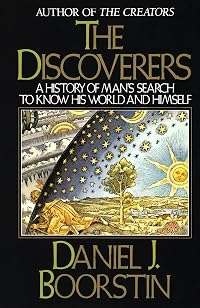
The Discoverers: A History of Man's Search to Know His World and Himself
by Daniel Boorstin
Boorstin's Histories (1)
On This Page
Description
In this wide-ranging, panoramic examination, former Librarian of Congress and esteemed historian Daniel J. Boorstin traces man's insatiable need to know. Boorstin also considers the obstacles to discovery and the illusion that knowledge can also put in our way - covering time, the earth, the seas, nature, and society. In this engaging, witty, and thought - provoking overview, Boorstin gathers and analyzes stories of man's profound quest to understand his world and the cosmos.Tags
Recommendations





















Member Recommendations
John_Vaughan Daniel Boorstin is an eminently readable author and historian; his trilogies construct a solid understanding of the subject he writes about.
20
Member Reviews
At 684 densely printed pages, plus a further sixty for the author's notes and index, this is neither a light nor an easy read - but very well worthwhile. It was not till I'd finished that I read on to discover, inside the back cover, that Boorstin had been Librarian of Congress the last time I was able to visit that wondeful place, back in the 1980s. Plans to visit this Spring have been dashed by some pandemic - next year perhaps (2022).
Although the general thrust of 'discovery' (the long evolution of man's understanding of our world and ourselves) may be well known to most prospective readers, don't let this put you off - I defy anyone to read almost and chapter without discovering some new personality or some new insight.
And don't be show more so foolish as to assume that, published in 1983, the book is dated, Yes, of course, we've continued to learn many things about distant black holes, the inner space of atoms and the inner space of our own minds, but this book is about the journey - a journey that will never end. show less
Although the general thrust of 'discovery' (the long evolution of man's understanding of our world and ourselves) may be well known to most prospective readers, don't let this put you off - I defy anyone to read almost and chapter without discovering some new personality or some new insight.
And don't be show more so foolish as to assume that, published in 1983, the book is dated, Yes, of course, we've continued to learn many things about distant black holes, the inner space of atoms and the inner space of our own minds, but this book is about the journey - a journey that will never end. show less
The Discoverers is a genial, readable, welcome overview of some of the major scientific discoveries in human history, linked together by theme, and a good candidate for "best book that should have been one of my textbooks in high school but inexplicably wasn't". Boorstin is apparently a generally strong historian, having written several other acclaimed works like the 1974 History Pulitzer winner The Americans, and if that one was anything like this it should be a great read. The Discoverers takes a strongly narrative approach to its scope of inquiry, which endeared it to me. It's divided into four main sections: Time, which discusses the inventions of the calendar and clock; The Earth and Seas, which recounts the refinement of mapping, show more geography, and exploration; Nature, which covers astronomy, medicine, and physics; and Society, which wraps up the modern era as an age where people have studied themselves and their works in unprecedented detail. These general topics are related to the reader through the stories of the explorers and scientists who uncovered new lands and new knowledge, and Boorstin's smooth writing style and talent for both panoramic surveys and detailed explanations should make the content stick in the mind a bit better than the somewhat disjointed style of most textbooks.
I like the way that he treats the "story of progress" as the stories of people, both because he's a great humanist, sensitive to the struggles of people to shrug off constraints of ignorance and see a little farther, and also because that way he's better able to impart just how difficult those struggles were. The overall lesson is that progress is very difficult: people's prejudices - be they the spontaneous generation, geocentrism, the threefold world map - are almost always seemingly reasonable and justifiable by simple inspection, and it takes a lot of deep thinking and hard work to advance the frontiers of knowledge. Boorstin is able to incite both sympathy for the inhabitants of the old worlds and admiration for the pioneers of the new worlds, while returning again and again to a sentiment we would all do well to remember: "I have observed that the world has suffered far less from ignorance than from pretensions to knowledge. It is not skeptics or explorers but fanatics and ideologues who menace decency and progress. No agnostic ever burned anyone at the stake or tortured a pagan, a heretic, or an unbeliever." Well said. Here's hoping that more people read this book, both to celebrate the great scientists and adventurers of the past, and keep in mind that spirit of discovery. show less
I like the way that he treats the "story of progress" as the stories of people, both because he's a great humanist, sensitive to the struggles of people to shrug off constraints of ignorance and see a little farther, and also because that way he's better able to impart just how difficult those struggles were. The overall lesson is that progress is very difficult: people's prejudices - be they the spontaneous generation, geocentrism, the threefold world map - are almost always seemingly reasonable and justifiable by simple inspection, and it takes a lot of deep thinking and hard work to advance the frontiers of knowledge. Boorstin is able to incite both sympathy for the inhabitants of the old worlds and admiration for the pioneers of the new worlds, while returning again and again to a sentiment we would all do well to remember: "I have observed that the world has suffered far less from ignorance than from pretensions to knowledge. It is not skeptics or explorers but fanatics and ideologues who menace decency and progress. No agnostic ever burned anyone at the stake or tortured a pagan, a heretic, or an unbeliever." Well said. Here's hoping that more people read this book, both to celebrate the great scientists and adventurers of the past, and keep in mind that spirit of discovery. show less
Today in our interconnected global community we take for granted how much we know about the world around us, but not so long ago every aspect of our modern world would have been considered fantasy but through individuals who expanded the knowledge of their time our world was made. The Discoverers by Daniel Boorstin is a historic tale of individuals that pushed the boundaries of human discoveries in the physical realm and more theoretical ones.
Boorstin begins his book with how the calendar came about and finished with how the atom went from concept to fact and in between he covered how time got measured, how the earth was measured then fully mapped out, how plants and animals were classified, and finally how everything about man from the show more inside out and his creation of science shaped himself and the world. In almost 700 pages Boorstin explores how individuals—all men to be honest—built on the work of others even if it meant they undercut that had come before to revealing something new and unknown, even if it went up against “the establishment” whether that meant the academic consensus or the all-powerful Church, with each segment focusing on a different avenue for discoveries near seamlessly transitioning from one to another. Boorstin’s focus is on the West, he does give China a spotlight early one though to show a cultural contrast, and one needs to come into the book with full knowledge that it will be European-focused.
The Discoverers is the first of a trilogy series by Daniel Boorstin on “Knowledge”, a hefty book that covers a wide range of human adventures into their world. show less
Boorstin begins his book with how the calendar came about and finished with how the atom went from concept to fact and in between he covered how time got measured, how the earth was measured then fully mapped out, how plants and animals were classified, and finally how everything about man from the show more inside out and his creation of science shaped himself and the world. In almost 700 pages Boorstin explores how individuals—all men to be honest—built on the work of others even if it meant they undercut that had come before to revealing something new and unknown, even if it went up against “the establishment” whether that meant the academic consensus or the all-powerful Church, with each segment focusing on a different avenue for discoveries near seamlessly transitioning from one to another. Boorstin’s focus is on the West, he does give China a spotlight early one though to show a cultural contrast, and one needs to come into the book with full knowledge that it will be European-focused.
The Discoverers is the first of a trilogy series by Daniel Boorstin on “Knowledge”, a hefty book that covers a wide range of human adventures into their world. show less
For years this was one of those books in my collection that I would read a chapter that I was interested in then put down. Finally, I decided I was going to read everything that I hadn't read already. I did that as well as rereading quite a few chapters that I had already covered a few years ago. What a wonderful work of art this very lengthy book is! So many literary portraits of so many fascinating characters. I wish this would have been required reading when I took a history of science class in college (or at least parts of it). With the right guide, I would have come out better educated and perhaps chose a more interesting research project. The Discovers turns out to be an extremely engaging tour of the history of science in western show more civilization by the late erudite Daniel Boorstin. More accurately, it is a history of those who shaped our understanding of the world as we know and live it today. For instance, Columbus was not a scientist as we think of a scientist but his voyages cannot be separated from the development of the sciences of cartography, navigation and geography. While a popular history, The Discovers always draws the reader deeper in individual subjects rather than leading to a smug superficial knowledge. If I could provide one humble criticism it is that Boorstin, for all his reputation, is philosophically shallow. Such a lengthy treatise should ask some deeper questions about what we've lost in the pursuit of science. Everywhere, philosophical progress and theological collapse are assumed to be inseparable from the Western trajectory of scientific knowledge and advance. Nonetheless, the Discoverers is better than an encyclopedia because Boorstin is a master of narrative. Yet, it is also, I believe, purposefully non-encyclopedic in its breadth. It ends with Faraday and Maxwell and only alludes to the 20th c. atomic scientists and says nothing about the moon landing. Is the anticlimactic ending to the book the point? There is no climax to the pursuit of knowledge. show less
Dry reading, but TONS of information -- the history of science and scientific thought and even the history of the social sciences, including the history of history. Fascinating between the drier portions.
A magisterial history of how we have inched forwards in our understanding of ourselves and the world we live in. This is a big book, over 700 pages, but it is so beautifully written that it was a delight to pick it up each time, and I could and will read it through again. It encompasses science of course, but also many other aspects of culture and our world view. This truly is a book in a million.
Boorstin opens up history from a Discoverers point of view in a way that James Burke in his "connections" never seems to pull off. While the latter's "connections" are tenuous at best, Boorstine's are solid: they lead to something tangible.
I loved it.
I loved it.
Members
- Recently Added By
Lists

Books to Read in 2015
13 works; 1 member

Big History
72 works; 1 member

al.vick-parents books
301 works; 1 member

Mind Expanding Books by hackerkid
581 works; 8 members

My List
302 works; 1 member

Books Read in 2025
4,091 works; 97 members
Author Information

89+ Works 16,381 Members
A prolific writer, Daniel Boorstin is the author of numerous scholarly and popular works in American Studies. Born in Georgia and raised in Oklahoma, Boorstin received degrees from Harvard and Yale universities and was a Rhodes Scholar at Balliol College, Oxford. A member of the Massachusetts Bar, he has been visiting professor of American History show more at the Universities of Rome, Puerto Rico, Kyoto, and Geneva. He was the first incumbent of the chair of American History at the Sorbonne and Pitt Professor of American History and Institutions at Cambridge. He taught at the University of Chicago for 25 years. In 1959 Columbia University awarded him its Bancroft Prize for The Americans: The Colonial Experience (1958), the first volume of his trilogy titled The Americans. In 1966 he received the Francis Parkman Award for the second volume, The Americans: The National Experience (1965), and in 1974 he received the Pulitzer Prize for the third volume, The Americans: The Democratic Experience (1973). Many of Boorstin's books have been translated into Chinese, Japanese, and various European languages. In 1969 Boorstin became director of the National Museum of History and Technology of the Smithsonian Institution. In 1973 he became senior historian at the Smithsonian. Boorstin was appointed Librarian of Congress in 1975 and served in that position with distinction for 12 years, becoming Librarian Emeritus in 1987. (Publisher Provided) show less
Some Editions
Awards and Honors
Distinctions
Series

Belongs to Publisher Series
Biblioteca de divulgación científica (RBA) (55-60-63-65)
Work Relationships
Common Knowledge
- Canonical title
- The Discoverers: A History of Man's Search to Know His World and Himself
- Original title
- The Discoverers. A History of Man's Search to Know His World and Himself
- Original publication date
- 1983
- People/Characters
- Marco Polo; Ptolemy; Prester John
- Epigraph
- And take upon 's the mystery of things,
As if we were God's spies.
Shakespeare, King Lear, v. 3
(Title page)
Nay, the same Soloman the king, although he excelled in the glory of treasure and magnificent buildings, of shipping and navigation, of service and attendance, of fame and renown, and the like, yet he maketh no claim to any o... (show all)f these glories, but only to the glory of inquisition of truth; for so he saith expressly, "The glory of God is to conceal a thing, but the glory of the king is to find it out"; as if, according to the innocent play of children, the Divine Majesty took delight to hide his works, to the end to have them found out; and as if kings could not obtain a greater honor than to be God's play-fellows in that game.
Francis Bacon, The Advancement of Learning (1605)
Time is the greatest innovator.
Francis Bacon, "Of Innovations" (1625)
(Book One)
God did not create the planets and stars with the intention that they should dominate man, but that they, like other creatures, should obey and serve him. Paracelsus, Concerning the Nature of Things (c. 1541) (Book One, Par... (show all)t One) - Dedication
- For Ruth
- First words
- From far-northwest Greenland to the southernmost tip of Patagonia, people hail the new moon—a time for singing and praying, eating and drinking.
- Last words
- (Click to show. Warning: May contain spoilers.)Time and space came together in a single tantalizing riddle, which led Einstein to conclude that "the eternal mystery of the world is its comprehensibility."
- Canonical DDC/MDS
- 909
- Canonical LCC
- CB69
Classifications
Statistics
- Members
- 4,759
- Popularity
- 2,997
- Reviews
- 46
- Rating
- (4.06)
- Languages
- 11 — Chinese, Danish, Dutch, English, French, German, Japanese, Polish, Portuguese, Spanish, Turkish
- Media
- Paper, Audiobook, Ebook
- ISBNs
- 33
- ASINs
- 31