On This Page
Description
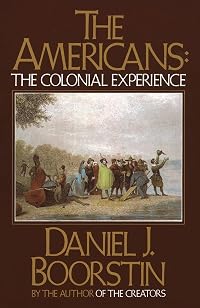
Governor William Bradford, an eyewitness, reported the landing of the Mayflower passengers on the American shore in mid-November 1620. Never had a Promised Land looked more unpromising. But within a century and a half -- even before the American Revolution -- this forbidding scene had become one of the more "civill" parts of the world. The large outlines of a new civilization had been drawn. How did it happen?Tags
Recommendations











Member Recommendations
John_Vaughan Daniel Boorstin is an eminently readable author and historian; his trilogy The Americans offers a full outline of Colonial America.
Member Reviews
This is a remarkable book about colonial life in America, presented in a fashion quite unlike most history books provide. Boorstin looks at various aspects of life - religion, literacy and literature, the press, the military - and examines them in turn, and paints a picture of life in the colonies as reflected in the activities of the colonists. It is an excellent way into the beginnings of American history, from a fresh and innovative perspective.
From the individual founding of each colony and their unique cultures to the developments the spanned up and down the continent, this is how America started. The Americans: The Colonial Experience is the first volume of Daniel J. Boorstin’s trilogy which features the American experience from the various English arrivals on the Eastern Seaboard to the verge of Revolution.
Over the course of 372 pages, Boorstin covers the colonial period of the “American experience” beginning by covering the founding and political development of four of the 13 colonies then ending with how the colonies viewed war especially in comparison with the British view of war. The chapters focused on the Quaker governance of Pennsylvania and the saga of show more Georgia’s early history were very enlightening. Another fascinating aspect that Boorstin brought out was how Puritanism, Quakerism, and Anglicanism (Episcopalism) developed differently in American and Britain with how those differences effected the course of American history in both political and cultural terms. The decentralization of British America with 13 colonial capitals and not one central cultural location diversified education, those in profession occupations needing to be jacks-of-all-trades, and the profusion of various centers of printing were also touched upon not only in shaping the beginnings of America but in how in contrast they were to Britain. Finally, Boorstin’s four chapters on the colonial view of war and how the localization of soldiery made them unprofessional and disunited—much to British annoyance during the Seven Years War—that would continue into the modern day thus preventing the creation of a military caste. Overall, this is a quality written history of the colonial period that seems both “conservative” and “revisionist” at the same time when comparing it to the mythologized and popular version general readers might think of when opening this book.
The Americans: The Colonial Experience is Daniel J. Boorstin’s well-researched and well-written volume on how America was shaped by the same things as Britain during the colonial period but turned out completely different. show less
Over the course of 372 pages, Boorstin covers the colonial period of the “American experience” beginning by covering the founding and political development of four of the 13 colonies then ending with how the colonies viewed war especially in comparison with the British view of war. The chapters focused on the Quaker governance of Pennsylvania and the saga of show more Georgia’s early history were very enlightening. Another fascinating aspect that Boorstin brought out was how Puritanism, Quakerism, and Anglicanism (Episcopalism) developed differently in American and Britain with how those differences effected the course of American history in both political and cultural terms. The decentralization of British America with 13 colonial capitals and not one central cultural location diversified education, those in profession occupations needing to be jacks-of-all-trades, and the profusion of various centers of printing were also touched upon not only in shaping the beginnings of America but in how in contrast they were to Britain. Finally, Boorstin’s four chapters on the colonial view of war and how the localization of soldiery made them unprofessional and disunited—much to British annoyance during the Seven Years War—that would continue into the modern day thus preventing the creation of a military caste. Overall, this is a quality written history of the colonial period that seems both “conservative” and “revisionist” at the same time when comparing it to the mythologized and popular version general readers might think of when opening this book.
The Americans: The Colonial Experience is Daniel J. Boorstin’s well-researched and well-written volume on how America was shaped by the same things as Britain during the colonial period but turned out completely different. show less
Daniel Boorstin gave us a great history book when he wrote 'The Americans'. In it he tells of the major initial settlements in the American colonies, 'the Puritans of Massachusetts Bay', 'the Quakers of Pennsylvania', 'the Settlers of Georgia', and 'the Virginians'. He explains how their values varied from one another which influenced how their lives differed as much as did the climate and geography in which they lived. He tells of the first institutions of learning, as well as about the printed word in the colonies (books, newspapers, and pamphlets). Boorstin also explains how the colonists often had to be well rounded because they had to be able to do so much for themselves. For instance, there was a lack of lawyers and law books in show more the early colonies, so men had to learn law on their own if they wanted to succeed. I found it interesting that Thomas Jefferson wanted to ensure that his daughter got a well rounded education, which was uncommon for the era. He felt that the time called for his daughter to be educated not just in the arts and literature, but also in science because she would need the skills to be able to run a family, household, and estate. Boorstin also gives great insight into the world of medicine and science during the colonial era, as well as various viewpoints on warfare. show less
Summary: Governor William Bradford, an eyewitness, reported the landing of the Mayflower passengers on the American shore in mid-November 1620. Never had a Promised Land looked more unpromising. But within a century and a half -- even before the American Revolution -- this forbidding scene had become one of the more "civill" parts of the world. The large outlines of a new civilization had been drawn. How did it happen?
LT The Americans: the Colonial Experience, Daniel Boorstin, Vintage Books, 1958, 4/28-5/3/21 read in Phoenix; recommended by [if anybody], Where is hard copy? BCSA in history section
Theme: the founding history of American, tracing four threads (seeds) from which came today’s country (Pilgrims in New England/MA, Quakers in PA, English estates in VA, planned in GA); like Warmth of Other Sons (as to black roots)
Type: history with commentary
Value: 1-
Age: college
Interest: 1-
Objectionable:
Synopsis/Noteworthy: like Warmth of Other Suns in showing where today’s country came from
CBC
5 Practical Yet what really distinguished them [the Puritans] in their day was that they were less interested in theology itself, than in the application of show more theology to everyday life, and especially to society.
7 Potential (practical) In the eyes of Puritans this was the peculiar opportunity of New England. Why not for once see what true orthodoxy could accomplish? … Here at last men could devote their full energy to applying Christianity—not to clarifying doctrine but to building doctrine [these are concurrent!].
12 Practical The history of the New England pulpit is thus an unbroken chronicle of the attempt of leaders in the New World to bring their community steadily closer to the Christian model.
13 Sermons There were two sermons on the Sabbath, and usually a lecture sermon on Thursday. Attendance was required by law; absence was punishable by fine… Most distinctive, perhaps, were election-day sermons, by which the clergy affected the course of political events and which remained a New England institution through the American Revolution.
18 Congregations A church was formed, then, not by administrative fiat nor by the random gathering of professing Christians, but by the “covenanting” or agreement of a group of “saints,” that is, Christians who had a special “converting experience.” … To be a minister at all a man had to be “called” by a group of Christians; when that relation ceased, he was no longer a minister.
29 Story wiring Moreover the Bible was a narrative and not a speculative work; theirs was at most a common-law utopianism, a utopianism of analogies in situations rather than of dogmas, principles, and abstractions.
34 Quakers While the Puritans believed the Indians to be cohorts of the devil and had no patience with people who differed in the slightest from their doctrine, the Quakers were impressed by the extent to which the Indian religion resembled their own. They welcomed men of all sects.
41 Non-conformity While the dogmas of Quakerism grew more fixed and uncompromising those of Puritanism tended more and more toward compromise.
68 Insular Quakers Perhaps no sect of equal size has had so many “missionaries,” yet none has sought fewer converts. Quaker missionaries, whether from abroad or from within their own province, were for the most part, missionaries to the Quakers. Instead of urging the truth upon their unenlightened neighbors, energetic Quaker missionaries visited one Quaker Meeting after another hoping to save the Society of Friends from trifling faults
85 Georgia The flavor of American life was compounded of risk, spontaneity, independence, initiative, drift, mobility, and opportunity. Even the American ideal of equality could not be imposed from above. But the Georgia settlers suffered from the fact that they were in the hands of benefactors. While investors seek profits, benefactors pursue an abstract purpose. Investors are not unduly inquisitive about the conduct of their enterprises if they yield fair returns. But the benefactor’s dividend is in doing good in his own special way. The Trustees of Georgia were no exception.
119 Founders not orators These men were talking to each other; none of them was much impressed by the flowery phrase. With the conspicuous exception of a few like Patrick Henry, Virginia’s representatives talked in sober and conversational style; there was seldom an age of representative government when the power to orate was less important.
122 Founders not bookish How irrelevant to look to the bookish prospectuses of English or French political theorists—of Locke, Montesquieu, or Rosseau—to explain Virginia’s political enthusiasms! Americans who knew the reality did not need the dream/
187 Men are blockheads Jefferson’s own plan of reading for his daughter Patsy, he explained in 1783, needed to be “considerably different from what I think would be most proper for her sex in any other country than America. I m obliged in it to extend my views beyond herself, and consider her as possibly the head of a little family of her own. The chance that in marriage he will draw a blockhead I calculate at about fourteen to one, and of course that the education of her family will probably rest on her own ideas and direction without assistance.”
194 Calling The ancient, familiar, and respectable idea of a “calling” had been displaced by the great idea of opportunity.
211/214/217/226 Medicine (211) …implied that there was a necessary providential coincidence between the place where a disease occurred and the place where its remedy would be found. (214) The ministers in early Massachusetts, who were probably most familiar with the diseases of their community, were inclined to prescribe such wholesome and harmless treatments as rest, fresh air, and message. (217) Much of the burden of doctoring fell upon the planter’s wife, who might be called out of bed at any hour of the night to deliver a baby or to care for the violently ill in the slave-quarters. (2260 In establishing inoculation as an American institution, a strong, if crude, empirical strain, a carelessness of theory, and in insistence on results were decisive.
254-6 Structure of paradigm [Franklin’s] amateur and non-academic frame of mind was his greatest advantage; like many another discovering American, he saw more because he knew much less of what he was supposed to see. (255) On receiving Franklin’s request for books on electricity in 1759, he urged him to “go on making experiments entirely on your own initiative and thereby pursue a path entirely different from that of the Europeans, for then you shall certainly find many other things which have been hidden to natural philosophers throughout the space of centuries.” Unfortunately, by this time Franklin had already become “learned” in electricity and the damage was done.
272 Classless language Our common, classless language has provided the vernacular equality in America.
285-90 Spelling-pronunciation (285) Very early, Americans began trying to discover how a word “ought” to be pronounced by seeing how it was spelled. … Our insistent spelling-pronunciation shows itself in our habit of preserving the full value of syllables. (286) Such persons do not advocate and practice precision in speech on logical grounds alone; they are also moved, plainly enough, by the fact that it tends to conceal their own cultural insecurity (H. L. Mencken). (287) These men have considerable education They not lonely learn to read, write, and keep accounts; but a vast proportion of them read newspapers every week, and besides the Bible, which is found in all families, they read the best English sermons and treatises upon religion, ethics, geography and history… (Noah Webster) (288) At the same time that Webster legislated on language, he disclaimed the purpose of a legislator. All such legislation was superfluous, he said, because the real authority in matters of language was the American people. (289) Just as in their attitude to all other laws, Americans would combine a naïve faith in legislation with a profound reverence for ancient customs and the common law. This alchemy of opposites which gave vitality to our written Federal Constitution also gave vitality to our language. (290) Here, in place of the “King’s English,” there had developed a “People’s English,” peculiarly suited to a country without a capital, where everybody was privileged to speak like an aristocrat.
298-9 Books Nothing was more “practical” in Puritan New England than religion. Their preoccupation with applied religion gave a point to religious books. But it also confined their vision… [I disagree, as theology is the largest-infinite paradigm.] (300) Some of the flavor changed after the Revolution, with the increasingly secular temper. … Still these were minor changes; the hard core of religions matter—the Apostles’ Creed, the Lord’s Prayer, and some form of the Catechism—remained well into the 19th century, when the Primer was finally engulfed by Noah Webster’s spellers and readers.
331 Freedom of press During the War, when all publications unfavorable to the Revolutionary movement were suppressed, there was no effective freedom of the press After peace came, political leaders in Massachusetts demanded, not a “free press,” but return to a “well-regulated” press.
355 Guns Anyone who did not already own arms was required to purchase the; if he could not afford the price, the money would be advanced by the town to be repaid by the citizen as possible.
362 Federalism There is, then, no paradox in the fact that the colonies were willing to “revolt” and yet were unwilling to unite; on the contrary, the two facts explain each other. The intense separatism and the determination to keep local resources to defend homes… And these were the reasons which would make American federalism difficult, necessary, and in the long run spectacularly successful.
367/369/370/372 GW-leader, National Guard
367 “Subsidiarity” Even Washington’s patience wore thin; but since local prides were not to be overcome, he learned to live with them and somehow to harness them in the common cause. “I have abored, ever since I have been in the service,” Washington wrote at the end of 1776, “to discourage all kinds of local attachments and distinctions of country [i.e., of State], denominating the whole by the greater name of American, but I have found it impossible to overcome prejudices…
K
139 Roots It is hard to bring ourselves to believe that the great Virginia fathers of the Republic were nourished in the soil of aristocracy, slavery, and an established church.
140 Traditionalism—their loyalty to the working ways of ancient England—rooted them in time; localism—their loyalty o the habits of their parish and county and to their friends and neighbors—rooted them in space.
141 Federalism It was the seed of Federalism, without which the nation could not have lived and liberal institutions could not have flourished.
143 Aristocracy The leaders of that age were the last flower of the aristocracy of mid-18th century Virginia, not the first flower of a national spirit.
150ff-fp American knowing Sometimes consciously, sometimes through force of circumstance, Americans listened to the dictates of “self-evidence.” Before long this appeal to self-evidence became a distinctive popular epistemology—a substitute for philosophy or a philosophy for non-academic thinkers.
201 Common sense “Common sense” was, of course, an old and thoroughly respectable notion in western civilization. Some Scottish thinkers in the 18th century—they were not without their influence in America and one actually had become the favorite philosopher of George III—elaborated a special “philosophy” of common sense. In America, however, the more influential appeal to self-evidence did not take any such academic for; it was a philosophy which had no philosophers. It had to be so, for it was a way of thinking pervaded by doubt that the professional thinker could think better than others.
221 Cotton Mather It is misleading to separate Mather and Franklin by the academic antithesis between “Calvinism” and “The Enlightenment.” The similarities in the interests and achievements of these two great men reveal distinctive features of American culture in the provincial age: an undiscriminating universality of interest surprisingly unconfined by a priori theories; a lack of originality; an intense practicality; an unsystematic and random approach to philosophy; and, above all, a willingness to be challenged by New World opportunities.
269 Spelling “Those people spell best who do not know how to spell.” Benjamin Franklin
312/313/315 Books (313) The colonists were able to reap the profit from several centuries of an aristocratic and leisured culture without having to accumulate for themselves the capital sum of social distinctions and intellectual and economic inequalities from which that culture had been produced.
322 Encyclopedia Britannica But not until 1790, after type-founding and paper-making were well-established to American enterprises, did the first monumental work appear from an American press: the serial publication beginning in 1790 of the American issue of the Encyclopedia Britannica which ran into 18 volumes and required seven years to print.
323 Ugliest book …the Mennonite Book of Martyrs, Der Blutige Schau-Platz (1748), which with its 756 leaves had the distinction of being the largest (reputedly also the ugliest) book published in the colonies before the Revolution.
356 Distinction, guns, army The failure to distinguish between the “military man” and every other man was simply another example of the dissolving of the monopolies and distinctions of European life.
Hugh Jones often quoted 282, 304
Seve self-evident 152
Whit blockhead 187
L 305, 321
Ethan 293-4 (litterateur)
X 7, 299 show less
Theme: the founding history of American, tracing four threads (seeds) from which came today’s country (Pilgrims in New England/MA, Quakers in PA, English estates in VA, planned in GA); like Warmth of Other Sons (as to black roots)
Type: history with commentary
Value: 1-
Age: college
Interest: 1-
Objectionable:
Synopsis/Noteworthy: like Warmth of Other Suns in showing where today’s country came from
CBC
5 Practical Yet what really distinguished them [the Puritans] in their day was that they were less interested in theology itself, than in the application of show more theology to everyday life, and especially to society.
7 Potential (practical) In the eyes of Puritans this was the peculiar opportunity of New England. Why not for once see what true orthodoxy could accomplish? … Here at last men could devote their full energy to applying Christianity—not to clarifying doctrine but to building doctrine [these are concurrent!].
12 Practical The history of the New England pulpit is thus an unbroken chronicle of the attempt of leaders in the New World to bring their community steadily closer to the Christian model.
13 Sermons There were two sermons on the Sabbath, and usually a lecture sermon on Thursday. Attendance was required by law; absence was punishable by fine… Most distinctive, perhaps, were election-day sermons, by which the clergy affected the course of political events and which remained a New England institution through the American Revolution.
18 Congregations A church was formed, then, not by administrative fiat nor by the random gathering of professing Christians, but by the “covenanting” or agreement of a group of “saints,” that is, Christians who had a special “converting experience.” … To be a minister at all a man had to be “called” by a group of Christians; when that relation ceased, he was no longer a minister.
29 Story wiring Moreover the Bible was a narrative and not a speculative work; theirs was at most a common-law utopianism, a utopianism of analogies in situations rather than of dogmas, principles, and abstractions.
34 Quakers While the Puritans believed the Indians to be cohorts of the devil and had no patience with people who differed in the slightest from their doctrine, the Quakers were impressed by the extent to which the Indian religion resembled their own. They welcomed men of all sects.
41 Non-conformity While the dogmas of Quakerism grew more fixed and uncompromising those of Puritanism tended more and more toward compromise.
68 Insular Quakers Perhaps no sect of equal size has had so many “missionaries,” yet none has sought fewer converts. Quaker missionaries, whether from abroad or from within their own province, were for the most part, missionaries to the Quakers. Instead of urging the truth upon their unenlightened neighbors, energetic Quaker missionaries visited one Quaker Meeting after another hoping to save the Society of Friends from trifling faults
85 Georgia The flavor of American life was compounded of risk, spontaneity, independence, initiative, drift, mobility, and opportunity. Even the American ideal of equality could not be imposed from above. But the Georgia settlers suffered from the fact that they were in the hands of benefactors. While investors seek profits, benefactors pursue an abstract purpose. Investors are not unduly inquisitive about the conduct of their enterprises if they yield fair returns. But the benefactor’s dividend is in doing good in his own special way. The Trustees of Georgia were no exception.
119 Founders not orators These men were talking to each other; none of them was much impressed by the flowery phrase. With the conspicuous exception of a few like Patrick Henry, Virginia’s representatives talked in sober and conversational style; there was seldom an age of representative government when the power to orate was less important.
122 Founders not bookish How irrelevant to look to the bookish prospectuses of English or French political theorists—of Locke, Montesquieu, or Rosseau—to explain Virginia’s political enthusiasms! Americans who knew the reality did not need the dream/
187 Men are blockheads Jefferson’s own plan of reading for his daughter Patsy, he explained in 1783, needed to be “considerably different from what I think would be most proper for her sex in any other country than America. I m obliged in it to extend my views beyond herself, and consider her as possibly the head of a little family of her own. The chance that in marriage he will draw a blockhead I calculate at about fourteen to one, and of course that the education of her family will probably rest on her own ideas and direction without assistance.”
194 Calling The ancient, familiar, and respectable idea of a “calling” had been displaced by the great idea of opportunity.
211/214/217/226 Medicine (211) …implied that there was a necessary providential coincidence between the place where a disease occurred and the place where its remedy would be found. (214) The ministers in early Massachusetts, who were probably most familiar with the diseases of their community, were inclined to prescribe such wholesome and harmless treatments as rest, fresh air, and message. (217) Much of the burden of doctoring fell upon the planter’s wife, who might be called out of bed at any hour of the night to deliver a baby or to care for the violently ill in the slave-quarters. (2260 In establishing inoculation as an American institution, a strong, if crude, empirical strain, a carelessness of theory, and in insistence on results were decisive.
254-6 Structure of paradigm [Franklin’s] amateur and non-academic frame of mind was his greatest advantage; like many another discovering American, he saw more because he knew much less of what he was supposed to see. (255) On receiving Franklin’s request for books on electricity in 1759, he urged him to “go on making experiments entirely on your own initiative and thereby pursue a path entirely different from that of the Europeans, for then you shall certainly find many other things which have been hidden to natural philosophers throughout the space of centuries.” Unfortunately, by this time Franklin had already become “learned” in electricity and the damage was done.
272 Classless language Our common, classless language has provided the vernacular equality in America.
285-90 Spelling-pronunciation (285) Very early, Americans began trying to discover how a word “ought” to be pronounced by seeing how it was spelled. … Our insistent spelling-pronunciation shows itself in our habit of preserving the full value of syllables. (286) Such persons do not advocate and practice precision in speech on logical grounds alone; they are also moved, plainly enough, by the fact that it tends to conceal their own cultural insecurity (H. L. Mencken). (287) These men have considerable education They not lonely learn to read, write, and keep accounts; but a vast proportion of them read newspapers every week, and besides the Bible, which is found in all families, they read the best English sermons and treatises upon religion, ethics, geography and history… (Noah Webster) (288) At the same time that Webster legislated on language, he disclaimed the purpose of a legislator. All such legislation was superfluous, he said, because the real authority in matters of language was the American people. (289) Just as in their attitude to all other laws, Americans would combine a naïve faith in legislation with a profound reverence for ancient customs and the common law. This alchemy of opposites which gave vitality to our written Federal Constitution also gave vitality to our language. (290) Here, in place of the “King’s English,” there had developed a “People’s English,” peculiarly suited to a country without a capital, where everybody was privileged to speak like an aristocrat.
298-9 Books Nothing was more “practical” in Puritan New England than religion. Their preoccupation with applied religion gave a point to religious books. But it also confined their vision… [I disagree, as theology is the largest-infinite paradigm.] (300) Some of the flavor changed after the Revolution, with the increasingly secular temper. … Still these were minor changes; the hard core of religions matter—the Apostles’ Creed, the Lord’s Prayer, and some form of the Catechism—remained well into the 19th century, when the Primer was finally engulfed by Noah Webster’s spellers and readers.
331 Freedom of press During the War, when all publications unfavorable to the Revolutionary movement were suppressed, there was no effective freedom of the press After peace came, political leaders in Massachusetts demanded, not a “free press,” but return to a “well-regulated” press.
355 Guns Anyone who did not already own arms was required to purchase the; if he could not afford the price, the money would be advanced by the town to be repaid by the citizen as possible.
362 Federalism There is, then, no paradox in the fact that the colonies were willing to “revolt” and yet were unwilling to unite; on the contrary, the two facts explain each other. The intense separatism and the determination to keep local resources to defend homes… And these were the reasons which would make American federalism difficult, necessary, and in the long run spectacularly successful.
367/369/370/372 GW-leader, National Guard
367 “Subsidiarity” Even Washington’s patience wore thin; but since local prides were not to be overcome, he learned to live with them and somehow to harness them in the common cause. “I have abored, ever since I have been in the service,” Washington wrote at the end of 1776, “to discourage all kinds of local attachments and distinctions of country [i.e., of State], denominating the whole by the greater name of American, but I have found it impossible to overcome prejudices…
K
139 Roots It is hard to bring ourselves to believe that the great Virginia fathers of the Republic were nourished in the soil of aristocracy, slavery, and an established church.
140 Traditionalism—their loyalty to the working ways of ancient England—rooted them in time; localism—their loyalty o the habits of their parish and county and to their friends and neighbors—rooted them in space.
141 Federalism It was the seed of Federalism, without which the nation could not have lived and liberal institutions could not have flourished.
143 Aristocracy The leaders of that age were the last flower of the aristocracy of mid-18th century Virginia, not the first flower of a national spirit.
150ff-fp American knowing Sometimes consciously, sometimes through force of circumstance, Americans listened to the dictates of “self-evidence.” Before long this appeal to self-evidence became a distinctive popular epistemology—a substitute for philosophy or a philosophy for non-academic thinkers.
201 Common sense “Common sense” was, of course, an old and thoroughly respectable notion in western civilization. Some Scottish thinkers in the 18th century—they were not without their influence in America and one actually had become the favorite philosopher of George III—elaborated a special “philosophy” of common sense. In America, however, the more influential appeal to self-evidence did not take any such academic for; it was a philosophy which had no philosophers. It had to be so, for it was a way of thinking pervaded by doubt that the professional thinker could think better than others.
221 Cotton Mather It is misleading to separate Mather and Franklin by the academic antithesis between “Calvinism” and “The Enlightenment.” The similarities in the interests and achievements of these two great men reveal distinctive features of American culture in the provincial age: an undiscriminating universality of interest surprisingly unconfined by a priori theories; a lack of originality; an intense practicality; an unsystematic and random approach to philosophy; and, above all, a willingness to be challenged by New World opportunities.
269 Spelling “Those people spell best who do not know how to spell.” Benjamin Franklin
312/313/315 Books (313) The colonists were able to reap the profit from several centuries of an aristocratic and leisured culture without having to accumulate for themselves the capital sum of social distinctions and intellectual and economic inequalities from which that culture had been produced.
322 Encyclopedia Britannica But not until 1790, after type-founding and paper-making were well-established to American enterprises, did the first monumental work appear from an American press: the serial publication beginning in 1790 of the American issue of the Encyclopedia Britannica which ran into 18 volumes and required seven years to print.
323 Ugliest book …the Mennonite Book of Martyrs, Der Blutige Schau-Platz (1748), which with its 756 leaves had the distinction of being the largest (reputedly also the ugliest) book published in the colonies before the Revolution.
356 Distinction, guns, army The failure to distinguish between the “military man” and every other man was simply another example of the dissolving of the monopolies and distinctions of European life.
Hugh Jones often quoted 282, 304
Seve self-evident 152
Whit blockhead 187
L 305, 321
Ethan 293-4 (litterateur)
X 7, 299 show less
香港大學歷史系
Ratings
Members
- Recently Added By
Lists

Books Read in 2025
4,091 works; 97 members
Author Information

89+ Works 16,386 Members
A prolific writer, Daniel Boorstin is the author of numerous scholarly and popular works in American Studies. Born in Georgia and raised in Oklahoma, Boorstin received degrees from Harvard and Yale universities and was a Rhodes Scholar at Balliol College, Oxford. A member of the Massachusetts Bar, he has been visiting professor of American History show more at the Universities of Rome, Puerto Rico, Kyoto, and Geneva. He was the first incumbent of the chair of American History at the Sorbonne and Pitt Professor of American History and Institutions at Cambridge. He taught at the University of Chicago for 25 years. In 1959 Columbia University awarded him its Bancroft Prize for The Americans: The Colonial Experience (1958), the first volume of his trilogy titled The Americans. In 1966 he received the Francis Parkman Award for the second volume, The Americans: The National Experience (1965), and in 1974 he received the Pulitzer Prize for the third volume, The Americans: The Democratic Experience (1973). Many of Boorstin's books have been translated into Chinese, Japanese, and various European languages. In 1969 Boorstin became director of the National Museum of History and Technology of the Smithsonian Institution. In 1973 he became senior historian at the Smithsonian. Boorstin was appointed Librarian of Congress in 1975 and served in that position with distinction for 12 years, becoming Librarian Emeritus in 1987. (Publisher Provided) show less
Awards and Honors
Awards
Distinctions
Series

Belongs to Publisher Series
Vintage Books (V-513)
Work Relationships
Is contained in
Common Knowledge
- Original publication date
- 1958
- Epigraph
- "It may be said, That in a Sort,/ They began the World a New." - Jared Eliot
- Dedication
- For Ruth
Classifications
Statistics
- Members
- 1,186
- Popularity
- 21,065
- Reviews
- 6
- Rating
- (3.88)
- Languages
- English, Hungarian, Portuguese
- Media
- Paper, Ebook
- ISBNs
- 16
- ASINs
- 13