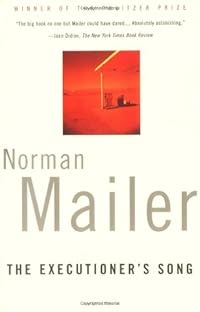
The Executioner's Song
by Norman Mailer 
On This Page
Description
In what is arguably his greatest book--written in 1979 and reissued here in trade paperback--America's most heroically ambitious writer follows the short, blighted career of Gary Gilmore, an intractably violent product of America's prisons who---after robbing two men and killing them in cold blood--insisted on dying for his crime.Tags
Recommendations

























Member Recommendations
Member Reviews
It grew into a calm rage. And I opened the gate and let it out'
By sally tarbox on 29 Oct. 2013
Format: Kindle Edition
A huge (1000+ page) work on the final months in the life of Gary Gilmore, this opens with his release from many years in prison to stay with relatives in Utah. All too soon their well-meaning efforts to rehabilitate him seem doomed to failure, especially as he takes up with the damaged Nicole... I found the first part of the book utterly compelling - his home life, and ultimately the two terrible and pointless murders that he carries out.
The second half, for me, was way too long. The characters who take centre stage now are largely lawyers and newspaper reporters, for whom Gilmore's death penalty represents a chance to get show more rich:
'We're embarrassed to tell you this, but the contract is only effective if the execution is carried out.'
The whole media circus; the appeals as various lawyers and human rights groups fight for Gilmore's life (against his will as he demands to die rather than spend his life in jail) seemed to go on excessively.
Although we get to know most of the characters- including, briefly, an account of the lives of the victims - Gary - despite his letters and the pages of conversation transcribed - really remains an enigma. Intelligent, besotted, a believer in karma...yet a double killer. Was it the prolixin - a drug forcibly administered on his previous time in jail? Was there something in his childhood?
The end is deeply sad, exacerbated by the last minute efforts to get a stay of execution, and Gilmore's uncertainty till the very end as to whether he would die.
This is a tour de force based on interviews with over a hundred people: Mailer observes that the collected transcripts would approach fifteen thousand pages. show less
By sally tarbox on 29 Oct. 2013
Format: Kindle Edition
A huge (1000+ page) work on the final months in the life of Gary Gilmore, this opens with his release from many years in prison to stay with relatives in Utah. All too soon their well-meaning efforts to rehabilitate him seem doomed to failure, especially as he takes up with the damaged Nicole... I found the first part of the book utterly compelling - his home life, and ultimately the two terrible and pointless murders that he carries out.
The second half, for me, was way too long. The characters who take centre stage now are largely lawyers and newspaper reporters, for whom Gilmore's death penalty represents a chance to get show more rich:
'We're embarrassed to tell you this, but the contract is only effective if the execution is carried out.'
The whole media circus; the appeals as various lawyers and human rights groups fight for Gilmore's life (against his will as he demands to die rather than spend his life in jail) seemed to go on excessively.
Although we get to know most of the characters- including, briefly, an account of the lives of the victims - Gary - despite his letters and the pages of conversation transcribed - really remains an enigma. Intelligent, besotted, a believer in karma...yet a double killer. Was it the prolixin - a drug forcibly administered on his previous time in jail? Was there something in his childhood?
The end is deeply sad, exacerbated by the last minute efforts to get a stay of execution, and Gilmore's uncertainty till the very end as to whether he would die.
This is a tour de force based on interviews with over a hundred people: Mailer observes that the collected transcripts would approach fifteen thousand pages. show less
I wish I'd liked this more. While Mailer does a remarkable job of capturing Gary and Nicole and the entire milieu of the execution, I did find the exhaustive detail and the dizzying cast of characters just too much. I enjoyed the middle portion of the book, after Gary committed the murders and was jailed, far more than the beginning and then the end. In the beginning I found it hard to comprehend Gary's behavior and care about his relationships with others, towards the end I just wanted the story to be over. I do think Gary and Nicole will stick with me, because I've spent so much time with them and because Mailer so successfully brought the characters off of the page. But I can't say I'm sorry to be finished with this book.
What a reading event. Massive, and fast-moving. It consumed my time during this grey mid-winter. Dave Egger's forward (which I encourage you to read afterwards) captures the breadth and Mailer's work better than I ever could. I'm not sure I've ever read a journalistic "event" before this that rode the midline so well and so consistently, offering an observation or emotion one moment and then counterbalancing it - withdrawing it, the next. I guess, in that way, a metaphor for the American human condition. A balance of astronauts and mass-murderers, as Eggers suggests. During the middle part of the book I was trying to adhere to my new approach of being a tougher Goodreads "grader," assuming this would come in at 4 stars, but once done I show more really had to think about what kind(s) of works can surpass an effort like this, and so, ended up giving it 5. That may change....need to let this sit for a bit. show less
I have heard it said that Norman Mailer is inconsistent within novels, whereas ordinary writers are inconsistent novel to novel. I have always found this true when reading his books. He was a prolific all-American novelist, who repeatedly tried to write The Great American novel, and experimented with form and content. His first so-called great work was The Naked and the Dead, still infamous, which I found by turns inspired and unconscionable. Good luck trying to fix Mailer's moral standpoint in either of these novels. Like that first 700-pager, The Executioner's Song is even more ambitious but recounts the vicissitudes of Gary Gilmore, of all people.
I'll be honest. I thought this was one of the greatest books I'd ever read for around show more 250 pages. Over time I awoke to the realization that it was a flawed masterpiece, and finally, after hundreds of pages more, I lost nearly all my enthusiasm for it, not to mention that the word 'masterpiece' had begun to feel like a wildly inappropriate appellation. The length is exhaustive, and the details verge on minutiae. You might rate him five stars simply for how much research and legwork he did. But you should still take the book with a grain of salt, since it is technically fiction. By labeling it so, Mailer could have taken any number of liberties with the facts. He was famous for erecting these Mount Rushmore-like tomes out of endlessly compiled research. Must have been a real treat for him recreating Truman Capote's method - see In Cold Blood.
There are moving moments, but on the whole it is spread too thin to be moving. It has brilliant moments, but they are sprinkled throughout mundanity and wacko segments of unexplainably detailed sex and heavy-handed commentary.
Gary Gilmore, as expected, is a difficult fellow to sympathize with by the end, though you might have admired him for gumption and charisma, until you really get to know him. Mailer writes about him as he would a close friend, but Mailer's own lack of squeamishness really turns me off. The same thing happened when I read Ancient Evenings, which might be my favorite novel of his so far, where you can tell after a while he is padding the narrative with the kinds of scenes he really likes to write. Read enough of it, and you get an icky feeling in the pit of your stomach. You picked the book up for the sake of intellectual investigation, for history, but the history is not the focus of half of the writing.
Executioner's Song, on the other hand, is a brilliant character study in its own right, even if the focus and writing is uneven. Are some people incurable? Is America's justice system moral? What justifications can be given for the 'insanity defense?' These are just some of the questions posited by the book's subtext. Regardless of its mind-numbing length and pompous pretenses, it is an important testament by an overblown, but talented American writer. show less
I'll be honest. I thought this was one of the greatest books I'd ever read for around show more 250 pages. Over time I awoke to the realization that it was a flawed masterpiece, and finally, after hundreds of pages more, I lost nearly all my enthusiasm for it, not to mention that the word 'masterpiece' had begun to feel like a wildly inappropriate appellation. The length is exhaustive, and the details verge on minutiae. You might rate him five stars simply for how much research and legwork he did. But you should still take the book with a grain of salt, since it is technically fiction. By labeling it so, Mailer could have taken any number of liberties with the facts. He was famous for erecting these Mount Rushmore-like tomes out of endlessly compiled research. Must have been a real treat for him recreating Truman Capote's method - see In Cold Blood.
There are moving moments, but on the whole it is spread too thin to be moving. It has brilliant moments, but they are sprinkled throughout mundanity and wacko segments of unexplainably detailed sex and heavy-handed commentary.
Gary Gilmore, as expected, is a difficult fellow to sympathize with by the end, though you might have admired him for gumption and charisma, until you really get to know him. Mailer writes about him as he would a close friend, but Mailer's own lack of squeamishness really turns me off. The same thing happened when I read Ancient Evenings, which might be my favorite novel of his so far, where you can tell after a while he is padding the narrative with the kinds of scenes he really likes to write. Read enough of it, and you get an icky feeling in the pit of your stomach. You picked the book up for the sake of intellectual investigation, for history, but the history is not the focus of half of the writing.
Executioner's Song, on the other hand, is a brilliant character study in its own right, even if the focus and writing is uneven. Are some people incurable? Is America's justice system moral? What justifications can be given for the 'insanity defense?' These are just some of the questions posited by the book's subtext. Regardless of its mind-numbing length and pompous pretenses, it is an important testament by an overblown, but talented American writer. show less
I'm sure this masterpiece will stay with me for a very long time. It's the only work that I know of that can seriously challenge In Cold Blood for the claim of greatest true crime literature of all time.
The attention to detail and the portrayal of a time and place is magnificent. Some reviewers may have been frustrated by the level of description, but I think that was largely the work's point. The fine and banal detail of a scene like a person's last night alive points out the absurdity of capital punishment and maybe also more generally all life.
I would classify this one as an absolute must-read in American Literature.
The attention to detail and the portrayal of a time and place is magnificent. Some reviewers may have been frustrated by the level of description, but I think that was largely the work's point. The fine and banal detail of a scene like a person's last night alive points out the absurdity of capital punishment and maybe also more generally all life.
I would classify this one as an absolute must-read in American Literature.
Unforgettable! The prose style of this narrative-realistic novel is unique in my experience. It is a book that I devoured and one that has stayed in the back of my mind for years as one that I should reread. I continue to wonder at the genius of Norman Mailer as exhibited in this creation. He creates the world of Gary Gilmore in a way that made this reader feel it in a visceral way. It takes great writing to do that and keep you reading for hundreds of pages. Mailer nailed it.
For the moment, let’s set aside the fact vs. fiction argument raging on either side of Norman Mailer’s "The Executioner’s Song" and face up to one simple fact: this is one FANTASTIC read! Some folks have even called it a "masterpiece." I’m not going to try and talk anyone out of the "M" word.
As we look back over this century of literature, "The Executioner’s Song" is certainly right up there on the masterpiece bookshelf. If you’re one of those who insists on arranging books according to fiction and non-fiction, then you’d better shelve Mailer’s "true-life novel" somewhere in the middle. Using a novelist’s technique of fabricated dialogue and compressed events, Mailer writes with such force and energy that it fully show more deserves its trophy-case of literary prizes, including the Pulitzer.
Mailer (who first burst onto the scene with "The Naked and the Dead" in 1948) has always rankled both critics and readers with his sprawling literature. Some readers lose patience with his wordy prose; some critics say he’s just plain bombastic. I say he’s just plain good.
[I should admit right from the get-go, "The Executioner’s Song" is the only book of his I’ve tackled. "Harlot’s Ghost" is weighing down one end of my bookcase, but I’m saving it for the day I have a long hospital stay or I’m booked for the desert-island tour.]
When you make it to the end of "The Executioner’s Song," panting and dripping sweat by page 1,024, you’ll probably have your own opinion of the man. You’ll either hate him or love him—Mailer does not allow any namby-pamby in-between. I’ve read "The Executioner’s Song" twice—the first time in 1981, two years after its publication and four years after Gary Mark Gilmore’s death by Utah firing squad; the second time was last year. The interval of nearly two decades did little to dim my enthusiasm for this book (which, by the way, I prefer to classify as "embellished journalism").
When Gilmore was arrested, tried and convicted of killing two Mormon men in Provo, Utah, on one hot July night in 1976, I was living about 500 miles away. Up in Wyoming, I followed the whole murder case on the evening news. Back then, the viciousness of Gilmore’s crime (shooting decent Americans in the head with little provocation) was big news. Our society had yet to see the likes of Jeffrey Dahmer, the Night Stalker or Columbine High School. Gilmore, with his movie-star good looks and piercing gaze, was the Monster Next Door.
Then, after his conviction, things really took a turn for the bizarre. Gilmore was given the death penalty and, rather than fighting with a series of appeals and pleas for gubernatorial pardons, Gilmore told the state that he wanted to die. Never before had someone pursued his own death sentence. The media swooped in on the state penitentiary and the rest of the world held its breath to see if Gilmore would eventually change his mind. He didn’t. And that’s partly what makes this book so fascinating—the character (if a real person can be called a "character") of Gary Mark Gilmore. He is, in fact, so complex that even a tough-guy writer like Norman Mailer has difficulty getting inside his heart and head to find out what made the Monster Next Door tick.
But Mailer gives it his best shot and the result is a big, whopping book that tracks the lives of Gilmore, his girlfriend Nicole, his Mormon relatives, his victims and the media circus that set up camp outside the state penitentiary. "The Executioner’s Song" is divided into two parts: "Western Voices" (the crimes and the trial) and "Eastern Voices" (the deathwatch and execution). Of the two, the first is much more fascinating and suspenseful—a result, probably, of our morbid fascination with all things bloody and twisted. Some of the second half is tedious, especially the long stretches with Lawrence Schiller, pseudo-journalist and self-promoter who is the only writer allowed to share Gilmore’s last moments (Mailer cut a deal with Schiller to use his notes and tape recordings for this book). Still, I was actually moved by Gilmore’s final walk toward the firing-squad chamber. By that point, he almost had my sympathy.
The book is huge in both size and scope, but Mailer always finds the right words to describe even the smallest of events. Here, for instance, is the moment the entire book has been leading to—the execution by firing squad:
"When it happened, Gary never raised a finger. Didn’t quiver at all. His left hand never moved, and then, after he was shot, his head went forward, but the strap held his head up, and then the right hand slowly rose in the air and slowly went down as if to say, ‘That did it, gentlemen.’ Schiller thought the movement was as delicate as the fingers of a pianist raising his hand before he puts it down on the keys."
I have just one word for a passage like that. Wow.
Note: For another look at what made Gilmore tick, read "Shot in the Heart," the equally fascinating (and entirely non-fiction) book by his brother Mikal. Not only does it make a good companion piece to "The Executioner’s Song," but "Shot in the Heart" is one of the best written memoirs to come out of the cathartic, tell-all years of the 1990s. Read Mailer first, though. show less
As we look back over this century of literature, "The Executioner’s Song" is certainly right up there on the masterpiece bookshelf. If you’re one of those who insists on arranging books according to fiction and non-fiction, then you’d better shelve Mailer’s "true-life novel" somewhere in the middle. Using a novelist’s technique of fabricated dialogue and compressed events, Mailer writes with such force and energy that it fully show more deserves its trophy-case of literary prizes, including the Pulitzer.
Mailer (who first burst onto the scene with "The Naked and the Dead" in 1948) has always rankled both critics and readers with his sprawling literature. Some readers lose patience with his wordy prose; some critics say he’s just plain bombastic. I say he’s just plain good.
[I should admit right from the get-go, "The Executioner’s Song" is the only book of his I’ve tackled. "Harlot’s Ghost" is weighing down one end of my bookcase, but I’m saving it for the day I have a long hospital stay or I’m booked for the desert-island tour.]
When you make it to the end of "The Executioner’s Song," panting and dripping sweat by page 1,024, you’ll probably have your own opinion of the man. You’ll either hate him or love him—Mailer does not allow any namby-pamby in-between. I’ve read "The Executioner’s Song" twice—the first time in 1981, two years after its publication and four years after Gary Mark Gilmore’s death by Utah firing squad; the second time was last year. The interval of nearly two decades did little to dim my enthusiasm for this book (which, by the way, I prefer to classify as "embellished journalism").
When Gilmore was arrested, tried and convicted of killing two Mormon men in Provo, Utah, on one hot July night in 1976, I was living about 500 miles away. Up in Wyoming, I followed the whole murder case on the evening news. Back then, the viciousness of Gilmore’s crime (shooting decent Americans in the head with little provocation) was big news. Our society had yet to see the likes of Jeffrey Dahmer, the Night Stalker or Columbine High School. Gilmore, with his movie-star good looks and piercing gaze, was the Monster Next Door.
Then, after his conviction, things really took a turn for the bizarre. Gilmore was given the death penalty and, rather than fighting with a series of appeals and pleas for gubernatorial pardons, Gilmore told the state that he wanted to die. Never before had someone pursued his own death sentence. The media swooped in on the state penitentiary and the rest of the world held its breath to see if Gilmore would eventually change his mind. He didn’t. And that’s partly what makes this book so fascinating—the character (if a real person can be called a "character") of Gary Mark Gilmore. He is, in fact, so complex that even a tough-guy writer like Norman Mailer has difficulty getting inside his heart and head to find out what made the Monster Next Door tick.
But Mailer gives it his best shot and the result is a big, whopping book that tracks the lives of Gilmore, his girlfriend Nicole, his Mormon relatives, his victims and the media circus that set up camp outside the state penitentiary. "The Executioner’s Song" is divided into two parts: "Western Voices" (the crimes and the trial) and "Eastern Voices" (the deathwatch and execution). Of the two, the first is much more fascinating and suspenseful—a result, probably, of our morbid fascination with all things bloody and twisted. Some of the second half is tedious, especially the long stretches with Lawrence Schiller, pseudo-journalist and self-promoter who is the only writer allowed to share Gilmore’s last moments (Mailer cut a deal with Schiller to use his notes and tape recordings for this book). Still, I was actually moved by Gilmore’s final walk toward the firing-squad chamber. By that point, he almost had my sympathy.
The book is huge in both size and scope, but Mailer always finds the right words to describe even the smallest of events. Here, for instance, is the moment the entire book has been leading to—the execution by firing squad:
"When it happened, Gary never raised a finger. Didn’t quiver at all. His left hand never moved, and then, after he was shot, his head went forward, but the strap held his head up, and then the right hand slowly rose in the air and slowly went down as if to say, ‘That did it, gentlemen.’ Schiller thought the movement was as delicate as the fingers of a pianist raising his hand before he puts it down on the keys."
I have just one word for a passage like that. Wow.
Note: For another look at what made Gilmore tick, read "Shot in the Heart," the equally fascinating (and entirely non-fiction) book by his brother Mikal. Not only does it make a good companion piece to "The Executioner’s Song," but "Shot in the Heart" is one of the best written memoirs to come out of the cathartic, tell-all years of the 1990s. Read Mailer first, though. show less
Members
- Recently Added By
Published Reviews
ThingScore 25
Mailer's massive study of the Gilmore case is unlikely to have the impact its author expected. All journalism dates, and this is not so much the higher as the longer journalism: 1,056 big pages and far too many facts. The value of this sedulous accumulation was presumably intended to rest on the uniqueness of Gilmore's rejection of penal liberalism, but Gilmore has ceased to be unique. Style show more will not preserve the book, since it has no style...
What we might have expected from The Executioner's Song is a Mailerian mystico-astrologico-metaphysical expatiation on the significance of Gilmore – quasi-existential victim-hero – in a culture increasingly selling out to evil, but there is no commentary as there is no style. The question must finally be asked: why bother? Granted that every human soul may be worthy of 1,056 pages, why should a cold murderer with a certain capacity for love and poetry be deemed worthier of such expensive celebration than the harmless grocer of Gissing's New Grub Street? show less
What we might have expected from The Executioner's Song is a Mailerian mystico-astrologico-metaphysical expatiation on the significance of Gilmore – quasi-existential victim-hero – in a culture increasingly selling out to evil, but there is no commentary as there is no style. The question must finally be asked: why bother? Granted that every human soul may be worthy of 1,056 pages, why should a cold murderer with a certain capacity for love and poetry be deemed worthier of such expensive celebration than the harmless grocer of Gissing's New Grub Street? show less
added by SnootyBaronet
Lists

True Crime Books
62 works; 15 members

National Book Award Finalists - Fiction
377 works; 12 members

The Complete Rory Gilmore Reading List
506 works; 5 members

True Crime
156 works; 1 member
Canon de la narrativa universal del s. XX (cicutadry)
499 works; 3 members

Mustich's 1000 Books to Read Before You Die: A Life Changing List
1,001 works; 18 members

Rory Gilmore Challenge 101-200
33 works; 1 member

Rory Gilmore Book Club
193 works; 5 members

Favorite Long Books
330 works; 42 members

Canon de la narrativa universal del siglo XX
254 works; 6 members
TML 200 Best Books 1950-1999
202 works; 10 members

Best of American Literature
146 works; 9 members
Literary Travelogue of the United States Challenge
133 works; 6 members
Pulitzer Prize Winners for Fiction
102 works; 54 members

The Guardian's 100 greatest novels of all time
100 works; 16 members

Amanda's Guaranteed Books
110 works; 5 members
Harold Bloom - The Western Canon: D. The Chaotic Age
833 works; 24 members

Non-Fiction Worth Reading
1,015 works; 255 members

Pulitzer Prize-Winning Books
42 works; 9 members

True Crime
216 works; 16 members

The American novels that should have won the Booker prize
16 works; 3 members

Swinging Seventies
255 works; 16 members

1970s
657 works; 23 members
501 Must-Read Books
508 works; 72 members

The Modern Library (The Two Hundred Best Novels....
202 works; 1 member
Author Information

158+ Works 24,714 Members
Norman Kingsley Mailer was born on January 31, 1923 in Long Branch, N. J. and then moved with his family to Brooklyn, N. Y. Mailer later attended Harvard University and graduated with a degree in aeronautical engineering. Mailer served in the Army during World War II, and later wrote, directed, and acted in motion pictures. He was also a show more co-founder of the Village Voice and edited Disssent for nine years. Mailer has written several books including: The Armies of the Night, which won the National Book Award, the Pulitzer Prize, and a Polk Award; and The Executioner's Song, which won the Pulitzer Prize. In 2005, he won the Medal for Distinguished Contribution to American Letters from the National Book Foundation. He published his last novel, The Castle in the Forest, in 2007. He died of acute renal failure on November 10, 2007. (Bowker Author Biography) show less
Norman Mailer has a Legacy Library. Legacy libraries are the personal libraries of famous readers, entered by LibraryThing members from the Legacy Libraries group.
Some Editions
Awards and Honors
Awards
Distinctions
Notable Lists
Series
Belongs to Publisher Series
Work Relationships
Contains
Has the adaptation
Common Knowledge
- Canonical title
- The Executioner's Song
- Original title
- The Executioner's Song
- Alternate titles
- Executioner's Song
- Original publication date
- 1979
- People/Characters
- Gary Gilmore; Mikal Gilmore; Lawrence Schiller
- Important places
- Utah, USA
- Related movies
- The Executioner's Song (1982 | IMDb)
- Epigraph
- Deep in my dungeon
I welcome you here
Deep in my dungeon
I worship your fear
Deep in my dungeon
I dwell.
I do not know
if I wish you well
--old prison rhyme - Dedication
- To Norris, to John Buffalo, and to Scott Meredith
- First words
- Brenda was six when she fell out of the apple tree.
- Quotations
- Other reporters would be on the phone, checking back to hear what was going down, but Schiller sat and relaxed and let the heat of the room pour over him and the fatigues of twenty-five years perspired slowly, a drop and anot... (show all)her drop from the bottomless reservoirs of fatigue, and he sat there quietly thinking, and let his sins and errors wash over him, and reviewed them. He considered it obscene not to learn from experience.
Gary had taken a small cardboard box, painted it black, and put a tiny hole in it so it looked as if it were one of those lensless pinpoint cameras. He told Skeezix he had film in the box, and it would take a picture through ... (show all)the pinhole. Everybody gathered around to watch Gary take a picture of the fellow going down on himself. Skeezix was so dumb he was still waiting for the photo to come back.
On finishing his story, Gary went off laughing so hard, Brenda thought he’d sling his spaghetti around the room. She was awful glad when he wheezed into silence and fixed her with his eye as if to say, “Now, do you see my conversational problem?” - Last words
- (Click to show. Warning: May contain spoilers.)"Let them come."
Classifications
Statistics
- Members
- 3,190
- Popularity
- 5,404
- Reviews
- 50
- Rating
- (3.99)
- Languages
- 12 — Dutch, English, Finnish, French, German, Hungarian, Italian, Polish, Portuguese, Croatian, Spanish, Swedish
- Media
- Paper, Audiobook, Ebook
- ISBNs
- 54
- UPCs
- 1
- ASINs
- 15