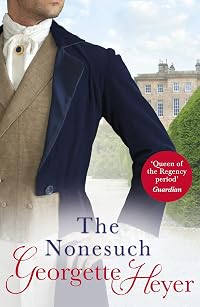
The Nonesuch
by Georgette Heyer
On This Page
Description
An impetuous flight... Tiffany Wield's bad behavior is a serious trial to her chaperone. "On the shelf " at twenty-eight, Ancilla Trent strives to be a calming influence on her tempestuous charge, but then Tiffany runs off to London alone and Ancilla is faced with a devastating scandal. A gallant rescue... Sir Waldo Hawkridge, confirmed bachelor and one of the wealthiest men in London, comes instantly to the aid of the intrepid Ancilla to stop Tiffany's flight, and in the process discovers show more that it's never too late for the first bloom of love. show lessTags
Recommendations














Member Reviews
It's not exactly fast paced, and the cant is almost unintelligible -- and that's what I really enjoyed about this book. The sheer wallowing in Regency slang. The sweetness of the romance. The exaggeration of character (both good and bad). The lesson that physical beauty just isn't that great if you don't back it up with an excellent personality. The responsibility that people take for each other and for their own actions. Satisfying.
After reading a few lacklustre romance stories I have returned to Georgette Heyer who, in The Nonesuch was able to completely steal my heart away. With wonderful characters, a good deal of humor and a romance that evolves through her intriguing story, this was a book that will remain dear to my heart for a long, long time.
Revolving around a small community in Yorkshire, the Nonesuch, Waldo, a well-renown man of his class, and his nephew, Julian, arrive to inspect and put in order an estate he has inherited. Becoming involved in the social circle of this rural parish, both Waldo and Julian each find a special someone that they hope to share their futures with. Of course true love never runs smoothly and the bulk of the story keeps us show more entertained with the ups and downs of their romances and the obstacles, such as a spoiled and silly heiress and a late arriving relative of Waldo’s, that put a few ripples into the course of true love.
With language that trips musically off the tongue, I relished sentences like “That damned resty, rackety, caper-witted cousin of mine - ! Vex me, she’s run off with that man-milliner, Calver!”. The always sparkling dialogue along with her detailed period research makes Georgette Heyer a guaranteed good read. The Nonesuch was a fun, relaxing and, yes, romantically satisfying book that will be listed among my favorites of this author. show less
Revolving around a small community in Yorkshire, the Nonesuch, Waldo, a well-renown man of his class, and his nephew, Julian, arrive to inspect and put in order an estate he has inherited. Becoming involved in the social circle of this rural parish, both Waldo and Julian each find a special someone that they hope to share their futures with. Of course true love never runs smoothly and the bulk of the story keeps us show more entertained with the ups and downs of their romances and the obstacles, such as a spoiled and silly heiress and a late arriving relative of Waldo’s, that put a few ripples into the course of true love.
With language that trips musically off the tongue, I relished sentences like “That damned resty, rackety, caper-witted cousin of mine - ! Vex me, she’s run off with that man-milliner, Calver!”. The always sparkling dialogue along with her detailed period research makes Georgette Heyer a guaranteed good read. The Nonesuch was a fun, relaxing and, yes, romantically satisfying book that will be listed among my favorites of this author. show less
The Nonesuch of the title is Sir Waldo Hawkridge, a man about town par execellence, who has just inherrited an estate in Yorkshire. He and his cousin, Julian, Lord Lindeth, go to inspect the place and put it into order. Initially he goes for a week or so, but ends up staying as romantic entanglements work out their kinks for both men.
The village of Oversett is somewhat overset by the news of their arrival and their entry into the social scene. Fortunately, Waldo is responsible and the ladies of the village have no worries about their sons mimicking poor behaviour. He's almost a bit too good to be true.
Of the ladies, the most noticeable is Tiffany Wield, who has to be the most memorably unpleasant lady in any of Heyer's books - I can't show more remember one I enjoyed disliking more. She's an orphan heiress, and has been shunted from aunts and uncles on both sides of the family and rarely taken care of by anyone. She's spoilt and rude and utterly unbearable and needs a right set down (one can only applaud when it is delivered). Her current governess is the hard pressed Miss Ancilla Trent and we very soon realise that she & Waldo have an attraction. She tries to deny it because of her position, the fact that her family is down on its luck and she's had to take paid employment. He, fortunately, is liberal enough to not see that as a barrier. They meet, they waltz, she tries to avoid the gossip and innuendo that spreads about the village. It's quite a low key romance. The position of the governess, as not being a servant, but not being of the family, is well described, and the reservation with which that romance comes to a head feels genuine enough. Waldo feels a little bit too good to be true, being an exceptional sportsman, having liberal values and being a philanthropist with an orphan school. Surely all too much in one man!
As a contrast, we have Julian having his head turned by Tiffany, in his first romance, and it is only after several incidents that he starts to realise that beauty is only skin deep. In the place of the infatuation, there is a more tender romance, that has started as friendship and then blossoms into something more when Patience dives under a coach and horses to rescue an urchin. As you might expect, Tiffany takes this badly and the loss of an admirer turns into a disaster when she seems to be falling out of fashion. It's a real check, well delivered and, you feel, utterly wasted.
The thing about Heyer's books isn't that the ending is a surprise for the key protagonists (and it isn't here either), it's the way you get there and the supporting cast. In this case we have several families, with Mrs Underhill trying her best to present a polished side to her practical common sense and propriety. The vicar and his wife being in mixed minds about the waltz - I can see him trying it later with his wife, in the privacy of their own home. They're all solid characters, each with their aims and expectations of life and trying to make the best of the situation. Oversett is a delightful place to spend some time. show less
The village of Oversett is somewhat overset by the news of their arrival and their entry into the social scene. Fortunately, Waldo is responsible and the ladies of the village have no worries about their sons mimicking poor behaviour. He's almost a bit too good to be true.
Of the ladies, the most noticeable is Tiffany Wield, who has to be the most memorably unpleasant lady in any of Heyer's books - I can't show more remember one I enjoyed disliking more. She's an orphan heiress, and has been shunted from aunts and uncles on both sides of the family and rarely taken care of by anyone. She's spoilt and rude and utterly unbearable and needs a right set down (one can only applaud when it is delivered). Her current governess is the hard pressed Miss Ancilla Trent and we very soon realise that she & Waldo have an attraction. She tries to deny it because of her position, the fact that her family is down on its luck and she's had to take paid employment. He, fortunately, is liberal enough to not see that as a barrier. They meet, they waltz, she tries to avoid the gossip and innuendo that spreads about the village. It's quite a low key romance. The position of the governess, as not being a servant, but not being of the family, is well described, and the reservation with which that romance comes to a head feels genuine enough. Waldo feels a little bit too good to be true, being an exceptional sportsman, having liberal values and being a philanthropist with an orphan school. Surely all too much in one man!
As a contrast, we have Julian having his head turned by Tiffany, in his first romance, and it is only after several incidents that he starts to realise that beauty is only skin deep. In the place of the infatuation, there is a more tender romance, that has started as friendship and then blossoms into something more when Patience dives under a coach and horses to rescue an urchin. As you might expect, Tiffany takes this badly and the loss of an admirer turns into a disaster when she seems to be falling out of fashion. It's a real check, well delivered and, you feel, utterly wasted.
The thing about Heyer's books isn't that the ending is a surprise for the key protagonists (and it isn't here either), it's the way you get there and the supporting cast. In this case we have several families, with Mrs Underhill trying her best to present a polished side to her practical common sense and propriety. The vicar and his wife being in mixed minds about the waltz - I can see him trying it later with his wife, in the privacy of their own home. They're all solid characters, each with their aims and expectations of life and trying to make the best of the situation. Oversett is a delightful place to spend some time. show less
The Nonesuch has a distinctly Austen-y flavour, more so than some of Heyer's other novels. It opens with a remarkably eligible bachelor inheriting a manor in rural Yorkshire, which he proceeds to visit. His presence causes great excitement and diversion for his neighbours, and they plan appropriate social amusements - the dinners and parties and outings - which will allow them to become acquainted with Sir Waldo and his younger cousin.
This is what the story revolves around: a rural community of young people and their families responding to the arrival of interesting newcomers. In particular, the responses of Tiffany Wield, an impulsive, high-spirited young heiress, and Miss Ancilla Trent, the governess-companion who has to deal with show more Tiffany's antics. It's the sort of story in which one gets to know all the main players and forms expectations about they will react. I like that.
While I enjoyed The Nonesuch, in hindsight I wish it was a more serious novel. There was the potential for the accidents and social calamities to be graver, for the obstacles to be greater. After all, equivalent-but-more serious things happen in Austen! And her heroes and heroines prove that they can rise to the occasion. By failing to provide her characters with more serious problems to solve, I feel Heyer was doing them a disservice.
(Also, by the end, I was finding Tiffany particularly tiresome. I realise that was the point - other characters are finding her tiresome, too - but I wanted to see her develop and grow, if she was going to take centre stage so much of the time.) show less
This is what the story revolves around: a rural community of young people and their families responding to the arrival of interesting newcomers. In particular, the responses of Tiffany Wield, an impulsive, high-spirited young heiress, and Miss Ancilla Trent, the governess-companion who has to deal with show more Tiffany's antics. It's the sort of story in which one gets to know all the main players and forms expectations about they will react. I like that.
While I enjoyed The Nonesuch, in hindsight I wish it was a more serious novel. There was the potential for the accidents and social calamities to be graver, for the obstacles to be greater. After all, equivalent-but-more serious things happen in Austen! And her heroes and heroines prove that they can rise to the occasion. By failing to provide her characters with more serious problems to solve, I feel Heyer was doing them a disservice.
(Also, by the end, I was finding Tiffany particularly tiresome. I realise that was the point - other characters are finding her tiresome, too - but I wanted to see her develop and grow, if she was going to take centre stage so much of the time.) show less
Some great characters and funny moments make “The Nonesuch” a dashed good read.
If Tiffany was real, she’d drive me crazy with her vanity and selfishness, but as she’s safely housed within the pages of a book, I found her to be great entertainment. Many a time I laughed out loud at her petty antics.
At one point, she tells one of the men to “Go away!” four times in succession. So much better and more humorous than today’s “**** off!” equivalent response.
Funnier still, though, is Tiffany’s aunt, Mrs Underhill. A classic Yorkshire lass with principles and a sense of propriety. Only a secondary character, but she’s a first-rate entertainer.
If Tiffany was real, she’d drive me crazy with her vanity and selfishness, but as she’s safely housed within the pages of a book, I found her to be great entertainment. Many a time I laughed out loud at her petty antics.
At one point, she tells one of the men to “Go away!” four times in succession. So much better and more humorous than today’s “**** off!” equivalent response.
Funnier still, though, is Tiffany’s aunt, Mrs Underhill. A classic Yorkshire lass with principles and a sense of propriety. Only a secondary character, but she’s a first-rate entertainer.
When Sir Waldo Hawkridge and his young cousin, Lord Lindeth, arrive in the small Yorkshire village of Oversett in order to inspect some property that Sir Waldo has inherited, the two unmarried gentlemen excite all the attention and admiration that one would expect at the arrival of such cosmopolitan strangers in a provincial area.
The subsequent romantic entanglements of Sir Waldo and Lord Lindeth, the former with superior and very genteel lady's companion Ancilla Trent, and the latter, first with beautiful but narcissistic heiress Tiffany Weild, and then with virtuous vicar's daughter Patience Chartley, play out with all the twists and turns one would expect of a Heyer concoction.
There are elements of The Nonesuch which are strongly show more reminiscent of Jane Austen's beloved classic Pride and Prejudice, and Heyer tells her tale with all her customary aplomb. But for all that I enjoyed this light-hearted romp, I cannot think it as delightful as some of the author's other titles, nor could I entirely suspend my disbelief, as it concerns Ancilla Trent's treatment as a paid companion, or with regard to some of Tiffany's more outrageous behavior. However that may be, while not one of Ms. Heyer's masterpieces, her legions of fans - among whom I count myself - will still greatly enjoy it. show less
The subsequent romantic entanglements of Sir Waldo and Lord Lindeth, the former with superior and very genteel lady's companion Ancilla Trent, and the latter, first with beautiful but narcissistic heiress Tiffany Weild, and then with virtuous vicar's daughter Patience Chartley, play out with all the twists and turns one would expect of a Heyer concoction.
There are elements of The Nonesuch which are strongly show more reminiscent of Jane Austen's beloved classic Pride and Prejudice, and Heyer tells her tale with all her customary aplomb. But for all that I enjoyed this light-hearted romp, I cannot think it as delightful as some of the author's other titles, nor could I entirely suspend my disbelief, as it concerns Ancilla Trent's treatment as a paid companion, or with regard to some of Tiffany's more outrageous behavior. However that may be, while not one of Ms. Heyer's masterpieces, her legions of fans - among whom I count myself - will still greatly enjoy it. show less
Georgette Heyer must have had a wonderful sense of humor. Her Regency novels are often filled with slang, which does much to embellish the personalities of her characters and makes them appear either very witty or almost silly. Heyer takes this to the next level in her Regency romance, The Nonesuch. The title itself is slang for a man who stands well above everyone else in terms of accomplishments such as driving/riding horses, shooting firearms, sports, manners of dress, and of course wealth.
The character owning the title of "The Nonesuch" is Sir Waldo Hawkridge, a wealthy man in his own right who has just inherited another estate in Yorkshire. Sir Waldo decides to visit the estate to oversee the necessary repairs to make the building show more habitable and convert it into a children's home.
The arrival of The Nonesuch causes quite a stir in the small community. Dances and outings ensue, as the young women (and especially their mothers) try their best to interest Sir Waldo and his cousin Julian into leaving bachelorhood behind. No one tries harder (with less effort) than the young, beautiful and self-proclaimed social diva Tiffany Wield. Tiffany has been sent to the country from London by despairing relatives unable to control her behavior. In the household of the Underhills, she is kept company by a slightly older companion, Ancilla Trent. Tiffany is accustomed to getting her own way without any regard for the feelings of others. Ancilla does her best to soothe Tiffany's tantrums while minimizing her damage.
This scenario provides the backdrop for romance and some interesting character studies. Sir Waldo is a confirmed bachelor, yet he is attracted to Ancilla's calming personality and sharp intellect. Ancilla, thinking herself too old at 28 for either love or marriage, is less than impressed with Sir Waldo's money and personage as The Nonesuch, but she is attracted to his strong, quiet nature and ability to separate himself from his reputation. Tiffany, who expects all men to love her madly, has difficulty understanding how Julian could have the slightest interest in anyone else.
I really enjoyed this book and Heyer's characterizations, especially that of Tiffany's. She seemed to me to be very much like Scarlett O'Hara at the beginning of Gone With the Wind - in fact, I kept waiting for her to say "fiddle-dee-dee" or "butter won't melt in my mouth." But Heyer wrote of a different era with its own set of slang. And speaking of Regency slang, check out this site for a list of words and expressions and their meanings. It will come in handy! show less
The character owning the title of "The Nonesuch" is Sir Waldo Hawkridge, a wealthy man in his own right who has just inherited another estate in Yorkshire. Sir Waldo decides to visit the estate to oversee the necessary repairs to make the building show more habitable and convert it into a children's home.
The arrival of The Nonesuch causes quite a stir in the small community. Dances and outings ensue, as the young women (and especially their mothers) try their best to interest Sir Waldo and his cousin Julian into leaving bachelorhood behind. No one tries harder (with less effort) than the young, beautiful and self-proclaimed social diva Tiffany Wield. Tiffany has been sent to the country from London by despairing relatives unable to control her behavior. In the household of the Underhills, she is kept company by a slightly older companion, Ancilla Trent. Tiffany is accustomed to getting her own way without any regard for the feelings of others. Ancilla does her best to soothe Tiffany's tantrums while minimizing her damage.
This scenario provides the backdrop for romance and some interesting character studies. Sir Waldo is a confirmed bachelor, yet he is attracted to Ancilla's calming personality and sharp intellect. Ancilla, thinking herself too old at 28 for either love or marriage, is less than impressed with Sir Waldo's money and personage as The Nonesuch, but she is attracted to his strong, quiet nature and ability to separate himself from his reputation. Tiffany, who expects all men to love her madly, has difficulty understanding how Julian could have the slightest interest in anyone else.
I really enjoyed this book and Heyer's characterizations, especially that of Tiffany's. She seemed to me to be very much like Scarlett O'Hara at the beginning of Gone With the Wind - in fact, I kept waiting for her to say "fiddle-dee-dee" or "butter won't melt in my mouth." But Heyer wrote of a different era with its own set of slang. And speaking of Regency slang, check out this site for a list of words and expressions and their meanings. It will come in handy! show less
Members
- Recently Added By
Lists

Favorite Georgette Heyer Novels, Ranked
49 works; 29 members

Books I've Read More Than Once
602 works; 49 members
Comfort Reads
221 works; 41 members

Academia in Fiction
158 works; 23 members

Books Read in 2016
4,666 works; 199 members

Books Read in 2017
4,249 works; 129 members

Books Read in 2018
4,360 works; 110 members

Books Read in 2019
4,052 works; 110 members

Books Read in 2021
5,361 works; 114 members

Books that are a victim of Cancel Culture
46 works; 3 members
Author Information

125+ Works 78,087 Members
Georgette Heyer was born on August 16, 1902 at Wimbledon, London. She wrote The Black Moth as a story for her brother Boris. Her father, impressed with his daughter's imagination, suggested that she prepare it to be published, which it was by Constable in 1921. Having scored an instant success with The Black Moth at the age of nineteen under her show more own name, Georgette Heyer, she experimented with a pseudonym, Stella Martin, for her third book, published by Mills & Boon. She continued writing and in 1925 she married Ronald Rougier, a mining engineer. After reasonable but not spectacular sales from her first few books the instant success of These Old Shades in 1926 brought her a solid source of income which was very necessary at the time since the family relied to a large extent on the income from Georgette Heyer's writing. She wrote over fifty books during her lifetime and created the Regency England genre of romance novels. She died on July 4, 1974 at the age of 71. (Bowker Author Biography) show less
Some Editions
Series
Belongs to Publisher Series
Work Relationships
Common Knowledge
- Canonical title*
- Passion au manoir
- Original title
- The nonesuch
- Original publication date
- 1962
- People/Characters
- Gregory Ash; Laurence Calver; Jane Chartley; John Chartley (Reverend); Patience Chartley; Elizabeth Colebatch (show all 18); Humphrey Colebatch; Sir Waldo Hawkridge 'The Nonesuch'; Julian, Lord Lindeth; Sophia, Lady Lindeth; Mrs Mickleby; Arthur Mickleby; Ancilla Trent; Mrs Underhill; Courtenay Underhill; Charlotte Underhill; Tiffany Wield; George Wingham
- Important places
- Oversett, West Riding, Yorkshire, England, UK
- First words
- There was a twinkle in the Nonesuch's eye as he scanned the countenances of his assembled relations, but his voice was perfectly grave, even a trifle apologetic.
- Last words
- (Click to show. Warning: May contain spoilers.)"Damme, a Trojan!"
- Original language
- English
*Some information comes from Common Knowledge in other languages. Click "Edit" for more information.
Classifications
Statistics
- Members
- 1,830
- Popularity
- 11,873
- Reviews
- 73
- Rating
- (3.95)
- Languages
- 7 — Dutch, English, French, German, Italian, Spanish, Swedish
- Media
- Paper, Audiobook, Ebook
- ISBNs
- 38
- UPCs
- 2
- ASINs
- 28