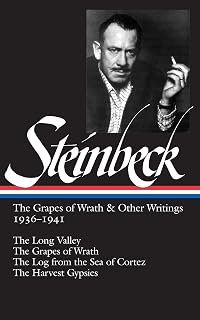
Steinbeck: The Grapes of Wrath and Other Writings, 1936-1941
by John Steinbeck
On This Page
Description
From the Publisher: This second volume in The Library of America's authoritative edition of John Steinbeck features his acknowledged masterpiece, The Grapes of Wrath. Written in an incredibly compressed five-month period, the novel had an electrifying impact upon publication in 1939, unleashing a political storm with its vision of America's dispossessed struggling for survival. It continues to exert a powerful influence on American culture, and has inspired artists as diverse as John Ford, show more Woody Guthrie, and Bruce Springsteen. Tracing the journey of the Joad family from the dust bowl of Oklahoma to the migrant camps of California, Steinbeck creates an American epic, spacious, impassioned, and pulsating with the rhythms of living speech. The novel won the Pulitzer Prize and has since sold millions of copies worldwide. The text of The Grapes of Wrath has been newly edited based on Steinbeck's manuscript, typescript, and proofs. Many errors have been corrected and words omitted or misconstrued by his typist have been restored. In addition, The Harvest Gypsies, his 1936 investigative report on migrant workers which laid the groundwork for the novel, is included as an appendix. The Long Valley (1938) displays Steinbeck's brilliance as a writer of short stories, including such classics as The Chrysanthemums, The White Quail, Flight, and The Red Pony. Set in the Salinas Valley landscape which was Steinbeck's enduring inspiration, the stories explore moments of fear, tenderness, isolation, and violence with poetic intensity. The Log from the Sea of Cortez, an account of the 1940 marine biological expedition in which Steinbeck participated with his close friend Ed Ricketts, is a unique blend of science, philosophy, and adventure, as well as one of Steinbeck's most revealing expositions of his core beliefs. First published in 1941 as part of the collaborative volume Sea of Cortez, Steinbeck's narrative was reissued separately a decade later, augmented by the moving tribute About Ed Ricketts. show lessTags
Recommendations















Member Reviews
THE GRAPES OF WRATH
I've always favored Steinbeck's work, but it's been decades since I read this, IF I ever read it in its entirety before. I think I was introduced to it in high school but it must have been abridged, bowdlerized, or merely sampled; the sexual references and some of the language were most surely NOT the kind of thing we would have been given to read in my high school. Much of my memory of the story comes from the film, and my impression was of some pretty melodramatic over-acting, and maudlin scenes. The content certainly lends itself to that sort of treatment, and there are segments that could have been trimmed or lightened up, but it's much, much better than I remembered, and there's a lot of true grittiness in it. show more The plight of people driven off their land, where they never had much, into cross-country flight where they have next-to-nothing but baseless hope is really hard to contemplate. And I think there’s a tendency now to believe it couldn’t possibly have been that bad, or anyway it’s history now and could never happen again...well, that’s why a book like this is often on Great American Novel lists. It may be fiction, but it reveals a lot of truth. There is amazing prose here, and the structure was appealing to me—chapters which moved the Joad family’s story along, alternating with chapters which laid out the historical circumstances in more general terms (there was a Faulknerian quality to the prose in some of those chapters, and naturally I lapped that up). Recommended. show less
I've always favored Steinbeck's work, but it's been decades since I read this, IF I ever read it in its entirety before. I think I was introduced to it in high school but it must have been abridged, bowdlerized, or merely sampled; the sexual references and some of the language were most surely NOT the kind of thing we would have been given to read in my high school. Much of my memory of the story comes from the film, and my impression was of some pretty melodramatic over-acting, and maudlin scenes. The content certainly lends itself to that sort of treatment, and there are segments that could have been trimmed or lightened up, but it's much, much better than I remembered, and there's a lot of true grittiness in it. show more The plight of people driven off their land, where they never had much, into cross-country flight where they have next-to-nothing but baseless hope is really hard to contemplate. And I think there’s a tendency now to believe it couldn’t possibly have been that bad, or anyway it’s history now and could never happen again...well, that’s why a book like this is often on Great American Novel lists. It may be fiction, but it reveals a lot of truth. There is amazing prose here, and the structure was appealing to me—chapters which moved the Joad family’s story along, alternating with chapters which laid out the historical circumstances in more general terms (there was a Faulknerian quality to the prose in some of those chapters, and naturally I lapped that up). Recommended. show less
July 09: The Long Valley, 4 of 5
The most of Valley's collection is solid, standard Steinbeck fare. The eleventh of thirteen stories, "Saint Katy", however, is terribly out of place in both style and content, a poorly executed experiment in fable having nothing whatever to do with the rest of the collection's shared elements of time, manner and place. It's really quite puzzling and bizarre why after ten stories we suddenly leave early 20th-century Salinas Valley in order to witness Steinbeck completely out of his element with a sloppily-written tale of a talking pig's elevation to sainthood by 13th-century monks, only to be thrust back almost with a vengence into the bright, shining star of the collection, the flawless, beautifully show more constructed, exemplary "The Red Pony", which I'm inclined to tuck just behind East of Eden as my favourite Steinbeck work. show less
The most of Valley's collection is solid, standard Steinbeck fare. The eleventh of thirteen stories, "Saint Katy", however, is terribly out of place in both style and content, a poorly executed experiment in fable having nothing whatever to do with the rest of the collection's shared elements of time, manner and place. It's really quite puzzling and bizarre why after ten stories we suddenly leave early 20th-century Salinas Valley in order to witness Steinbeck completely out of his element with a sloppily-written tale of a talking pig's elevation to sainthood by 13th-century monks, only to be thrust back almost with a vengence into the bright, shining star of the collection, the flawless, beautifully show more constructed, exemplary "The Red Pony", which I'm inclined to tuck just behind East of Eden as my favourite Steinbeck work. show less
Grapes of Wrath (2007)
Tom Joad, fresh from a four year bit in prison for manslaughter, accompanies his family to the rumored promised land of California during the dust bowl years. Thousands of families arrive in search of work and they are shuttered into migrant camps. Tensions rise as jobs and food grow scarcer. During an argument over whether to organize into a union, one of Tom’s friends is killed by a policeman and Tom kills the policeman.
Steinbeck was born and raised in the agricultural community of Salinas, CA. As the depression raged, Steinbeck decided to write a novel from the perspective of the poor migrants who were suffering the worst effects. He journeyed with an Oklahoma family to California and used the experience to show more write [Grapes of Wrath].
[Grapes of Wrath] is the plainest of Steinbeck’s social commentaries and it has suffered over the years for its clear intent. Perhaps, because of the way he researched the novel, Steinbeck was too invested in making his point, as the characters and story are stretched a little thin over the social commentary.
Bottom Line: Steinbeck won a Pulizter Prize for the novel but it’s not his best work – too much social commentary and not enough of full-bodied characters and story.
4 bones!!!!! show less
Tom Joad, fresh from a four year bit in prison for manslaughter, accompanies his family to the rumored promised land of California during the dust bowl years. Thousands of families arrive in search of work and they are shuttered into migrant camps. Tensions rise as jobs and food grow scarcer. During an argument over whether to organize into a union, one of Tom’s friends is killed by a policeman and Tom kills the policeman.
Steinbeck was born and raised in the agricultural community of Salinas, CA. As the depression raged, Steinbeck decided to write a novel from the perspective of the poor migrants who were suffering the worst effects. He journeyed with an Oklahoma family to California and used the experience to show more write [Grapes of Wrath].
[Grapes of Wrath] is the plainest of Steinbeck’s social commentaries and it has suffered over the years for its clear intent. Perhaps, because of the way he researched the novel, Steinbeck was too invested in making his point, as the characters and story are stretched a little thin over the social commentary.
Bottom Line: Steinbeck won a Pulizter Prize for the novel but it’s not his best work – too much social commentary and not enough of full-bodied characters and story.
4 bones!!!!! show less
The Grapes of Wrath is one of my absolute favorite books of all time and inspired me to write my junior year term paper on Steinbeck in high school. Steinbeck's creative use of ordinary objects and circumstances to tell such a dramatic story is one aspect that really sets this story apart.
"The long valley", "The wrapes of wrath", "The log from the sea of Cortez", "The harvest sypsies"
Ratings
Members
- Recently Added By
Author Information

483+ Works 207,488 Members
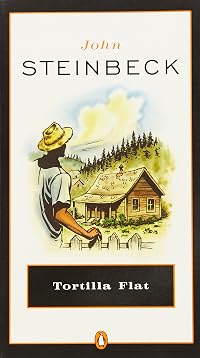
In recent years Steinbeck has been elevated to a more prominent status among American writers of his generation. If not quite at the world-class artistic level of a Hemingway or a Faulkner, he is nonetheless read very widely throughout the world by readers of all ages who consider him one of the most "American" of writers. Born in Salinas County, show more California on February 27, 1902, Steinbeck was of German-Irish parentage. After four years as a special student at Stanford University, he went to New York, where he worked as a reporter and as a hod carrier. Returning to California, he devoted himself to writing, with little success; his first three books sold fewer than 3,000 copies. Tortilla Flat (1935), dealing with the paisanos, California Mexicans whose ancestors settled in the country 200 years ago, established his reputation. In Dubious Battle (1936), a labor novel of a strike and strike-breaking, won the gold medal of the Commonwealth Club of California. Of Mice and Men (1937), a long short story that turns upon a melodramatic incident in the tragic friendship of two farm hands, written almost entirely in dialogue, was an experiment and was dramatized in the year of its publication, winning the New York Drama Critics Circle Award. It brought him fame. Out of a series of articles that he wrote about the transient labor camps in California came the inspiration for his greatest book, The Grapes of Wrath (1939), the odyssey of the Joad family, dispossessed of their farm in the Dust Bowl and seeking a new home, only to be driven on from camp to camp. The fiction is punctuated at intervals by the author's voice explaining this new sociological problem of homelessness, unemployment, and displacement. As the American novel "of the season, probably the year, possibly the decade," it won the Pulitzer Prize in 1940. It roused America and won a broad readership by the unusual simplicity and tenderness with which Steinbeck treated social questions. Even today, The Grapes of Wrath remains alive as a vivid account of believable human characters seen in symbolic and universal terms as well as in geographically and historically specific ones. Ma Joad is one of the most memorable characters in twentieth-century American fiction. It is her courage that sustains the family. Steinbeck's best and most ambitious novel after The Grapes of Wrath is East of Eden (1952), a saga of two American families in California from before the Civil War through World War I. Cannery Row (1945), The Wayward Bus (1947), and Sweet Thursday (1955) are lighter works that find Steinbeck returning to the lighthearted tone of Tortilla Flat as he recounts picaresque adventures of modern-day picaros. The Winter of Our Discontent (1961) struck some reviewers as being appropriately titled because of its despairing treatment of humanity's fall from grace in a wasteland world where money is king. Steinbeck also wrote important nonfiction, including Russian Journal (1948) in collaboration with the photographer Robert Capa; Once There Was a War (1958) and America and Americans (1966), which features pictures by 55 leading photographers and a 70-page essay by Steinbeck. His interest in marine biology led to two books primarily about sea life, Sea of Cortez (1941) (with Edward F. Ricketts) and The Log from the Sea of Cortez (1951). Travels with Charley (1962) is an engaging account of his journey of rediscovery of America, which took him through approximately 40 states. Steinbeck was married three times and died in New York City on December 20, 1968 of heart disease and congestive heart failure. He was 66, and had been a life-long smoker. (Bowker Author Biography) show less
All Editions
Series
Belongs to Publisher Series
Library of America (086)
Work Relationships
Contains
Common Knowledge
- Canonical title
- Steinbeck: The Grapes of Wrath and Other Writings, 1936-1941
- Original publication date
- 1996-09-01
- Important places
- California, USA; Mexico; Baja California, Mexico; Oklahoma, USA
- Publisher's editor
- DeMott, Robert; Steinbeck, Elaine A.
- Disambiguation notice
- This is an omnibus unique to the Library of America; therefore, all CK facts apply to this publication only.
Classifications
Statistics
- Members
- 769
- Popularity
- 36,522
- Reviews
- 6
- Rating
- (4.41)
- Languages
- English, French
- Media
- Paper
- ISBNs
- 2
- ASINs
- 5