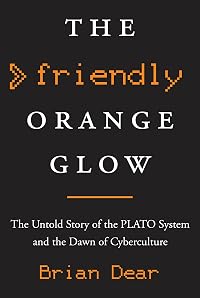
The Friendly Orange Glow: The Untold Story of the PLATO System and the Dawn of Cyberculture
by Brian Dear
On This Page
Description
Documents the story of the 1960s computer program and platform that marked the true beginning of cyberculture, revealing the role of PLATO ideas in inspiring countless technological innovations, from flat-panel wall TVs to multiplayer games.Tags
Recommendations















Member Reviews
"The Friendly Orange Glow" by Brian Dear was a fascinating tech history by a master storyteller. I knew nothing about PLATO when starting the book, as most of the events and innovation took place before I was born, but now feel as if the technology, along with people and places that built and 'hacked' and enriched the community surrounding it, are my old friends and familiar haunts. Some readers may be put off by the long-windedness of some of the personal stories and anecdotes, but I found that they added a surprising richness and cohesiveness to the book and a offered a delightful buildup to some mind-blowing revelations of this lost technological history. I was given a free ARC from Penguin's First to Read program, but my opinions show more are my own, etc. show less
I received an early copy of this book from Penguin's First to Read program.
As a someone with a saltwater view (I didn't realize there were freshwater views, I figured it was an unpeople land of quiet groves of trees and fields of corn and little else), I was pleased to read about something I knew very little about. This was a fascinating history of an impressive feat in the early days of modern computing. Dear does a great job setting the scene and revealing some of the personalities involved in the development of the PLATO system at the University of Illinois. It's fascinating to see so many parallels between the efforts to create a teaching machine and some of the stuff going on in education with computers today. It just goes to show show more how far we've come (the availability of cheap internet access and access to computing power) and how we still make the same mistakes (the author muses, "[s]chools continue to spend billions on computers, software, and network, but the question remains who is benefiting more, students or vendors.").
In the early part of the book and development of PLATO it hit me how many of the things we did in the 80s and early 90s, interactive fiction through MUDs and tools like Eastgate's StorySpace, while they felt like brand new inventions then, had been around for ages at that stage, pioneering all sorts of new interactions we take for granted now.
Dear tells the story really well, though I felt the slightest touch of seasickness in the middle of the book as we seemed to wash back and forth over some of the same time periods as he had to backtrack to walk through the timeline of another thread in the story of PLATO. But the evolution of PLATO from a government-funded, academic-hosted project to adapt to various computing trends and eventually fizzle out with the closure of NovaNET (owned by Pearson, taking the story of computers in education from near the start with B.F. Skinner to a modern day education company) kept the story interesting all along.
If you're interested in the history of computing, computers in education, and the beginnings of networked culture this is an excellent story. show less
As a someone with a saltwater view (I didn't realize there were freshwater views, I figured it was an unpeople land of quiet groves of trees and fields of corn and little else), I was pleased to read about something I knew very little about. This was a fascinating history of an impressive feat in the early days of modern computing. Dear does a great job setting the scene and revealing some of the personalities involved in the development of the PLATO system at the University of Illinois. It's fascinating to see so many parallels between the efforts to create a teaching machine and some of the stuff going on in education with computers today. It just goes to show show more how far we've come (the availability of cheap internet access and access to computing power) and how we still make the same mistakes (the author muses, "[s]chools continue to spend billions on computers, software, and network, but the question remains who is benefiting more, students or vendors.").
In the early part of the book and development of PLATO it hit me how many of the things we did in the 80s and early 90s, interactive fiction through MUDs and tools like Eastgate's StorySpace, while they felt like brand new inventions then, had been around for ages at that stage, pioneering all sorts of new interactions we take for granted now.
Dear tells the story really well, though I felt the slightest touch of seasickness in the middle of the book as we seemed to wash back and forth over some of the same time periods as he had to backtrack to walk through the timeline of another thread in the story of PLATO. But the evolution of PLATO from a government-funded, academic-hosted project to adapt to various computing trends and eventually fizzle out with the closure of NovaNET (owned by Pearson, taking the story of computers in education from near the start with B.F. Skinner to a modern day education company) kept the story interesting all along.
If you're interested in the history of computing, computers in education, and the beginnings of networked culture this is an excellent story. show less
I'd meant to read this ever since it appeared. I work at UIUC next to the CS building where there is a display with a PLATO IV terminal and some innards, including what appears to be an R&D plasma screen, so I'd been curious about it for quite a while. Part II focuses on the user community, which was the feature that really made PLATO's culture. I was unexpectedly moved and inspired a particular chapter in Part III illustrating PLATO's impact on one particular person.
It was fascinating that for how groundbreaking PLATO was, it (not to mention Control Data Corporation) was so unprepared for the microcomputer and switched packet networking.
As an early computing history geek, I wish there had been more detail about the technical aspects.
It was fascinating that for how groundbreaking PLATO was, it (not to mention Control Data Corporation) was so unprepared for the microcomputer and switched packet networking.
As an early computing history geek, I wish there had been more detail about the technical aspects.
The Friendly Orange Glow by Brian Dear is an endeavor to preserve a history that is at risk of being lost. The research put into compiling the history of the PLATO computer system is clear in the length and depth of the details and the extensive list of sources and notes. The personal interest and viewpoint of the author is clear from beginning to end. The book is lengthy and dense but nevertheless a fascinating story of a time, a place, and a community.
Read my complete review at http://www.memoriesfrombooks.com/2017/12/the-friendly-orange-glow.html
Reviewed for Penguin First to Read
Read my complete review at http://www.memoriesfrombooks.com/2017/12/the-friendly-orange-glow.html
Reviewed for Penguin First to Read
The Friendly Orange Glow by Brian Dear. My father was a computer programmer and his first use of the computer systems was PLATO and NovaNET as part of his training to work with different platforms and be able to solve other people’s porblems. I was blessed to have one of the first in-home computer units as a young child because of his job (we were the envy of the neighborhood, no one had ever seen these monstrosities before!
I was really excited to read this book, because of our family history with computers and networking. Sadly, I was unable to finish the book., The only reason I was unable to finish this book was in the middle of the book there was too much weaving in and out of the timelines and many repeats of history, which made show more me want to throw the modern day representation of those huge computers of learning—my iPad at the wall. It was too much repeating for me and I lost patience.
Thanks for the opportunity to read the portion of the book I did read.
We all owe B.F. Skinner for the wonder we have In our lives for computer use while learning even in lieu of the education systems till not grasping the proper use of his vision.
My early love of gaming started young, I appreciate the opportunity to feel a connection to some of the history in the book. While as a college student, I used numerous Pearson programs. I appreciate Mr. Dear for taking upon himself the challenge of learning about PLATO and telling the PLATO story so we can all learn about an integral component in our lives and show us the past where computing has been in existence for much longer than most people ever knew.
I give this book a rating of 3/5 stars.
I was given this book by Penquin’s First to Read for my honest review. Thank, Penquin Random House!
* I finally finished the book. It was better than I originally rated it. I know give it a 4/5 stars. show less
I was really excited to read this book, because of our family history with computers and networking. Sadly, I was unable to finish the book., The only reason I was unable to finish this book was in the middle of the book there was too much weaving in and out of the timelines and many repeats of history, which made show more me want to throw the modern day representation of those huge computers of learning—my iPad at the wall. It was too much repeating for me and I lost patience.
Thanks for the opportunity to read the portion of the book I did read.
We all owe B.F. Skinner for the wonder we have In our lives for computer use while learning even in lieu of the education systems till not grasping the proper use of his vision.
My early love of gaming started young, I appreciate the opportunity to feel a connection to some of the history in the book. While as a college student, I used numerous Pearson programs. I appreciate Mr. Dear for taking upon himself the challenge of learning about PLATO and telling the PLATO story so we can all learn about an integral component in our lives and show us the past where computing has been in existence for much longer than most people ever knew.
I give this book a rating of 3/5 stars.
I was given this book by Penquin’s First to Read for my honest review. Thank, Penquin Random House!
* I finally finished the book. It was better than I originally rated it. I know give it a 4/5 stars. show less
Ratings
Members
- Recently Added By
Author Information
1 Work 165 Members
Classifications
- Genres
- Technology, Nonfiction, History, General Nonfiction, Science & Nature
- DDC/MDS
- 303.48 — Society, government, & culture Social sciences, sociology & anthropology Social processes Social change Causes of change
- LCC
- QA76.8 .P53 .D43 — Science Mathematics Mathematics Instruments and machines Calculating machines Electronic computers. Computer science
- BISAC
Statistics
- Members
- 165
- Popularity
- 198,919
- Reviews
- 5
- Rating
- (3.82)
- Languages
- English
- Media
- Paper, Audiobook, Ebook
- ISBNs
- 4
- ASINs
- 2