
On This Page
Description
“McCaffrey's world of the Talented is as vivid as that of Pern and its dragons.”—Publishers WeeklyWhen a freak accident furnishes solid scientific proof of paranormal mental abilities, the world reacts with suspicion and fear. How can ordinary people coexist with a minority able to read minds, heal with a touch, peer into the future, or move objects with a thought? How can anyone with such power be trusted not to abuse it? Harsh repression seems the only answer
Gifted with show more precognitive talent, Henry Darrow has other ideas, foreseeing a future in which the Talents are accepted for what they are and not what they can offer their fellow humans. But the road to that future will not be easy. Darrow and the powerful telepath Daffyd op Owen must win the public's trust while overcoming the threat of rogue Talents like Solange Boshe, a young girl so consumed with hatred that her thoughts can kill, and the singer known as Amalda, whose... show less
Tags
Recommendations
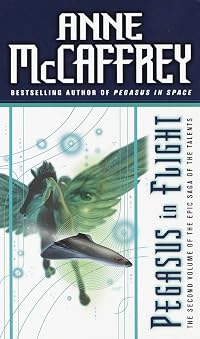







Member Reviews
If you see the title To Ride Pegasus and think whimsical fantasy, think again. Anne McCaffrey uses Pegasus as a metaphor for a powerful talent that is hard to live with—to wit, any number of psychic talents, from precognition to telepathy. The novel is a fix-up that reminds me of Robert Heinlein’s Howard family novels like Methuselah's Children. A man with precognition creates a safe place for other people with psychic talent. Unfortunately, McCaffrey’s treatment of the extrasensory is not science elevated to magic, it is just magic.
To read more reviews in this series and others, check out my blog keikii eats books!
Average Rating: 60 points, 3 ¼ stars.
Trigger Warning: Old School Ethical Issues
Quote:
Review:
I'm kind of dreading reviewing To Ride Pegasus right now. On the one hand, I genuinely love the world and like most of the characters. On the other hand, holy gaping ethical issues! I hate that I love the world so much, because if I didn't I could just put the book down for good and be done with it and be righteous in my indignation. show more Instead I keep wanting to know more, and being horrified by the implications of things.
To Ride Pegasus is a collection of four novellas that start the Talents Universe. These stories were written between 1969 and 1973, and this collection was first published in 1973. While the storytelling was very quick, it was also an older storytelling mode that was a little hard for me to adapt to since I'm not used to.
But, most importantly, this should best be read as a product of its time. Read this and be glad at how far we have come as a society. To Ride Pegasus genuinely tries to figure out what it would be like to have psychic powers morally and ethically. It is almost like X-Men, but way less heavy-handed with the whole humans vs. mutants/psychics thing. Yet it misses the mark so, so badly. Like, jaw-droppingly, "what in the actual fuck did I just read" bad.
The biggest, most rage inducing incident of this book is the way that Anne McCaffrey has the characters use a mentally challenged boy. The characters praise themselves for using this child to correct the psychic actions of an adult. Which literally distresses the child. The wording used is so, so much worse, too.
Yet disconcertingly, I wanted to know more about the story. The novellas all feature different aspects of what it would be like for psychics to be real and to come out in the world. The first story deals about finding out that psychics are real and figuring out how to make science back up the find while preparing for a future where psychics are real. The second story is when they get rights and they try and figure out how to use their powers ethically. The third story was probably the least interesting, as the psychics are trying to assimilate into the world but are being blamed for a rogue Talent. The last story is supposed to be how they need to figure out how to test for and create psychics better, but really it is about deep rooted ethical issues that they don't even realize is deeply wrong.
I just love the world that McCaffrey builds throughout these pages. It reminds me of one of my favourite book series if things had gone just a little bit differently. And I'm continuing on because I do really love that world, and I didn't mind the characters. Yet I hope the glaring problems I had get solved in the next book. show less
Average Rating: 60 points, 3 ¼ stars.
Trigger Warning: Old School Ethical Issues
Quote:
"Okay for us, for the time being. But not for the rest of us. No, now don't worry, Molly luv. I know where we're going."
Molly regarded him steadily for a second. "But you don't know exactly how we'll get there, is that it?"
Review:
I'm kind of dreading reviewing To Ride Pegasus right now. On the one hand, I genuinely love the world and like most of the characters. On the other hand, holy gaping ethical issues! I hate that I love the world so much, because if I didn't I could just put the book down for good and be done with it and be righteous in my indignation. show more Instead I keep wanting to know more, and being horrified by the implications of things.
To Ride Pegasus is a collection of four novellas that start the Talents Universe. These stories were written between 1969 and 1973, and this collection was first published in 1973. While the storytelling was very quick, it was also an older storytelling mode that was a little hard for me to adapt to since I'm not used to.
But, most importantly, this should best be read as a product of its time. Read this and be glad at how far we have come as a society. To Ride Pegasus genuinely tries to figure out what it would be like to have psychic powers morally and ethically. It is almost like X-Men, but way less heavy-handed with the whole humans vs. mutants/psychics thing. Yet it misses the mark so, so badly. Like, jaw-droppingly, "what in the actual fuck did I just read" bad.
The biggest, most rage inducing incident of this book is the way that Anne McCaffrey has the characters use a mentally challenged boy. The characters praise themselves for using this child to correct the psychic actions of an adult. Which literally distresses the child. The wording used is so, so much worse, too.
I'm putting this quote under spoilers. Just be warned that it is actually pretty disgusting.The first sessions with Harold Orley had been conducted with Amalda fairly well sedated. The girl had been revolted by Harold’s witlessness. There could have been no clearer mirror for her reaction. Pity for the moronic empath had been quickly suppressed because Harold would disconcertingly burst into tears. At first Amalda had rebelled at being forced to work with Harold but she could not refute the fact that he would react instantly to her emotions and until she could control them in his presence, she couldn’t expect to be able to control them sufficiently in public.
Yet disconcertingly, I wanted to know more about the story. The novellas all feature different aspects of what it would be like for psychics to be real and to come out in the world. The first story deals about finding out that psychics are real and figuring out how to make science back up the find while preparing for a future where psychics are real. The second story is when they get rights and they try and figure out how to use their powers ethically. The third story was probably the least interesting, as the psychics are trying to assimilate into the world but are being blamed for a rogue Talent. The last story is supposed to be how they need to figure out how to test for and create psychics better, but really it is about deep rooted ethical issues that they don't even realize is deeply wrong.
I just love the world that McCaffrey builds throughout these pages. It reminds me of one of my favourite book series if things had gone just a little bit differently. And I'm continuing on because I do really love that world, and I didn't mind the characters. Yet I hope the glaring problems I had get solved in the next book. show less
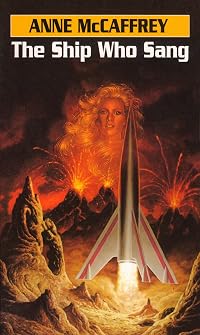
This is an early work by McCaffrey published in 1973 but some parts first appeared in 1969. I’m not sure when I first read anything by McCaffrey but I’m pretty sure it was The Ship Who Sang. Years later I had the privilege of hearing McCaffrey read that story at the Winnipeg Science Fiction Convention. Everyone present, including McCaffrey, had tears in their eyes by the end. This book isn’t up to that calibre but it is interesting to read something from a great writer’s formulative period.
People with psionic powers (telepathy, telekinesis, telempathy, precognition and other powers) in the 21st century are bombarded with sensations because people are so packed together in megalopolises. Jerhattan is one of the biggest and has show more all the problems one would expect in such a large city. A man who can predict the future, including his own precise death date, Henry Darrow, conceives of a refuge for those with powers and they would then use their powers to help the city. He convinces a wealthy man who owns one of the largest tracts of land that has not yet been divided to allow the center to set up shop on the land. Darrow tells the man that he knows when he will die to the precise moment and the man agrees that the center can stay if he does indeed die at that moment. However, if he lives longer the center has to leave. Of course, Darrow is right and the center is established. The title comes from the analogy that Darrow uses to describe using extrasensory powers: It’s like riding a winged horse; one can get on its back but it is hard to get off once it is in flight. However, as the center expands and matures they learn more about using the powers and harnessing the winged horse.
As I said, this is not the best example of McCaffrey’s work but it is still very enjoyable. show less
People with psionic powers (telepathy, telekinesis, telempathy, precognition and other powers) in the 21st century are bombarded with sensations because people are so packed together in megalopolises. Jerhattan is one of the biggest and has show more all the problems one would expect in such a large city. A man who can predict the future, including his own precise death date, Henry Darrow, conceives of a refuge for those with powers and they would then use their powers to help the city. He convinces a wealthy man who owns one of the largest tracts of land that has not yet been divided to allow the center to set up shop on the land. Darrow tells the man that he knows when he will die to the precise moment and the man agrees that the center can stay if he does indeed die at that moment. However, if he lives longer the center has to leave. Of course, Darrow is right and the center is established. The title comes from the analogy that Darrow uses to describe using extrasensory powers: It’s like riding a winged horse; one can get on its back but it is hard to get off once it is in flight. However, as the center expands and matures they learn more about using the powers and harnessing the winged horse.
As I said, this is not the best example of McCaffrey’s work but it is still very enjoyable. show less
I think I figured out what doesn't work for me from McCaffrey: her characters are flat as pancakes. They don't grow, the plot (if there is any) drives their actions/words rather than the other way around, they don't make sense. It is baffling that this book's blurb describes 5 important-sounding women in detail, promising their perspectives on how they shape the world of the Talents, but the whole story is told from the POV of 2 men. *throws hands up*
Henry Darrow is a surprisingly accurate astrologer. He predicted the car accident that would give him a serious head injury and would put him in the one hospital with an ultra-sensitive electroencephalograph, otherwise known as a Goosegg. After his surgery he woke to a nurse watching him. He had a precognitive episode predicting they would get married and since he was being monitored by the Goosegg the chart showed the unusual activity in his brain at the exact moment of his episode. Scientific proof that parapsychic talent exists. From that point Henry Darrow begins the hard work needed to form the Parapsychic Center and bring all those with Talent under its protection.
This book contains four short stories chronicling Henry Darrow’s show more hard work to get the Center started then a place for the Talented to stay where their quarters weren’t crammed in with others and could be shielded to protect their minds. Land for the center, finding Talents to bring into the fold and getting laws passed to protect them all started with Darrow, but continued well after his death.
While this book was first published in 1973, I didn’t read it until after came out in paperback in 1986. Did I read it in 1986? No. I read it in 1990 after reading The Rowan, the first book in The Tower and Hive series. After reading McCaffrey’s Dragonriders of Pern series, I was hunting for other works by her to read and when I picked up The Rowan I didn’t realized there were three books prior to it in a series called The Talent. Once I realized that fact it was just a matter of hunting down the books.
I was enthralled with the idea that people had extrasensory abilities and I remain enthralled to this day. A fan of Anne McCaffrey since my brother gave me Dragonflight when I was a kid (in the 70s), I love her writing. She brings a world and people to life with a minimum of description that is a perfect balance between describing what she sees and allowing the reader to paint their own version of the same picture, letting imagination fly. Her plots are tight and the characters are well-developed. The endings always make you want to have the next book on deck, so you can dive right back in.
To Ride Pegasus is the beginning of the The Talent series and it morphs into The Tower and the Hive series with The Rowan. If you like books that feature people with a wide range of parapsychic abilities then this story and all those that follow should appeal to you.
*Book source ~ My home library. show less
This book contains four short stories chronicling Henry Darrow’s show more hard work to get the Center started then a place for the Talented to stay where their quarters weren’t crammed in with others and could be shielded to protect their minds. Land for the center, finding Talents to bring into the fold and getting laws passed to protect them all started with Darrow, but continued well after his death.
While this book was first published in 1973, I didn’t read it until after came out in paperback in 1986. Did I read it in 1986? No. I read it in 1990 after reading The Rowan, the first book in The Tower and Hive series. After reading McCaffrey’s Dragonriders of Pern series, I was hunting for other works by her to read and when I picked up The Rowan I didn’t realized there were three books prior to it in a series called The Talent. Once I realized that fact it was just a matter of hunting down the books.
I was enthralled with the idea that people had extrasensory abilities and I remain enthralled to this day. A fan of Anne McCaffrey since my brother gave me Dragonflight when I was a kid (in the 70s), I love her writing. She brings a world and people to life with a minimum of description that is a perfect balance between describing what she sees and allowing the reader to paint their own version of the same picture, letting imagination fly. Her plots are tight and the characters are well-developed. The endings always make you want to have the next book on deck, so you can dive right back in.
To Ride Pegasus is the beginning of the The Talent series and it morphs into The Tower and the Hive series with The Rowan. If you like books that feature people with a wide range of parapsychic abilities then this story and all those that follow should appeal to you.
*Book source ~ My home library. show less
Now this is a book I read many, many years ago, and while this cover doesn't match the edition I just read, it does match the cover I remember from many years ago.
It's a collection of four short stories all centered about psionic talents in the late 20th early 21st century. This near-future (and now near-past in some instances) written in the 1960s and 1970s does have some quite interesting failures on the part of prediction, but it's interesting to look at a perception of the future at that time.
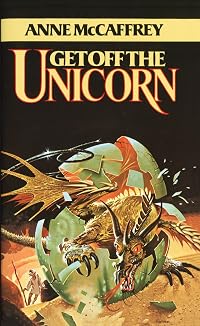
It's a collection of four stories, A Womanly Talent was originally published in Analog in 1969, Apple appeared in Crime prevention in the 30th Century in 1969 (even though it's set in the early 21st Century) and appears in Get off the Unicorn show more and A bridle for Pegasus appeared in Analog in 1973.
To Ride Pegasus is set in 1997, a story about the discovery of the reality of paranormal talents between an astrologer, Henry Darrow and a nurse with healing hands, Molly Mahony and the attempt to set up a centre for paranormal talents and to get Talents (as they refer to psychics) recognised as legitimate people.
A womanly talent felt the most dated in certain ways, set in the early 21st Century. The stories are of their time and some of the attitudes grate but they're also an interesting look at the perception of women and their roles from a woman's point of view. Then I thought about it again and I know women like that., so maybe not completely out of order.
Apple is all about hunting a larcenous talent and about pushing your talent.
A Bridle for Pegasus is a lot about ethics and understanding and an unusual relationship.
It's an interesting set of stories that set up the world that The Rowan and Damia come into, while they are dated (computer tapes and IBM CARDS!!) a lot of the core of the story is quite interesting and well done. Not her best, but as a backdrop to later stories an interesting read. show less
It's a collection of four short stories all centered about psionic talents in the late 20th early 21st century. This near-future (and now near-past in some instances) written in the 1960s and 1970s does have some quite interesting failures on the part of prediction, but it's interesting to look at a perception of the future at that time.
It's a collection of four stories, A Womanly Talent was originally published in Analog in 1969, Apple appeared in Crime prevention in the 30th Century in 1969 (even though it's set in the early 21st Century) and appears in Get off the Unicorn show more and A bridle for Pegasus appeared in Analog in 1973.
To Ride Pegasus is set in 1997, a story about the discovery of the reality of paranormal talents between an astrologer, Henry Darrow and a nurse with healing hands, Molly Mahony and the attempt to set up a centre for paranormal talents and to get Talents (as they refer to psychics) recognised as legitimate people.
A womanly talent felt the most dated in certain ways, set in the early 21st Century. The stories are of their time and some of the attitudes grate but they're also an interesting look at the perception of women and their roles from a woman's point of view. Then I thought about it again and I know women like that., so maybe not completely out of order.
Apple is all about hunting a larcenous talent and about pushing your talent.
A Bridle for Pegasus is a lot about ethics and understanding and an unusual relationship.
It's an interesting set of stories that set up the world that The Rowan and Damia come into, while they are dated (computer tapes and IBM CARDS!!) a lot of the core of the story is quite interesting and well done. Not her best, but as a backdrop to later stories an interesting read. show less
Some very interesting short stories strung together as a book - I love the focus on the legal implications of being able to predict the future. If you predict a disaster, so people spend lots of time and money on preventing it, and so it doesn't happen, are you legally responsible for all the time and money they 'wasted'? Cute ideas, but not gripping, and hard to follow the charecters.
Members
- Recently Added By
Lists

Best reading order of Anne McCaffrey's non-Pern sci-fi
43 works; 2 members

Speculative Fiction to Read
706 works; 32 members

Fantastical/Mythological Creatures in the Title
37 works; 2 members

Best Pern Books
79 works; 11 members
Author Information

260+ Works 208,128 Members
Anne McCaffrey was born in Cambridge, Massachusetts on April 1, 1926. She received a degree in Slavonic languages from Radcliffe College. She worked in advertising for Helena Rubenstein from 1947 to 1952. Her first publication was a short story in Science Fiction Magazine, and her first novel, Restoree, was published in 1967. She is a well-known show more author of over 100 books, mostly science fiction, including the Dragonriders of Pern series, the Crystal Singer series, Acorna's Children series, The Twins of Petaybee series, and Barque Cats series. She won numerous awards including the Hugo Award for Best Novella for the short story Weyr Search in 1968 and the Nebula Award for Best Novella for Dragonrider in 1969. In 2006, she was inducted into the Science Fiction Hall of Fame. She has also written books under the pseudonym Jody Lynn. She died of a stroke on November 21, 2011 at the age of 85. (Bowker Author Biography) show less
Some Editions
Series


Belongs to Publisher Series
Pocket (5439)
Heyne Science Fiction & Fantasy (06/4289)
Work Relationships
Common Knowledge
- Canonical title*
- Le galop d'essai
- Original title
- To Ride Pegasus
- Original publication date
- 1973-08
- People/Characters
- Amalda "Mally"; Joel Andres; Henry "Hank" Darrow; Frank Gillings; Gil Gracie; George Henner (show all 72); Barbara "Babs" Holland; Dorotea Horvath; Lajos Horvath; Ruth Horvath; Sally Iselin ap Owen; Mary "Molly" Mahony Darrow; Charity McGillicuddy; Solange "Maggie" O Boshe; Daffyd "Dai" "Dave" op Owen; Julian Pennstrak; Vsevolod "Vascha" Roznine; Dr Scherman; Dr Wahlman; Dr Rellahan; Titter Beyley; Watson Claire; Ralph "Rat" Watson; Abbey; Schwarz; Voscgin; Clasmir; Frank Hummel; Jerry; James "Jim" Marshall; Augustus "Gus" Molenar; James "Jim" Lawson; Steve Hawkins; Rambley; Frank Negelsco; Sen Maxwell; Sen Abrahams; Sen Montello; Sen Gratz; Sen Killiney; Benjamin "Ben" Anecon; Patsy "Pat" Tucker; Terry Cle; A Fracati; Irenee; Mara Canning; Manfield Zuesman; Jerry Frames; Cecily King; Lester "Les" Welch; Charlie "Charles" Moorefield; Henry Rizor; Mara Helgalt; Lambert Gould McNabb; Robert Bob Teague; Charles Mansfield; Ted Lewis; Harrold Orley; Julian Pennstrak; Pat Tawfick; Sam; Webster "Web"; Heib; Bill Jones; Aaron Greenfield; Dick Ditts; Harry Ditts; Norman Kabilov; Bruce Red Vaden; Carla Jacobs; Croner; Pete
- Important places
- Jerhattan, North America
- Dedication
- This book is
respectfully dedicated to
Betty Ballantine,
a woman of many talents - First words
- The slick pavement, oily with rain and motor lubricants that had dripped from the hundreds of ill-repaired vehicles utilizing the major north-south artery into Jerhattan, caused the accident.
- Last words
- (Click to show. Warning: May contain spoilers.)"With the ambition and drive that young man has, he'd rule the world in half a year if Amalda and Bruce weren't there to stop him."
- Publisher's editor*
- Jacques Goimard
- Original language
- English
- Canonical DDC/MDS
- 813.54
- Canonical LCC
- PS3563.A255
- Disambiguation notice
- The short stories in this volume should not be combined with the stories of the same name (and plot) as the following:
Apple c1967 - Crime Prevention in the 20th Century
A Womanly Talent c1969 - Analog
A Brid... (show all)le for Pegasus c1973, Analog
To Ride Pegasus c1973 appears to have been written for this volume
*Some information comes from Common Knowledge in other languages. Click "Edit" for more information.
Classifications
Statistics
- Members
- 2,886
- Popularity
- 6,243
- Reviews
- 27
- Rating
- (3.71)
- Languages
- 5 — English, French, German, Hungarian, Polish
- Media
- Paper, Audiobook, Ebook
- ISBNs
- 30
- ASINs
- 21