On This Page
Description
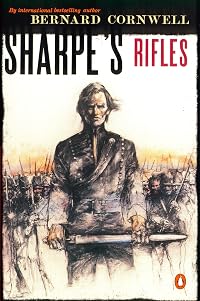
It's 1809 and the powerful French juggernaut is sweeping across Spain. Lieutenant Sharpe is newly in command of the demoralized, distrustful men of the 95th Rifles. He must lead them to safety and the only means of escape is a treacherous trek through the enemy-infested mountains of Spain. Blas Vivar and his band of intrepid Spanish soldiers may prove to be their salvation. But Vivar is transporting a mysterious chest that he claims can shift the tides of war, and the French are determined show more to get it-no matter what the cost. show lessTags
Recommendations





Member Reviews
"He might not be a born officer, but by God he was a born soldier. He was the son of a whore, bereft of God, but a God-damned soldier."
I've decided that the best way to approach the Sharpe series -- in which the publication order differs so radically from the publication order as to seem all but an exercise in randomization -- the way one does when reading stories about Conan the Cimmerian. There might be some narrative carry-over from novel to novel, but it's best to just regard them as discrete stories that happen to be about a guy with the same name and more or less the same character.
I say this because Sharpe's Rifles is the point where a lot of people who have chosen to read these books in chronological order start complaining show more about inconsistencies. The book was written some half a dozen years after those of the original core series, but cast as a prequel to them -- and the books I've read so far were written many, many years after this one, but take place earlier in Sharpe's career.
So in a lot of ways, the Richard Sharpe in Sharpe's Rifles bears little resemblance to the character I've grown to love through his adventures in India, at sea, and in Denmark, except in the ways described in the ur-Cornwellian sentence I quoted at the beginning of this post. He's still pretty uncouth and brutal, still an all but conscience-less and cold-blooded killer, but he seems only to have honed those qualities from his prior adventures* but not to have experienced the character building that came with them. To wit: he is unsure in his authority (though it could be argued that the years he has spent as a downtrodden Quartermaster for the 95th Rifles might have eroded the confidence he gained in India and Denmark), a complete sucker for anything in a skirt (see my asterisk below) and taking lessons in leadership from the Spanish major Bias Vivar that he really ought already to have absorbed from the good examples of his protectors in India like McCandless.
But these are small quibbles, and become meaningless once one has agreed to treat the novels as things outside of time and narrative continuity. Especially when the material at hand is so good, as it is here. For Sharpe's Rifles has everything I've come to expect from a Sharpe story: over-the-top adventure (here a ragtag band of survivors of a famous retreat across Spain is teaming up with a small-but-elite cadre of the Spanish army commanded by the aforementioned Don Bias on a mission to bring a Holy McGuffin to the Cathedral at Santiago de Compostella and thus create a new legend to inspire the Spanish peasantry to rise up against the hated French invaders), internecine bickering, inspired combat tactics, cold chivalry among enemies, and all the fighting, drinking and swearing (if not, this time, the whoring) one might expect from a good piece of military fiction.
Here, too, is an origin story of sorts, though its significance is lost to chronological readers who have not osmotically absorbed a certain level of meta-knowledge about the series -- for it is here that Sharpe and his gonna-be best friend, Sergeant Harper, meet for the first time. And it's a pretty good meet as those go -- Harper almost stages a mutiny against Sharpe! -- but it's still not as good as Aubrey and Maturin and the concert at Port Mahon. But that's maybe not a fair comparison, right? I'm sure back in the 1980s when only the original core Peninsular War books existed, fans of Sharpe/Harper were delighted to observe this meeting, but for us chronological readers starting in the 21st century, it will never have the same power.
Still, cracking good stuff. Again, lots of explorations of how the rifle changed warfare, and how swords still matter, even if one sword is in the hand of a guy astride a big horse and the other in the hand of a guy on foot who ran out of ammo or out of time to reload his weapon, lots of amusing ruses de guerre... and then there's the attack on Santiago itself, which doesn't hold a candle to the big set-piece battles we saw in India, but is still very satisfying indeed.
Truly, Sharpe never disappoints.
*At least, thank goodness, his prior adventures don't involve a lot of ret-conning; the allusions to his deeds in India, at Seringapatam and Gawalghur, etc. match up with the stories I've read. Well, except for Lady Grace, his lover from Sharpe's Waterloo who died after giving him a son before Sharpe's Prey. I'm pretty sure that once you've bedded a gorgeous noblewoman you're not going to be so terribly overawed by a mere member of the impecunious country gentry, however mischievous and cute. show less
I've decided that the best way to approach the Sharpe series -- in which the publication order differs so radically from the publication order as to seem all but an exercise in randomization -- the way one does when reading stories about Conan the Cimmerian. There might be some narrative carry-over from novel to novel, but it's best to just regard them as discrete stories that happen to be about a guy with the same name and more or less the same character.
I say this because Sharpe's Rifles is the point where a lot of people who have chosen to read these books in chronological order start complaining show more about inconsistencies. The book was written some half a dozen years after those of the original core series, but cast as a prequel to them -- and the books I've read so far were written many, many years after this one, but take place earlier in Sharpe's career.
So in a lot of ways, the Richard Sharpe in Sharpe's Rifles bears little resemblance to the character I've grown to love through his adventures in India, at sea, and in Denmark, except in the ways described in the ur-Cornwellian sentence I quoted at the beginning of this post. He's still pretty uncouth and brutal, still an all but conscience-less and cold-blooded killer, but he seems only to have honed those qualities from his prior adventures* but not to have experienced the character building that came with them. To wit: he is unsure in his authority (though it could be argued that the years he has spent as a downtrodden Quartermaster for the 95th Rifles might have eroded the confidence he gained in India and Denmark), a complete sucker for anything in a skirt (see my asterisk below) and taking lessons in leadership from the Spanish major Bias Vivar that he really ought already to have absorbed from the good examples of his protectors in India like McCandless.
But these are small quibbles, and become meaningless once one has agreed to treat the novels as things outside of time and narrative continuity. Especially when the material at hand is so good, as it is here. For Sharpe's Rifles has everything I've come to expect from a Sharpe story: over-the-top adventure (here a ragtag band of survivors of a famous retreat across Spain is teaming up with a small-but-elite cadre of the Spanish army commanded by the aforementioned Don Bias on a mission to bring a Holy McGuffin to the Cathedral at Santiago de Compostella and thus create a new legend to inspire the Spanish peasantry to rise up against the hated French invaders), internecine bickering, inspired combat tactics, cold chivalry among enemies, and all the fighting, drinking and swearing (if not, this time, the whoring) one might expect from a good piece of military fiction.
Here, too, is an origin story of sorts, though its significance is lost to chronological readers who have not osmotically absorbed a certain level of meta-knowledge about the series -- for it is here that Sharpe and his gonna-be best friend, Sergeant Harper, meet for the first time. And it's a pretty good meet as those go -- Harper almost stages a mutiny against Sharpe! -- but it's still not as good as Aubrey and Maturin and the concert at Port Mahon. But that's maybe not a fair comparison, right? I'm sure back in the 1980s when only the original core Peninsular War books existed, fans of Sharpe/Harper were delighted to observe this meeting, but for us chronological readers starting in the 21st century, it will never have the same power.
Still, cracking good stuff. Again, lots of explorations of how the rifle changed warfare, and how swords still matter, even if one sword is in the hand of a guy astride a big horse and the other in the hand of a guy on foot who ran out of ammo or out of time to reload his weapon, lots of amusing ruses de guerre... and then there's the attack on Santiago itself, which doesn't hold a candle to the big set-piece battles we saw in India, but is still very satisfying indeed.
Truly, Sharpe never disappoints.
*At least, thank goodness, his prior adventures don't involve a lot of ret-conning; the allusions to his deeds in India, at Seringapatam and Gawalghur, etc. match up with the stories I've read. Well, except for Lady Grace, his lover from Sharpe's Waterloo who died after giving him a son before Sharpe's Prey. I'm pretty sure that once you've bedded a gorgeous noblewoman you're not going to be so terribly overawed by a mere member of the impecunious country gentry, however mischievous and cute. show less
I truly liked this book a lot, it was a fast read for me. Mostly because I enjoyed the twists and turns. There were many of them, it kept me on my toes and I liked that. One of those books that I really had no idea what could possibly happen next, making me enjoy the mysteriousness that much more.
Though the beginning is slow and too detailed for my taste, the book provides a fascinating look into the routine of the English regiment during Napoleonic Wars. Sharpe's character evolves with the plot movement, and in a way his journey through French occupied Spain is his rite of passage: he grows up to become a leader of his men.
This is the sixth episode, chronologically, in the adventures of Richard Sharpe, British infantryman during the Napoleonic Wars.
Up front, let me say that this book is still a lot of fun. It's only in comparison to the first five that I downgrade it a bit.
This book was written ninth, which might seem fairly far along in the 24 book series, but it was still before the first five books that preceded it chronologically. I think that this shows in a couple of ways.
You get some hints of this in the facts of the story. In one scene, Sharpe is recounting the battles he has fought in and needs to make a fairly complete accounting. Though he mentions Seringapatam, Assaye and Gawilghur, he omits mention of Trafalgar and Copenhagen...presumably show more Cornwell hadn't thought of those adventures, yet. There is also a bit of an inconsistency in his reaction to the weight of Murray's cavalry saber, though he used—and liked—a much heavier sword in India during the first three books. However, those types of things are really very minor and don't detract from the book.
What did detract, for me, from the last sixth of the book was Sharpe's character. It seemed less formed that it had in the first five books. Without giving specific spoilers, I thought this was most notable in his reactions to Louisa Parker toward the end: his initial response felt right but, within a day, this brooding, sensitive, sometimes bitter fellow was somehow happy-go-lucky and accepting of rather unfair and certainly unexpected behavior toward him by a couple of individuals. It didn't fit the Sharpe we've come to know and didn't ring true.
On the positive side, we get an exciting opening and, once we get past a bit of mysticism in the middle, a quite exciting ending. We get introduced to Patrick Harper who is almost as an enjoyable character as Sharpe, and who I understand plays a major role in succeeding volumes.
The series is very good; this particular episode is good. I continue to recommend them. show less
Up front, let me say that this book is still a lot of fun. It's only in comparison to the first five that I downgrade it a bit.
This book was written ninth, which might seem fairly far along in the 24 book series, but it was still before the first five books that preceded it chronologically. I think that this shows in a couple of ways.
You get some hints of this in the facts of the story. In one scene, Sharpe is recounting the battles he has fought in and needs to make a fairly complete accounting. Though he mentions Seringapatam, Assaye and Gawilghur, he omits mention of Trafalgar and Copenhagen...presumably show more Cornwell hadn't thought of those adventures, yet. There is also a bit of an inconsistency in his reaction to the weight of Murray's cavalry saber, though he used—and liked—a much heavier sword in India during the first three books. However, those types of things are really very minor and don't detract from the book.
What did detract, for me, from the last sixth of the book was Sharpe's character. It seemed less formed that it had in the first five books. Without giving specific spoilers, I thought this was most notable in his reactions to Louisa Parker toward the end: his initial response felt right but, within a day, this brooding, sensitive, sometimes bitter fellow was somehow happy-go-lucky and accepting of rather unfair and certainly unexpected behavior toward him by a couple of individuals. It didn't fit the Sharpe we've come to know and didn't ring true.
On the positive side, we get an exciting opening and, once we get past a bit of mysticism in the middle, a quite exciting ending. We get introduced to Patrick Harper who is almost as an enjoyable character as Sharpe, and who I understand plays a major role in succeeding volumes.
The series is very good; this particular episode is good. I continue to recommend them. show less
Sharpe's history of the Peninsular War starts here, in the 9th book written on him by Cornwell. It's good fun, fairly historically accurate, and sets up the characters well, but that's not too surprizing, as we already know them. But I began Sharpe with this effort and was honestly sucked in. Keep hearing Sean Bean doing the lines though.
Though Bernard Cornwell has added many more Sharpe's novels to the collection, Sharpe's Rifles is the first in the original series of eleven books that goes chronologically from the defeat of Sir John Moore's column in Spain in 1809 to the final defeat of Napoleon at Waterloo in 1815.
We meet Lieutenant Richard Sharpe, despised by his officers and men as former enlisted man elevated to an officer by an act of suicidal bravery. Not a gentleman of means, not having purchased his position, Sharpe is a pariah among the officers. He is equally isolated from his men who think that only their betters can lead them. It is this struggle for acceptance that dog Sharpe throughout Cornwell's novels.
In Sharpe's Rifles, Sharpe finds himself cut off show more from the rest of Moore's army ,which will be embarked for England at Corunna, and is forced to find its way to the British garrison at Lisbon. Along the way he falls in with a Spanish cavalry leader guarding a secretive treasure, and on a strange mission. As with most Sharpe's adventures, he also encounters a menacing enemy, and participates in a desperate battle, often complicated by his attraction to a beautiful woman-in this case, the lovely 19-year old Louisa, seeking adventure in Spain.
Though the novels often seem formulaic, Cornwell gets at least 95% of the history right, is a wonderful story teller with a masterly descriptive style. show less
We meet Lieutenant Richard Sharpe, despised by his officers and men as former enlisted man elevated to an officer by an act of suicidal bravery. Not a gentleman of means, not having purchased his position, Sharpe is a pariah among the officers. He is equally isolated from his men who think that only their betters can lead them. It is this struggle for acceptance that dog Sharpe throughout Cornwell's novels.
In Sharpe's Rifles, Sharpe finds himself cut off show more from the rest of Moore's army ,which will be embarked for England at Corunna, and is forced to find its way to the British garrison at Lisbon. Along the way he falls in with a Spanish cavalry leader guarding a secretive treasure, and on a strange mission. As with most Sharpe's adventures, he also encounters a menacing enemy, and participates in a desperate battle, often complicated by his attraction to a beautiful woman-in this case, the lovely 19-year old Louisa, seeking adventure in Spain.
Though the novels often seem formulaic, Cornwell gets at least 95% of the history right, is a wonderful story teller with a masterly descriptive style. show less
#6 in the Richard Sharpe series.
Two years have passed since the Copenhagen campaign, and in January, 1809, Sharpe finds himself, along wiht about three hundred men of the 95th Rifles, in Galician Spain running for safety, along with the rest of the defeated British army, from the French victory at Corunna. But in the retreat, Sharpe and the Rifles have become cut off from the main part of the army. Far from taking part in the fighting, Sharpe is Quartermaster of the 95th, a menial and to him, humiliating task. Still, he tries to fulfill his duties, making sure that the men load up on extra powder and shot as they prepare to leave everything behind and run.
However, before the Rifles can fully recoup in the small village in which they're show more recovering (mostly by drinking themselves insensible), the French appear in the form of dragoons, cavalry. As a result of the ensuing fight, all the officers die, leaving Sharpe in command of a much reduced band of Rifles who do not accept his authority--he is not a proper officer in their minds, not a "proper gentleman". As Sharpe, keenly aware of the resentment and feeling awkward in his new role as commanding officer, makes plans to lead the men to safety, he is met with rebellion in the ranks. The men designate Rifleman Harper, a big bull of an Irishman, as their "spokesman"--in reality, as Sharpe realizes, to kill him. Sharpe and Harper engage in a fight to the death--which is interrupted, just as Sharpe is about to skewer Harper, by the appearance of a Spanish cavalry officer, Major Blas Vivar and what is left of his company of elite cavalry, the Cazadores.
Thus begins the strange odyssey of Sharpe and the Rifles as they accompany Major Blas to Santtiago de Compostela, Spain's holiest site, and an impossible mission which results in a suicidal attack on the French.
This is military action-adventure at its very best. The action is non-stop and the fight/battle scenes are superbly written. As an ardent fan of Patrick O'Brian and the Aubrey/Maturin series, I must say that Sharpe's Rifles is as least as well written as O'Brian's best; the only difference is that Jack Aubrey and Stephen Maturin evolve into far more complex characters--Sharpe, over 6 books, has not changed much. But he's developed enough to be believable, and devotees of the genre will not even notice the lack.
highly recommended. show less
Two years have passed since the Copenhagen campaign, and in January, 1809, Sharpe finds himself, along wiht about three hundred men of the 95th Rifles, in Galician Spain running for safety, along with the rest of the defeated British army, from the French victory at Corunna. But in the retreat, Sharpe and the Rifles have become cut off from the main part of the army. Far from taking part in the fighting, Sharpe is Quartermaster of the 95th, a menial and to him, humiliating task. Still, he tries to fulfill his duties, making sure that the men load up on extra powder and shot as they prepare to leave everything behind and run.
However, before the Rifles can fully recoup in the small village in which they're show more recovering (mostly by drinking themselves insensible), the French appear in the form of dragoons, cavalry. As a result of the ensuing fight, all the officers die, leaving Sharpe in command of a much reduced band of Rifles who do not accept his authority--he is not a proper officer in their minds, not a "proper gentleman". As Sharpe, keenly aware of the resentment and feeling awkward in his new role as commanding officer, makes plans to lead the men to safety, he is met with rebellion in the ranks. The men designate Rifleman Harper, a big bull of an Irishman, as their "spokesman"--in reality, as Sharpe realizes, to kill him. Sharpe and Harper engage in a fight to the death--which is interrupted, just as Sharpe is about to skewer Harper, by the appearance of a Spanish cavalry officer, Major Blas Vivar and what is left of his company of elite cavalry, the Cazadores.
Thus begins the strange odyssey of Sharpe and the Rifles as they accompany Major Blas to Santtiago de Compostela, Spain's holiest site, and an impossible mission which results in a suicidal attack on the French.
This is military action-adventure at its very best. The action is non-stop and the fight/battle scenes are superbly written. As an ardent fan of Patrick O'Brian and the Aubrey/Maturin series, I must say that Sharpe's Rifles is as least as well written as O'Brian's best; the only difference is that Jack Aubrey and Stephen Maturin evolve into far more complex characters--Sharpe, over 6 books, has not changed much. But he's developed enough to be believable, and devotees of the genre will not even notice the lack.
highly recommended. show less
Members
- Recently Added By
Lists

Favourite Books
1,820 works; 316 members
Historical Fiction
889 works; 91 members

THE WAR ROOM
813 works; 24 members
Author Information

172+ Works 93,854 Members
Bernard Cornwell was born in London, England, on February 23, 1944, and came to the United States in 1980. He received a B.A. from the University of London in 1967. Cornwell served as producer of the British Broadcasting Corporation from 1969-1976. After this he was head of current affairs for BBC-TV in Belfast, Northern Ireland. In 1979 he became show more editor of television news for Thames Television of London. Since 1980 he has been a freelance writer. he lives with his wife on Cape Cod. Cornwell's Sharpe series, adventure stories about a British soldier set in the Peninsula War of 1808-1814, are built on the author's interest in the Duke of Wellington's army. Titles include Sharpe's Rifles, Sharpe's Revenge, Sharpe's Siege, Sharpe's Regiment, and Sharpe's Waterloo. The Last Kingdom series has ten books. Book ten, The Flame Bearer is on the bestsellers list. He has also written other works including Wildtrack, Killer's Wake, Sea Lord, Stormchild, Rebel, Copperhead, and Battle Flag. His title Death of Kings made The New York Times Best Seller List in 2012 and In 2014 his title The Pagan Lord made the list again. (Bowker Author Biography) show less
Some Editions
Series

Work Relationships
Is contained in
Sharpe's Rifles | Sharpe's Havoc | Sharpe's Eagle | Sharpe's Gold | Sharpe's Escape by Bernard Cornwell
Sharpe's War Battle Collection (Sharpe's Waterloo, Sharpe's Siege, Sharpe's Regiment, Sharpe's Company, Sharpe's Battle, Sharpe's Fury, Sharpe's Escape, Sharpe's Gold, Sharpe's Eagle, Sharpe's Havoc, Sharpe's Rifles, Sharpe's Prey, Sharpe's Trafalgar, Sharpe's Fortress, Sharpe's Triumph, Sharpe's Tiger) by Bernard Cornwell
Sharpe Series (Sharpe's Trafalgar; Sharpe's Tiger; Sharpe's Triumph; Sharpe's Fortress; Sharpe's Prey; Sharpe's Rifles; Sharpe's Havoc; Sharpe's Eagle; Sharpe's Gold; Sharpe's Escape; Sharpe's Battle; Sharpe's Company; Sharpe's Sword; Sharpe's Enemy) by Bernard Cornwell
Sharpe Series (Sharpe's Rifles, Sharpe's Eagle, Sharpe's Company, Sharpe's Sword, Sharpe's Battle, Sharpe's Honour, Sharpe's Regiment, Sharpe's Devil) by Bernard Cornwell
Has the adaptation
Is abridged in
Has as a reference guide/companion
Common Knowledge
- Canonical title
- Sharpe's Rifles
- Original title
- Sharpe's Rifles
- Alternate titles
- Sharpe's Rifles: Richard Sharpe and the French Invasion of Galicia, January 1809
- Original publication date
- 1988-12
- People/Characters
- Richard Sharpe; Patrick Harper; Arthur Wellesley, 1st Duke of Wellington; Major Blas Vivar; Louisa Parker; Marshal Soult (show all 11); Sir John Moore; Count of Mouromorto; Michael Hogan; Daniel Hagman; Captain Murray
- Important places
- Santiago de Compostela, Galicia, Spain
- Related movies
- Sharpe's Rifles (1993 | IMDb)
- Dedication
- For Carolyn Ryan
- First words
- The prize was a strongbox.
- Last words
- (Click to show. Warning: May contain spoilers.)They were Sharpe's Rifles.
Classifications
Statistics
- Members
- 1,992
- Popularity
- 10,604
- Reviews
- 26
- Rating
- (4.00)
- Languages
- 8 — Czech, English, German, Hungarian, Italian, Polish, Portuguese, Spanish
- Media
- Paper, Audiobook, Ebook
- ISBNs
- 52
- ASINs
- 22