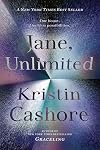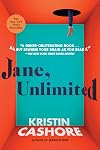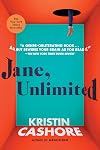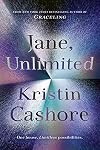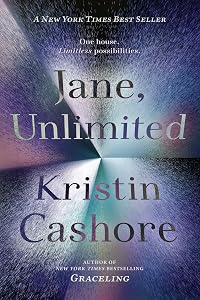
Jane, Unlimited
by Kristin Cashore
On This Page
Description
An instant New York Times bestseller--from the award-winning author of the Graceling Realm series--about adventure, grief, storytelling, and finding yourself in a world of seemingly infinite choices. "A wild gift for readers who like books that take them to unexpected places."--Melissa Albert, author of The Hazel Wood Jane has lived a mostly ordinary life, raised by her recently deceased aunt Magnolia, whom she counted on to turn life into an adventure. Without Aunt Magnolia, Jane is lost. show more So she's easily swept away when a glamorous, capricious, and wealthy acquaintance from years ago asks Jane to accompany her to a gala at the extravagant island mansion called Tu Reviens. Jane remembers her aunt telling her: "If anyone ever invites to you to Tu Reviens, promise me that you'll go." What Jane doesn't know is that the house will offer her five choices that could ultimately determine the course of her life. One choice leads Jane into a heist mystery. Another takes her into a spy thriller. She finds herself in a gothic horror story, a space opera, and an extraordinary fantasy realm. She might fall in love, she might lose her life, she might come face-to-face with herself. Every choice comes with a price. But together, all the choices will lead her to the truth. One house. Five choices. Limitless possibilities. Read Jane, Unlimited and remember why The New York Times has raved, "Some authors can tell a good story; some can write well. Cashore is one of the rare novelists who do both." show lessTags
Recommendations


Member Recommendations
Member Reviews
I seem to be in a rut, involving heist books set in mysterious, somewhat sentient houses. Fortunately for me, that appears to be one of my favorite genres, so hooray. This one is somewhat of a choose your own adventure book with Cashore roaring back into the publishing world and proving without a shadow of a doubt that she is a mind-bendingly interesting writer that can spin a story you won't want to put down.
Jane is endearing and stubbornly funny. Her umbrella artistry is fascinating. Her adventures in Tu Reviens are multiple and vary in their degree of happiness -- I've decided to go with the first or the final possibilities, because they make me happiest, but I also long to know how some of the scenarios might continue to play out show more after the first choice is made, because surely Jane doesn't forget all the other things altogether? Is she aware as the choices are mapped out? Does she choose? Kiran's experiences seem to indicate maybe yes. And that is why I love Kristin Cashore -- implications and explorations without making all the decisions for the reader, and with a cunning illustration of mirror universes. Nicely done. show less
Jane is endearing and stubbornly funny. Her umbrella artistry is fascinating. Her adventures in Tu Reviens are multiple and vary in their degree of happiness -- I've decided to go with the first or the final possibilities, because they make me happiest, but I also long to know how some of the scenarios might continue to play out show more after the first choice is made, because surely Jane doesn't forget all the other things altogether? Is she aware as the choices are mapped out? Does she choose? Kiran's experiences seem to indicate maybe yes. And that is why I love Kristin Cashore -- implications and explorations without making all the decisions for the reader, and with a cunning illustration of mirror universes. Nicely done. show less
Jane, Unlimited has a certain number of parallels to Jane Eyre: eighteen year old Jane is an orphan with an artistic streak who has been raised by her aunt; she goes to stay in a mansion and discovers its secrets. But it isn’t really a Jane Eyre retelling, for this is where the parallels end.
Jane, devastated when her Aunt Magnolia, an underwater photographer, dies during a trip to Antarctica, fails biology and drops out of college. An old acquaintance, Kiran Thrash, finds Jane miserable and working in the college bookshop, and invites her to Tu Reviens, the Thrash family’s island mansion. Tu Reviens is preparing for the spring gala and Jane quickly has unanswered questions about the goings-on of the family, the other guests, the show more servants and even the basset hound. There’s missing artwork, a missing child, a missing stepmother… And why did Aunt Magnolia make Jane promise to never turn down an invitation to Tu Reviens?
There’s a point in the story where Jane has to decide which mystery to pursue first. What follows is a series of possible adventures, in which Jane makes a different choice and uncovers different secrets. Each adventure is stranger than the one before. Each a different genre.
I loved them all - with the notable exception of the third one, a horror story involving a creepy library, a warped copy of Winnie-the-Pooh and Beatles songs. I suspect I found it all the more disturbing, because it took things I love and twisted them. Or maybe I would have been disturbed by it no matter what it twisted? Horror is not my genre. It was the only point where I regretted listening to the audiobook, because I couldn’t just skim-read through it.
Each of these stories is a different genre, but as the novel continues, it becomes possible for the reader to see how, often unbeknownst to Jane, the other stories are going on in the background. Even if sometimes they unfold very differently if Jane doesn't become involved. (Fortunately the horror-element is pretty much limited to the third story.) And as each unfolds, different sides to the characters are revealed - which can be fascinating and surprising.
Although each story is different, Jane continues to be Jane. She wears Doctor Who pyjamas and quotes Winnie-the-Pooh and makes unusual, handmade umbrellas. She is immediately connects with Ivy, one of the servants, and Jasper, the basset hound. She grieves for her Aunt Magnolia.
This is a highly usual story, full of surprises and characters I cared about. It's compelling and I'm really am glad I read it (in spite of the horror).
Christopher Robin and Winnie-the-Pooh set out to sea once in an umbrella, Jane remembers. During a flood, to save Piglet.
Maybe, she thinks to herself, she should take her umbrellas down to the water, turn them upside down like boats, and send them off on the waves, carrying nothing. Maybe if they carried away all the nothing, she’d be left with something.
A note on the audiobook: The only downside is that you don’t get the maps of the house, and this was the sort of story where I really wanted to consult the maps. But I found an online preview of the book which included the maps easily, so that worked out. Floorplans! I love floorplans for fictional buildings! show less
Jane, devastated when her Aunt Magnolia, an underwater photographer, dies during a trip to Antarctica, fails biology and drops out of college. An old acquaintance, Kiran Thrash, finds Jane miserable and working in the college bookshop, and invites her to Tu Reviens, the Thrash family’s island mansion. Tu Reviens is preparing for the spring gala and Jane quickly has unanswered questions about the goings-on of the family, the other guests, the show more servants and even the basset hound. There’s missing artwork, a missing child, a missing stepmother… And why did Aunt Magnolia make Jane promise to never turn down an invitation to Tu Reviens?
There’s a point in the story where Jane has to decide which mystery to pursue first. What follows is a series of possible adventures, in which Jane makes a different choice and uncovers different secrets. Each adventure is stranger than the one before. Each a different genre.
I loved them all - with the notable exception of the third one, a horror story involving a creepy library, a warped copy of Winnie-the-Pooh and Beatles songs. I suspect I found it all the more disturbing, because it took things I love and twisted them. Or maybe I would have been disturbed by it no matter what it twisted? Horror is not my genre. It was the only point where I regretted listening to the audiobook, because I couldn’t just skim-read through it.
Each of these stories is a different genre, but as the novel continues, it becomes possible for the reader to see how, often unbeknownst to Jane, the other stories are going on in the background. Even if sometimes they unfold very differently if Jane doesn't become involved. (Fortunately the horror-element is pretty much limited to the third story.) And as each unfolds, different sides to the characters are revealed - which can be fascinating and surprising.
Although each story is different, Jane continues to be Jane. She wears Doctor Who pyjamas and quotes Winnie-the-Pooh and makes unusual, handmade umbrellas. She is immediately connects with Ivy, one of the servants, and Jasper, the basset hound. She grieves for her Aunt Magnolia.
This is a highly usual story, full of surprises and characters I cared about. It's compelling and I'm really am glad I read it (in spite of the horror).
Christopher Robin and Winnie-the-Pooh set out to sea once in an umbrella, Jane remembers. During a flood, to save Piglet.
Maybe, she thinks to herself, she should take her umbrellas down to the water, turn them upside down like boats, and send them off on the waves, carrying nothing. Maybe if they carried away all the nothing, she’d be left with something.
A note on the audiobook: The only downside is that you don’t get the maps of the house, and this was the sort of story where I really wanted to consult the maps. But I found an online preview of the book which included the maps easily, so that worked out. Floorplans! I love floorplans for fictional buildings! show less
This book is excellent, although I didn't really enjoy it as much as it probably merited. How can both those statements be true? The fact is, while I appreciated the artistry and loved the characters, the structure of the book did not appeal to me. But I couldn’t help but admire it anyway, and I certainly couldn't stop thinking about all the ideas within it.
The book is divided into sections that retell the basic story several times. Each iteration is set off by a different response to the same circumstances made by Jane, who is 18 and has recently lost the only mother she ever knew, her Aunt Magnolia. Each choice Jane makes leads to a different reality, and therein lies the plot.
Jane has accepted an invitation from her former high show more school tutor Kiran to stay at Kiran’s family estate, “Tu Reviens.” Jane agrees because she made a promise to her Aunt Magnolia before her aunt left on her final trip: “You remember your old writing tutor?” Kiran Thrash?” Aunt Magnolia said to her. “. . . If anyone ever invites you to Tu Reviens, promise me that you’ll go.” “Okay,” Jane had said. “Um, why?” Her aunt replied cryptically, “I’ve heard it’s a place of opportunity.”
Now, the author writes: “Jane suddenly feels like a character in a novel by Edith Wharton or the Brontës:
"I’m a young woman of reduced circumstances, with no family and no prospects, invited by a wealthy family to their glamorous estate. Could this be my heroic journey?”
And indeed, it turns out to be just that.
The name of the mansion, which translates to “You Return,” has more than one meaning (as does just about everything in this book). The building itself has been cobbled together from different pieces from different eras. Each room evokes a different time and different mood. The house, in essence, is a metaphor for the multiverse.
As one of the many guests in the house explains to Jane:
“The concept of the multiverse comes from the idea that every time something happens, everything else that could have happened in that moment also happens, causing new universes to break off from the old universe and come into being. So there are multiple versions of us, living different lives than the ones we live, across multiple universes, making every decision we could possibly make.”
Kiran often speculates on this idea to Jane. (Kiran’s mother is a quantum physicist and the idea of interdimensionality is much on Kiran’s mind.) She says, “I’m finding . . . that despite everything, I’m glad to live in this universe. . . . If we live in a multiverse, in which multiple versions of us liver alternate lives in an infinite series of universes, I’m glad I live in this one. I think that maybe I’m better off than some other Kirans.”
Jane is perplexed by all the strangeness she encounters in the house. Even Jasper, the basset hound, seems bizarrely attached to her, and intent on nosing her this way and that as she explores the house.
Jane takes solace in fashioning umbrellas, which she has elevated to an art form. She brings all of her umbrellas - 37 of them - and supplies to make more, with her to Tu Reviens. She relates to them and even anthropomorphizes them:
“How nice, to have a weather-resistant skin and a body that can vibrate with tension or be at rest. How satisfying to have working parts, lovingly crafted. Rain is a musical patter against Jane’s imagination. Every umbrella is born knowing that sound, its soul straining for that sound, waiting patiently through rainless day after rainless day for the day when raindrops will thrum against its skin.”
Ravi, Kiran’s twin and an art dealer, admires her umbrellas, and says Jane is a real artist. He opines that she could even open a shop somewhere, like in Paris. “Paris?,” Jane asks incredulously. “Or wherever,” Ravi says. “The world is your rainstorm.”
And of course Kiran’s reaction is: “What if you’d been born in a universe where there was no rain?”
With every new understanding Jane gleans, she fashions a new umbrella to express it. What, Jane finally wonders, would a “transdimensional” umbrella be like? “It would need to be able to blend into any scenario, in any kind of world, without drawing attention to itself. Jane has never made a plain black umbrella before.”
There are any number of more concrete mysteries than just philosophical ones that Jane encounters in the house. There has been an art theft, and the servants act very strange. So do the other guests, who sneak around at night carrying supplies and even guns. A mysterious little girl is running around the house, and Kiran’s father’s second wife Charlotte is missing. His first wife Anita apparently resides in the mansion - somewhere - but Jane never sees either wife. The house is full of whispering sounds, and sometimes shouting and music coming from strange places. And there is romance in the air. Or not. Kiran has a boyfriend Colin who is staying at the house, and Ravi has a girlfriend Lucy there, but neither Kiran nor Ravi seem happy in their relationships. Does Kiran really love one of the “servants,” Patrick? But if so, why is she so angry at him? And what about Patrick’s beautiful sister Ivy? She is always up to something strange, but Jane is attracted to her as well as to Ravi.
Part I ends, and a bell rings somewhere, just as Jane must make a choice. Should she go with Kiran to see the library and hear about Charlotte, or go talk to Mrs. Vanders, the housekeeper, who apparently knew Aunt Magnolia, or try to find out who the little girl is, or go talk to Ravi or to Ivy? And then there is Jasper, also nudging her to follow him. Which direction should she choose? The next sections all start the same, and tell what happened each time when Jane made a different choice.
Each selection in fact opens up an entire new universe, and takes the story in a new direction and a new genre! It is a crime story, then a spy story, then a horror story, then a science fiction story. Meanwhile, more of the plot strands are revealed as they come together in new ways. But the universe has bifurcated with each different choice, and suddenly there are contrasting versions of the same essential reality.
Indeed, one of the major themes is the repercussions to choices we make. Suppose, for example, you choose one college for a major as opposed to a different college in a different state for a different major. Then you may meet a different life partner than you would have otherwise. Or you decide to date one person over another. How do we know which option is the “right” one? As Kiran says to Jane about Colin: “I feel like I should like him.” Jane replies: “Aunt Magnolia used to tell me to be careful not to should all over myself…”
Another theme is that of trust and its counterpart, betrayal. This too is cleverly tied to the idea of different universes. As Jane describes betrayal, “It’s like having everything ripped away from you and then thrown back at you all sharp and unrecognizable.” So too is the notion of a different twist on a reality you thought you knew.
A rather humorous thread running through the book is, unexpectedly, that of frogs. Frogs turn up continuously in unexpected ways, often as a substitute for cats or dogs. For example, Jane’s mother, prior to her death in an accident, had been near the end of her dissertation on a new meteorological explanation for why it rains frogs. The Vermeer painting stolen from Tu Reviens, “Lady Writing a Letter with her Maid” is here depicted as “Lady Writing a Letter with her Frog.” And instead of “Schrodinger’s cat” the famous physics concept is referred to as “Schrodinger’s frog.” Is this our universe, or a different one?
In place of the stolen Vermeer there is a forgery - yet another related theme. Not only does this highlight the idea of the same thing with a slight difference, but forged copies get Jane to think about copies in general: “What if it turned out that there were copies of Aunt Magnolia? . . . What if Jane’s personal copy wasn’t the original? Would that make Jane’s aunt Magnolia less precious? Wasn’t Jane’s copy precious because she was Jane’s?
[There are so many references to other books within this book, just as there are so many universes invoked. With the preceding quote you might be reminded of Antoine de Saint-Exupéry's The Little Prince. Other works alluded to include The Chronicles of Narnia: The Lion, The Witch and the Wardrobe, other time travel books, Dr. Who, Daphne DuMaurier’s Rebecca, Charlotte Brontë’s Jane Eyre, and Winnie-the-Pooh, inter alia.]
In the final analysis, Jane must decide which universe she wants to inhabit, and which Jane she will be, just as Kiran had to decide.
Discussion: How cleverly the author overcomes the linear restrictions of text, making her work more in fact like a computerized hypertext book, giving one the ability to branch off to other paths, explore other sites, and create and connect ad libitum. The written word no longer “fixes” reality in one place. Just like the characters in the story, we are no longer bound by time and space.
In another meta trope, rather than [just] experiencing “the reader in the text” we also experience the protagonist in the text. Through Jane, the reader examines the same plot line through multiple perspectives. Thus, our “horizon of understanding” (as German theorist Hans-Georg Gadamer phrased it), is continuously changing over the course of the book. As the plot unfolds, the author sheds new light on it, but from radically altered angles.
And there are some magical nuggets of prose scattered throughout. Some of my favorites not yet mentioned include these:
“Jane finds a clear wedge of yellow shag carpet near the morning room windows and lies down. She needs to think. The moon is smaller now, higher, paler than it was before, a slice of apple. Slowly it slides out of her view. The sky lightens and dissolves the stars.”
“Jane wonders, suddenly, if she’s being naive; if it’s normal for rich people in fancy houses to walk around with guns. This is the USA, after all; judging by the news, doesn’t every third person have a gun?”
“When Ivy turns and walks out of sight, Jane stands there for a moment, wondering how a tiny, earthbound thing like the question of whom to kiss can possibly be as confusing as transdimensional velociraptors.”
Evaluation: Although I mentioned at the outset of this review that this wasn’t really my type of book, I am so glad I read it. This is no routinely imagined story; your reading will take you on a journey through a world filled with nooks and crannies of meaning, and humor both subtle and overt. It has so much to offer in so many ways, that I think it would have been a shame if I had missed it! show less
The book is divided into sections that retell the basic story several times. Each iteration is set off by a different response to the same circumstances made by Jane, who is 18 and has recently lost the only mother she ever knew, her Aunt Magnolia. Each choice Jane makes leads to a different reality, and therein lies the plot.
Jane has accepted an invitation from her former high show more school tutor Kiran to stay at Kiran’s family estate, “Tu Reviens.” Jane agrees because she made a promise to her Aunt Magnolia before her aunt left on her final trip: “You remember your old writing tutor?” Kiran Thrash?” Aunt Magnolia said to her. “. . . If anyone ever invites you to Tu Reviens, promise me that you’ll go.” “Okay,” Jane had said. “Um, why?” Her aunt replied cryptically, “I’ve heard it’s a place of opportunity.”
Now, the author writes: “Jane suddenly feels like a character in a novel by Edith Wharton or the Brontës:
"I’m a young woman of reduced circumstances, with no family and no prospects, invited by a wealthy family to their glamorous estate. Could this be my heroic journey?”
And indeed, it turns out to be just that.
The name of the mansion, which translates to “You Return,” has more than one meaning (as does just about everything in this book). The building itself has been cobbled together from different pieces from different eras. Each room evokes a different time and different mood. The house, in essence, is a metaphor for the multiverse.
As one of the many guests in the house explains to Jane:
“The concept of the multiverse comes from the idea that every time something happens, everything else that could have happened in that moment also happens, causing new universes to break off from the old universe and come into being. So there are multiple versions of us, living different lives than the ones we live, across multiple universes, making every decision we could possibly make.”
Kiran often speculates on this idea to Jane. (Kiran’s mother is a quantum physicist and the idea of interdimensionality is much on Kiran’s mind.) She says, “I’m finding . . . that despite everything, I’m glad to live in this universe. . . . If we live in a multiverse, in which multiple versions of us liver alternate lives in an infinite series of universes, I’m glad I live in this one. I think that maybe I’m better off than some other Kirans.”
Jane is perplexed by all the strangeness she encounters in the house. Even Jasper, the basset hound, seems bizarrely attached to her, and intent on nosing her this way and that as she explores the house.
Jane takes solace in fashioning umbrellas, which she has elevated to an art form. She brings all of her umbrellas - 37 of them - and supplies to make more, with her to Tu Reviens. She relates to them and even anthropomorphizes them:
“How nice, to have a weather-resistant skin and a body that can vibrate with tension or be at rest. How satisfying to have working parts, lovingly crafted. Rain is a musical patter against Jane’s imagination. Every umbrella is born knowing that sound, its soul straining for that sound, waiting patiently through rainless day after rainless day for the day when raindrops will thrum against its skin.”
Ravi, Kiran’s twin and an art dealer, admires her umbrellas, and says Jane is a real artist. He opines that she could even open a shop somewhere, like in Paris. “Paris?,” Jane asks incredulously. “Or wherever,” Ravi says. “The world is your rainstorm.”
And of course Kiran’s reaction is: “What if you’d been born in a universe where there was no rain?”
With every new understanding Jane gleans, she fashions a new umbrella to express it. What, Jane finally wonders, would a “transdimensional” umbrella be like? “It would need to be able to blend into any scenario, in any kind of world, without drawing attention to itself. Jane has never made a plain black umbrella before.”
There are any number of more concrete mysteries than just philosophical ones that Jane encounters in the house. There has been an art theft, and the servants act very strange. So do the other guests, who sneak around at night carrying supplies and even guns. A mysterious little girl is running around the house, and Kiran’s father’s second wife Charlotte is missing. His first wife Anita apparently resides in the mansion - somewhere - but Jane never sees either wife. The house is full of whispering sounds, and sometimes shouting and music coming from strange places. And there is romance in the air. Or not. Kiran has a boyfriend Colin who is staying at the house, and Ravi has a girlfriend Lucy there, but neither Kiran nor Ravi seem happy in their relationships. Does Kiran really love one of the “servants,” Patrick? But if so, why is she so angry at him? And what about Patrick’s beautiful sister Ivy? She is always up to something strange, but Jane is attracted to her as well as to Ravi.
Part I ends, and a bell rings somewhere, just as Jane must make a choice. Should she go with Kiran to see the library and hear about Charlotte, or go talk to Mrs. Vanders, the housekeeper, who apparently knew Aunt Magnolia, or try to find out who the little girl is, or go talk to Ravi or to Ivy? And then there is Jasper, also nudging her to follow him. Which direction should she choose? The next sections all start the same, and tell what happened each time when Jane made a different choice.
Each selection in fact opens up an entire new universe, and takes the story in a new direction and a new genre! It is a crime story, then a spy story, then a horror story, then a science fiction story. Meanwhile, more of the plot strands are revealed as they come together in new ways. But the universe has bifurcated with each different choice, and suddenly there are contrasting versions of the same essential reality.
Indeed, one of the major themes is the repercussions to choices we make. Suppose, for example, you choose one college for a major as opposed to a different college in a different state for a different major. Then you may meet a different life partner than you would have otherwise. Or you decide to date one person over another. How do we know which option is the “right” one? As Kiran says to Jane about Colin: “I feel like I should like him.” Jane replies: “Aunt Magnolia used to tell me to be careful not to should all over myself…”
Another theme is that of trust and its counterpart, betrayal. This too is cleverly tied to the idea of different universes. As Jane describes betrayal, “It’s like having everything ripped away from you and then thrown back at you all sharp and unrecognizable.” So too is the notion of a different twist on a reality you thought you knew.
A rather humorous thread running through the book is, unexpectedly, that of frogs. Frogs turn up continuously in unexpected ways, often as a substitute for cats or dogs. For example, Jane’s mother, prior to her death in an accident, had been near the end of her dissertation on a new meteorological explanation for why it rains frogs. The Vermeer painting stolen from Tu Reviens, “Lady Writing a Letter with her Maid” is here depicted as “Lady Writing a Letter with her Frog.” And instead of “Schrodinger’s cat” the famous physics concept is referred to as “Schrodinger’s frog.” Is this our universe, or a different one?
In place of the stolen Vermeer there is a forgery - yet another related theme. Not only does this highlight the idea of the same thing with a slight difference, but forged copies get Jane to think about copies in general: “What if it turned out that there were copies of Aunt Magnolia? . . . What if Jane’s personal copy wasn’t the original? Would that make Jane’s aunt Magnolia less precious? Wasn’t Jane’s copy precious because she was Jane’s?
[There are so many references to other books within this book, just as there are so many universes invoked. With the preceding quote you might be reminded of Antoine de Saint-Exupéry's The Little Prince. Other works alluded to include The Chronicles of Narnia: The Lion, The Witch and the Wardrobe, other time travel books, Dr. Who, Daphne DuMaurier’s Rebecca, Charlotte Brontë’s Jane Eyre, and Winnie-the-Pooh, inter alia.]
In the final analysis, Jane must decide which universe she wants to inhabit, and which Jane she will be, just as Kiran had to decide.
Discussion: How cleverly the author overcomes the linear restrictions of text, making her work more in fact like a computerized hypertext book, giving one the ability to branch off to other paths, explore other sites, and create and connect ad libitum. The written word no longer “fixes” reality in one place. Just like the characters in the story, we are no longer bound by time and space.
In another meta trope, rather than [just] experiencing “the reader in the text” we also experience the protagonist in the text. Through Jane, the reader examines the same plot line through multiple perspectives. Thus, our “horizon of understanding” (as German theorist Hans-Georg Gadamer phrased it), is continuously changing over the course of the book. As the plot unfolds, the author sheds new light on it, but from radically altered angles.
And there are some magical nuggets of prose scattered throughout. Some of my favorites not yet mentioned include these:
“Jane finds a clear wedge of yellow shag carpet near the morning room windows and lies down. She needs to think. The moon is smaller now, higher, paler than it was before, a slice of apple. Slowly it slides out of her view. The sky lightens and dissolves the stars.”
“Jane wonders, suddenly, if she’s being naive; if it’s normal for rich people in fancy houses to walk around with guns. This is the USA, after all; judging by the news, doesn’t every third person have a gun?”
“When Ivy turns and walks out of sight, Jane stands there for a moment, wondering how a tiny, earthbound thing like the question of whom to kiss can possibly be as confusing as transdimensional velociraptors.”
Evaluation: Although I mentioned at the outset of this review that this wasn’t really my type of book, I am so glad I read it. This is no routinely imagined story; your reading will take you on a journey through a world filled with nooks and crannies of meaning, and humor both subtle and overt. It has so much to offer in so many ways, that I think it would have been a shame if I had missed it! show less
Before her Aunt Magnolia died, she made Jane promise that she would never turn down an invitation to Tu Reviens, an eclectic island mansion owned by the family of one of Jane's acquaintances. Jane is living on her own and barely getting by when Kiran, the aforementioned acquaintance, runs into Jane and casually invites her to the house for an upcoming gala. On her first evening there, Jane sees and hears many strange things: a girl digging holes in the garden, the odd circumstance of the missing second Mrs. Thrash, some valuable art that might have been misplaced -- or was it stolen? -- a gun in the night, a slightly too-charming young man, an intriguing and quirky girl, a story about an entire family disappearing after a failed bank show more robbery, and an oddly behaved dog. And then, the story branches...
Cashore has written five books in one, because each of Jane's possible choices leads her to a different style of story: mystery, thriller, horror, science fiction, and fantasy. And yet, each story builds on and intertwines with the ones before, so that the reader can put together the details and solve all of the mysteries by the time Jane reaches the satisfying end of the final story.
This is nothing like Cashore's Graceling trilogy, but don't let that put you off! It owes a debt (as Cashore acknowledges in her author's note) to Rebecca and Jane Eyre. I'd also recommend it to those who enjoyed E. Lockheart's We Were Liars. But really, I think just about anyone will find something to like in this fascinating amalgam of genres. show less
Cashore has written five books in one, because each of Jane's possible choices leads her to a different style of story: mystery, thriller, horror, science fiction, and fantasy. And yet, each story builds on and intertwines with the ones before, so that the reader can put together the details and solve all of the mysteries by the time Jane reaches the satisfying end of the final story.
This is nothing like Cashore's Graceling trilogy, but don't let that put you off! It owes a debt (as Cashore acknowledges in her author's note) to Rebecca and Jane Eyre. I'd also recommend it to those who enjoyed E. Lockheart's We Were Liars. But really, I think just about anyone will find something to like in this fascinating amalgam of genres. show less
Jane has recently dropped out of college in the wake of the death of her Aunt Magnolia when she bumps into her former tutor Kiran Thrash. When Kiran invites Jane to come to Kiran's family estate, Tu Reviens, for their annual spring gala, Jane accepts to fulfill a promise to her aunt. Once on the island where the estate is located it quickly becomes evident that not everything is at it seems at Tu Reviens. And in the course of a single morning, a single decision could lead Jane down a multitude of paths.
This book was so much fun. Riffing on both the ideas of the multiverse with hints of a choose your own adventure, Cashore creates a novel whose different pathways feed off each other in ways that are sure to delight regular readers of show more fantasy or sci fi as well as those who just enjoy Cashore's writing. Playing with different genres in different timelines, there's a little bit of everything in this novel, which as noted in the author's final end notes was heavily influence by both [Rebecca] and [Jane Eyre], although familiarity with those texts isn't required to enjoy the novel. A fun exploration of how our decisions make us who we are, this is a delightful novel that I'll be recommending all over the place. show less
This book was so much fun. Riffing on both the ideas of the multiverse with hints of a choose your own adventure, Cashore creates a novel whose different pathways feed off each other in ways that are sure to delight regular readers of show more fantasy or sci fi as well as those who just enjoy Cashore's writing. Playing with different genres in different timelines, there's a little bit of everything in this novel, which as noted in the author's final end notes was heavily influence by both [Rebecca] and [Jane Eyre], although familiarity with those texts isn't required to enjoy the novel. A fun exploration of how our decisions make us who we are, this is a delightful novel that I'll be recommending all over the place. show less
Apparently, this book started out as a choose-your-own-adventure and it grieves me that it didn't stay that way, because that could have been awesomely revolutionary. Instead we get something that is neither fish nor fowl, a book that keeps changing its mind about what it wants to be, a kludge-like story full of disparate pieces that never fit together. In short its a clunky, inelegant, headache-inducing experiment that's trying so damned hard to cram everything in, its annoying. I think the mantra, "Less is More" would have served this tale very, very well.
I won this advance reading copy through Goodreads so thank you to the publisher and I'm sorry I didn't like it more.
I won this advance reading copy through Goodreads so thank you to the publisher and I'm sorry I didn't like it more.
For those who are not familiar, the novel is set up very uniquely. There is an opening chapter which introduces the reader to the main actors and our narratorial voice, Jane. At the end of this chapter Jane is presented with a choice to choose to follow five different characters. Depending on which she follows she ends up in a different genre. Now because they all stem from the same set-up, all the same plots are still in the background, they just play out different depending on Jane's involvement. This is kind of hard to explain without specifics, so without trying to give too much away: In choice 1, Jane gets involved in a whodunnit mystery. The item that got stolen is still stolen regardless of which choice Jane makes, the resolution show more of the whodunnit just doesn't matter to Jane when she is involved in other details.
This structure is fascinating to me, creative and a lot could be done with exploring it, but I have a lot of issues with Cashore's execution which led to me rating this novel with only two stars.
First, I don't understand why each choice leads to a different genre. The first two are a mystery and a spy thriller, but the other three are horror, science fiction, and fantasy. So the last three are much, much harder to be believable are happening in the background of the other plots, especially the horror plot which involvesthe house (and the missing stepmother) to be eating guests of the house. In the other plots, there aren't any people mysteriously missing and the way certain characters are effected by the house is not apparent in the other plots .
Second, I don't think Cashore does a good job in representing each genre. Short fiction doesn't seem to be a strong suit of Cashore's, but each of these multiverse stories is, essentially, a short story which does not entirely belong in the genres they represented. For instance, in the first plot, the mystery, one of the generic requirements of the mystery genre is that the reader is left with enough clues in order to solve the mystery on their own, so at the end you have one of those "I should've figured that out!" moments, or the delight of having outsmarted the detective. Jane is not a good detective and she fully admits her conclusion to the mystery basically comes from intuition. There are similar problems in each of the other genres as well. Cashore attaches a large number of the trapping of certain genres to her plots--spaceships in the science fiction plot, magic in the fantasy plot, spies in the spy thriller, stolen valuable goods in the mystery--but does not seem to really understand how these genres fundamentally function.
Third, although the novel's trajectory hinges on Jane's choice she doesn't make a lot of active choices; her choice is ultimately who to follow and which plot to watch unfold. Although she does make some active choices along the way, she is a fairly reactionary character. I found myself much more interested in other characters--especially Kiran--than in Jane. She sort of fades into the background as only a conduit for the reader to observe. Cashore says on her blog that she originally wrote this in second person as more of a choose-your-own-adventure and that presents, to me, even more problematics, of turning a living human being into a tool for her story, not just paper and ink people.
I love Cashore's other books (the Graceling Realm trilogy) and have even written about them in my academic career, so I was disappointed that this new offering from her was not more fleshed out. I think she is an imaginative writer, but I think she needs to still hone her craft more. show less
This structure is fascinating to me, creative and a lot could be done with exploring it, but I have a lot of issues with Cashore's execution which led to me rating this novel with only two stars.
First, I don't understand why each choice leads to a different genre. The first two are a mystery and a spy thriller, but the other three are horror, science fiction, and fantasy. So the last three are much, much harder to be believable are happening in the background of the other plots, especially the horror plot which involves
Second, I don't think Cashore does a good job in representing each genre. Short fiction doesn't seem to be a strong suit of Cashore's, but each of these multiverse stories is, essentially, a short story which does not entirely belong in the genres they represented. For instance, in the first plot, the mystery, one of the generic requirements of the mystery genre is that the reader is left with enough clues in order to solve the mystery on their own, so at the end you have one of those "I should've figured that out!" moments, or the delight of having outsmarted the detective. Jane is not a good detective and she fully admits her conclusion to the mystery basically comes from intuition. There are similar problems in each of the other genres as well. Cashore attaches a large number of the trapping of certain genres to her plots--spaceships in the science fiction plot, magic in the fantasy plot, spies in the spy thriller, stolen valuable goods in the mystery--but does not seem to really understand how these genres fundamentally function.
Third, although the novel's trajectory hinges on Jane's choice she doesn't make a lot of active choices; her choice is ultimately who to follow and which plot to watch unfold. Although she does make some active choices along the way, she is a fairly reactionary character. I found myself much more interested in other characters--especially Kiran--than in Jane. She sort of fades into the background as only a conduit for the reader to observe. Cashore says on her blog that she originally wrote this in second person as more of a choose-your-own-adventure and that presents, to me, even more problematics, of turning a living human being into a tool for her story, not just paper and ink people.
I love Cashore's other books (the Graceling Realm trilogy) and have even written about them in my academic career, so I was disappointed that this new offering from her was not more fleshed out. I think she is an imaginative writer, but I think she needs to still hone her craft more. show less
Members
- Recently Added By
Lists

Books Read in 2017
4,249 works; 130 members

2018 Hugo Eligible Novels
170 works; 16 members

LGBTQ+ Speculative Fiction
821 works; 51 members

School library books removed after TX state legislator inquiry
429 works; 6 members

Nightmares Not Included
175 works; 3 members
Author Information

76 Works 26,643 Members
Some Editions
Awards and Honors
Distinctions
Common Knowledge
- Canonical title
- Jane, Unlimited
- Original title
- Jane, Unlimited
- Original publication date
- 2017
- People/Characters
- Jane; Kiran Thrash; Ravi Thrash; Octavian Thrash; Aunt Magnolia; Jasper (show all 15); Mrs. Vanders; Mr. Vanders; Ivy Yellan; Patrick Yellan; Philip Okada; Phoebe Okada; Lucy St. George; Colin Mack; Grace Panzavecchia
- Important places
- New York, USA
- Dedication
- for all aunts,
especially mine - First words
- The house on the cliff looks like a ship disappearing into fog.
- Last words
- (Click to show. Warning: May contain spoilers.)Jane takes Ivy's hand and leads her into another world.
- Blurbers
- Rutkoski, Marie; Rubin, Gretchen
- Original language
- English
Classifications
Statistics
- Members
- 848
- Popularity
- 32,331
- Reviews
- 45
- Rating
- (3.56)
- Languages
- English, Polish, Swedish
- Media
- Paper, Audiobook, Ebook
- ISBNs
- 16
- ASINs
- 2