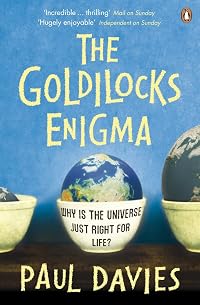
The Goldilocks Enigma: Why Is the Universe Just Right for Life?
by Paul Davies
On This Page
Description
Physicist Paul Davies shows how recent scientific discoveries point to a perplexing fact: many basic features of the physical universe--from the speed of light to the most humble carbon atom--seem tailor-made to produce life. A radical new theory says it's because our universe is just one of an infinite number of universes, each one slightly different. Our universe is bio-friendly by accident; we just happened to win the cosmic jackpot. While this multiverse theory is compelling, it has show more bizarre implications, from infinite copies of each of us to Matrix-like simulated universes. Davies believes there's a more satisfying solution to the question of existence: the observations we make today could help shape the nature of reality in the remote past. If this is true, then life and, ultimately, consciousness aren't just incidental byproducts of nature, but central players in the formation of the universe.--From publisher description. show lessTags
Recommendations





Member Reviews
The Goldilocks Enigma actually is a pretty good book—a far better book than I’d expected going in. I’d seen Paul Davies on the Discovery Channel in 2011, discussing with physicist Sean Carroll, and some others, whether evidence from physics contradicts the hypothesis of a divine creator of the universe. In that exchange, I pegged Davies as an accomodationist in the long-running hostilities between naturalism and religion. That was, I now recognize, at least a slightly unfair characterization.
Davies’ book begins with a survey tour of the current state of physics, paying special attention to the properties of the universe that are both (1) necessary for the emergence of life similar to that found on earth, and (2) difficult or show more impossible to account for on any orthodox theory of cosmology. This introductory material—truth be told, approximately two-thirds of the book’s length—is actually valuable in its own right as a readable physics popularization. Sure, if you’re reading this, you’ve probably been through much of it before with Stephen Hawking or Michio Kaku or Brian Greene—and Davies is definitely no Brian Greene—but I for one find it useful to rehear this stuff in different mind-voices. If one author can’t make the material stick in my head, sometimes a different one can. My point being: even leaving aside the special mission of The Goldilocks Enigma—to evaluate the cosmologies that are proposed to mitigate the mystery of the existence of life—it’s not a total waste of time if you just read it as a run-of-the-mill book of popular physics.
Davies then turns to explications and evaluations of the various cosmologies proposed by physicists to account for the fact that life exists when nothing inherent in the laws physics seems to insist that life must exist. He gives them names: the Absurd Universe (in which it is total random chance that the laws of physics allow for the emergence of life); the Unique Universe (in which a final physical theory nails down all the parameters of physical law, thus establishing that the only universe that could exist is the one that does exist); the Multiverse (in which a potentially infinite number of universes are generated, and it’s no surprise that we find ourselves in one of the ones whose physical laws are congenial to our existence); the Designed Universe (in which a transcendent being twiddled the knobs of physical law to ensure that life would emerge); the Fake Universe (in which a non-transcendent being in a higher universe is just simulating our universe on his computer, as a science fair project, presumably); and the Self-Explaining/Biophilic Universe (in which the future state of the universe somehow influences the past state of the universe in such a way as to cause the emergence of physical laws which in turn will lead to the emergence of conscious observers, which are pivotal under the Copenhagen interpretation of quantum mechanics, so that the future universe will exist… the way it wants to?... is this making sense anymore?)
It is notable that of the cosmologies laid out above, Davies prefers the Self-Explaining/Biophilic Universe—the one that both he and I are finding impossible to articulate without sounding like the burnout you met in college at that party that one time (you know who I mean).
In support of what can only be called his “predilection” for the Self-Explaining/Biophilic Universe, Davies trots out the old theistic hobby horse that the canonical cosmologies he surveys yield universes that are “meaningless”—he includes the Designed Universe in this characterization, by the way. Apparently, he intends to avoid this fate for his Self-Explaining/Biophilic Universe by cobbling it together entirely out of sentences that are themselves wholly meaningless. I joke, because I think that Davies has taken too seriously the idea that meaning and meaninglessness are important factors to consider in evaluating cosmologies. He misses the mark for two reasons.
First, he is too quick to assume that there is a class of ultimate cosmological explanations that preserve the importance and meaningfulness of human life. On the contrary, I think it’s just in the nature of cosmological explanations that ultimate meaning will have to be jettisoned. Think about it. Once you have a set of laws expressed in the language of mathematics that completely describes all possible interactions of matter and energy from the beginning of time until its end, how is it possible to justify yourself as the special little snowflake that you perceive yourself to be? A final theory of cosmology, whatever its content, will necessarily be an existential letdown. Whether we succeed in mathematically proving ourselves to be products of chance on the one hand, or of necessity on the other, we will have unleashed an inevitable nihilism on the cosmological scale.
But secondly, and on a more weirdly indomitable note, Davies underestimates the ease with which a sense of meaning can emerge even in an absurd cosmos. Near the end of The Goldilocks Enigma, in dismissing the idea that ours is a fake/simulated universe, Davies reasons, “If the universe is a sham, why bother to figure out how it works?” Maybe he’s just being glib, but this sounds like an obvious instance of bad faith to me. Would Davies really call an end to his career in physics if he found out that the universe was a simulation? I sort of doubt it. I think that he, like pretty much every other physicist, finds a sense of meaning in the quest for an explanation of how this universe works, irrespective of its provenance. Who would care about physics in a simulated universe? You better fucking believe I would, and I don’t think I’m alone in that. To generalize on this point, there’s a flipside to the observation that any scientific cosmology ultimately leads to nihilism at the largest scales: no scientific cosmology can compel nihilism at the human scale. Irrespective of how and whether the ultimate laws of physics place constraints on the kinds of universe that could or can emerge, you and I will go on loving, hating, fearing, and aspiring. show less
Davies’ book begins with a survey tour of the current state of physics, paying special attention to the properties of the universe that are both (1) necessary for the emergence of life similar to that found on earth, and (2) difficult or show more impossible to account for on any orthodox theory of cosmology. This introductory material—truth be told, approximately two-thirds of the book’s length—is actually valuable in its own right as a readable physics popularization. Sure, if you’re reading this, you’ve probably been through much of it before with Stephen Hawking or Michio Kaku or Brian Greene—and Davies is definitely no Brian Greene—but I for one find it useful to rehear this stuff in different mind-voices. If one author can’t make the material stick in my head, sometimes a different one can. My point being: even leaving aside the special mission of The Goldilocks Enigma—to evaluate the cosmologies that are proposed to mitigate the mystery of the existence of life—it’s not a total waste of time if you just read it as a run-of-the-mill book of popular physics.
Davies then turns to explications and evaluations of the various cosmologies proposed by physicists to account for the fact that life exists when nothing inherent in the laws physics seems to insist that life must exist. He gives them names: the Absurd Universe (in which it is total random chance that the laws of physics allow for the emergence of life); the Unique Universe (in which a final physical theory nails down all the parameters of physical law, thus establishing that the only universe that could exist is the one that does exist); the Multiverse (in which a potentially infinite number of universes are generated, and it’s no surprise that we find ourselves in one of the ones whose physical laws are congenial to our existence); the Designed Universe (in which a transcendent being twiddled the knobs of physical law to ensure that life would emerge); the Fake Universe (in which a non-transcendent being in a higher universe is just simulating our universe on his computer, as a science fair project, presumably); and the Self-Explaining/Biophilic Universe (in which the future state of the universe somehow influences the past state of the universe in such a way as to cause the emergence of physical laws which in turn will lead to the emergence of conscious observers, which are pivotal under the Copenhagen interpretation of quantum mechanics, so that the future universe will exist… the way it wants to?... is this making sense anymore?)
It is notable that of the cosmologies laid out above, Davies prefers the Self-Explaining/Biophilic Universe—the one that both he and I are finding impossible to articulate without sounding like the burnout you met in college at that party that one time (you know who I mean).
In support of what can only be called his “predilection” for the Self-Explaining/Biophilic Universe, Davies trots out the old theistic hobby horse that the canonical cosmologies he surveys yield universes that are “meaningless”—he includes the Designed Universe in this characterization, by the way. Apparently, he intends to avoid this fate for his Self-Explaining/Biophilic Universe by cobbling it together entirely out of sentences that are themselves wholly meaningless. I joke, because I think that Davies has taken too seriously the idea that meaning and meaninglessness are important factors to consider in evaluating cosmologies. He misses the mark for two reasons.
First, he is too quick to assume that there is a class of ultimate cosmological explanations that preserve the importance and meaningfulness of human life. On the contrary, I think it’s just in the nature of cosmological explanations that ultimate meaning will have to be jettisoned. Think about it. Once you have a set of laws expressed in the language of mathematics that completely describes all possible interactions of matter and energy from the beginning of time until its end, how is it possible to justify yourself as the special little snowflake that you perceive yourself to be? A final theory of cosmology, whatever its content, will necessarily be an existential letdown. Whether we succeed in mathematically proving ourselves to be products of chance on the one hand, or of necessity on the other, we will have unleashed an inevitable nihilism on the cosmological scale.
But secondly, and on a more weirdly indomitable note, Davies underestimates the ease with which a sense of meaning can emerge even in an absurd cosmos. Near the end of The Goldilocks Enigma, in dismissing the idea that ours is a fake/simulated universe, Davies reasons, “If the universe is a sham, why bother to figure out how it works?” Maybe he’s just being glib, but this sounds like an obvious instance of bad faith to me. Would Davies really call an end to his career in physics if he found out that the universe was a simulation? I sort of doubt it. I think that he, like pretty much every other physicist, finds a sense of meaning in the quest for an explanation of how this universe works, irrespective of its provenance. Who would care about physics in a simulated universe? You better fucking believe I would, and I don’t think I’m alone in that. To generalize on this point, there’s a flipside to the observation that any scientific cosmology ultimately leads to nihilism at the largest scales: no scientific cosmology can compel nihilism at the human scale. Irrespective of how and whether the ultimate laws of physics place constraints on the kinds of universe that could or can emerge, you and I will go on loving, hating, fearing, and aspiring. show less
Davies discusses modern physics and summarizes scientists views on why the universe is so perfectly set up to enable life (and consequent intelligent understanding). Only the slightest modifications of the laws of physics would make life impossible so why are these laws the way they are and so improbably suitable?
He shows the tendency of the scientific community to avoid the issue, but answers range from a multiverse in which ours is the lucky one among many (or infinite number), to a self aware intelligent universe generating suitable laws (in the future) with backward causation effected by manipulating time in some unknown way.
He sees human (or consequent machine) intelligence as a fundamental force in its own right, at the moment in show more a very early stage, but capable of growing over future hundreds of millions of years to a galactic scale. He quotes the idea that a future intelligence altering the functioning of the sun would generate errors for a distant observer that would seem to indicate a failure of physical laws.
Backward causation, or at least selection of outcomes, is supported by Wheelers variant of the two slit light wave/particle experiment and he favours an unknown mechanism behind this by which the future selects between the myriad of past and present possibilities to "enable" itself. Optimum physical laws are then not a "Cosmic Jackpot" but rather a calculated and selected necessity.
A tremendously good and thought provoking book. show less
He shows the tendency of the scientific community to avoid the issue, but answers range from a multiverse in which ours is the lucky one among many (or infinite number), to a self aware intelligent universe generating suitable laws (in the future) with backward causation effected by manipulating time in some unknown way.
He sees human (or consequent machine) intelligence as a fundamental force in its own right, at the moment in show more a very early stage, but capable of growing over future hundreds of millions of years to a galactic scale. He quotes the idea that a future intelligence altering the functioning of the sun would generate errors for a distant observer that would seem to indicate a failure of physical laws.
Backward causation, or at least selection of outcomes, is supported by Wheelers variant of the two slit light wave/particle experiment and he favours an unknown mechanism behind this by which the future selects between the myriad of past and present possibilities to "enable" itself. Optimum physical laws are then not a "Cosmic Jackpot" but rather a calculated and selected necessity.
A tremendously good and thought provoking book. show less
Davies sees some amount of wonder at the bio-friendliness of the universe. Is it just random chance that our universe got it right on the first go? Is there a multi-verse or a bunch of universes, only those of which have observers are observed? Are there an infinite number of universes, or even fake universes? Did God do it? Did the universe create itself? Is life and mind an integral law of the universe?
Such questions Davies seeks to answer. It doesnt seem that he satisfactorily answers them for himself, but the journey provided in the book is very explicative and enlightening. He ends up near the camp that the universe is inextricably interwoven with life, and that it is probable that the universe caused its own existence through some show more sort of quantum (or other?) mechanism.
Regardless of one's assumptive answer to the above questions, much of one's suppositions is based on faith. Faith in the universe, faith in God, faith on unobserved theoretical physics....its turtles all the way down; pick your super-turtle. show less
Such questions Davies seeks to answer. It doesnt seem that he satisfactorily answers them for himself, but the journey provided in the book is very explicative and enlightening. He ends up near the camp that the universe is inextricably interwoven with life, and that it is probable that the universe caused its own existence through some show more sort of quantum (or other?) mechanism.
Regardless of one's assumptive answer to the above questions, much of one's suppositions is based on faith. Faith in the universe, faith in God, faith on unobserved theoretical physics....its turtles all the way down; pick your super-turtle. show less
First half of the book's a good introduction into quantum physics and cosmology. The second half's much more interesting and abstract. WHY aren't the laws of physics different than we notice? If we believe in the multiverse do you HAVE to believe in God? It become a little too philosophical for me at the end but nonetheless interesting and thought-provoking book.
Such cool stuff! Not that I understand everything Paul Davies writes in “The Goldilocks Enigma”, but the universe is fascinating and awe-inspiring. To me, the science of the tiniest stuff (quantum mechanics) and the biggest stuff (cosmology) show a mind-boggling grandeur. It all makes me ask some fundamental questions for which I don’t know any pat answers. Yet just wondering is stimulating!
Davies gives an up-to-date account of cosmology and particle physics in order to present the possibilities that the universe's fitness for life is (1) a fluke or (2) the result of observer selection from a multiverse (the anthropic principle). He most wants us to know about John Wheeler's idea that (3) "the universe has engineered its own self-awareness through quantum backward causation or some other physical mechanism still to be discovered" (p 250). The brilliance of his writing is compromised only by his failure to see that the nonsensicality of theology is *total*.
This another book that takes you through the history of the universe and addresses some of the relevant fundamental particle physics and unification theories. The latter part of the book is more interesting where he discusses the multiverse theories and brings in some discussion of where God fits into this.
Members
- Recently Added By
Author Information

29+ Works 9,038 Members
Awards and Honors
Awards
Series
Belongs to Publisher Series
Ursan julkaisuja (106)
Work Relationships
Is abridged in
Common Knowledge
- Original title
- The Goldilocks Enigma: Why Is the Universe Just Right for Life?
- Original publication date
- 2006
- Dedication
- To John Archibald Wheeler, who was never afraid to tackle the big questions
- First words
- For thousands of years, human beings have contemplated the world about them and asked the great questions of existence: Why are we here?
- Last words
- (Click to show. Warning: May contain spoilers.)Meanwhile, it has to be admitted, most scientists stick with something like position A and get on with their work, leaving the big questions to philosophers and priests.
Classifications
Statistics
- Members
- 704
- Popularity
- 40,355
- Reviews
- 14
- Rating
- (3.75)
- Languages
- 9 — Czech, Dutch, English, Finnish, German, Hungarian, Italian, Portuguese, Slovenian
- Media
- Paper, Ebook
- ISBNs
- 15
- UPCs
- 2
- ASINs
- 8