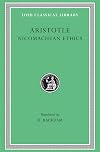
Nicomachean Ethics
by Aristotle
On This Page
Description
Nearly all the works Aristotle (384-322 BCE) prepared for publication are lost; the priceless ones extant are lecture-materials, notes, and memoranda (some are spurious). They can be categorized as practical; logical; physical; metaphysical; on art; other; fragments.Tags
Recommendations















Member Reviews
This is Aristotle's classic guide to ethics including the golden mean, the nature of friendship and other topics. While it is more a set of lecture notes than a polished philosophical treatise it still demonstrates the power of the mind of the man behind it. As he does for other subjects Aristotle approaches ethics in an organized and scientific manner with an initial emphasis on definitions such as: what is the good, virtue, justice and moral excellence? He does this with an expectation of only that level of precision that is appropriate for the subject at hand. Over the course of the middle section of the treatise the reader is introduced to the concept of the 'golden mean' by which virtues are discussed with regard to extremes (eg. show more courage vs. rashness) which allow for a middle ground or mean between the extremes. In book seven he discusses moral strength and weakness, and he follows this in book eight with an analysis of the nature and importance of friendship and the need for it. He makes the case that:
"The perfect form of friendship is that between good men who are alike in excellence or virtue. For these friends wish alike for one an other's good because they are good men, and the are good per se, (that is, their goodness is something intrinsic, not incidental). Those who wish for their friends' good for their friends' sake are friends in the truest sense since their attitude is determined by what their friends are and not by incidental considerations."(1156b, 6-12)
The ethics culminates in a argument for the supreme importance of contemplation. He says,
"But a wise man is able to study even by himself, and the wiser he is the more is he able to do it. . . study (contemplation) seems to be the only activity which is loved for its own sake."(1177a, 33- 1177b, 1)
The ethical principles, the method of demonstration and the sheer power of the ideas presented here make this a valuable guide even as we approach the twenty-first century. show less
"The perfect form of friendship is that between good men who are alike in excellence or virtue. For these friends wish alike for one an other's good because they are good men, and the are good per se, (that is, their goodness is something intrinsic, not incidental). Those who wish for their friends' good for their friends' sake are friends in the truest sense since their attitude is determined by what their friends are and not by incidental considerations."(1156b, 6-12)
The ethics culminates in a argument for the supreme importance of contemplation. He says,
"But a wise man is able to study even by himself, and the wiser he is the more is he able to do it. . . study (contemplation) seems to be the only activity which is loved for its own sake."(1177a, 33- 1177b, 1)
The ethical principles, the method of demonstration and the sheer power of the ideas presented here make this a valuable guide even as we approach the twenty-first century. show less
This is an inquiry into the nature of human happiness and an analysis of the conditions under which
happiness may be gained or lost, with an indication of what men must do in their conduct and thinking in
order to become happy or to avoid unhappiness, the principal emphasis being placed on the cultivation of
the virtues, both moral and intellectual, although other goods are also recognized as necessary for
happiness, such as wealth, health, friends, and a just society in which to live.
happiness may be gained or lost, with an indication of what men must do in their conduct and thinking in
order to become happy or to avoid unhappiness, the principal emphasis being placed on the cultivation of
the virtues, both moral and intellectual, although other goods are also recognized as necessary for
happiness, such as wealth, health, friends, and a just society in which to live.
Edition: // Descr: 280 p. 18 cm. // Series: Call No. { 888 A4 3 } Edited by Franciscus Susemihl Contains Notes, Index, and Appendix. // //
Ratings
Members
- Recently Added By
Lists

sotiris' favourites circa january 2023
43 works; 2 members
Author Information

2,092+ Works 57,700 Members
Some Editions
Series
Belongs to Publisher Series
Work Relationships
Is abridged in
Common Knowledge
- Canonical title
- Nicomachean Ethics
- Disambiguation notice
- This is Aristotle's Ethica Nichomachea (Nichomachean Ethics) in Ancient Greek. Do not combine with editions only in translation.
Classifications
Statistics
- Members
- 579
- Popularity
- 51,025
- Reviews
- 3
- Rating
- (4.00)
- Languages
- 6 — English, Greek (Ancient), Italian, Latin, Multiple languages, Polish
- Media
- Paper, Ebook
- ISBNs
- 10
- ASINs
- 8