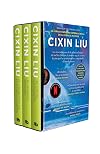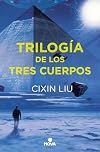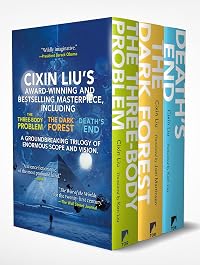
Remembrance of Earth's Past: The Three-Body Trilogy
by Cixin Liu
Remembrance of Earth's Past (Collections and Selections — Omnibus 1-3)
On This Page
Description
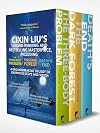
Imagine a universe patrolled by numberless and nameless predators. Imagine what might happen to any civilisation unwise enough to broadcast its location. This is Cixin Liu's THREE-BODY PROBLEM TRILOGY. Weaving a complex web of stratagem, subterfuge, philosophy and physics across light years of space and 18.9 million years of time, this tale of humanity's struggle to reach the stars is a visionary masterwork of unprecedented scale and momentum. Available now in a single volume, including: 1 show more THE THREE-BODY PROBLEM; 2 THE DARK FOREST; 3 DEATH'S END. Read the award-winning, critically acclaimed, multi-million-selling phenomenon -- soon to be a Netflix Original Series from the creators of Game of Thrones. show lessTags
Recommendations





Member Reviews
Does humanity have a bright or dark future? Which do we deserve?
An engrossing read with an impressive depth to the story and characters. Liu sets out a very human drama at a truly universal scale. At times the physics exposition gets a bit heavy handed as Liu sets out to explain believable but reality shattering concepts, but I found these all very readable and well thought through. The one aspect I found less than satisfying was the political and relational side of the story. Certain aspects of the individual characters and of humanity as a whole felt foreign to me. This would be fine if constrained to the characters alone but some of the decisions made corporately by "humanity" were baffling from a western/individualistic lens. The show more portrayal of motherly/feminine vs ruthless/masculine was also a bit troubling. Overall though the trilogy is a spectacular achievement and one I'm glad to have read, and which I'm sure will continue to reveal hidden depths as I mull over it in coming days. show less
An engrossing read with an impressive depth to the story and characters. Liu sets out a very human drama at a truly universal scale. At times the physics exposition gets a bit heavy handed as Liu sets out to explain believable but reality shattering concepts, but I found these all very readable and well thought through. The one aspect I found less than satisfying was the political and relational side of the story. Certain aspects of the individual characters and of humanity as a whole felt foreign to me. This would be fine if constrained to the characters alone but some of the decisions made corporately by "humanity" were baffling from a western/individualistic lens. The show more portrayal of motherly/feminine vs ruthless/masculine was also a bit troubling. Overall though the trilogy is a spectacular achievement and one I'm glad to have read, and which I'm sure will continue to reveal hidden depths as I mull over it in coming days. show less
The Three-Body Problem trilogy is an ambitious work of science fiction, spanning centuries and galaxies.
The first book if fast-paced, at least if you watched the American TV series. However, don't expect to see a lot of western characters, because that's not the case. If you're not acquainted to oriental culture, names are the hardest part to get used to in this book. There are a lot of characters, and keeping track of their Chinese names is not easy, but the story is rather smooth. It begins in China during the Cultural Revolution, when scientist Ye Wenjie is sent to work in a labour camp after her father is killed—same as in the series. There, she witnesses the reality of the regime and the power of science to both create and show more destroy, but do not expect any judgment on the matter from the author's POV. I honestly didn't perceive any, but I might be wrong.
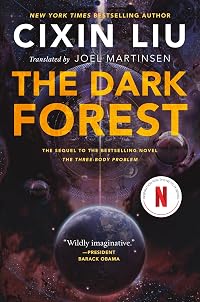
The second book, The Dark Forest, explores the dark side of human nature, the potential for conflict between civilizations, and it's the slowest one. If it took me a month to read the entire trilogy, it's mostly because of the central part with the stories of the Wallfacers. I did love the concept of the Dark Forest, its meaning in the story and for humanity. I don't know if it was explored before, but I found it fascinating, and in the end, disruptive.
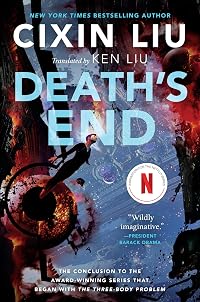
The third book, Death's End, brings the trilogy to a thrilling conclusion with the emergence of the Sworldholder. The first part of the third book is one I read faster. The second and last part was a drag, with pages and pages of descriptions that would be considered info dump in a western book. But you can't read this book if you don't open your mind to eastern culture. If you're vaguely familiar with the Tea Ceremony, and Zen, you know what I'm talking about. While I've never taken part in the former, I know what it entails—it's also described in the books—and I'm familiar with the latter.
This is definitely not a book for everyone. Not for all hard sci-fi fans out there, either.
The Three-Body Problem trilogy's characters are well-developed, and the story is full of suspense, although the pages and pages of descriptions tend to stretch it to a limit that might break your patience. The trilogy raises questions about the nature of reality, the future of humanity, and the possibility of contact with alien life.
The story is heavily influenced by populism. Humanity's reactions to important events—and there are several—create conflict, of course, but it's like there's a hand driving them all into one direction. Propaganda? Possibly, but we're never told about it. This wasn't a surprise, though. The author is Chinese, and so he's influenced by the society in which he was born and educated, even if it's obvious he was opened to western culture. References to the Mona Lisa, the Louvre, Van Gogh, and even Gone with the Wind can be found throughout the book. What do these three woks have in common apart from being western? They hint at revolution, fight against the standards of society. I don't know if this is just appreciation for art or something deeper, but I like it.
There's something else that comes out, and it's the reaction of the characters to important events in their lives. Trauma and pain have a marginal internal effect, but you don't see it in the way they go on with their lives and their interactions with the others. And I think that's here that the eastern way of thinking/living shines the most. When the third Wallfacer is almost killed, it's not a big deal to him or to the others around him. In terms of culture and politics, the individual is not significant, not even to themselves. What matters is not the traveller, but the journey.
If you are looking for a thought-provoking and intellectually stimulating read, I highly recommend The Three-Body Problem trilogy.
However, there are a few things to keep in mind before reading it. First, the books are long. The first one is over 600 pages, and the second and third books are even longer. Second, the books are complex. The story jumps around in time and space, and there are many characters and scientific concepts to keep track of. Third, the books are dark. The story deals with themes of war, violence, and genocide, although I read books that focus on these themes much more. For this reason, I wouldn't say it is the darkest read I can think of. show less
The first book if fast-paced, at least if you watched the American TV series. However, don't expect to see a lot of western characters, because that's not the case. If you're not acquainted to oriental culture, names are the hardest part to get used to in this book. There are a lot of characters, and keeping track of their Chinese names is not easy, but the story is rather smooth. It begins in China during the Cultural Revolution, when scientist Ye Wenjie is sent to work in a labour camp after her father is killed—same as in the series. There, she witnesses the reality of the regime and the power of science to both create and show more destroy, but do not expect any judgment on the matter from the author's POV. I honestly didn't perceive any, but I might be wrong.
The second book, The Dark Forest, explores the dark side of human nature, the potential for conflict between civilizations, and it's the slowest one. If it took me a month to read the entire trilogy, it's mostly because of the central part with the stories of the Wallfacers. I did love the concept of the Dark Forest, its meaning in the story and for humanity. I don't know if it was explored before, but I found it fascinating, and in the end, disruptive.
The third book, Death's End, brings the trilogy to a thrilling conclusion with the emergence of the Sworldholder. The first part of the third book is one I read faster. The second and last part was a drag, with pages and pages of descriptions that would be considered info dump in a western book. But you can't read this book if you don't open your mind to eastern culture. If you're vaguely familiar with the Tea Ceremony, and Zen, you know what I'm talking about. While I've never taken part in the former, I know what it entails—it's also described in the books—and I'm familiar with the latter.
This is definitely not a book for everyone. Not for all hard sci-fi fans out there, either.
The Three-Body Problem trilogy's characters are well-developed, and the story is full of suspense, although the pages and pages of descriptions tend to stretch it to a limit that might break your patience. The trilogy raises questions about the nature of reality, the future of humanity, and the possibility of contact with alien life.
The story is heavily influenced by populism. Humanity's reactions to important events—and there are several—create conflict, of course, but it's like there's a hand driving them all into one direction. Propaganda? Possibly, but we're never told about it. This wasn't a surprise, though. The author is Chinese, and so he's influenced by the society in which he was born and educated, even if it's obvious he was opened to western culture. References to the Mona Lisa, the Louvre, Van Gogh, and even Gone with the Wind can be found throughout the book. What do these three woks have in common apart from being western? They hint at revolution, fight against the standards of society. I don't know if this is just appreciation for art or something deeper, but I like it.
There's something else that comes out, and it's the reaction of the characters to important events in their lives. Trauma and pain have a marginal internal effect, but you don't see it in the way they go on with their lives and their interactions with the others. And I think that's here that the eastern way of thinking/living shines the most. When the third Wallfacer is almost killed, it's not a big deal to him or to the others around him. In terms of culture and politics, the individual is not significant, not even to themselves. What matters is not the traveller, but the journey.
If you are looking for a thought-provoking and intellectually stimulating read, I highly recommend The Three-Body Problem trilogy.
However, there are a few things to keep in mind before reading it. First, the books are long. The first one is over 600 pages, and the second and third books are even longer. Second, the books are complex. The story jumps around in time and space, and there are many characters and scientific concepts to keep track of. Third, the books are dark. The story deals with themes of war, violence, and genocide, although I read books that focus on these themes much more. For this reason, I wouldn't say it is the darkest read I can think of. show less
This is an interesting but, but it didn't seem on a par with other Hugo winners that I've read.
I found the story creative and pretty well told. I had some trouble with all the Chinese names but the list at the beginning of the book really helps.
It's difficult to describe adequately without giving spoilers, so it has a first-contact with an unusual culture in an odd manner that leads to an invasion of the earth. And that's misleading.
This is the first book of a trilogy and ends on a down note.
I found the story creative and pretty well told. I had some trouble with all the Chinese names but the list at the beginning of the book really helps.
It's difficult to describe adequately without giving spoilers, so it has a first-contact with an unusual culture in an odd manner that leads to an invasion of the earth. And that's misleading.
This is the first book of a trilogy and ends on a down note.
What can I say, brilliant writing and execution throughout all 3 books but ultimately left me feeling bleak and a bit unfulfilled story wise. The reason being the authors projection of Darwinism onto the universe: the very high tech sci-fi is driven by a very simple and ultimately dated mechanical survivalist perspective that does not properly account for emergence. When emergence is ignored in grand scale evolution fiction it tends to lead to oddly predictable behaviour no matter what level complexity is being dealt with, as is the case with this trilogy.
I approached this book with great hope, and it started well during the Chinese Cultural Revolution. Even though she does not appear much in the first two books, a central character is Ye Wenjie, whose father died during those times.
From there, the book meanders. People discover that an alien civilization is approaching us, and it will take them five centuries to reach us.
The question is: will we save the planet, or will it be doomed?
The tale meanders between the Three-Body Problem game, reality, and communication with the aliens.
I liked the book's concept, but the meandering tale finally became too much. There is almost no character or relationship development in the book, and everyone seems carved out of stone.
The book disappointed me.
From there, the book meanders. People discover that an alien civilization is approaching us, and it will take them five centuries to reach us.
The question is: will we save the planet, or will it be doomed?
The tale meanders between the Three-Body Problem game, reality, and communication with the aliens.
I liked the book's concept, but the meandering tale finally became too much. There is almost no character or relationship development in the book, and everyone seems carved out of stone.
The book disappointed me.
What's interesting about this book, which is about Earth learning of a hostile alien invasion some 500 years beforehand, and then planning to thwart, is that it takes place (mostly) in China. Subtle and not-so-subtle differences in values are apparent. I read this on the recommendation of Barack Obama, and it is an intellectual exercise. The writing is not lyric (although this depends somewhat on who's translating) and there's not much character development. But the problems set forth and the (hardly ever successful) solutions arrived at kept me turning the pages.
I liked all the sci-fi, but it seemed a bit dated in 2022. Some parts drag on, but not too much
Members
- Recently Added By
Lists

Top Five Books of 2022
736 works; 272 members

Favorite Books in Translation
320 works; 133 members

Book Recommendations Masterlist
28 works; 1 member

Favorite Science Fiction
456 works; 219 members
Author Information

92+ Works 26,481 Members
Cixin Liu is the author of The Three Body Problem, which won Best Novel at the Hugo Awards 2015. (Bowker Author Biography)
Some Editions
Awards and Honors
Notable Lists
Series

Work Relationships
Contains
Common Knowledge
- Canonical title
- Remembrance of Earth's Past: The Three-Body Trilogy
Classifications
- Genres
- Fiction and Literature, Science Fiction
- DDC/MDS
- 895.136 — Literature & rhetoric Literatures of other languages Literatures of East and Southeast Asia Chinese Chinese fiction 2010–
- LCC
- PL2947 .C59 .R46 — Language and Literature Languages and literatures of Eastern Asia, Africa, Oceania Languages of Eastern Asia, Africa, Oceania Chinese language and literature Chinese literature Individual authors and works
- BISAC
Statistics
- Members
- 396
- Popularity
- 78,920
- Reviews
- 9
- Rating
- (4.23)
- Languages
- 7 — Chinese, Czech, English, French, German, Italian, Spanish
- Media
- Paper, Audiobook, Ebook
- ISBNs
- 18
- ASINs
- 9