On This Page
Description
Leggy Marjorie Clune, unjustly accused of murder of sleazy movie promoter Frank Patton, must rely on the able counsel of Perry Mason to clear her name.Tags
Recommendations















Member Reviews
At the end of "The Case of the Sulky Girl", Mason received a telegram with a girl's lucky legs and signed by Eva Lamont. So when a man shows up and start talking about the case, the lawyer is a bit confused. J. R. Bradbury had just arrived from Cleverdale after sending the telegram, under a different name because he sent it from his office - or so it claims. And the story he tells is sad - a girl from the town had won a contest for best legs which came with a movie contract and the local businessmen had been sold some of the rights of the movie. Except that the movie was never made because the young girl, Marjorie Clune, was not screening well - or so the studio claimed. Her dreams are shattered, the businessmen will never make any show more money or get theirs back and J. R. really wants to have the man responsible for all that to punished. But the DA refuses to bring charges. So J. R hires Perry Mason to find the missing clues that will allow the prosecution to take the case. And so the story starts.
Then the guy that organized the contest is found dead - and all clues seem to lead to Marjorie. And to Thelma - another girl that had won a contest in a small town - and never had her career. Although it takes a while until everyone sees the connections - and it will take another young lady (not a contest winner), a young doctor (who gets into the frame for the murder as well of course) and J. R. who starts getting weirder and weirder - and start telling Perry Mason what the lawyer must do and to threaten him. Of course Perry does not help himself much by getting involved both in a murder and in the hiding of fugitives but that is to be expected after all.
The person that really shines in this installment is Della Street - especially compared to the other women in the book (maybe except for Mamie but we do not see enough of her). She is competent and self-assured and is an even match for Mason. On the other hand Drake was somewhat of a disappointment - he seemed to be there to antagonize Mason most of the time.
It is an unusual novel in some ways - there is no trial, the DA and Perry are on the same side (trying to get the swindler) and the novel ends with Perry telling the police the full story and pointing the killer at the last moment. It is closer to a classic mystery than the usual legal thrillers that make up the series and it is handled nicely - the clues are there so when the dots start getting connecting, it does not sound unexpected. show less
Then the guy that organized the contest is found dead - and all clues seem to lead to Marjorie. And to Thelma - another girl that had won a contest in a small town - and never had her career. Although it takes a while until everyone sees the connections - and it will take another young lady (not a contest winner), a young doctor (who gets into the frame for the murder as well of course) and J. R. who starts getting weirder and weirder - and start telling Perry Mason what the lawyer must do and to threaten him. Of course Perry does not help himself much by getting involved both in a murder and in the hiding of fugitives but that is to be expected after all.
The person that really shines in this installment is Della Street - especially compared to the other women in the book (maybe except for Mamie but we do not see enough of her). She is competent and self-assured and is an even match for Mason. On the other hand Drake was somewhat of a disappointment - he seemed to be there to antagonize Mason most of the time.
It is an unusual novel in some ways - there is no trial, the DA and Perry are on the same side (trying to get the swindler) and the novel ends with Perry telling the police the full story and pointing the killer at the last moment. It is closer to a classic mystery than the usual legal thrillers that make up the series and it is handled nicely - the clues are there so when the dots start getting connecting, it does not sound unexpected. show less
I think I must have bought this secondhand when I was a teenager - one of the people Mason is engaged to defend is a 'leg model' so there is some excuse for the cover picture. There was no court room action at all in this story and no police questioning either, unless you count their questioning of Mason himself at the end.
I didn't really enjoy this one: the client was obnoxious, everyone lied to Mason, Mason lied to the police, Mason was supercilious with Paul Drake, and there was a fair amount of repetition. It is very fortunate that the people Mason represents always turn out to be innocent...I think it is time my small ESG collection is returned to a secondhand book store.
I didn't really enjoy this one: the client was obnoxious, everyone lied to Mason, Mason lied to the police, Mason was supercilious with Paul Drake, and there was a fair amount of repetition. It is very fortunate that the people Mason represents always turn out to be innocent...I think it is time my small ESG collection is returned to a secondhand book store.
Another good yarn. This is not Raymond Burr's Perry Mason. Physically, I can see Burr in the role, but the way Mason skirts the law and schemes was not the way he was portrayed in the TV series. I particularly like the ones written in the 30's. It really catches the flavor of the popular culture of the era. Fun mindless entertainment ... good characters and a good plot.
I didn't care for this as much as the first two Perry Mason books. The murder case just lost my interest along the way. I did enjoy the sneaky version of Mason, breaking into locked doors and lying, all in the service of justice.
This is an earlier Mason mystery. The mystery itself is strong, but a couple of the plot points are a bit jumpy.
I watched the Perry Mason TV courtroom drama series as a child but I had never read one of Earl Stanley Gardner's books. Perhaps the TV show was better than this book or maybe some of the other Perry Mason mystery books were better than this. There was no courtroom drama in The Case of the Lucky Legs. Everything took place in Mason's office and in some hotels and apartments. I will try one more before I totally give up on him.
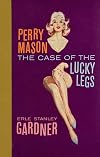
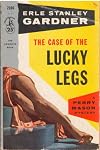
Interesting cover design showing stockings, legs, dice and high heels; the motto for the Pocket books series is 'kind to your pocket and your pocketbook'. The first sentence brings back the memory of Perry Mason on black and white TV: 'Della Street held open the door of Perry Mason's private office' - and the last sentence '''Show him in", he said'
Members
- Recently Added By
Author Information

883+ Works 30,777 Members
Mystery writer Erle Gardner was born on July 17, 1889 in Malden, Massachusetts. In 1902, he had moved to Oroville, CA. His parents could not afford to send a second son to college, so he worked in a legal office as a clerk reading law. He spent a short time at Valparaiso University in Indiana but had to drop out because of an illegal boxing show more exhibition. He continued to travel throughout California and read law at several law offices and finally passed the bar in 1911, at the age of 21. He married Natalie Francis Beatrice Talbert on April 9, 1912. In 1916, he formed the Law Firm of Orr and Gardner in Venture, CA. Gardner used many pseudonyms such as Charles Green, Kyle Corning and Grant Holiday. While working as an attorney, he began writing fiction. In 1921, "Nellie's Naughty Nighty" was published in the pulp magazine Breezy Stories. He had a goal of writing 100,000 words a month and would sometimes write two or more stories a day. In 1923, "The Shrieking Skeleton" was sold to the Black Mask Magazine. In the 1930's, Gardner had two manuscripts that were rejected and than "rediscovered" by Thayer Hobson, the president of the William Morrow Publishing Company, and rewritten as courtroom mysteries. During this process, the character Perry Mason was born. In 1933, the first Perry Mason book was written, "The Case of the Velvet Claws." The next one was entitled "The Case of the Sulky Girl" and they were followed by more than eighty additional Mason mysteries. Gardner died on March 11, 1970. (Bowker Author Biography) show less
Some Editions
Series

Belongs to Publisher Series
Work Relationships
Common Knowledge
- Canonical title*
- Onnelliset sääret
- Original title
- The Case of the Lucky Legs
- Original publication date
- 1934-02
- People/Characters
- Perry Mason; Della Street; Paul Drake; J.R. Bradbury; Eva Lamont; Marjorie Clune (show all 9); Frank Patton; Dr Robert Doray; Mamie
- Related movies
- The Case of the Lucky Legs (1935 | IMDb)
- First words
- Della Street held open the door of Perry Mason's private office.
- Last words
- (Click to show. Warning: May contain spoilers.)"Good-by, Mr. Mason," Marjorie said gently. "I never can thank you enough, you know that."
*Some information comes from Common Knowledge in other languages. Click "Edit" for more information.
Classifications
Statistics
- Members
- 361
- Popularity
- 87,674
- Reviews
- 10
- Rating
- (3.54)
- Languages
- 9 — Czech, Dutch, English, Finnish, German, Hungarian, Italian, Portuguese, Spanish
- Media
- Paper, Audiobook, Ebook
- ISBNs
- 20
- ASINs
- 26