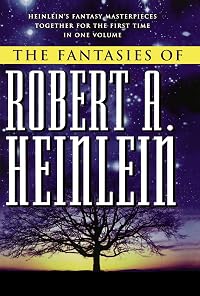
The Fantasies of Robert A. Heinlein
by Robert A. Heinlein
On This Page
Description
Collected in a single volume for the first time, all of Heinlein's finest fantasy short stories and novellas come together in a selection that includes Magic, Inc., They, and The Unpleasant Profession of Jonathan Hoag, among other notable works.Tags
Recommendations














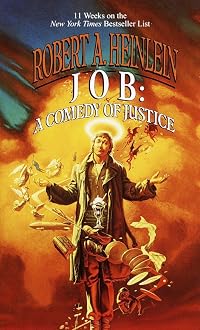


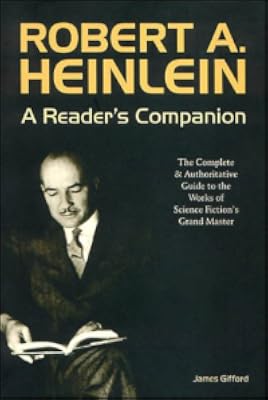


Member Reviews
Heinlein didn't venture into fantasy very often, and if the eight stories gathered here are any indication, that's a good thing. Only a couple of these stories work very well, and they are the ones that are closer to the SF side of the genre divide. Despite my misgivings, I should note that the three longest stories were all Retro Hugo nominees, including one winner.
"Magic, Inc." is probably the best of those; it's set in a (then) contemporary American city in which magic is real, and an important part of most small businesses. Heinlein imagines how the annoyances of running a business -- protection rackets, lobbying against stupid legislation -- would play out in a magical world. It's a pleasant story, marred by brief passages of show more sexism and racism that are uncharacteristic for Heinlein.
In "The Unpleasant Profession of Jonathan Hoag," a married pair of private detectives are hired by Mr. Hoag, who cannot remember what he does during the day, and fears that his amnesia might be caused by the stress of having done horrible things. Their attempts to tail Hoag lead the detectives to discover the creepy, surreal powers who really run the world. The climax of the story, in which we finally learn what Mr. Hoag's profession is, is a joke that falls terribly flat.
The title character in "Waldo" -- that's the Hugo-winning story -- is a mechanical/scientific genius who's called on to solve a crisis with the world's energy source. He must do so remotely, because he lives in space, where zero gravity makes his neuromuscular disability easier to manage. Heinlein's treatment of Waldo's disability is meant to be respectful, and probably is by 1942 standards, but there are definitely some uncomfortable moments for today's reader. The story is notable as the source of the engineering term "waldo," a tool that allows people to manipulate objects remotely.
The two stories that hold up the best are both significantly shorter, each under twenty pages. "And He Built a Crooked House" explores four-dimensional space, with an architect accidentally building a home in the form of a tesseract. (In the same way that a cube is a three-dimensional extension of a two-dimensional square, a tesseract is a four-dimensional extension of a three-dimensional cube.) "All You Zombies" distills a particular type of time travel paradox down to the bare bones, ringing every possible variation on its theme in 12 pages; it's a classic.
Ah well, even the greats can't be good at everything, I suppose. show less
"Magic, Inc." is probably the best of those; it's set in a (then) contemporary American city in which magic is real, and an important part of most small businesses. Heinlein imagines how the annoyances of running a business -- protection rackets, lobbying against stupid legislation -- would play out in a magical world. It's a pleasant story, marred by brief passages of show more sexism and racism that are uncharacteristic for Heinlein.
In "The Unpleasant Profession of Jonathan Hoag," a married pair of private detectives are hired by Mr. Hoag, who cannot remember what he does during the day, and fears that his amnesia might be caused by the stress of having done horrible things. Their attempts to tail Hoag lead the detectives to discover the creepy, surreal powers who really run the world. The climax of the story, in which we finally learn what Mr. Hoag's profession is, is a joke that falls terribly flat.
The title character in "Waldo" -- that's the Hugo-winning story -- is a mechanical/scientific genius who's called on to solve a crisis with the world's energy source. He must do so remotely, because he lives in space, where zero gravity makes his neuromuscular disability easier to manage. Heinlein's treatment of Waldo's disability is meant to be respectful, and probably is by 1942 standards, but there are definitely some uncomfortable moments for today's reader. The story is notable as the source of the engineering term "waldo," a tool that allows people to manipulate objects remotely.
The two stories that hold up the best are both significantly shorter, each under twenty pages. "And He Built a Crooked House" explores four-dimensional space, with an architect accidentally building a home in the form of a tesseract. (In the same way that a cube is a three-dimensional extension of a two-dimensional square, a tesseract is a four-dimensional extension of a three-dimensional cube.) "All You Zombies" distills a particular type of time travel paradox down to the bare bones, ringing every possible variation on its theme in 12 pages; it's a classic.
Ah well, even the greats can't be good at everything, I suppose. show less
I bought this collection to read "All You Zombies" after watching the film adaptation, "Predestination." I was surprised to find in 11 pages basically the same story as was told in the 2 and a half hour movie. It is a bit abrupt at 11 pages, but the majority of it is the same.
The rest of the stories in this book were mostly mediocre, and rather dated. However, I was very impressed by "The Unpleasant Profession of Jonathan Hoag." It was more interesting from the beginning than the other stories in the book, and even the resolution was better than most short stories I've read.
The rest of the stories in this book were mostly mediocre, and rather dated. However, I was very impressed by "The Unpleasant Profession of Jonathan Hoag." It was more interesting from the beginning than the other stories in the book, and even the resolution was better than most short stories I've read.
Heinlein, Robert A. The Fantasies of Robert Heinlein. Tor, 1999.
The Fantasies of Robert Heinlein gets together some stories from the 1940s and ‘50s that are not pure science fiction but aren’t pure fantasy either. Heinleinian engineering is everywhere apparent. “Magic, Inc.” describes a world where magic is just another construction tool. “And He Built a Crooked House” plays with fractal math. “The Unpleasant Profession of Jonathan Hoag” provides a cautionary tale about using computational data to make predictions. “All You Zombies” is a classically efficient time-travel paradox story. “Waldo,” my favorite story of the bunch, has so many instances of clever technology that it is hardly fair to call it fantasy at show more all. In his later career, Heinlein turned to long, rambling epics, but these stories show what he could do with the short form when there was a market for it. 4 stars. show less
The Fantasies of Robert Heinlein gets together some stories from the 1940s and ‘50s that are not pure science fiction but aren’t pure fantasy either. Heinleinian engineering is everywhere apparent. “Magic, Inc.” describes a world where magic is just another construction tool. “And He Built a Crooked House” plays with fractal math. “The Unpleasant Profession of Jonathan Hoag” provides a cautionary tale about using computational data to make predictions. “All You Zombies” is a classically efficient time-travel paradox story. “Waldo,” my favorite story of the bunch, has so many instances of clever technology that it is hardly fair to call it fantasy at show more all. In his later career, Heinlein turned to long, rambling epics, but these stories show what he could do with the short form when there was a market for it. 4 stars. show less
Heinlein didn't write many fantasies, tending to stay closer to the hard end of science fiction, or at least the polemically political end. As a result, when collecting Heinlein's fantasies, it is actually possible to assemble pretty much every story published under his name that could credibly called "fantasy" into a single volume. Although the title of the book is The Fantasies of Robert A. Heinlein, anyone looking for swords, sandals, and mysterious wizards handing out quests is likely to be disappointed. Quite simply, Heinlein didn't tell those kinds of stories. Instead, when he did dabble in magical realities, he dealt in a kind of fantasy that was both closer to our own and stranger than most "standard" fantasy fiction at the same show more time. Containing three novellas and a number of shorter stories, this book is a fun collection of some of Heinlein's most fantastical and in some ways weirdest works arranged in order of original publication.
The first story in the book, and the first of the three long stories contained in the collection, is Magic, Inc., and unfortunately it is one of the weakest stories in the volume. Set in a world very much like our own with the addition of magic as part of the everyday reality of life. The protagonist, a construction supplier and contractor who hires magical help to make sure his products are up to high quality standards, finds himself confronted by a protection racket that is attempting to direct all of the magical business to their preferred suppliers. Eventually, the would-be monopolists shift tactics and try legal avenues to secure their cartel by creating a government sanctioned professional organization to restrict entry into the market and control those who do. Effectively, the "fantasy" element of the story is little more than a vehicle to tell a fairly standard Heinlein tale of free market ideology. In a world in which regulation of entry requirements has come to encompass professions as innocuous as interior decorators and hairdressers, the story seems as relevant now as it was when it was written in 1940. However, the story repeatedly beats the reader over the head with its point, and as a result, it gets somewhat tiresome and loses effectiveness that a slightly more subtle argument would have had.
Another of the three longer stories in the book, Waldo is an strangely schizophrenic tale about an eccentric engineering genius, a thorny technological problem, and the magical solution that comes out of nowhere. In a future in which the power for almost everything is collected as "radiant energy" by deKalb generators, it is potentially disastrous when some of the generators simply cease working for unknown reasons. Desperate, the power company hires the notoriously cranky and reclusive Waldo, a genius who lives entirely in orbit as a result of the extraordinary weakness of his own body. Waldo uses a variety of remote apparatus to conduct business on Earth, and has become fabulously wealthy, allowing him to maintain a fairly lavish lifestyle even though everything has to be shipped to him from the surface of the planet. Confronted with the problem of the deKalb generators and a related problem related to his own health, Waldo is intrigued but frustrated as no engineering solution seems to offer any hope of finding the cure for the mysteriously malfunctioning power receptors. To a certain extent it feels like Heinlein got bored while writing the story, because the answer appears magically out of thin air and essentially moots everything that came before in the story. At the end, things take a massive left turn into an anticlimactic oddity - albeit an oddity that was sort of presaged in the very opening of the story. The trouble with Waldo is that after the first three-quarters of it sets up an interesting set of mysteries, the remaining quarter hand waves its way to the resolution, giving the whole an entirely unsatisfactory feel.
The final long story in the book is The Unpleasant Profession of Jonathan Hoag, a very strange and creepy tale about a man who doesn't know what he does for a living. Told from the perspective of a private investigator Hoag hires to find out what his job is, the story wanders through some bizarre territory as the protagonist tangles with a shadowy conspiracy before finding out what Hoag's very unlikely profession actually is. This is probably the strangest story in the book, and even though the "good guys" ostensibly come through on top, the journey to the resolution calls into question the basic nature of reality in such a way that makes the resolution deeply unsettling. One interesting side note about this story is that even though Heinlein posits a constructed world with a designer behind it, the lives of the characters are given no purpose or meaning as a result of this. Heinlein seems to have not been a particularly big fan of most religious organizations, and this, and a few other elements of the story, seems to be an almost deliberate attempt to stick his thumb in the eye of theologians.
Two of the stories '-And He Built a Crooked House-' and Our Fair City provide mostly comic relief in the collection, although in a manner that is distinctly Heinlein. In '-And He Built a Crooked House-' an architect gets the idea of building a four-dimensional house in the shape of a tesseract. Because it is impossible to build a four dimensional object in our three dimensional world, he settles for building a version of his hypercube house in an "unfolded" state. However, it turns out that tampering with four-dimensional objects is not as simple as one might think, with somewhat confusing and humorous results. Our Fair City is a silly little story about a sentient whirlwind and the man who befriends it. The story is a parody of local politics and government corruption with a dash of goofiness thrown in.
Another story with a touch of humor, but which is mostly bittersweet is The Man Who Traveled in Elephants, featuring John Watts, an elderly everyman and widower who had worked his entire life as a traveling salesman. When he retired, rather than asking him to settle down, his wife suggested that they continue to wander the country as door-to-door elephant salesmen with the "purpose" of canvassing the market for potential buyers. After a lifetime spent enjoying the simple pleasures of county fairs and roadside diners, Watts finds himself on a special bus on his way to the state fair. His journey is interrupted by a minor traffic accident that turns out to be more significant than he thought at first. The story wends its way into a very homespun kind of Midwestern heaven. Though the story is somewhat predictable, and Watts seems a bit slow on the uptake, it is touching without being overly cloying or maudlin.
The best two stories in the volume are among the shortest, and both deal with the question of solipsism from different angles. 'They-' is a study in paranoia in which the central character is convinced that he is the target of a massive conspiracy designed to make him think that the reality around him is real, and not the false facade that he believes it to be. Approaching the question of solipsism from a different angle, the protagonist of '-All You Zombies-' turns out to be much more that one thinks at the outset, and their disbelief in the reality of any other person seems almost justified. It is one of the strangest and best time travel tales and if your head doesn't hurt from trying to map out the interlocking pieces of the looping puzzle at the core of the story, then you probably missed something.
Because they are Heinlein stories, the sum total is pretty good, although most of them are fairly different than what one normally thinks of when one says "fantasy" tending more towards science fiction with an overlay of fantasy. With three outstanding stories, one pretty good story, two funny stories, and two average stories, the contents of this collection span nearly twenty years and encompass Heinlein's most prolific period of writing short stories. For anyone who likes their fantasy with a little bit of a science edge or who just wants to read some good Heinlein stories, The Fantasies of Robert A. Heinlein is an excellent compilation of unusual fantasies from the mind of a Grand Master of science fiction.
This review has also been posted to my blog Dreaming About Other Worlds. show less
The first story in the book, and the first of the three long stories contained in the collection, is Magic, Inc., and unfortunately it is one of the weakest stories in the volume. Set in a world very much like our own with the addition of magic as part of the everyday reality of life. The protagonist, a construction supplier and contractor who hires magical help to make sure his products are up to high quality standards, finds himself confronted by a protection racket that is attempting to direct all of the magical business to their preferred suppliers. Eventually, the would-be monopolists shift tactics and try legal avenues to secure their cartel by creating a government sanctioned professional organization to restrict entry into the market and control those who do. Effectively, the "fantasy" element of the story is little more than a vehicle to tell a fairly standard Heinlein tale of free market ideology. In a world in which regulation of entry requirements has come to encompass professions as innocuous as interior decorators and hairdressers, the story seems as relevant now as it was when it was written in 1940. However, the story repeatedly beats the reader over the head with its point, and as a result, it gets somewhat tiresome and loses effectiveness that a slightly more subtle argument would have had.
Another of the three longer stories in the book, Waldo is an strangely schizophrenic tale about an eccentric engineering genius, a thorny technological problem, and the magical solution that comes out of nowhere. In a future in which the power for almost everything is collected as "radiant energy" by deKalb generators, it is potentially disastrous when some of the generators simply cease working for unknown reasons. Desperate, the power company hires the notoriously cranky and reclusive Waldo, a genius who lives entirely in orbit as a result of the extraordinary weakness of his own body. Waldo uses a variety of remote apparatus to conduct business on Earth, and has become fabulously wealthy, allowing him to maintain a fairly lavish lifestyle even though everything has to be shipped to him from the surface of the planet. Confronted with the problem of the deKalb generators and a related problem related to his own health, Waldo is intrigued but frustrated as no engineering solution seems to offer any hope of finding the cure for the mysteriously malfunctioning power receptors. To a certain extent it feels like Heinlein got bored while writing the story, because the answer appears magically out of thin air and essentially moots everything that came before in the story. At the end, things take a massive left turn into an anticlimactic oddity - albeit an oddity that was sort of presaged in the very opening of the story. The trouble with Waldo is that after the first three-quarters of it sets up an interesting set of mysteries, the remaining quarter hand waves its way to the resolution, giving the whole an entirely unsatisfactory feel.
The final long story in the book is The Unpleasant Profession of Jonathan Hoag, a very strange and creepy tale about a man who doesn't know what he does for a living. Told from the perspective of a private investigator Hoag hires to find out what his job is, the story wanders through some bizarre territory as the protagonist tangles with a shadowy conspiracy before finding out what Hoag's very unlikely profession actually is. This is probably the strangest story in the book, and even though the "good guys" ostensibly come through on top, the journey to the resolution calls into question the basic nature of reality in such a way that makes the resolution deeply unsettling. One interesting side note about this story is that even though Heinlein posits a constructed world with a designer behind it, the lives of the characters are given no purpose or meaning as a result of this. Heinlein seems to have not been a particularly big fan of most religious organizations, and this, and a few other elements of the story, seems to be an almost deliberate attempt to stick his thumb in the eye of theologians.
Two of the stories '-And He Built a Crooked House-' and Our Fair City provide mostly comic relief in the collection, although in a manner that is distinctly Heinlein. In '-And He Built a Crooked House-' an architect gets the idea of building a four-dimensional house in the shape of a tesseract. Because it is impossible to build a four dimensional object in our three dimensional world, he settles for building a version of his hypercube house in an "unfolded" state. However, it turns out that tampering with four-dimensional objects is not as simple as one might think, with somewhat confusing and humorous results. Our Fair City is a silly little story about a sentient whirlwind and the man who befriends it. The story is a parody of local politics and government corruption with a dash of goofiness thrown in.
Another story with a touch of humor, but which is mostly bittersweet is The Man Who Traveled in Elephants, featuring John Watts, an elderly everyman and widower who had worked his entire life as a traveling salesman. When he retired, rather than asking him to settle down, his wife suggested that they continue to wander the country as door-to-door elephant salesmen with the "purpose" of canvassing the market for potential buyers. After a lifetime spent enjoying the simple pleasures of county fairs and roadside diners, Watts finds himself on a special bus on his way to the state fair. His journey is interrupted by a minor traffic accident that turns out to be more significant than he thought at first. The story wends its way into a very homespun kind of Midwestern heaven. Though the story is somewhat predictable, and Watts seems a bit slow on the uptake, it is touching without being overly cloying or maudlin.
The best two stories in the volume are among the shortest, and both deal with the question of solipsism from different angles. 'They-' is a study in paranoia in which the central character is convinced that he is the target of a massive conspiracy designed to make him think that the reality around him is real, and not the false facade that he believes it to be. Approaching the question of solipsism from a different angle, the protagonist of '-All You Zombies-' turns out to be much more that one thinks at the outset, and their disbelief in the reality of any other person seems almost justified. It is one of the strangest and best time travel tales and if your head doesn't hurt from trying to map out the interlocking pieces of the looping puzzle at the core of the story, then you probably missed something.
Because they are Heinlein stories, the sum total is pretty good, although most of them are fairly different than what one normally thinks of when one says "fantasy" tending more towards science fiction with an overlay of fantasy. With three outstanding stories, one pretty good story, two funny stories, and two average stories, the contents of this collection span nearly twenty years and encompass Heinlein's most prolific period of writing short stories. For anyone who likes their fantasy with a little bit of a science edge or who just wants to read some good Heinlein stories, The Fantasies of Robert A. Heinlein is an excellent compilation of unusual fantasies from the mind of a Grand Master of science fiction.
This review has also been posted to my blog Dreaming About Other Worlds. show less
My dad borrowed this book from the library and told me I would enjoy it. He gave it to me once he was finished, and had to renew it twice because of me. (In my defense, it's hard to find time to read during the holiday season.)
This is the first Heinlein book I've ever read, so I feel it was a good introduction to him. I enjoyed every story in this anthology. Some were funny; some were thrilling; and at least one brought a tear to my eye. Obviously, the anthology includes a wide variety of fantasies. The only one that bugged me was the final story, which involved time travel. I can't explain much without giving away major spoilers, but there's a serious paradox in this story. Narratively, I can understand the paradox, but whenever I try show more to work my way through it logically, my brain hurts. I suppose that's the nature of paradoxes though.
This anthology has inspired me to look into reading more of Heinlein's works. Thankfully, my dad has at least a dozen here in the house, so I won't get bored any time soon. show less
This is the first Heinlein book I've ever read, so I feel it was a good introduction to him. I enjoyed every story in this anthology. Some were funny; some were thrilling; and at least one brought a tear to my eye. Obviously, the anthology includes a wide variety of fantasies. The only one that bugged me was the final story, which involved time travel. I can't explain much without giving away major spoilers, but there's a serious paradox in this story. Narratively, I can understand the paradox, but whenever I try show more to work my way through it logically, my brain hurts. I suppose that's the nature of paradoxes though.
This anthology has inspired me to look into reading more of Heinlein's works. Thankfully, my dad has at least a dozen here in the house, so I won't get bored any time soon. show less
A very nice collection of Heinlein's fantasy stories. I had never read "The Man Who Trave led in Elephants" or "Our Fair City" before. "Magic, Inc.," "Waldo", and "The Unpleasant Profession of Jonathan Hoag" are all well worth rereading. I will confess that I find "--All You Zombies--" a little bit more annoying every time I read it, but hey, it's only one story, and the last one in the book.
Recommended.
Recommended.
This is a collection of short stories and novellas from Heinlein published through the 1940s and 1950s. I was first introduced to Heinlein in the book 'The Past through Tomorrow', went on to read the rest of the books related to that, and am now working my way through his other works, and I really, really dig some of these earlier stories. Definitely recommend for Heinlein fans.
Members
- Recently Added By
Author Information

459+ Works 174,683 Members
Robert Anson Heinlein was born on July 7, 1907 in Butler, Mo. The son of Rex Ivar and Bam Lyle Heinlein, Robert Heinlein had two older brothers, one younger brother, and three younger sisters. Moving to Kansas City, Mo., at a young age, Heinlein graduated from Central High School in 1924 and attended one year of college at Kansas City Community show more College. Following in his older brother's footsteps, Heinlein entered the Navel Academy in 1925. After contracting pulmonary tuberculosis, of which he was later cured, Heinlein retired from the Navy and married Leslyn MacDonald. Heinlein was said to have held jobs in real estate and photography, before he began working as a staff writer for Upton Sinclair's EPIC News in 1938. Still needing money desperately, Heinlein entered a writing contest sponsored by the science fiction magazine Thrilling Wonder Stories. Heinlein wrote and submitted the story "Life-Line," which went on to win the contest. This guaranteed Heinlein a future in writing. Using his real name and the pen names Caleb Saunders, Anson MacDonald, Lyle Monroe, John Riverside, and Simon York, Heinlein wrote numerous novels including For Us the Living, Methuselah's Children, and Starship Troopers, which was adapted into a big-budget film for Tri-Star Pictures in 1997. The Science Fiction Writers of America named Heinlein its first Grand Master in 1974, presented 1975. Officers and past presidents of the Association select a living writer for lifetime achievement. Also, the Science Fiction and Fantasy Hall of Fame inducted Heinlein in 1998. Heinlein died in 1988 from emphysema and other related health problems. Heinlein's remains were scattered from the stern of a Navy warship off the coast of California. (Bowker Author Biography) show less
Work Relationships
Classifications
Statistics
- Members
- 386
- Popularity
- 81,379
- Reviews
- 10
- Rating
- (3.80)
- Languages
- English
- Media
- Paper
- ISBNs
- 2