On This Page
Description
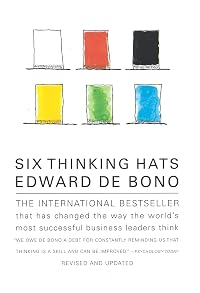
YOUR SUCCESS IN BUSINESS DEPENDS ON HOW WELL YOU THINK Six Thinking Hats can help you think better-with its practical and uniquely positive approach to making decisions and exploring new ideas. It is an approach that thousands of business managers, educators, and government leaders around the world have already adopted with great success. "The main difficulty of thinking is confusion," writes Edward de Bono, long recognized as the foremost international authority on conceptual thinking and show more on the teaching of thinking as a skill. "We try to do too much at once. Emotions, information, logic, hope, and creativity all crowd in on us. It is like juggling with too many balls." The solution? De Bono unscrambles the thinking process with his "six thinking hats": * WHITE HAT: neutral and objective, concerned with facts and figures * RED HAT: the emotional view * BLACK HAT: careful and cautious, the "devil's advocate" hat * YELLOW HAT: sunny and positive * GREEN HAT: associated with fertile growth, creativity, and new ideas * BLUE HAT: cool, the color of the sky, above everything else-the organizing hat Through case studies and real-life examples, Dr. de Bono reveals the often surprising ways in which deliberate role playing can make you a better thinker. He offers a powerfully simple tool that you-and your business, whether it's a start-up or a major corporation-can use to create a climate of clearer thinking, improved communication, and greater creativity. His book is an instructive and inspiring text for anyone who makes decisions, in business or in life. show lessTags
Recommendations



















Member Reviews
As a young staff officer in an artillery regiment in the mid-1990s, I was tasked with learning more about de Bono's Six Thinking Hats in preparation for an officers' retreat. The commanding officer at the time was completing an MBA and he had developed a vision statement and vision motto for the regiment. For many of the officers and men, it was deemed quite unnecessary. The deputy principal at Brisbane's Clayfield College was an expert in de Bono's work, and I met with him to learn more. The one thing that stuck with me was his approach to using random words as a 'provocation' (p. 131). His approach was to to have a list of sixty random nouns, numbered one to sixty. Whenever he needed to 'po', he would look at the minute hand on the show more clock, go to the corresponding number on his list, and then use the word as a way to shake things up in his thinking. On reading the Penguin version of this book for the first time, I noticed that the deputy principal at Clayfield College gets a mention (p. x), and then I learnt how much I had forgotten about de Bono's process. It was enlightening because I have used the Six Thinking Hats in the 'leading creativity' part of my leadership teaching, but with large classes and students in groups being introduced to the method for the first time has rarely proven any more than an introduction. It has often meant that I have I have inadvertently used the hats incorrectly, as people would end up using the same hat for the session (p. 7). Based on my re-reading of de Bono, I will try again in tutorial classes, which tend to be smaller, and I will act as the blue hat and focus on an issue of common concern. This problem is quite obvious. As former Vice Chancellor of the University of Canberra, Professor Stephen Parker said:
A university is a collection of disciplines brought together by a common concern over car parking.I will use car parking as it is an issue that most students struggle with every time they attend class. It was interesting to revisit 'parallel thinking', and to ensure the hats are used in this way. In effect, everyone must be looking in the same direction, something that falls apart when the hats are used by separate individuals rather than as a group (p. 4). I continue to find de Bono's critique of the 'Greek gang of Three' fascinating (p. 1). In my leadership classes, we discuss the opposing theories of Fred Fiedler versus Hersey and Blanchard. Fiedler suggests our leadership style is either task or relationship focused and it is difficult or impossible to change, whereas the Hersey-Blanchard model suggests we can and should change our style to suit different situations. While not referring to leadership styles per se, de Bono suggests that (p. 140):
I don't think it is possible to change personality... [however] the tragedy mask and the comedy mask are separate. The actor himself does not change.Finally, the concept of the creative pause is useful. One should stop, pause, and put on the green hat just because... for no reason, even if everything is on track, just stop, pause, and 'po'. I have been using what I call the Stoic 'deliberate pause' when making decisions to assess externalities. But I will now try to deliberately pause from time to time to also consider the possibilities. I think I can do this rather well, although I do have an efficiency preference for using the 'standard situation box' (p. 3) to deal with administrative matters and then only think creatively about the things that fall outside the box. But using the creative pause is something I would like to be more conscious of until it becomes a habit. There is something to be said about de Bono's method, and I believe if used properly, it can wield innovative results. At the same time, I think the number of management fads has turned most people off any form of corporate game, and we have all experienced vision statements that say one thing while the organisation does the exact opposite to its stakeholders. De Bono's method, however, does not need to be seen as a fad if the underlying philosophy and design of the systematised thinking process is considered. The concept of design in all aspects of life is on the rise at the moment, so I would recommend revisiting the Six Thinking Hats as a way to bring design thinking to bear. But we shall see. show less
This is a very easy read and provides a good simple approach for exploring ideas and problems through thinking from different perspectives in a structured manner. There are six hats, each of which have different characteristics:
- White Hat: facts, figures, information
- Red Hat: emotions and feelings, hunch and intuition
- Black Hat: devil's advocate, negative judgement
- Yellow Hat: optimism, positivity
- Green Hat: creativity
- Blue Hat: controlling of the hats and thinking, orchestration
The idea of the hat is that a person will put on or be asked to put on a hat and to express a view from that perspective. This gets people thinking in different ways and since it is play-acting people are more willing to express views from under the show more security of the hat that otherwise may be left unsaid. show less
- White Hat: facts, figures, information
- Red Hat: emotions and feelings, hunch and intuition
- Black Hat: devil's advocate, negative judgement
- Yellow Hat: optimism, positivity
- Green Hat: creativity
- Blue Hat: controlling of the hats and thinking, orchestration
The idea of the hat is that a person will put on or be asked to put on a hat and to express a view from that perspective. This gets people thinking in different ways and since it is play-acting people are more willing to express views from under the show more security of the hat that otherwise may be left unsaid. show less
Good overview of different thinking models. Best for anyone unfamiliar with leading teams through decision making or problem solving, someone early in their career who wants to better lead and facilitate groups.
The hats are different colors:
White (facts) ---- Red (emotional)
Black (serious, what could go wrong, devil's advocate) ---- Yellow (sunny, what could go right)
Green (abundant growth, grass, creativity and new ideas)----Blue (sky, control, organization)
The book walks through each in detail and gives good examples of when each might be appropriate. It also recommends my preferred group method of announcing what the question is and then having a few minutes of quiet so everyone can think about their answer before you go around the show more room to collect all the answers. I find this is helpful in getting people to listen better to others.
The first analogy that shows what parallel think is was most helpful (i.e. four people look at different sides of a house see completely different things, have all four walk around the house and view from all four angles to best leverage their experiences and capabilities).
I've spent a lot of time studying and using the Kepner/Tregoe (KT) methods of decision making and problem solving and find this similar albeit much higher level. For me, the phrases I use most often that seem most related by hat:
* White hat - do you think that, or have evidence for that. This is the start of any problem, getting the facts down to define what the problem is. (KT - situation analysis and first part of problem analysis)
* Red hat - what's your reaction to that, how are you feeling about that right now. (No KT corollary, just a facilitator thing you learn on the way)
*Black hat - What could go wrong with this and how might we prevent or mitigate. (KT - potential problem analysis)
* Yellow hat - What could go right and how do we build that in or leverage when it happens (KT - potential opportunity analysis)
* Green hat - what other options we we have (KT - part of a decision analysis). This is the most powerful question you can ask a group because they will assume there is a single right answer and start fighting over it. There is always a more elegant, easier to implement solution with less down sides. You just have to get them there.
* Blue hat - Open every meeting with an agenda, a problem statement, rules of engagement, role definition. During the meeting constantly listen for the weaker viewpoints and pull them out, capture what's being said, focus on getting everyone's voice heard and making their thinking visible. Then at the end, summarize the learnings, define and assign next steps, review the process to learn to do the next one better. (KT - some of a situation analysis and much of a decision analysis).
Quotes:
* The hats are not descriptions of people but models of behavior.
* A description is concerned with what has happened. A direction is concerned with what is about to happen.
* The whole point of parallel thinking is that the experience and intelligence of everyone should be used in each direction. show less
The hats are different colors:
White (facts) ---- Red (emotional)
Black (serious, what could go wrong, devil's advocate) ---- Yellow (sunny, what could go right)
Green (abundant growth, grass, creativity and new ideas)----Blue (sky, control, organization)
The book walks through each in detail and gives good examples of when each might be appropriate. It also recommends my preferred group method of announcing what the question is and then having a few minutes of quiet so everyone can think about their answer before you go around the show more room to collect all the answers. I find this is helpful in getting people to listen better to others.
The first analogy that shows what parallel think is was most helpful (i.e. four people look at different sides of a house see completely different things, have all four walk around the house and view from all four angles to best leverage their experiences and capabilities).
I've spent a lot of time studying and using the Kepner/Tregoe (KT) methods of decision making and problem solving and find this similar albeit much higher level. For me, the phrases I use most often that seem most related by hat:
* White hat - do you think that, or have evidence for that. This is the start of any problem, getting the facts down to define what the problem is. (KT - situation analysis and first part of problem analysis)
* Red hat - what's your reaction to that, how are you feeling about that right now. (No KT corollary, just a facilitator thing you learn on the way)
*Black hat - What could go wrong with this and how might we prevent or mitigate. (KT - potential problem analysis)
* Yellow hat - What could go right and how do we build that in or leverage when it happens (KT - potential opportunity analysis)
* Green hat - what other options we we have (KT - part of a decision analysis). This is the most powerful question you can ask a group because they will assume there is a single right answer and start fighting over it. There is always a more elegant, easier to implement solution with less down sides. You just have to get them there.
* Blue hat - Open every meeting with an agenda, a problem statement, rules of engagement, role definition. During the meeting constantly listen for the weaker viewpoints and pull them out, capture what's being said, focus on getting everyone's voice heard and making their thinking visible. Then at the end, summarize the learnings, define and assign next steps, review the process to learn to do the next one better. (KT - some of a situation analysis and much of a decision analysis).
Quotes:
* The hats are not descriptions of people but models of behavior.
* A description is concerned with what has happened. A direction is concerned with what is about to happen.
* The whole point of parallel thinking is that the experience and intelligence of everyone should be used in each direction. show less
Possibly the best way I have come across to run meetings.
The principle behind the book is that you have six hats: White - Information, Red - Emotions. Black - Caution, Yellow - Optimism, Green - Creativity and BlueControl of thinking.
Each participant at the meeting takes time to make suggestions at the meeting whilst metaphorically wearing the appropriate coloured hat. The advantage to this is that the doom and gloom merchants (Black hats) do have their time, but do not dominate the meeting, and are expected to contribute whilst 'wearing' the other hats, so they have to find positive things to say or be creative and so on.
de Bono makes suggestions as to the best order to run meetings in, and makes practical suggestions for time and the show more wearer of the blue hat. show less
The principle behind the book is that you have six hats: White - Information, Red - Emotions. Black - Caution, Yellow - Optimism, Green - Creativity and BlueControl of thinking.
Each participant at the meeting takes time to make suggestions at the meeting whilst metaphorically wearing the appropriate coloured hat. The advantage to this is that the doom and gloom merchants (Black hats) do have their time, but do not dominate the meeting, and are expected to contribute whilst 'wearing' the other hats, so they have to find positive things to say or be creative and so on.
de Bono makes suggestions as to the best order to run meetings in, and makes practical suggestions for time and the show more wearer of the blue hat. show less
picked this up to help kick my creativity in gear. However, Mr. Burns peed on this one too (and it IS a library book, so I get to buy them a new one). I'm getting really sick of this.
Critical thinking seminar at work next week and this is my homework. Sigh.
Members
- Recently Added By
Author Information

234+ Works 11,148 Members
Edward De Bono is world famous in the field of creative thinking: he invented the concept of lateral thinking and his advice and ideas on thought and learning have been sought from world leaders and Nobel Laureates for over 50 years. He has written numerous bestsellers, including How to Have a Beautiful Mind and How to Have Creative Ideas. show more Together his books have sold over 1 million copies worldwide. show less
Some Editions
Series

Belongs to Publisher Series
Work Relationships
Common Knowledge
- Canonical title
- Six Thinking Hats
- Original publication date
- 1985
- First words
- Can you really change the effectiveness of your thinking?
Classifications
- Genres
- Nonfiction, General Nonfiction, Business
- DDC/MDS
- 153.42 — Philosophy & psychology Psychology Conscious mental processes and intelligence Thought, thinking, reasoning, intuition, value, judgment Critical Thinking
- LCC
- BF441 .D385 — Philosophy, Psychology and Religion Psychology Psychology Consciousness. Cognition
- BISAC
Statistics
- Members
- 787
- Popularity
- 35,583
- Reviews
- 10
- Rating
- (3.58)
- Languages
- 11 — Dutch, English, French, German, Italian, Norwegian (Bokmål), Portuguese, Russian, Spanish, Swedish, Turkish
- Media
- Paper, Audiobook, Ebook
- ISBNs
- 43
- ASINs
- 15