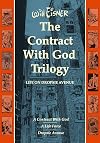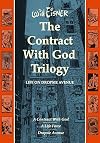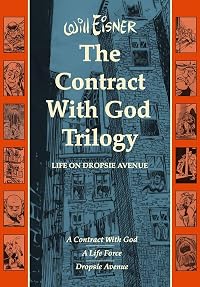
The Contract with God Trilogy
by Will Eisner
The Contract with God Trilogy (Collections and Selections — Omnibus 1-3), Will Eisner Library (Collections and Selections — Omnibus)
On This Page
Description
The legendary graphic novel and the sequels that launched an art form. With graphic narrative that "was closer to the writing of Bernard Malamud or Isaac Bashevis Singer than any comic art which had preceded it" (The Economist), A Contract with God, originally published in 1978, was the first graphic novel: the prototype-along with A Life Force and Dropsie Avenue-for such seminal works as Maus and Persepolis. Set during the Great Depression, this literary trilogy, assembled in one volume for show more the first time, presents a treasure house of now near-mythic stories that fictionally illustrate the bittersweet tenement life of Eisner's youth. With nearly one dozen new illustrations and a revealing brand-new foreword, this book ultimately tells the epic story of life, death, and resurrection while exploring man's fractious relationship with an all-too-vengeful God. This mesmerizing, fictional chronicle of the universal American immigrant experience is Eisner's most poignant and enduring legacy. show lessTags
Recommendations






Member Reviews
There is a tiny irony in the fact that when Will Eisner coined the phrase "graphic novel" in 1978 to describe his work A Contract with God, the book in question did not have the single plot of a unified novel. It was instead a set of four shorter narratives joined by a common setting at No. 55 Dropsie Avenue in the Bronx. The first of these is the properly-titled "A Contract with God," and it concerns the moral vicissitudes of a Jewish immigrant in New York. The other three stories center on a Depression-era "street singer," the building superintendent at No. 55, and a summer vacation season.
The Contract with God Trilogy collects the original book with its two sequels, both of which fully merit the "graphic novel" label. The Life Force show more is a complex story centered on the carpenter Jacob Starkah, and taking place mostly in 1934. Dropsie Avenue spans more than a century of transformations of the Dropsie neighborhood, pulling the events together into a single tale of striving, corruption, and transformation. The Trilogy volume is supplied with a preface and some new interstitial art from Eisner.
When he composed these pages, Eisner had already developed his techniques of visual storytelling to a high pitch, and throughout the work the characters and plots are presented with startling efficiency, while the compositions are striking and effective. The illustration is all in monochrome inks, presented in this handsome hardcover with uniform dark brown line art on ivory paper.
All of these stories raise powerful moral and emotional concerns, leavening them with occasional humor. They also clearly incorporate a level of memoir that powerfully documents 20th-century cultural history for the Bronx. I read a copy borrowed from the local public library, and I strongly believe it deserves a place in such collections. show less
The Contract with God Trilogy collects the original book with its two sequels, both of which fully merit the "graphic novel" label. The Life Force show more is a complex story centered on the carpenter Jacob Starkah, and taking place mostly in 1934. Dropsie Avenue spans more than a century of transformations of the Dropsie neighborhood, pulling the events together into a single tale of striving, corruption, and transformation. The Trilogy volume is supplied with a preface and some new interstitial art from Eisner.
When he composed these pages, Eisner had already developed his techniques of visual storytelling to a high pitch, and throughout the work the characters and plots are presented with startling efficiency, while the compositions are striking and effective. The illustration is all in monochrome inks, presented in this handsome hardcover with uniform dark brown line art on ivory paper.
All of these stories raise powerful moral and emotional concerns, leavening them with occasional humor. They also clearly incorporate a level of memoir that powerfully documents 20th-century cultural history for the Bronx. I read a copy borrowed from the local public library, and I strongly believe it deserves a place in such collections. show less
Published quietly in 1978, Will Eisner's revolutionary literary work A Contract With God marked the invention of the modern graphic novel, took on a life of its own, and inspired a generation of "sequential artists."
Will Eisner (1917–2005) saw himself as "a graphic witness reporting on life, death, heartbreak, and the never-ending struggle to prevail." The publication of A Contract With God when Eisner was sixty-one proved to be a watershed moment both for him and for comic literature. It marked the birth of the modern graphic novel and the beginning of an era when serious cartoonists could be liberated from their stultifying comic-book format.
More than a quarter-century after the initial publication of A Contract With God, and in the show more last few months of his life, Eisner chose to combine the three fictional works he had set on Dropsie Avenue, the mythical street of his youth in Depression-era New York City.
As the dramas unfold in A Contract With God, the first book in this new trilogy, it is at 55 Dropsie Avenue where Frimme Hersh, the pious Jew, first loses his beloved daughter, then breaks his contract with his maker, and ends up as a slumlord; it is on Dropsie Avenue where a street singer, befriended by an aging diva, is so beholden to the bottle that he fails to grasp his chance for stardom; and it is there that a scheming little girl named Rosie poisons a depraved super’s dog before doing in the super as well.
In the second book, A Life Force, declared by R. Crumb to be "a masterpiece," Eisner re-creates himself in his protagonist, Jacob Shtarkah, whose existential search reflected Eisner’s own lifelong struggle. Chronicling not only the Crash of 1929 and the Great Depression but also the rise of Nazism and the spread of left-wing politics, Eisner combined the miniaturist sensibility of Henry Roth with the grand social themes of novelists such as Dos Passos and Steinbeck.
Finally, in Dropsie Avenue: The Neighborhood, Eisner graphically traces the social trajectory of this mythic avenue over four centuries, creating a sweeping panorama of the city and its waves of new residents―the Dutch, English, Irish, Jews, African Americans, and Puerto Ricans―whose faces changed yet whose lives presented an unending "story of life, death, and resurrection."
The Contract With God Trilogy is a mesmerizing, fictional chronicle of a universal American experience and Eisner’' most poignant and enduring literary legacy. show less
Will Eisner (1917–2005) saw himself as "a graphic witness reporting on life, death, heartbreak, and the never-ending struggle to prevail." The publication of A Contract With God when Eisner was sixty-one proved to be a watershed moment both for him and for comic literature. It marked the birth of the modern graphic novel and the beginning of an era when serious cartoonists could be liberated from their stultifying comic-book format.
More than a quarter-century after the initial publication of A Contract With God, and in the show more last few months of his life, Eisner chose to combine the three fictional works he had set on Dropsie Avenue, the mythical street of his youth in Depression-era New York City.
As the dramas unfold in A Contract With God, the first book in this new trilogy, it is at 55 Dropsie Avenue where Frimme Hersh, the pious Jew, first loses his beloved daughter, then breaks his contract with his maker, and ends up as a slumlord; it is on Dropsie Avenue where a street singer, befriended by an aging diva, is so beholden to the bottle that he fails to grasp his chance for stardom; and it is there that a scheming little girl named Rosie poisons a depraved super’s dog before doing in the super as well.
In the second book, A Life Force, declared by R. Crumb to be "a masterpiece," Eisner re-creates himself in his protagonist, Jacob Shtarkah, whose existential search reflected Eisner’s own lifelong struggle. Chronicling not only the Crash of 1929 and the Great Depression but also the rise of Nazism and the spread of left-wing politics, Eisner combined the miniaturist sensibility of Henry Roth with the grand social themes of novelists such as Dos Passos and Steinbeck.
Finally, in Dropsie Avenue: The Neighborhood, Eisner graphically traces the social trajectory of this mythic avenue over four centuries, creating a sweeping panorama of the city and its waves of new residents―the Dutch, English, Irish, Jews, African Americans, and Puerto Ricans―whose faces changed yet whose lives presented an unending "story of life, death, and resurrection."
The Contract With God Trilogy is a mesmerizing, fictional chronicle of a universal American experience and Eisner’' most poignant and enduring literary legacy. show less
This dark and gritty omnibus tells the story of a New York City street and its many residents throughout the years. With heavy themes of religion, racism, and crime, it paints a bleak picture of the predictable sins of humanity.
The three books contained in this omnibus are each a collection of interconnected stories with no one protagonist throughout. Central to many are the quintessential American theme of immigration and the rollercoaster of business, money, survival and failure. These stories are definitely not a feel-good read but they are sharply observed and unsparingly rendered.
The three books contained in this omnibus are each a collection of interconnected stories with no one protagonist throughout. Central to many are the quintessential American theme of immigration and the rollercoaster of business, money, survival and failure. These stories are definitely not a feel-good read but they are sharply observed and unsparingly rendered.
Will Eisner is a famous in the comic world. I didn't even know. I just wanted a graphic novel to read. This just happened to be the one I grabbed. Lucky lucky lucky.
The Contract with God Trilogy collects 3 books written by Will Eisner; The Contract with God, A Life Force, and Dropsie Avenue. All of these take place in New York, in the Bronx, in a fictional neighborhood known as Dropsie Avenue, mostly during the early 1900's. The book captures the time period perfectly, with the organized crime, immigration troubles, and racial and ethnicity disputes among the residents, it did a terrific job transporting me to that particular time in New York.
Will Eisner's art is spectacular. He has such a way with faces. The characters are so show more expressive that it really brings them to life. The first book is just a collection of short stories, but I found that I grew attached to the characters so quickly thanks to Eisner's impeccable art that I truly cared for them before the short little tale ended. I can understand why he was so revered.
The character art is great, and the book does a great job whisking the reader away to the time period, but what really sets the book apart is the city. The book features a lot of characters. But the city remains. Really, it's the main character. Dropsie Avenue has become one of those mystical places in my mind, like Middle Earth, Hogwarts, or Dominaria. It is vivid, and I think I'll remember it for a long time. The last book is an extended comic that starts in the late 1800's when Dropsie is just a patch of farms land, and it chronicles the life of the land as it grows and degenerates into a sprawling, crime-ridden city. The characters come and go, they grow and die and leave descendants before your eyes, but Dropsie Avenue - the main character - is always looming in the background.
I loved The Contract with God Trilogy. Will Eisner was a remarkable man, and I have no doubt I'll read more of his work in the future. And so should you! show less
The Contract with God Trilogy collects 3 books written by Will Eisner; The Contract with God, A Life Force, and Dropsie Avenue. All of these take place in New York, in the Bronx, in a fictional neighborhood known as Dropsie Avenue, mostly during the early 1900's. The book captures the time period perfectly, with the organized crime, immigration troubles, and racial and ethnicity disputes among the residents, it did a terrific job transporting me to that particular time in New York.
Will Eisner's art is spectacular. He has such a way with faces. The characters are so show more expressive that it really brings them to life. The first book is just a collection of short stories, but I found that I grew attached to the characters so quickly thanks to Eisner's impeccable art that I truly cared for them before the short little tale ended. I can understand why he was so revered.
The character art is great, and the book does a great job whisking the reader away to the time period, but what really sets the book apart is the city. The book features a lot of characters. But the city remains. Really, it's the main character. Dropsie Avenue has become one of those mystical places in my mind, like Middle Earth, Hogwarts, or Dominaria. It is vivid, and I think I'll remember it for a long time. The last book is an extended comic that starts in the late 1800's when Dropsie is just a patch of farms land, and it chronicles the life of the land as it grows and degenerates into a sprawling, crime-ridden city. The characters come and go, they grow and die and leave descendants before your eyes, but Dropsie Avenue - the main character - is always looming in the background.
I loved The Contract with God Trilogy. Will Eisner was a remarkable man, and I have no doubt I'll read more of his work in the future. And so should you! show less
[b: The Contract With God|861023|A Contract With God and Other Tenement Stories|Will Eisner|https://images.gr-assets.com/books/1328363057s/861023.jpg|250281] is arguably the first example of a true 'graphic novel' as it was [a: Will Eisner|1642|Will Eisner|https://images.gr-assets.com/authors/1202618782p2/1642.jpg] who first coined the phrase. He sought to tell stories through the mixture of text and visuals, but rather than the superhero or adventure stories popular at the time, he wished to delve into deeper questions. Questions of meaning, of dealing with grief and life itself. What he did with the medium was absolutely astonishing for its time, and holds up well now. He touched upon universal truths, and didn't shy away from topics show more that are shocking to this day. It's a beautiful piece of art, and a worthy classic. Like [b: Watchmen|472331|Watchmen|Alan Moore|https://images.gr-assets.com/books/1442239711s/472331.jpg|4358649], [b: The Contract with God Trilogy: Life on Dropsie Avenue|33472|The Contract With God Trilogy Life on Dropsie Avenue (The Contract With God Trilogy, #1-3)|Will Eisner|https://images.gr-assets.com/books/1324242014s/33472.jpg|48199417] could be called a graphic novel for people who generally don't like the medium. By defining the medium, it truly transcended it.
[b: The Contract With God|861023|A Contract With God and Other Tenement Stories|Will Eisner|https://images.gr-assets.com/books/1328363057s/861023.jpg|250281] is a series of stories about tenement living in the 30s. The titular story is about a Jewish man who is believed to be so good as to be favored by God. When he escapes his small town of Germany to go to America, he writes himself a contract with God... only years later, God breaks the contract. How do you live with that? What do you do? Next is a story of a street singer who nearly makes it big, only to squander the chance. Then the super of 55 Dropsie Avenue is looked at, and used by the schemings of the person you'd least suspect...
The next volume in the trilogy is [b: A Life Force|60241|A Life Force|Will Eisner|https://images.gr-assets.com/books/1327877159s/60241.jpg|1528062]. These stories follow the development of the Depression and its effect upon 55 Dropsie Avenue. The main thread that these stories follow is that of "Izzy the Cockroach and the Meaning of Life". Jacob, recently laid off after having helped build a shul, wonders what it is that separates man from the cockroach. We both feel the deep life force, the need for living. Are we better than the cockroach, or are we just living without purpose? Did Man create God or did God create Man? These threads are followed through the Depression as people's position rise and fall...
Finally, [b: Dropsie Avenue|123911|Dropsie Avenue The Neighborhood|Will Eisner|https://images.gr-assets.com/books/1348793059s/123911.jpg|3158742] is the beautiful biography of that block itself from inception to modern day. The neighborhood rises and falls, but it's the people who make it up and their connections are surprisingly beautiful. This story deals with the goodness in people, in spite of the troubles and ills that befall them.
It's a gorgeous trilogy, beautifully illustrated and lovingly written. A deserved classic strong as it was when first published even now. show less
[b: The Contract With God|861023|A Contract With God and Other Tenement Stories|Will Eisner|https://images.gr-assets.com/books/1328363057s/861023.jpg|250281] is a series of stories about tenement living in the 30s. The titular story is about a Jewish man who is believed to be so good as to be favored by God. When he escapes his small town of Germany to go to America, he writes himself a contract with God... only years later, God breaks the contract. How do you live with that? What do you do? Next is a story of a street singer who nearly makes it big, only to squander the chance. Then the super of 55 Dropsie Avenue is looked at, and used by the schemings of the person you'd least suspect...
The next volume in the trilogy is [b: A Life Force|60241|A Life Force|Will Eisner|https://images.gr-assets.com/books/1327877159s/60241.jpg|1528062]. These stories follow the development of the Depression and its effect upon 55 Dropsie Avenue. The main thread that these stories follow is that of "Izzy the Cockroach and the Meaning of Life". Jacob, recently laid off after having helped build a shul, wonders what it is that separates man from the cockroach. We both feel the deep life force, the need for living. Are we better than the cockroach, or are we just living without purpose? Did Man create God or did God create Man? These threads are followed through the Depression as people's position rise and fall...
Finally, [b: Dropsie Avenue|123911|Dropsie Avenue The Neighborhood|Will Eisner|https://images.gr-assets.com/books/1348793059s/123911.jpg|3158742] is the beautiful biography of that block itself from inception to modern day. The neighborhood rises and falls, but it's the people who make it up and their connections are surprisingly beautiful. This story deals with the goodness in people, in spite of the troubles and ills that befall them.
It's a gorgeous trilogy, beautifully illustrated and lovingly written. A deserved classic strong as it was when first published even now. show less
WHAT IS IT ABOUT?
Will Eisner’s “The Contract With God Trilogy: Life on Dropsie Avenue” is a collection of three stand-alone graphic novels set on Dropsie Avenue, a fictional street in the Depression-era Bronx, one of the five boroughs of New York City. The first book in this trilogy, “A Contract With God,” consists of four audacious and cynical stories of Dropsie Avenue’s residents. In addition to being extremely entertaining, these stories probe such timeless issues as injustice and morality. In the second book, “A Life Force,” numerous stories of Dropsie Avenue’s residents intertwine with each other, drawing a vibrant and realistic picture of an urban life in America during the Great Depression as well as attempting show more to shine the light on the meaning of life. “Dropsie Avenue,” the final book in the trilogy, is a century-long biography of Dropsie Avenue itself, in which the birth, growth, decay and resurrection of the street is told through everyday lives of its inhabitants as well as the ethnic and social changes of the community throughout the decades.
THUMBS UP:
1) Timeless specimen.
Written in 1978, the first book in the trilogy, “A Contract with God,” marks the birth of a modern graphic novel, and the whole trilogy sets high standards for the genre. In addition to being so historically important and well-crafted, Eisner’s book is also timeless as it deals with eternal issues and truly seems like it could have been published yesterday.
2) Realistic.
Although the stories and characters in “The Contact With God Trilogy” are fictional, the book is extremely realistic. On Dropsie Avenue, bad things happen to good people for no reason, bad guys prevail, and the boundaries between right and wrong are blurred. Yes, it might seem bleak, hopeless and unnecessarily violent at times, but so is life, especially during the Great Depression. What is more, the life cycle of the street in “Dropsie Avenue” is so well-thought-out and masterfully written that it seems more of a first-hand experience than a made-up story.
3) Thought-provoking.
Even though most of the time Eisner’s tone is humorous and seemingly lighthearted, most of the stories carry a deeper message. Both directly and indirectly, the author often makes the reader pause and ponder upon the meaning of existence, reexamine shared values or reevaluate social norms.
4) Gorgeous artwork.
I simply adored the illustrations. They are not terrible detailed, especially when it comes to faces, as many of the characters look alike, while the same person often looks quite different in different panels, but I just love Eisner’s style: so lively, so expressive and so… stylish! I wish I could draw like that. By the way, the illustrations are colorless, just pencil and ink, but I think such artwork fits the gloomy mood of the Depression-era perfectly.
COULD BE BETTER:
1) Wordy.
At times, especially in “A Life Force,” there is a little bit too much text for a graphic novel. On the other hand, the background stories or the newspaper clips really help to set the mood and understand the events better.
2) Long and effortful.
I loved the first book, but later my enthusiasm dwindled. However, it might be due to the fact that I read the book in a relatively short time. Although it is a graphic novel, I wouldn’t call it a light read as it makes you think A LOT, and it seems that the more I think about the stories and revisit certain pages, the more I understand and appreciate the gravity of this book.
VERDICT: 4 out of 5
If you are a fan of graphic novels, Will Eisner’s “The Contract With God Trilogy: Life on Dropsie Avenue” is a must-read as it has a historical importance in the world of graphic storytelling and is a fine example of what the genre has to offer. If possible though, don’t rush reading this trilogy and take time to think about what you’ve read as this might help to understand and appreciate the book more. show less
Will Eisner’s “The Contract With God Trilogy: Life on Dropsie Avenue” is a collection of three stand-alone graphic novels set on Dropsie Avenue, a fictional street in the Depression-era Bronx, one of the five boroughs of New York City. The first book in this trilogy, “A Contract With God,” consists of four audacious and cynical stories of Dropsie Avenue’s residents. In addition to being extremely entertaining, these stories probe such timeless issues as injustice and morality. In the second book, “A Life Force,” numerous stories of Dropsie Avenue’s residents intertwine with each other, drawing a vibrant and realistic picture of an urban life in America during the Great Depression as well as attempting show more to shine the light on the meaning of life. “Dropsie Avenue,” the final book in the trilogy, is a century-long biography of Dropsie Avenue itself, in which the birth, growth, decay and resurrection of the street is told through everyday lives of its inhabitants as well as the ethnic and social changes of the community throughout the decades.
THUMBS UP:
1) Timeless specimen.
Written in 1978, the first book in the trilogy, “A Contract with God,” marks the birth of a modern graphic novel, and the whole trilogy sets high standards for the genre. In addition to being so historically important and well-crafted, Eisner’s book is also timeless as it deals with eternal issues and truly seems like it could have been published yesterday.
2) Realistic.
Although the stories and characters in “The Contact With God Trilogy” are fictional, the book is extremely realistic. On Dropsie Avenue, bad things happen to good people for no reason, bad guys prevail, and the boundaries between right and wrong are blurred. Yes, it might seem bleak, hopeless and unnecessarily violent at times, but so is life, especially during the Great Depression. What is more, the life cycle of the street in “Dropsie Avenue” is so well-thought-out and masterfully written that it seems more of a first-hand experience than a made-up story.
3) Thought-provoking.
Even though most of the time Eisner’s tone is humorous and seemingly lighthearted, most of the stories carry a deeper message. Both directly and indirectly, the author often makes the reader pause and ponder upon the meaning of existence, reexamine shared values or reevaluate social norms.
4) Gorgeous artwork.
I simply adored the illustrations. They are not terrible detailed, especially when it comes to faces, as many of the characters look alike, while the same person often looks quite different in different panels, but I just love Eisner’s style: so lively, so expressive and so… stylish! I wish I could draw like that. By the way, the illustrations are colorless, just pencil and ink, but I think such artwork fits the gloomy mood of the Depression-era perfectly.
COULD BE BETTER:
1) Wordy.
At times, especially in “A Life Force,” there is a little bit too much text for a graphic novel. On the other hand, the background stories or the newspaper clips really help to set the mood and understand the events better.
2) Long and effortful.
I loved the first book, but later my enthusiasm dwindled. However, it might be due to the fact that I read the book in a relatively short time. Although it is a graphic novel, I wouldn’t call it a light read as it makes you think A LOT, and it seems that the more I think about the stories and revisit certain pages, the more I understand and appreciate the gravity of this book.
VERDICT: 4 out of 5
If you are a fan of graphic novels, Will Eisner’s “The Contract With God Trilogy: Life on Dropsie Avenue” is a must-read as it has a historical importance in the world of graphic storytelling and is a fine example of what the genre has to offer. If possible though, don’t rush reading this trilogy and take time to think about what you’ve read as this might help to understand and appreciate the book more. show less
In general, I admit that I'm rather prejudiced toward graphic novels. I've been recommended Watchmen and similar works, but to me they seemed not different enough from regular ol' comics to merit the "novel" category. I never really felt that a graphic novel could really capture the sort of spark of light that you see in good books. And then I read The Contract With God trilogy.
What WIll Eisner does with these books is truly amazing. He creates an entire neighborhood, full of color and stories and wit, all contained within a single street (and for the most part, within a single building). Rather than hampering the story in any way, the art complements it completely, with the simply drawn yet expressive characters and backgrounds clearly show more showing what would otherwise take pages and pages on description. Some of the pages were so beautifully drawn that I had to stop reading and just stare at the art for some time. The writing is at turns naturalistic (at times overly reliant on dialect, I felt) and poetic, sort of mimicking Steinbeck.
The first book, The Contract with God, is a collection of four short stories set in a single building in the early 20th century Bronx, about a devout man angry with God, a street singer, a building super, and a Jewish resort town. I actually felt that the stories here were rather hit-or-miss, and I liked "The Street Singer" and "Cookalein" best. The second book, The Life Force, returns to the same building in the Depression, this time telling a long and winding narrative involving Communists, Holocaust refugees, interfaith relationships, an "enchanted prince", a Sicilian crime gang, and, of course, cockroaches. The plot sometimes feels that it simply has too much going on, but I was gripped from almost the first page.
The third book, Dropsie Avenue, is something different entirely, and sets itself apart from the other two books. It chronicles the entire history of this fictional neighborhood, as it passed from Dutch colonists to the English and Irish upper classes, then to in turns Italian, Jewish, Hispanic, and black tenement dwellers, and what happened afterward, covering several centuries in all but focusing primarily on the 20th century. It's a history of a neighborhood, but it's more than just that, because, as one character writes, "Buildings are only buildings, but people make a neighborhood." In this book, unlike the others, the reader truly gets to see characters grow: a core group of characters is seen from childhood to old age, and characters change as the neighborhood around them changes well. The book is very nostalgic, but also warns against overly attaching oneself to a single image of the past, because change is always present, in every neighborhood, "visible evidence of implacable growth."
P.S. I just read that Will Eisner wrote and drew Dropsie Avenue at age 78. This man is unbelievable. show less
What WIll Eisner does with these books is truly amazing. He creates an entire neighborhood, full of color and stories and wit, all contained within a single street (and for the most part, within a single building). Rather than hampering the story in any way, the art complements it completely, with the simply drawn yet expressive characters and backgrounds clearly show more showing what would otherwise take pages and pages on description. Some of the pages were so beautifully drawn that I had to stop reading and just stare at the art for some time. The writing is at turns naturalistic (at times overly reliant on dialect, I felt) and poetic, sort of mimicking Steinbeck.
The first book, The Contract with God, is a collection of four short stories set in a single building in the early 20th century Bronx, about a devout man angry with God, a street singer, a building super, and a Jewish resort town. I actually felt that the stories here were rather hit-or-miss, and I liked "The Street Singer" and "Cookalein" best. The second book, The Life Force, returns to the same building in the Depression, this time telling a long and winding narrative involving Communists, Holocaust refugees, interfaith relationships, an "enchanted prince", a Sicilian crime gang, and, of course, cockroaches. The plot sometimes feels that it simply has too much going on, but I was gripped from almost the first page.
The third book, Dropsie Avenue, is something different entirely, and sets itself apart from the other two books. It chronicles the entire history of this fictional neighborhood, as it passed from Dutch colonists to the English and Irish upper classes, then to in turns Italian, Jewish, Hispanic, and black tenement dwellers, and what happened afterward, covering several centuries in all but focusing primarily on the 20th century. It's a history of a neighborhood, but it's more than just that, because, as one character writes, "Buildings are only buildings, but people make a neighborhood." In this book, unlike the others, the reader truly gets to see characters grow: a core group of characters is seen from childhood to old age, and characters change as the neighborhood around them changes well. The book is very nostalgic, but also warns against overly attaching oneself to a single image of the past, because change is always present, in every neighborhood, "visible evidence of implacable growth."
P.S. I just read that Will Eisner wrote and drew Dropsie Avenue at age 78. This man is unbelievable. show less
Members
- Recently Added By
Lists

Recommended Comics / Graphic Novels
595 works; 122 members

Best Stand-Alone Graphic Novels
107 works; 19 members
Drawn Out: The 50 Best Non-Superhero Graphic Novels
175 works; 8 members
Author Information

665+ Works 11,937 Members
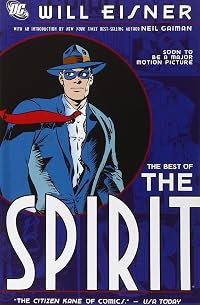
Will Eisner was born March 6, 1917 in Brooklyn, NY. As a child he worked for printers and sold newspapers. He attended De Witt Clinton High School in the Bronx, where his artwork first appeared in the school newspaper. His first job was at the New York American, but he lost that and found a job with WOW What a Magazine! in 1936. He created two show more features for the magazine, Harry Karry and The Flame. After the magazine went under, for a short time, he freelanced and drew stories for Comic Magazines before he and friend Jerry Iger formed a the Eisner-Iger studio. The two went their separate ways when Eisner joined the Quality Comics Group to produce a syndicated 16-page newspaper supplement. It was there that Eisner created his most well known character, the Spirit. In 1942, Eisner was drafted into the army where he produced posters and strips for the troops. After the war, he continued the Spirit strip until 1952. It was during this time that he created the American Visuals Corporation, a commercial art company that created comics for educational and commercial purposes. Some of the company's clients included RCA Records, the Baltimore Colts, and New York Telephone. Eisner had given up on the Spirit strip, but still produced new material for it from time to time. He chose to focus his efforts on a more mature storyline and so produced A Contract With God, which was published in 1978. It was the beginnings of the graphic novel. Eisner also taught cartooning at the School of Visual Arts in New York, in addition to writing Comics and Sequential Art and Graphic Storytelling. The Eisner Awards, one of only two comics industry awards, are named for Eisner and were established in 1988. Eisner's work was showcased in the Whitney Museum's 1996 "NYNY: City of Ambition" show. Will Eisner passed away on Monday January 3, 2005 at the age of 87 after undergoing quadruple bypass heart surgery. (Bowker Author Biography) show less
Awards and Honors
Distinctions
Series


Work Relationships
Common Knowledge
- Canonical title
- The Contract with God Trilogy
- Original title
- Will Eisner's The Contract with God Trilogy
- Alternate titles*
- The Contract with God Trilogy
- Original publication date
- 2006
- People/Characters
- Frimme Hersh; Jakob Shtarkah; Elton Shaftsbury II; Rivka Shtarkah; Rebecca Shtarkah; Frieda Gold
- Important places
- The Bronx, New York, New York, USA; Catskill Mountains, New York, USA
- Important events
- Great Depression
- Dedication
- To Ann
- Disambiguation notice*
- The Contract with God Trilogy is a different book from A Contract with God and Other Tenement Stories. Please, don't combine them.
*Some information comes from Common Knowledge in other languages. Click "Edit" for more information.
Classifications
- Genre
- Graphic Novels & Comics
- DDC/MDS
- 741.5973 — Arts & recreation Drawing & decorative arts Drawing Comic books, graphic novels, fotonovelas, cartoons, caricatures, comic strips History, geographic treatment, biography North American United States (General)
- LCC
- PN6727 .E4 .A6 — Language and Literature Literature (General) Literature (General) Collections of general literature Comic books, strips, etc.
- BISAC
Statistics
- Members
- 628
- Popularity
- 46,311
- Reviews
- 17
- Rating
- (4.14)
- Languages
- 5 — English, Italian, Polish, Portuguese (Brazil), Spanish
- Media
- Paper
- ISBNs
- 4
- ASINs
- 3