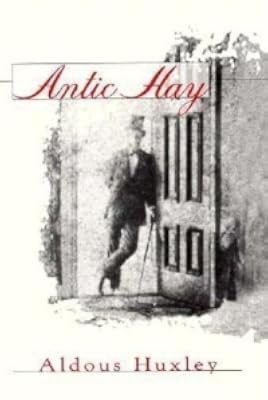
Antic Hay
by Aldous Huxley 
On This Page
Description
A lost generation searches for meaning in chaotic post-WWI London in this satirical novel by the acclaimed author of Brave New World. First published in 1923, Aldous Huxley's Antic Hay was banned in Australia and burned in Cairo for its frank depiction of bohemian life in the grim and listless aftermath of the Great War. Set in London, the comic novel follows a large cast of artists and intellectuals through their nihilistic yet determined pursuits. But at the center of these colorful show more characters is the peculiar man behind Gumbril's Patent Small Clothes. While sitting on the hard oak pews of his school's chapel, disenchanted schoolmaster Theodore Gumbril Junior fantasizes about a pair of trousers with an inflatable air cushion in the seat to make the endless sermon more tolerable. Deciding on a whim to pursue this absurd invention, Gumbril moves to London and soon finds himself among a circle of cynical poets, would-be artists, and bohemian philosophers. Though a timid romantic, Gumbril fashions a rakish alter ego for himself, "The Complete Man," as he pursues his fortunes in this scathing satire of British conventionality. show lessTags
Recommendations
















Member Recommendations
JuliaMaria Satirische Romane über das Leben der höheren Schichten - immer mit der Angst vor dem sozialen Abstieg.
Member Reviews
I'm finding out that just reading Brave New World in high school doesn't really give you any sense of what sort of an author Aldous Huxley was.
Antic Hay is a novel about, essentially, the Lost Generation and their feelings of disaffection and uncertainty in the wake of World War I. A satire, it is at times just poking a bit of fun, at times jabbing viciously. The themes are pretty timeless: disillusionment, the experience of feeling adrift in the world, wondering if what you've wanted for yourself is really worth wanting. The characters are a group of acquaintances who cope with their ennui in a variety of ways - having affairs, becoming unhealthily obsessed with a woman in their social circle, quitting a job, committing to an artistic show more life, taking pretending to be someone else to new levels.
The interesting things to me about this book were twofold: 1, how easily Huxley switches between humor and despair in the narrative; and 2, how he expressed truths in ways that would be just as valid in today's world with only a few key words changed. For an example, check out the quote at the end of the review. I found the book easy to read and digest, and an interesting look at the time period as well as human nature in general.
Recommended for: people who know that the more things change the more they stay the same, people who need to be reminded that they are not, by any stretch of the imagination, the first to feel unmoored.
Quote: "[W]ould a man with unlimited leisure be free, Mr. Gumbril? I say he would not. Not unless he 'appened to be a man like you or me, Mr. Gumbril, a man of sense, a man of independent judgment. An ordinary man would not be free. Because he wouldn't know how to occupy his leisure except in some way that would be forced on him by other people. People don't know 'how to entertain themselves now; they leave it to other people to do it for them. They swallow what's given them. They 'ave to swallow it, whether they like it or not. Cinemas, newspapers, magazines, gramophones, football matches, wireless, telephones -- take them or leave them, if you want to amuse yourself. The ordinary man can't leave them. He takes; and what's that but slavery?" show less
Antic Hay is a novel about, essentially, the Lost Generation and their feelings of disaffection and uncertainty in the wake of World War I. A satire, it is at times just poking a bit of fun, at times jabbing viciously. The themes are pretty timeless: disillusionment, the experience of feeling adrift in the world, wondering if what you've wanted for yourself is really worth wanting. The characters are a group of acquaintances who cope with their ennui in a variety of ways - having affairs, becoming unhealthily obsessed with a woman in their social circle, quitting a job, committing to an artistic show more life, taking pretending to be someone else to new levels.
The interesting things to me about this book were twofold: 1, how easily Huxley switches between humor and despair in the narrative; and 2, how he expressed truths in ways that would be just as valid in today's world with only a few key words changed. For an example, check out the quote at the end of the review. I found the book easy to read and digest, and an interesting look at the time period as well as human nature in general.
Recommended for: people who know that the more things change the more they stay the same, people who need to be reminded that they are not, by any stretch of the imagination, the first to feel unmoored.
Quote: "[W]ould a man with unlimited leisure be free, Mr. Gumbril? I say he would not. Not unless he 'appened to be a man like you or me, Mr. Gumbril, a man of sense, a man of independent judgment. An ordinary man would not be free. Because he wouldn't know how to occupy his leisure except in some way that would be forced on him by other people. People don't know 'how to entertain themselves now; they leave it to other people to do it for them. They swallow what's given them. They 'ave to swallow it, whether they like it or not. Cinemas, newspapers, magazines, gramophones, football matches, wireless, telephones -- take them or leave them, if you want to amuse yourself. The ordinary man can't leave them. He takes; and what's that but slavery?" show less
An enjoyable and harmless portrait of life amongst a group of friends in the aftermath of WW1 - staying out late, drinking, and partying in London. A lovely look at a life no longer available - a look at the young, unmarried flirtatious and presumptuous, with their hopes, anticipations, and disappointments that invariably proceed. "Gumbril's Patent Small Clothes" is the summary of the humour that ran through the story (particularly apt for me as I was reading the book on a hard public seat, unsympathetic to one's lumbar ganglia!). In addition, this character's purchase of a false beard, transforming him into "The Complete Man" is suitably humourous; and yet the novel is not all fun and games; Myra Viveash recalls with sorrow the loss of show more her one and only love due to the war, which in turn makes her cold and nonreciprocal towards her portrait artist who becomes so disillusioned with his work and life that he seriously contemplates suicide. Indeed the exhibition of his that was described by the critics as being insincere marked the start of his depression. Overall a good mix of characters and social life in 1930's London. show less
Like "Those Barren Leaves" this story is about that certain section of society which Huxley paints so humorously, though never to the detriment of the serious content. That content being the intellectual and philosophical themes that this book was written to discuss. Again, as far as I can tell, the book is written more for the thoughts and conversations of the characters, than for the plot and the actions of the characters, but that may just be the way I read it. The book is amusing in that it pokes fun at several of the characters with its almost farcical caricatures. The book also verges itself, just in the right places, of doing what it satirises, which makes it all the more fun, but he gets the balance just right. He also creates a show more balance between the full-of-life, and the morbid despair. The main character, Gumbril, gives up his dreary job as a teacher, which he doesn't enjoy, to enjoy his life more, and make the most out of it before he becomes too old. This is contrasted with another character, who being larger than life at the start, goes on to give up on it all, and becomes depressed,contemplating killing himself.
I found it more humourous than "Those Barren Leaves", and he does give the reader things to think about here too, but I don't think he concludes the book so well, and overall I didn't like it quite so much. I would reccomend it to those who have enjoyed other Huxley novels though, and also those who have not read Huxley before, because of its sheer hilarity. show less
I found it more humourous than "Those Barren Leaves", and he does give the reader things to think about here too, but I don't think he concludes the book so well, and overall I didn't like it quite so much. I would reccomend it to those who have enjoyed other Huxley novels though, and also those who have not read Huxley before, because of its sheer hilarity. show less
St. Bart's 2016 #3 - Somewhat interesting 'novel of ideas' that could not break 3 stars for me.....full of pretentious ridiculous characters that I struggled to care about, all pontificating on art, life, morals & on and on and on. And I realize that was part of the point of the book....to be a vehicle for a host of ideas, many conflicting, with only enough silly story to get them all out....but reading back what I have just typed makes me feel like I am back in school, a guaranteed way to stay below 3 stars! With that said, I did enjoy some of the humor in the book....I loved the focus on the inflatable trousers, I thoroughly enjoyed Theodore Sr., the big picture architect, & I laughed out loud over Pasteur's housekeeper calling him show more 'Master Paster.' But the interminable French & Latin & Italian quotes and verses drove me nuts! No, I don't speak French or Latin.....hell, I can barely speak English!!!! But if the intent was to make me feel inadequate and intellectually inferior, it was a big fail. Instead, my thoughts center on the absurdity of a novel of ideas being written to exclude a huge portion of potential readers from even contemplating the ideas, let alone be sold on them. I have read worse novels, for sure, and there is a datedness to this that further aggravates the situation, but I will tread cautiously as I approach the additional Huxley volumes in my library. show less
Huxley’s most theatrical novel of sorts, this early 1920’s satire toys with the relatively new concept of capitalistic advertizing to the masses, the perils of progress, and the differences between art and intellectual curiosity. The characters are far from his finest display, but worth a quick read for fans of the conversation novel.
Not the most memorable novel I’ll ever read. Apart from pneumatic trousers (a chindogu candidate if ever there was one), little remains a couple of months on as I write this review.
Perhaps it’s because I’ve read so, so many other novels that attempt to spoof the era after WW1 that it just kind of got lost in the haze. Why is it that so very many writers have to describe that era using witty, ascerbic satire rather than writing about it in any way seriously? Was that stance itself actually a tribute to the age?
Gumbril, who the book opens with and mostly focusses on, is probably the most memorable of the caricatures, and his pursuit of the “Complete Man” fantasy was at times amusing and wry.
But, although it was a good novel, it show more was only mildly amusing and not a patch on Decline and Fall, for example. Despite being written after his opening Crome Yellow, I prefer the earlier work although I can’t really put my finger on why. show less
Perhaps it’s because I’ve read so, so many other novels that attempt to spoof the era after WW1 that it just kind of got lost in the haze. Why is it that so very many writers have to describe that era using witty, ascerbic satire rather than writing about it in any way seriously? Was that stance itself actually a tribute to the age?
Gumbril, who the book opens with and mostly focusses on, is probably the most memorable of the caricatures, and his pursuit of the “Complete Man” fantasy was at times amusing and wry.
But, although it was a good novel, it show more was only mildly amusing and not a patch on Decline and Fall, for example. Despite being written after his opening Crome Yellow, I prefer the earlier work although I can’t really put my finger on why. show less
Antic Hay by Aldous Huxley
★★★★
Antic Hay is the irreverent and comedic novel depicting London’s elite in the 1920s. While the protagonist is primarily educator Theodore Gumbril Junior, the story follows motley crew of self-absorbed, directionless characters: Mercaptan, the intellectual, Lypiatt, the failing artist, Coleman the hedonist, Shearwater a physiologist, Myra Viveash, the siren/muse, and a host of other smaller characters.
There’s not much plot to this book. It has been described as a “kind of dance” and indeed this structure is intentional and reflected by the book title. I didn’t enjoy reading this book. There are some gems in the writing but for the most part I was bored and after a time I found his style show more grating. I had to read this book during times when I could look up terms or quotes. To get a full understanding of this novel the reader should be familiar with the classics, speak English, French, Latin, Italian, & German. I found it all rather pretentious. I disliked reading it but rated it a 3 b/c there are moments of genius in the writing that merited a higher rating despite my overall lack of enjoyment. show less
Members
- Recently Added By
Published Reviews
ThingScore 100
The story is told richly and elegantly with few of the interruptions which, despite their intrinsic interest, mar so much of Mr Huxley's story-telling. The disquisition on Wren's London should be in a book of essays but the parody of the night-club play is so funny that one welcomes its intrusion. The 'novel of ideas' raises its ugly head twice only, in the scenes with the tailor and the show more financier, crashing bores both of them but mere spectators at the dance. They do not hold up the fun for long...
Since 1923 Mr Huxley has travelled far. He has done more than change climate and diet. I miss that undertone in his later work. It was because he was then so near the essentials of the human condition that he could write a book that is frivolous and sentimental and perennially delightful. show less
Since 1923 Mr Huxley has travelled far. He has done more than change climate and diet. I miss that undertone in his later work. It was because he was then so near the essentials of the human condition that he could write a book that is frivolous and sentimental and perennially delightful. show less
added by SnootyBaronet
Lists

1001 Books You Must Read Before You Die
1,448 works; 1,134 members

Harold Bloom - The Western Canon: D. The Chaotic Age
833 works; 24 members

The Works of Aldous Huxley
49 works; 1 member
Author Information

287+ Works 104,947 Members
Aldous Huxley was born on July 26, 1894, in Surrey, England, into a distinguished scientific and literary family; his grandfather was the noted scientist and writer, T.H. Huxley. Following an eye illness at age 16 that resulted in near-blindness, Huxley abandoned hope of a career in medicine and turned instead to literature, attending Oxford show more University and graduating with honors. While at Oxford, he published two volumes of poetry. Crome Yellow, his first novel, was published in 1927 followed by Antic Hay, Those Barren Leaves, and Point Counter Point. His most famous novel, Brave New World, published in 1932, is a science fiction classic about a futuristic society controlled by technology. In all, Huxley produced 47 works during his long career, In 1947, Huxley moved with his family to southern California. During the 1950s, he experimented with mescaline and LSD. Doors of Perception and Heaven and Hell, both works of nonfiction, were based on his experiences while taking mescaline under supervision. In 1959, Aldous Huxley received the Award of Merit for the Novel from the American Academy of Arts and Letters. He died on November 22, 1963. (Bowker Author Biography) show less
Aldous Huxley has a Legacy Library. Legacy libraries are the personal libraries of famous readers, entered by LibraryThing members from the Legacy Libraries group.
Some Editions
Awards and Honors
Notable Lists
Series
Belongs to Publisher Series
Work Relationships
Is contained in
Common Knowledge
- Canonical title*
- Narrenreigen
- Original title
- Antic hay
- Original publication date
- 1923
- Important places
- London, England, UK
- Epigraph
- "My men like satyrs grazing on the lawns
Shall with their goat-feet dance the antic hay"
- Marlowe
My men like satyrs grazing on the lawns
Shall with their goat-feet dance the antic hay
-- Marlowe - First words
- Gumbril, Theodore Gumbril Junior, B.A.Oxon., sat in his oaken stall on the north side of the School Chapel and wondered, as he listened through the uneasy silence of half a thousand schoolboys to the First Lesson, pondered, a... (show all)s he looked up at the vast window opposite, all blue and jaundiced and bloody with nineteenth-century glass, speculated in his rapid and rambling way about the existence and nature of God.
- Quotations
- Most of one's life is an entr'acte
What is art, after all, but a protest against the horrible inclemency of life? - Last words
- (Click to show. Warning: May contain spoilers.)'And now,' said Mrs Viveash, straightening herself up, and giving herself a little shake, 'now we'll drive to Hampstead and have a look at Piers Cotton.'
*Some information comes from Common Knowledge in other languages. Click "Edit" for more information.
Classifications
Statistics
- Members
- 1,467
- Popularity
- 15,912
- Reviews
- 21
- Rating
- (3.27)
- Languages
- 9 — English, French, German, Greek, Italian, Norwegian, Russian, Slovenian, Spanish
- Media
- Paper, Audiobook, Ebook
- ISBNs
- 44
- ASINs
- 68